Strength and Hypertrophy: Does Getting Stronger Make Growth Easier?
As strength rises, it becomes easier to update the load and reps that drive hypertrophy. But getting stronger alone doesn't add muscle — only once you convert that capability into progression at the same form, range of motion and RIR do you create the next growth stimulus.
Rising muscle mass pushes strength up, and rising strength enables training at even higher load, so the two run in a loop rather than one direction. Neural adaptation and improved technique are mixed into this loop too.
Strength isn't decided by muscle mass alone
Strength, in a training sense, isn't simply "muscle size." Even at the same muscle mass, the weight you can lift shifts with your ability to recruit motor units, the skill of coordinating multiple muscles, familiarity with form, and joint angles or build. Fatigue, sleep, and measurement procedure also make that day's number fluctuate.
Maximal strength and repeated-effort capacity are separate metrics
1RM is the maximum weight you can lift once, and it strongly reflects technical familiarity with heavy load. How many reps you can do at a given weight, on the other hand, depends on maximal strength plus local fatigue tolerance and pacing. A meta-analysis comparing high and low load found comparable hypertrophy under failure conditions, while 1RM gains favored high load. In other words, strength relates to muscle mass, but the two aren't the same thing. The case of getting stronger without visibly changing is broken down further in why strength and size can diverge.
Conversely, a larger fiber cross-sectional area does raise the foundation for producing force. But translating that foundation into a specific exercise's record requires skill. You can't read "muscle went up, so 1RM instantly rose" or "1RM rose, so muscle went up by the same proportion" as a one-to-one relationship.
How rising strength comes to support the next round of hypertrophy
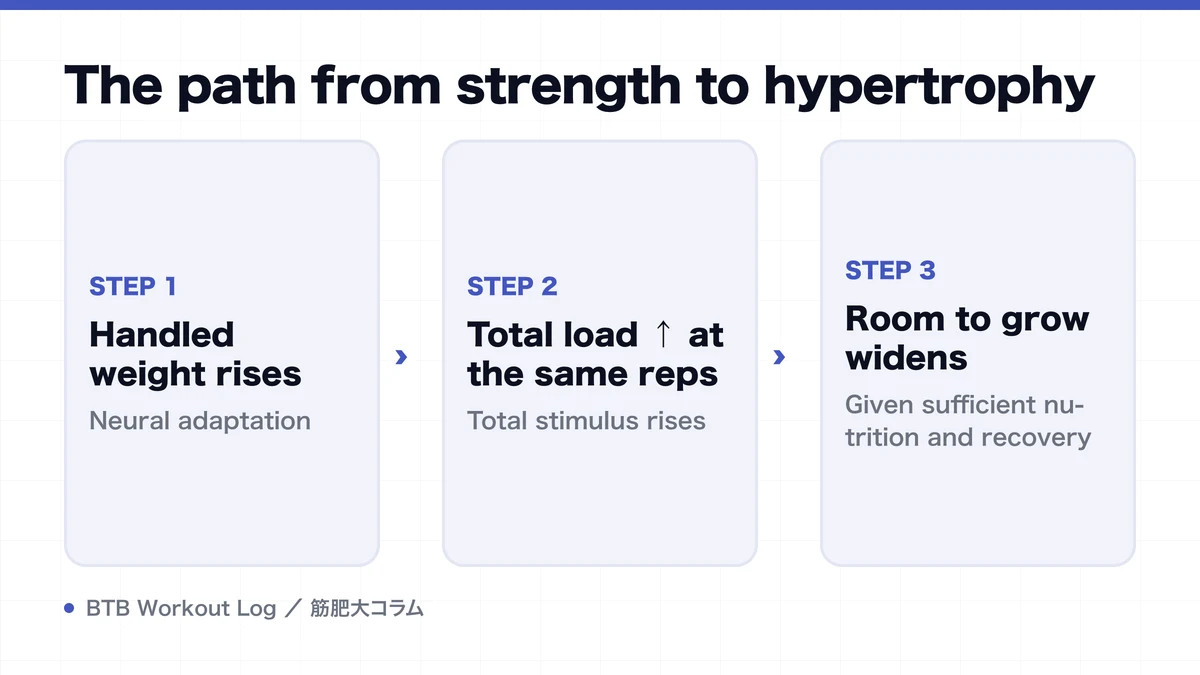
The path from strength to hypertrophy isn't a single leap — "got stronger, so automatically got bigger." What matters is the load setup and effort level in between.
- You adapt to training: neural, technical, or muscle-mass factors — one or several — improve, and you can produce more force in the same movement.
- Reserve opens up at your old load: at the same weight and reps, say, RIR — reps left before the limit — rises from 3 to 5. Capability has risen here, but the set's relative difficulty has dropped.
- You update weight or reps: add weight while holding form, range of motion and rest constant, or add reps at the same weight, and reset back toward your intended RIR. This is progressive overload in action.
- Sufficient tension returns to the active fibers: pushing the updated challenge close to the limit again creates stimulus matched to your post-growth capability. Repeat this within what you can recover from.
- Muscle mass becomes the foundation for the next round of strength: as mass rises with long-term adaptation, room to produce even more force opens up, feeding into the next round of progression.
In this flow, a strength gain is both a "cause" of hypertrophy and a "result" of adaptation up to that point. What matters is the stage where you convert raised capability into a load increase or a rep increase. If an old weight has gotten easier but you leave the prescription unchanged, the rise in strength never feeds back into the next stimulus.
Watch weight, reps and RIR as a set
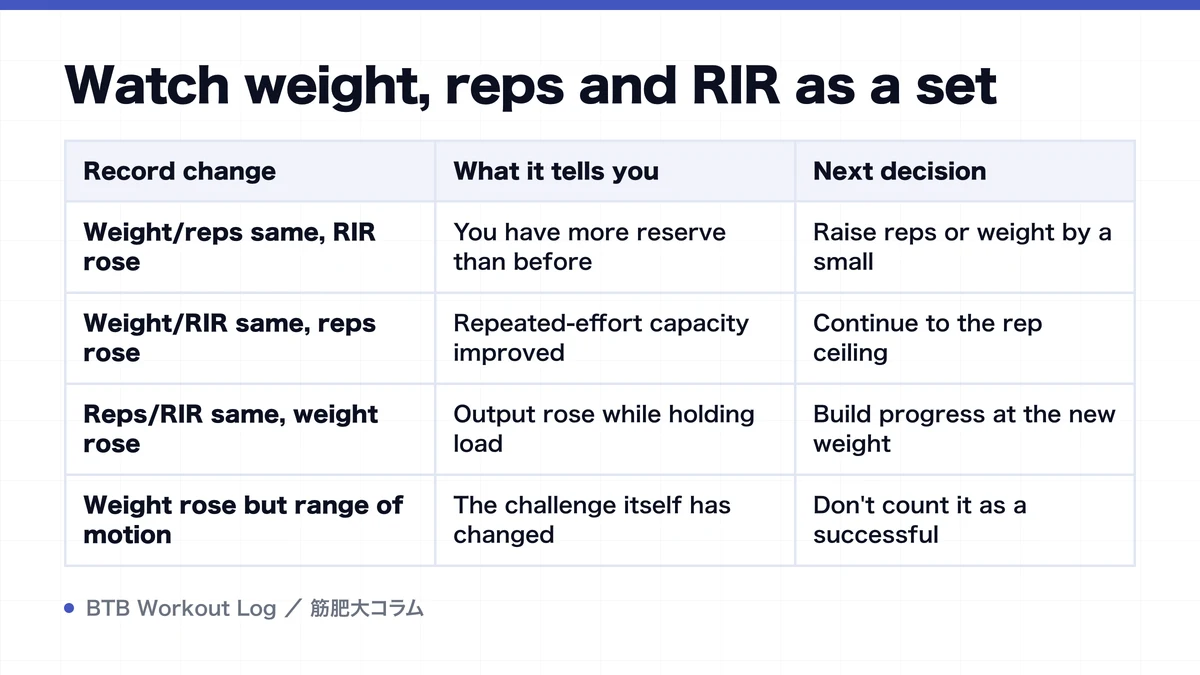
Load used alone can't tell you whether a strength gain got converted into growth stimulus. At minimum, watch weight, reps, RIR, form and range of motion together. RIR is subjective, but logging it against the same standard every time raises comparison accuracy.
| Record change | What it tells you | Next decision |
|---|---|---|
| Weight/reps same, RIR rose | You have more reserve than before | Raise reps or weight by a small amount |
| Weight/RIR same, reps rose | Repeated-effort capacity improved | Continue to the rep ceiling |
| Reps/RIR same, weight rose | Output rose while holding load | Build progress at the new weight |
| Weight rose but range of motion shortened | The challenge itself has changed | Don't count it as a successful increase — restore the movement |
| Only 1RM rose, normal sets stalled | Possibly a skill gain specific to a maximal lift | Evaluate hypertrophy-focused sets separately |
For example, someone doing 80kg for 8 reps at RIR 2 who can now do 80kg for 10 reps at the same RIR 2 has made progress even at the same weight. Conversely, raising to 85kg while shortening range of motion, letting more load leak to assisting muscles, and forcing it to RIR 0, is an ambiguous comparison for hypertrophy purposes. Volume load — weight times reps — is only one facet of workload too, and doesn't capture the quality of stimulus to the target muscle.
So it's more appropriate to treat progressive overload not as a race to build a bigger number, but as the work of matching comparison conditions and updating the challenge to fit your capability.
Is a heavy-load phase for building strength necessary for hypertrophy?
Heavy-load training tends to build maximal strength efficiently, which can serve as a tool supporting long-term hypertrophy. Experience handling heavy load at low reps trains compound-lift technique and the capacity to produce high force, and can later raise the ceiling of weight usable in a moderate-rep range. But inserting a heavy-load phase doesn't automatically accelerate hypertrophy afterward.
As a general trend, comparisons taking sets to failure show a wide range of loads can produce comparable hypertrophy, while high load favors 1RM strength gains. This doesn't mean "higher strength means more hypertrophy" — it shows maximal strength and hypertrophy have specificity in how they respond to load. See comparing heavy and high-rep training for how to read load-specific research.
If hypertrophy is the main goal, you don't need to push every set into the 1–5 rep heavy-load range. One approach: put low-to-moderate-rep sets on your main compound lifts, and keep the rest in a moderate-to-high-rep range where you can stably move the target muscle. If heavy load raises joint stress and whole-body fatigue enough to lower weekly hard sets or quality on later exercises, you haven't converted the strength gained into hypertrophy. Allocate load ranges to fit purpose, exercise, and recovery cost.
How to convert strength gains into hypertrophy
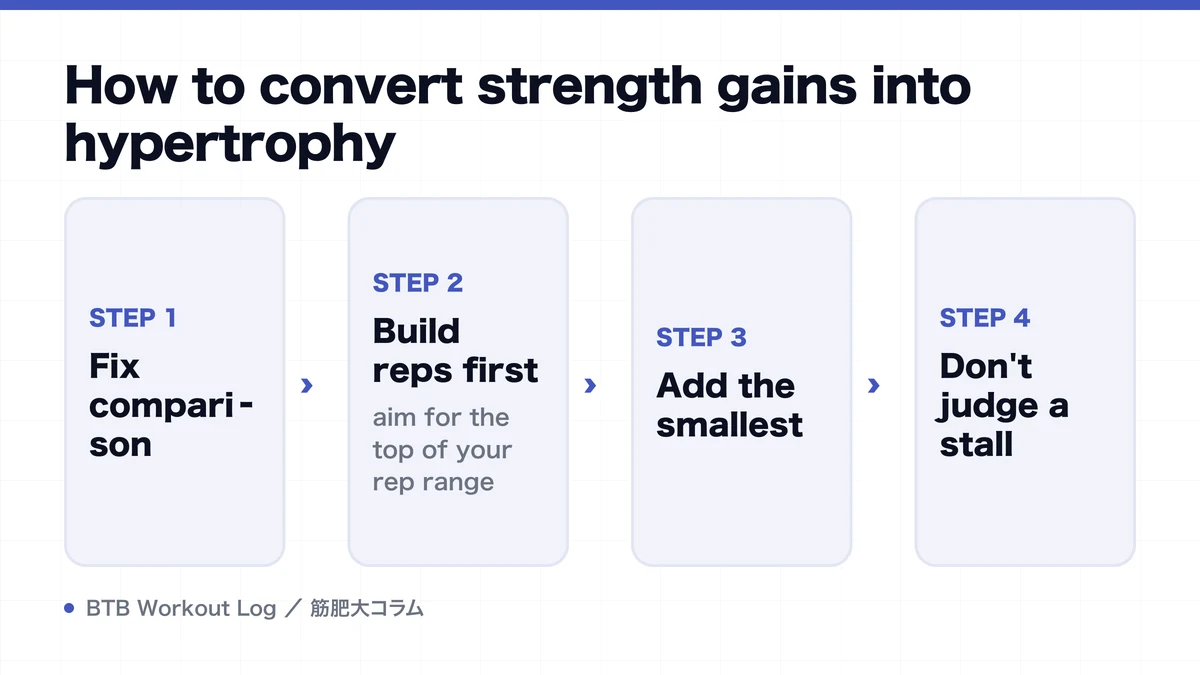
In practice, decide a rep range and target RIR for each main lift ahead of time, and track the trend across several weeks under matched conditions. This order lets you smoothly carry a strength gain into your next challenge.
- Fix comparison conditions: match exercise, form, range of motion, rest and rep range, and log weight, reps and RIR.
- Build reps first: aim for the top of your rep range while holding your target RIR. Rather than a single personal best, check whether it reproduces across several sessions.
- Add the smallest increment at the ceiling: after raising weight, accept reps dropping back toward the bottom of the range, and start building again.
- Don't judge a stall from one metric: continue if weight has stalled but reps or RIR are still progressing. If everything stalls for several weeks, separate out fatigue, weekly set count, nutrition and exercise fit.
When evaluating hypertrophy, use not just exercise records but medium-term trends in matched-condition measurements, photos and body weight as supporting evidence. Conversely, don't judge muscle mass gain purely from a 1RM update right after a max-strength phase. See causes of a weight plateau for a more detailed diagnosis when weight stalls.
Use the trend in the same exercise's weight, reps and set count as material for judging whether raised strength is being carried into the next load setup. Whether a strength gain is translating into raised total workload can't be seen from weight alone — you need to watch total volume too. BTB Workout Log lets you track both on the same screen.
FAQ
- Should I include 1–5 rep heavy work for hypertrophy too?
- Not mandatory. Heavy load is a tool for building maximal strength and compound-lift technique, but hypertrophy can occur across a wider load range. Watching joint stress and fatigue carried to later sets, it's enough to place it on part of your main lifts if needed.
- If weight is progressing, can I assume muscle is growing too?
- It's possible, but you can't conclude it from that alone. Neural adaptation, familiarity with form, or a change in range of motion can also raise weight. Layer in matched-condition reps, RIR and weekly set count, plus medium-term trends in measurements and body weight.
- Can muscle be growing while weight isn't progressing?
- Yes. This happens when repeated-effort capacity at high reps improved first, or when technique on a specific exercise, fatigue, or weight increments are the limiter. Check reps and RIR on your normal sets and movement reproducibility too, rather than deciding hypertrophy has stalled from weight alone.
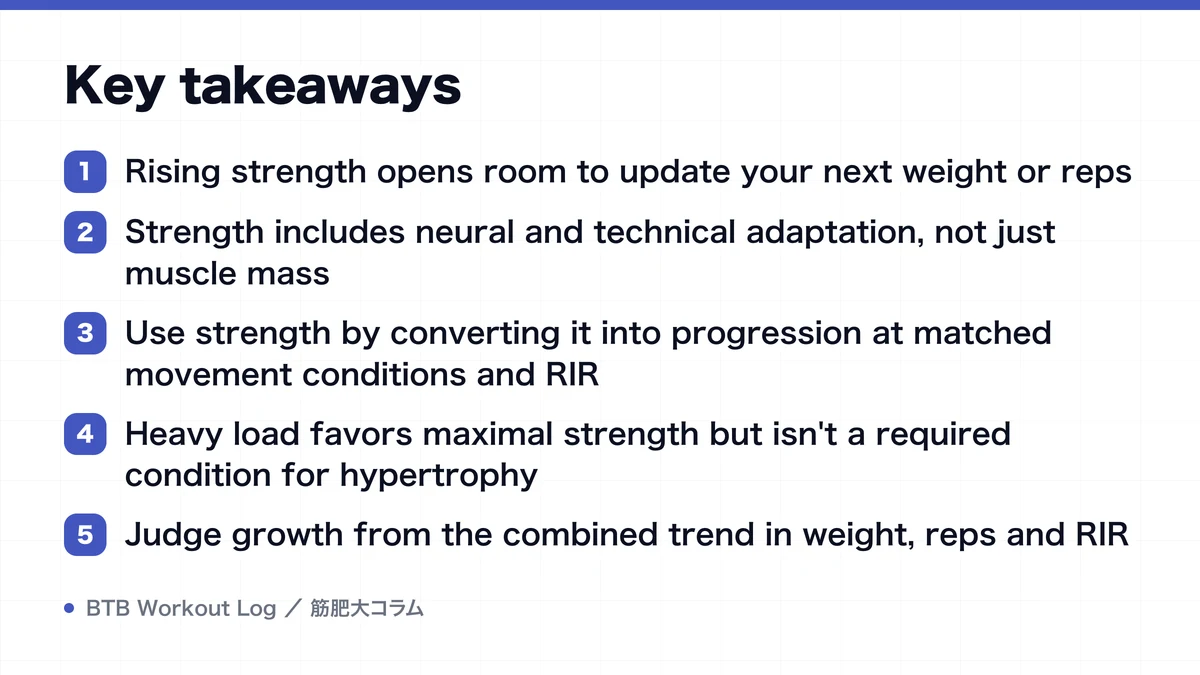
Key takeaways
- Rising strength opens room to update your next weight or reps
- Strength includes neural and technical adaptation, not just muscle mass
- Use strength by converting it into progression at matched movement conditions and RIR
- Heavy load favors maximal strength but isn't a required condition for hypertrophy
- Judge growth from the combined trend in weight, reps and RIR