
What Actually Happens During a Deload? | How Resting Makes You Stronger by Clearing Fatigue
Performance returning during a deload isn't because you build new strength in a short time — it's because the fatigue that was masking your accumulated adaptation shrinks first.
Lower load and the rate of new fatigue drops, letting recovery from sleep and nutrition outpace it. As a result, the same muscle mass and skill become easier to express as weight and reps.
Visible performance shifts based on "adaptation minus fatigue"
What remains after training isn't one thing. Adaptation — muscle mass, strength, and motor skill gained over a long time — and temporary fatigue from recent sets both exist simultaneously. Actual lift performance is observed as these two overlapping.
For example, even if strength has risen slightly over a period, if you keep adding hard sets and fatigue's effect grows larger than that gain, reps can drop at the same weight. Concluding "strength was lost" here risks adding even more stimulus and deepening the fatigue. Conversely, if reps return a few days after lowering load, that doesn't mean muscle suddenly grew in those few days — it's more natural to think you moved closer to a state where hidden capability could be expressed.
This isn't a claim that adaptation and fatigue can literally be measured as separate numbers — it's a model for reading changes in your records. Especially during a stretch of sets taken to the limit or continued high weekly volume, you need to think of "capability" and "whether you can express that capability today" as separate things.
Fatigue surfaces when the next load arrives before full recovery
In a single session, changes on different timescales occur — intramuscular energy use, metabolite buildup, stress on fibers and connective tissue, and neuromuscular output decline. Some return between sets; others persist into the next day and beyond. Once the next session arrives on top of that, and the fatigue produced keeps outpacing the amount you recover, it starts showing up not as one heavy day but as decline across several sessions.
Typical changes: reps drop earlier even at the same weight, range of motion and rest; lift speed slows before reaching your target RIR; form gets harder to hold in later sets. RIR is a reserve metric — how many more reps were possible — so if it drops from 3 to 1 at the same weight and reps, the burden has risen even though the surface numbers match.
That said, one heavy day alone can also come from sleep, diet, time of day, or warm-up. What justifies considering a deload is output decline persisting across several sessions even under matched conditions, or poor recovery spreading across several exercises. If it's purely a between-set issue, see fatigue from rest time; if it spans several days, think in terms of weekly placement and total volume — separating timescales like this avoids conflating causes.
A deload temporarily makes "incoming fatigue" smaller than your recovery
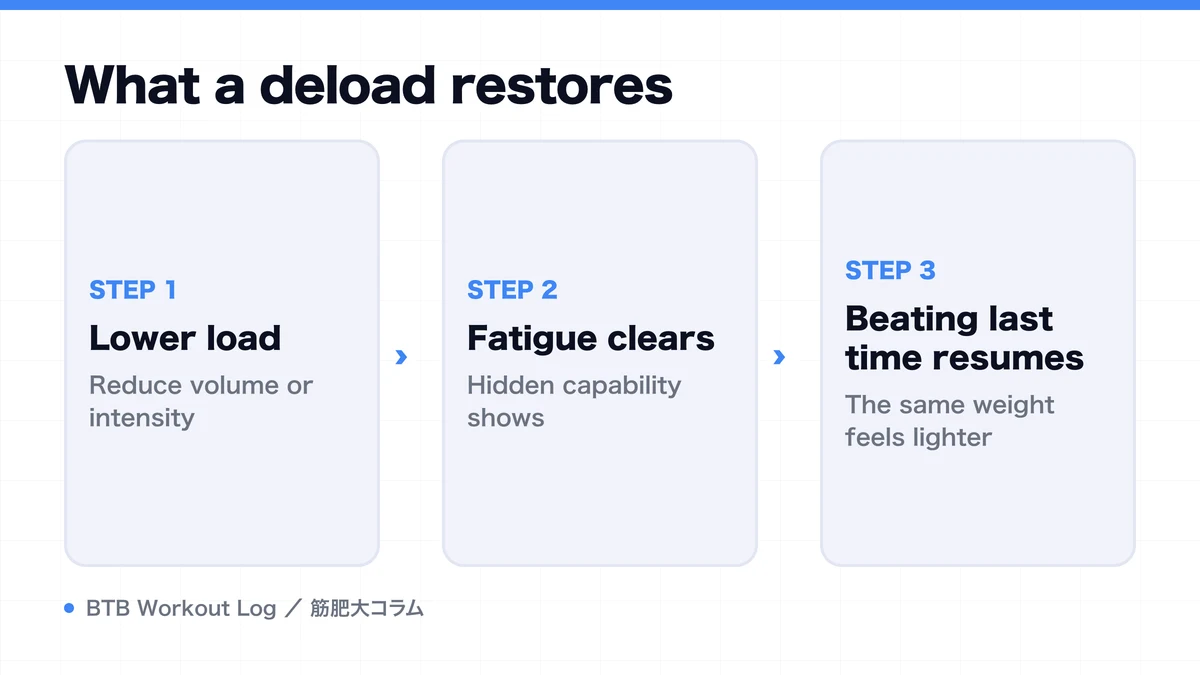
As long as you keep running the same hard sets as a normal week, the body keeps receiving new fatigue while also recovering. In a deload, you lower set count, weight used, and part of your proximity to the limit, deliberately reducing newly generated fatigue. As long as recovery conditions like sleep and nutrition haven't badly broken down, the net balance tips toward less fatigue.
What matters here isn't zeroing everything out — it's lowering whatever input was outpacing recovery. A light session that still includes movement practice can preserve exercise feel while reducing the burden from hard sets. But with joint pain, illness, or severe sleep loss, complete rest or a different response may be more appropriate — a deload isn't treatment for injury or illness.
Concrete ways to lower set count or weight are covered in how to run a deload. From a mechanism standpoint, what matters more than the specific method is whether burden is clearly lower than a normal week, creating room for recovery. A short-term load reduction and a long-term break aren't the same — consider changes from an extended break separately, as in the process of detraining.
Once fatigue drops faster than adaptation, capability shows up as weight and reps again
Not all fatigue clears at the same speed right after lowering load. Local tightness, whole-body sluggishness, joint-area discomfort, and difficulty focusing during a lift all return at different rates. Still, given a period of low new burden, the effect of short-term fatigue usually shrinks gradually, showing up in warm-up speed and main-set repeated-effort capacity.
The adaptation side doesn't disappear all at once from a few light days either. Muscle mass changes through long-term repeated stimulus and recovery, and exercise skill doesn't hit zero from one week of lowered load. So within the range where fatigue clears faster than adaptation is lost, net performance trends upward — the same weight moves at a lower RPE (higher RIR), reps rise at the same RIR, and form reproducibility returns.
That said, long-term studies isolating deloads specifically are limited, and you can't claim everyone hits a personal best right after one. Periodization studies matching total volume show that varying load in a planned way doesn't show a clear hypertrophy advantage, but does favor 1RM gains over non-periodized approaches. This supports planned load variation, but it doesn't directly prove "a one-week deload restores X% output through this mechanism." What returns is mainly expression capability — it doesn't necessarily mean new muscle was added. That distinction matters.
Judge a deload's success from matched-condition data after it ends
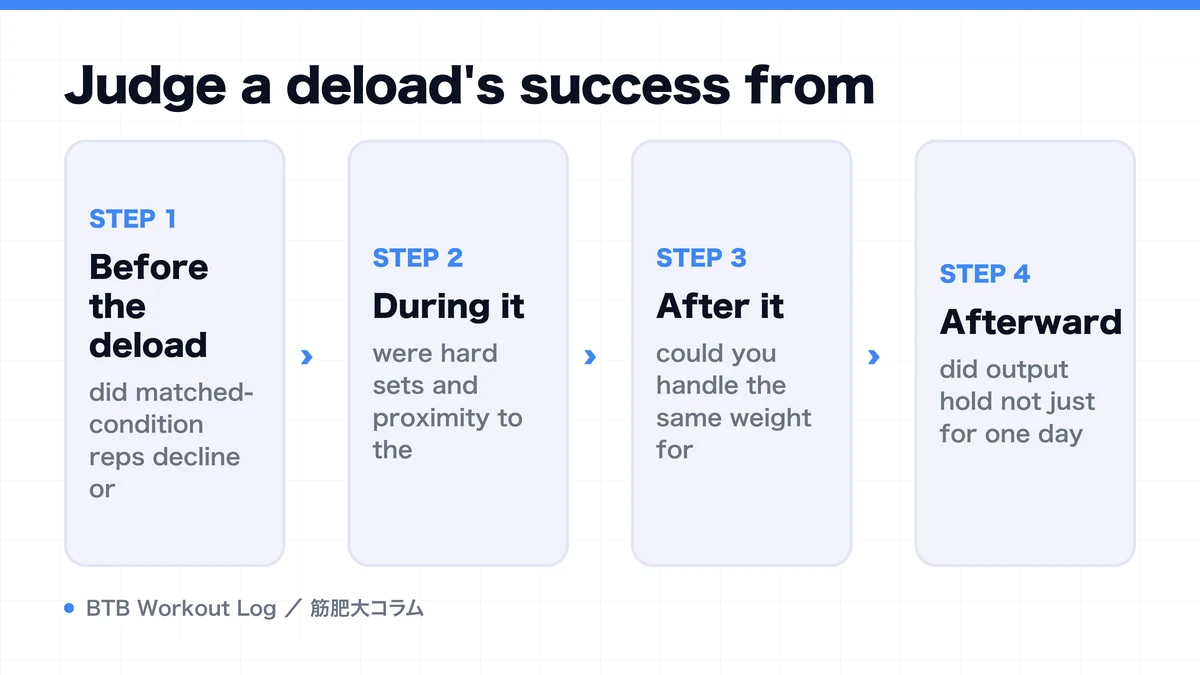
Judging from "I feel lighter" alone, or from "I hit a PR on day one" alone, is both unstable. Compare the same exercise's weight used, reps, RIR, range of motion and rest time before the deload, during it, and for the first one or two sessions after. Prioritize whatever indicator you can consistently track — main-set reps and RIR for compound lifts, or full-set rep decline for single-joint exercises. Check in this order.
- Before the deload: did matched-condition reps decline or RIR worsen across several sessions?
- During it: were hard sets and proximity to the limit clearly lower than a normal week?
- After it: could you handle the same weight for more reps, or the same reps at higher RIR?
- Afterward: did output hold not just for one day but after returning to normal training?
If it improved, fatigue was likely involved in the earlier stall. If nothing changed, investigate other hypotheses — sleep, energy intake, pain, exercise skill, or simply insufficient stimulus in the first place. Rather than extending the deload repeatedly, isolating the process behind a plateau leads to a better next decision.
Adding RIR and rest conditions to your weight and rep log turns the impression "it felt light" into material you can reuse next cycle. Whether a deload worked can be judged from whether your numbers return within the first few sessions after it. BTB Workout Log lets you line up before and after on the same scale.
FAQ
- Is there a risk of losing strength or muscle during a deload?
- It's unlikely that lowering load for a few days to a week instantly erases adaptation gained up to that point. But this is different from a long, complete break. Whether to keep light movement practice or rest fully depends on your fatigue level, pain, and condition.
- Is it a failure if weight doesn't return after a deload?
- You can't call it a failure from one off session. Match sleep, diet, time of day and rest, and check the first one or two sessions after. If it still doesn't recover, isolate causes beyond fatigue, or consider whether the load reduction was insufficient.
- Should I schedule a regular deload before condition drops?
- You can either mark the end of a high-load phase in advance, or trigger it from observed recovery issues in your log. Since a fixed cycle doesn't necessarily fit everyone, choose based on periods when your output has tended to break down in the past and your current recovery status.
Key takeaways
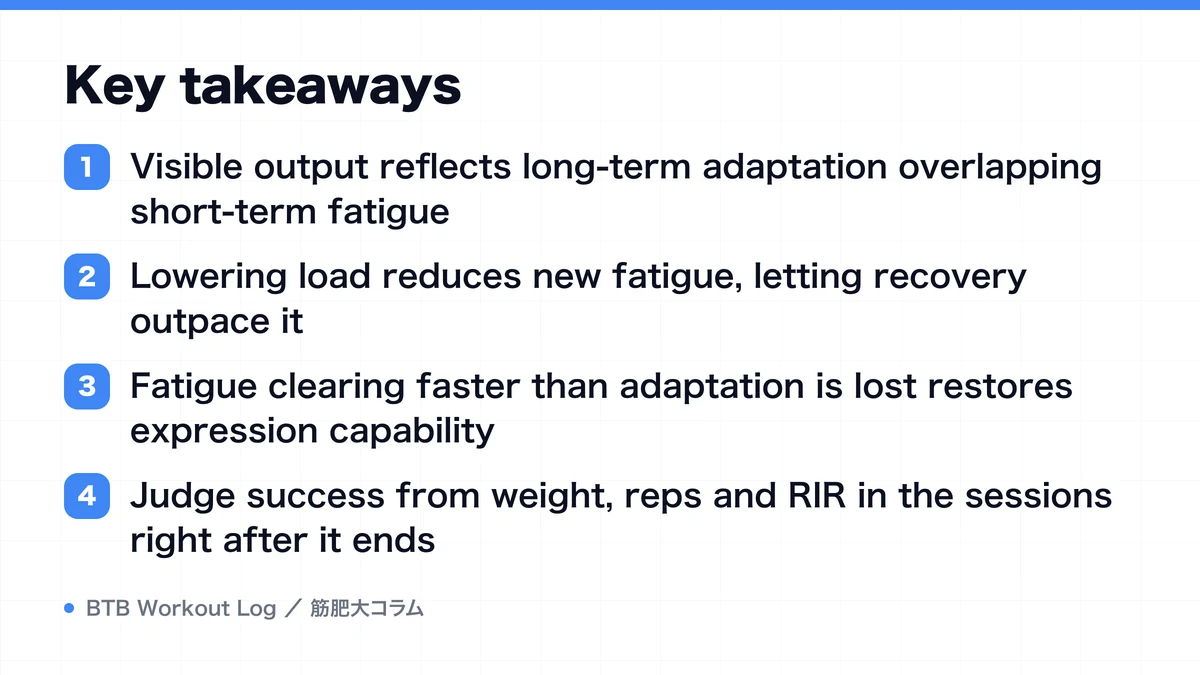
- Visible output reflects long-term adaptation overlapping short-term fatigue
- Lowering load reduces new fatigue, letting recovery outpace it
- Fatigue clearing faster than adaptation is lost restores expression capability
- Judge success from weight, reps and RIR in the sessions right after it ends