
Progressive Overload Explained: How Adding Weight Drives Hypertrophy
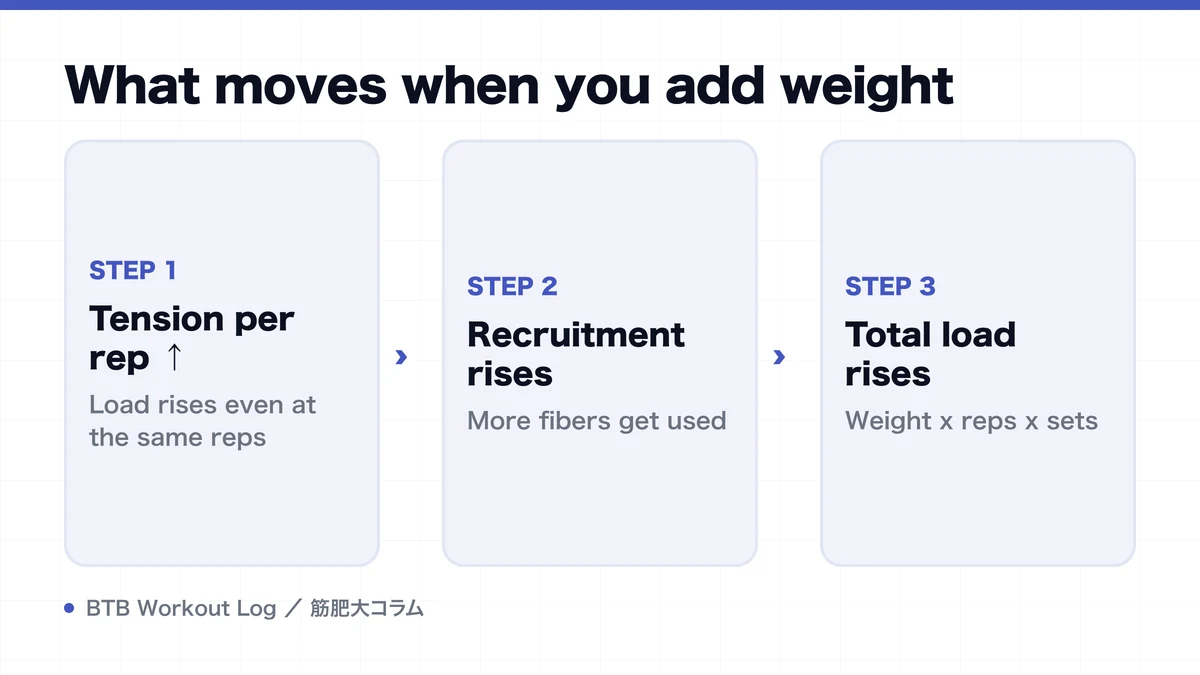
Raise weight while holding the same reps, range of motion, form and RIR, and the target muscle has to produce more force, keeping mechanical tension on the fiber at a higher level. Accumulated adaptation to that stimulus is what leads to hypertrophy.
But weight isn't a standalone switch that grows muscle by itself. Because capability raised by hypertrophy is what enables the next load increase, raising weight is both a tool for advancing stimulus and a result that reflects adaptation up to that point.
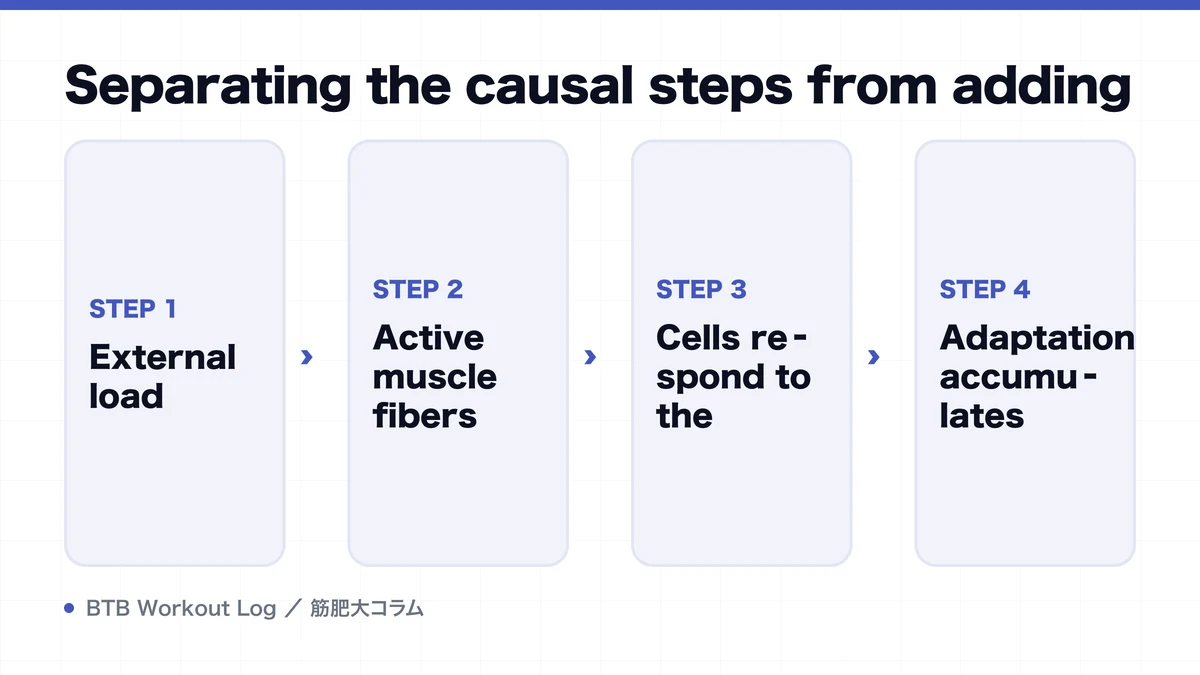
Separating the causal steps from adding weight to muscle actually growing
Progressive overload is the principle of advancing your training challenge over time to match the body's adaptation. Adding plates is one way to carry that out. Hypertrophy doesn't happen the instant you raise weight — there are several stages in between.
- External load increases: moving the equipment through the same path now requires producing more force around the joint.
- Active muscle fibers take on tension: the force demand on the target muscle rises, and repeating it to sufficient effort recruits more fibers into the work.
- Cells respond to the mechanical stimulus: through structures that detect tension, responses related to muscle protein synthesis and tissue remodeling occur.
- Adaptation accumulates across recovery: small changes from each session repeat, moving fiber cross-sectional area upward over the long term.
- Handling the same weight gets easier: skill and neural adaptation join the mass increase, letting you extend reps or RIR at the previous weight.
- You advance to the next load: matching the raised capability, you add weight and reset the challenge's difficulty back into an appropriate range.
What matters is that this flow isn't linear — it's a cycle. Raising weight refreshes the stimulus, and adaptation enables the next weight increase. "You grew because you got heavier" and "you got heavier because you grew" aren't in conflict — over long-term training, they're the first half and second half of the same cycle.
The conditions that turn plate weight into mechanical tension on the target muscle
Mechanical tension — central to hypertrophy — is the tension a muscle fiber takes on while producing force. External weight is the raw material for creating that tension, but the number on the plate and tension in the target muscle aren't the same thing. Equipment path, joint angle, moment arm, movement speed, momentum, and how much assisting muscles contribute all change which muscle bears how much force.
Say you raise weight on the bench press but stop lowering the bar all the way to your chest, or shorten the path by lifting your hips — the number went up, but you haven't necessarily raised the challenge to the pecs at the same range of motion. The same applies if upper-body momentum increases on curls. To read a load increase as hypertrophy-relevant overload, you need to hold the target muscle, range of motion, and form roughly fixed.
The other condition is effort. RIR shows, at the end of a set, "how many more reps were possible" — RIR 2 means roughly 2 more were available. Even at the same 10 reps, if last time was RIR 1 and this time — after raising weight — it's RIR 4, you may have gotten heavier without delivering sufficient repeated stimulus to the target muscle. Conversely, hypertrophy can occur at lighter load too if you push close to the limit. In other words, compare the whole challenge — movement quality plus RIR — not the absolute weight value alone.
Mechanical tension leads to muscle protein remodeling
In a fiber that's taken on tension, reactions proceed that convert the mechanical stimulus into intracellular chemical signals. This process is called mechanotransduction, and it affects pathways involved in muscle protein synthesis and breakdown and in tissue repair and remodeling. Rather than memorizing molecule names, it's more practically useful to understand it as: training with sufficient tension triggers muscle tissue remodeling during recovery.
Muscle protein synthesis rising after one session doesn't complete visible hypertrophy on the spot. Only once the synthesis-and-breakdown shift from training combines with dietary material and energy, plus recovery including sleep, and accumulation outpaces breakdown over a long period, do the fibers actually get bigger. So if you spike weight sharply to intensify stimulus and end up carrying unrecoverable fatigue or joint stress, the cycle actually becomes harder to sustain.
It's not simply true that more soreness, more muscle damage, or a stronger pump means bigger adaptation. Current mechanistic understanding places mechanical tension at the center, but even that isn't a race to maximize in one go — it needs to be repeated as recoverable hard sets. The evolution of research around mechanical tension is also covered in this re-examination of hypertrophy mechanisms.
Raising weight is both a cause of hypertrophy and a result of adaptation
If someone was doing 80kg for 8 reps at RIR 2 with the same form, and a few weeks later can do 80kg for 10 reps at RIR 2, their capability to perform that exercise has risen. Moving on to 82.5kg and rebuilding from around 8 reps again lets you demand the same effort from the target muscle at higher external load than before. Raising weight's role isn't a reward for growth — it's recalibrating a challenge that's become relatively lighter due to adaptation.
That said, you can't attribute every performance improvement to hypertrophy. Motor skill, coordination between muscle groups, neural adaptation for producing force, and how you feel that day can all raise load or reps too. Conversely, muscle mass can be increasing while weight temporarily stalls from fatigue or an exercise change. A weight record is a useful proxy metric, but it isn't a direct measurement of muscle size.
Because of this distinction, a week you can't raise weight shouldn't immediately be treated as failure. If reps rose at the same weight, if you did the same reps with more reserve, or if you held your numbers even after widening range of motion, the challenge has still advanced. How progress beyond weight changes the stimulus connects to the mechanics of adding reps, also part of this 100-article set.
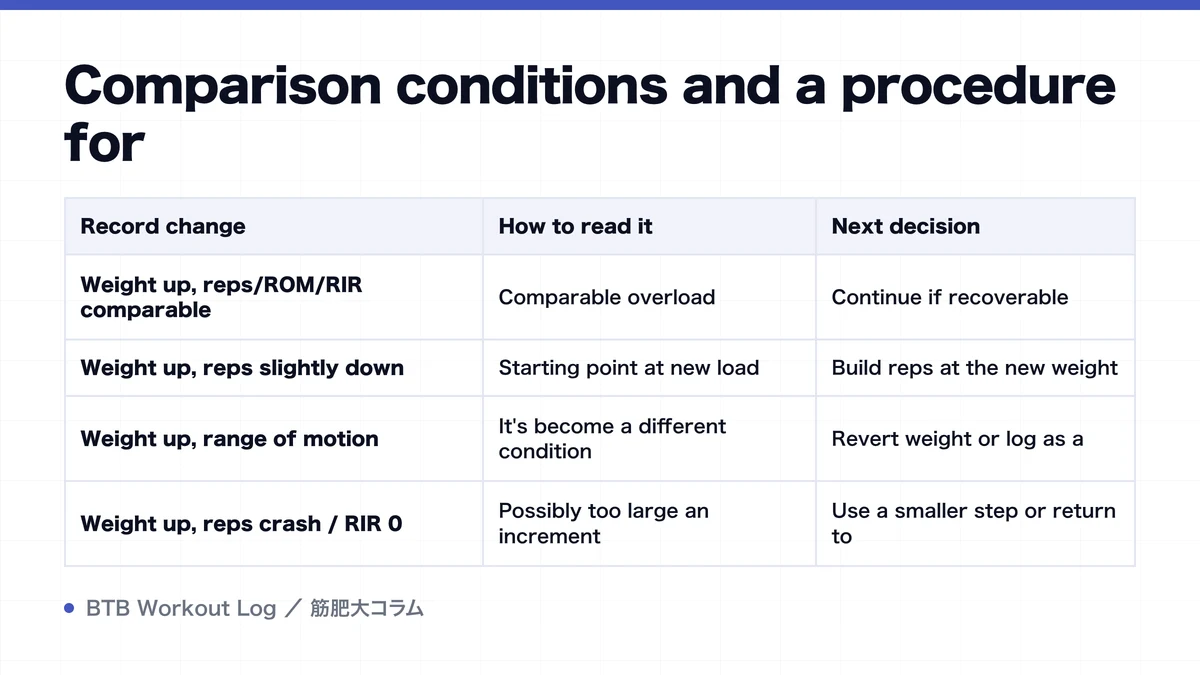
Comparison conditions and a procedure for turning a load increase into valid overload
Judge not just the weight compared to last time, but what you held constant while raising it. Organizing it like this makes it easier to separate an apparent update from genuine progress.
| Record change | How to read it | Next decision |
|---|---|---|
| Weight up, reps/ROM/RIR comparable | Comparable overload | Continue if recoverable |
| Weight up, reps slightly down within range | Starting point at new load | Build reps at the new weight |
| Weight up, range of motion shortened / more momentum | It's become a different condition | Revert weight or log as a separate record |
| Weight up, reps crash / RIR 0 every time | Possibly too large an increment | Use a smaller step or return to rep progression |
| Weight same, reps up / RIR comparable | Capability is advancing | Continue until you hit the ceiling |
Double progression is the easiest method to run in practice. Set, say, 6–10 reps, 3 sets, RIR 1–3, and build reps within that range at whatever weight you're using. Once every set reaches 10 reps at comparable RIR and movement quality, raise weight by the smallest available increment. Dropping back to 7–8 reps after that isn't a setback — it's the starting point for rebuilding at the new load.
There's no need to make a weight increase mandatory every session. The more intermediate you get, the more sessions it takes to reach the top of your rep range. On exercises with only large weight increments available, options include building reps first, using micro-plates, or progressing on a separate stable exercise. Which to move first is decided by comparing weight-first vs. rep-first progression.
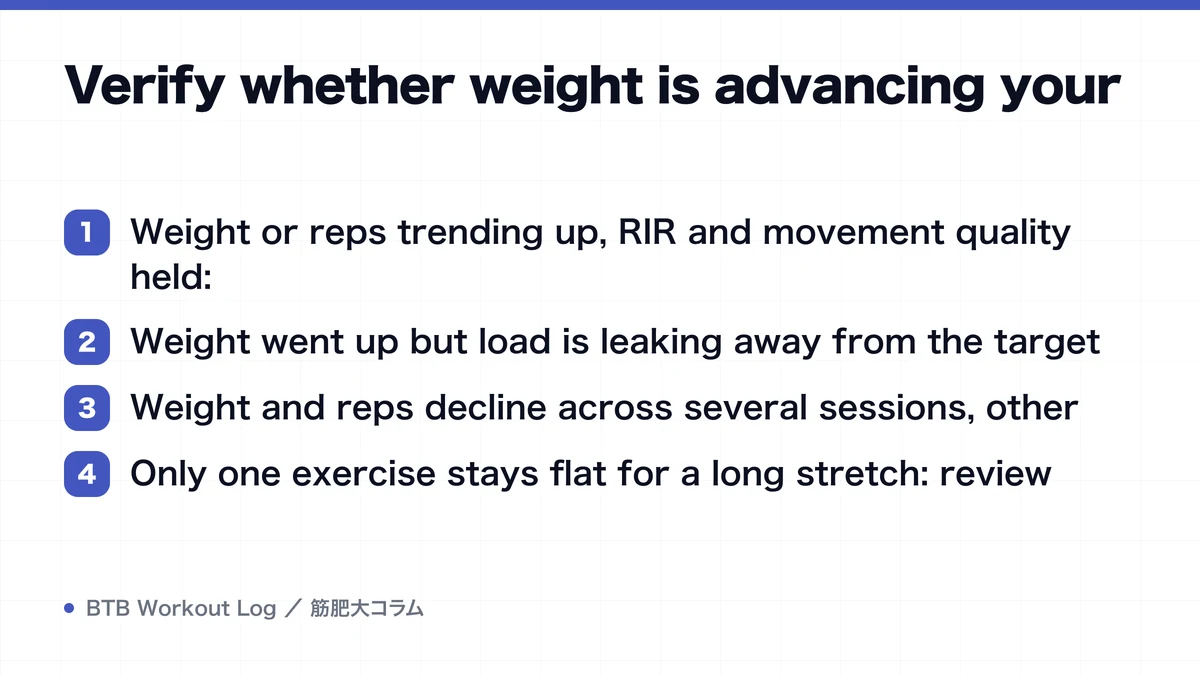
Verify whether weight is advancing your stimulus from several weeks of records
Look at the trend of lining up the same exercise across several weeks, rather than a single personal best. At minimum, log weight, reps per set, and RIR. Also leave a brief note on days you changed form or range of motion, cut rest short, or changed exercise order, so you don't misread the number's movement.
- Weight or reps trending up, RIR and movement quality held: the stimulus-and-recovery cycle is likely working.
- Weight went up but load is leaking away from the target muscle: revert the plate and re-establish comparable form.
- Weight and reps decline across several sessions, other exercises drop too: suspect fatigue or insufficient recovery before insufficient overload.
- Only one exercise stays flat for a long stretch: review weight increment, rep range, and exercise placement one at a time.
Tracking weight alone can make an update that sacrificed reps or RIR look like a success. Conversely, if weight has stalled while reps under matched conditions keep rising, you'd miss that progress. See why weight alone isn't enough too, to separate out how to read your records.
An app doesn't cause hypertrophy — it's a tool for judging whether the conditions for your next weight increase have been met.
FAQ
- Does hypertrophy follow automatically just from raising weight?
- Not from a weight increase alone. If the target muscle, range of motion, form, reps or RIR change substantially, you can't compare it as progress on the same challenge. Check that you raised load while staying near matched conditions, and that you're sustaining recoverable hard sets.
- How much should I raise weight by each time?
- Rather than a fixed percentage, it's practical to raise by the smallest available increment once you've hit the top of your set rep range at comparable RIR and form. If reps drop back to around the floor of the range after the increase, that's fine — you can start building again.
- Has hypertrophy stalled too during a stretch where weight isn't progressing?
- You can't tell from a single stall alone. Capability is still advancing if reps rise at the same weight, RIR rises at the same reps, or range of motion improves. Line up several weeks of records alongside recovery status, and factor in progress beyond weight and any decline on other exercises.
Key takeaways
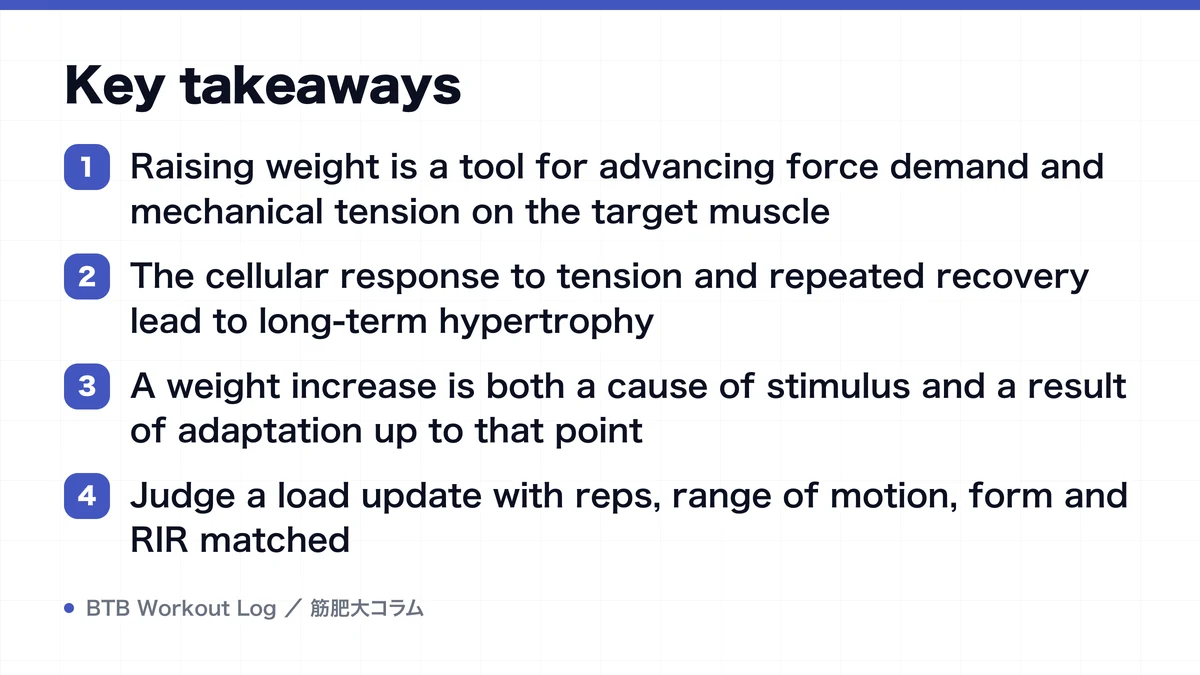
- Raising weight is a tool for advancing force demand and mechanical tension on the target muscle
- The cellular response to tension and repeated recovery lead to long-term hypertrophy
- A weight increase is both a cause of stimulus and a result of adaptation up to that point
- Judge a load update with reps, range of motion, form and RIR matched
References
- The Mechanisms of Muscle Hypertrophy and Their Application to Resistance Training
- Mechanisms of Muscle Hypertrophy: Current Understanding and Future Directions
- Low- vs High-load Resistance Training for Strength and Hypertrophy: Meta-analysis
- Muscle Hypertrophy Is Independent of Load Across Upper and Lower Limbs When Effort Is Matched
- ACSM Position Stand: Progression Models in Resistance Training for Healthy Adults