Hypertrophy: Can Training at Longer Muscle Lengths Build More Muscle?
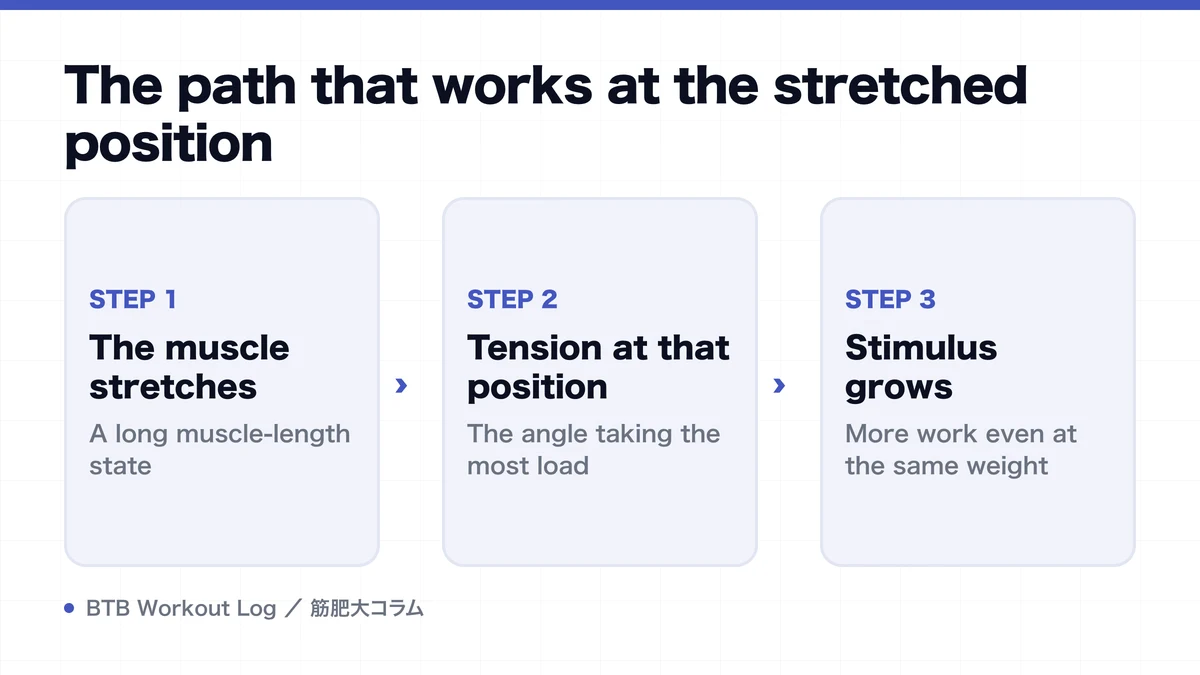
Take on sufficient tension while a muscle is stretched, and you add a mechanical condition that's hard to get from the shortened position alone — which can favor hypertrophy. What's working isn't the stretch sensation itself — it's the target muscle genuinely producing force at a long muscle length.
Bending a joint deeply, a muscle lengthening, and load being large at that position are three separate conditions. Separating them clarifies which exercises to choose, how far to move, and what to log.
"Being stretched" and "being loaded" aren't the same
Muscle length here refers to how long the target muscle becomes at a given joint position. For example, the calf lengthens at the bottom of a dorsiflexed calf raise, and the long head of the triceps lengthens at the bottom of an overhead triceps extension. But a muscle being long alone doesn't explain hypertrophy stimulus.
The force a muscle needs shifts not just with external weight, but with the distance between that weight's line of force and the joint — the external moment arm. Even at the muscle's most stretched endpoint, if gravity or the cable direction barely produces any torque to rotate the joint, the target muscle also produces little force. Conversely, even a visually light weight can place non-trivial tension on the target muscle if it's countering large joint torque at that long position.
So the order to check is: ① does the target muscle lengthen at that joint position, ② does external resistance remain in that segment, and ③ can you counter that resistance with the target muscle while holding posture. The distinction from simply increasing travel distance is covered in how range of motion changes stimulus.
Change joint angle and the tension required of the target muscle changes
Against the external resistance trying to bend or extend the joint, the target muscle produces torque in the opposite direction. That required torque isn't constant throughout the movement. Change joint angle, equipment path, cable direction, or body lean, and the hard point of the same 10kg shifts. This is each exercise's resistance curve.
An exercise that loads the long-muscle-length side isn't necessarily one where you go deeper at the bottom — it's one where sufficient required torque remains even while the target muscle is long. On the Romanian deadlift, for example, bending the hip creates more horizontal distance between the barbell and hip, so the hip extensors like the hamstrings resist while long. Free-weight exercises, meanwhile, can have a small external moment right at the endpoint — "the most stretched point is the hardest" isn't always true.
What matters here is that you can't directly read muscle tension from the weight number. Required torque shifts with machine cam, cable position, limb length, and form. Rather than judging by exercise name alone, watching which joint angle you slow down at, whether you can reverse direction without momentum, and whether something other than the target muscle becomes the limiter first, lets you practically identify loading at a long position.
At a long muscle length, the mix of active and passive tension changes
When a muscle produces force, it's not just active tension from fiber contraction — passive tension from elastic elements like titin and connective tissue also contributes, more so the longer the muscle. The ratio between them differs by muscle, joint angle, movement and individual, and doesn't simply mean total tension is always maximal at a long position. Still, what matters is that it creates a tension environment different from a movement biased toward the shortened position.
Countering external resistance at a long muscle length means the stretched fibers and their surrounding structures contract while under load. The mechanical deformation this produces gets converted, through sensing structures within the fiber, into signals involved in protein synthesis and structural remodeling. Repeating this process — with recovery and material supply between rounds — is what leads fiber cross-sectional area to increase long-term, following the basic causal chain to hypertrophy.
It's more accurate to think that the long-muscle-length side can favor growth not because it's a separate switch on that growth pathway, but because it changes where tension lands and how it distributes within tissue. How much passive tension directly contributes to hypertrophy, and what decides the difference between muscles, remain open questions. So this can't be explained as a straight line — "the more you stretch, the more it grows."
It favors hypertrophy when you can bank high-quality reps at the long position
For loading the stretched position to help, you need more than just reaching a long muscle length — you need to be able to repeat sets that include that segment with sufficient effort. If lowering weight leaves you ending with a lot of reserve, tension stimulus can end up small even while using the long position. Conversely, insisting on heavy weight and bouncing through the endpoint, or letting the joint or an assisting muscle become the limiter instead of the target muscle, steps outside the intended condition.
Also, adding a long-position exercise raises weekly set count too, so it becomes hard to tell whether an effect comes from muscle length or simply from added volume. If trialing this, it's easier to judge if you first swap out part of an existing exercise rather than substantially changing weekly set count. Choosing between full range of motion and a long-muscle-length partial isn't a fixed superiority question — decide by target muscle, resistance curve, and joint tolerance. See choosing between full range and partials for comparison criteria.
On an exercise you're unfamiliar with at the long position, keep load or reps conservative for the first few sessions, and watch not just next-day soreness but joint pain, next-session output, and range-of-motion reproducibility. A sudden load at a new muscle length tends to raise recovery cost — rather than adding sets right away, it's safer and easier to compare if you first find the range where you can do the same work with more control.
Choose by whether resistance remains at the long position, not by exercise name
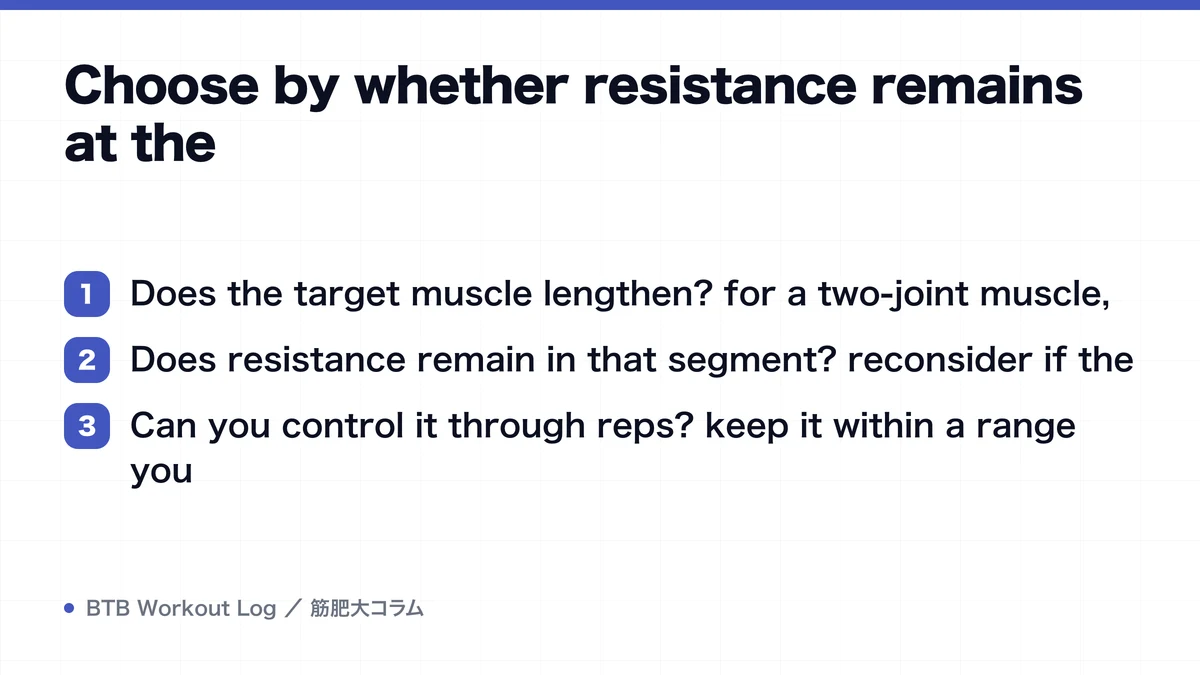
Using a deeper range of motion is not the only way to emphasize loading at longer muscle lengths. You can also adjust joint position, body orientation, cable height, or the resistance curves of machines. When choosing an exercise, check these three things together.
- Does the target muscle lengthen? For muscles that cross two joints, check the position at both ends, not just one joint.
- Is there still resistance in that part of the movement? Reconsider the setup if the weight rests on a support at the end of the movement, the cable goes slack, or gravity no longer produces torque.
- Can you repeat it under control? Avoid pain and use a range that lets you reproduce the same endpoint and body position every set.
Examples include loading the calves in the dorsiflexed position of a calf raise, the long head of the triceps in overhead exercises, and the hamstrings in hip hinge exercises with the hips flexed. But check muscle length and loading separately: a muscle can be anatomically lengthened without being heavily loaded by the equipment you are using. There is no need to compete for the deepest joint angle. Base your range of motion on what you can control without discomfort. For why you should first establish a repeatable full range of motion, see why full range of motion is the default.
In practice, evaluate a muscle-length change as a separate condition
Change range of motion or body position and the meaning of weight and reps shifts even under the same exercise name. If the weight you can handle drops right after going deeper, that isn't necessarily a strength loss — it's because travel distance, resistance curve, and turnaround conditions have all changed. Don't force it to match your pre-change record — rebuild a baseline weight under the new condition.
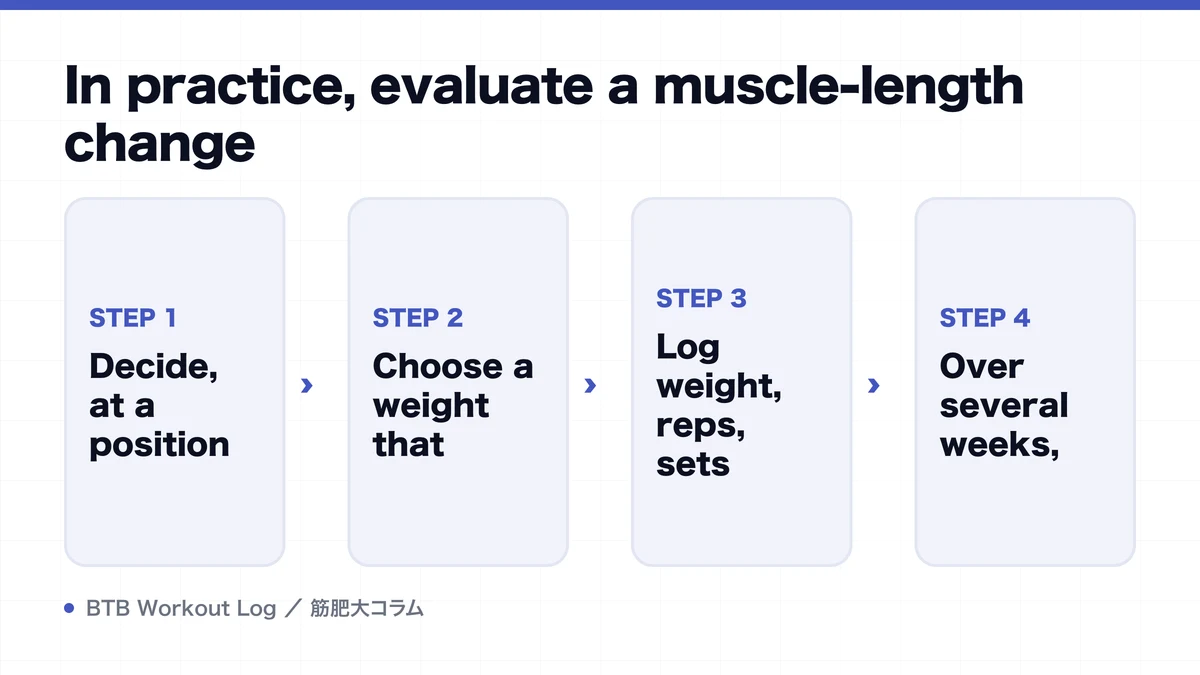
- Decide, at a position you can reproduce every time without pain, the endpoint where the target muscle lengthens.
- Choose a weight that lets you hold your target rep range and RIR without momentum. RIR is an estimate of remaining reps — roughly RIR 1–3 is an easy starting point.
- Log weight, reps, sets and RIR, plus your endpoint and form standard.
- Over several weeks, check whether reps or weight progress under matched conditions, and whether joint symptoms or next-session output worsen.
If progress continues while recovery holds, that exercise is delivering sustained tension at the long position. If it doesn't progress, before deciding "not stretched enough" and going deeper, recheck whether resistance actually remains there, plus RIR, weekly set count, and exercise order. Progressive overload can only be judged by comparing matched conditions.
FAQ
- Does a stronger stretch sensation mean more hypertrophy?
- A stretch sensation is a cue that you're at a long muscle length, but it isn't the stimulus amount itself. Check whether external resistance remains at that position and whether the target muscle is producing force without momentum. Don't treat pain or strong discomfort as evidence of valid stimulus.
- Should long-muscle-length partials be prioritized over full range of motion?
- Not universally. Use a reproducible full range of motion as your default, and consider a long-position partial an option when an exercise carries heavy resistance there, or to supplement a routine biased toward the shortened side. Once you change range of motion, log weight, reps and RIR as a separate condition.
- When adding a stretch-position exercise, is it fine to raise set count too?
- It's easier to judge if you start by replacing part of an existing exercise. Raising set count at the same time makes it hard to separate the effect of muscle length from the effect of added volume. Confirm output and recovery over several weeks first, then adjust in small increments if needed.
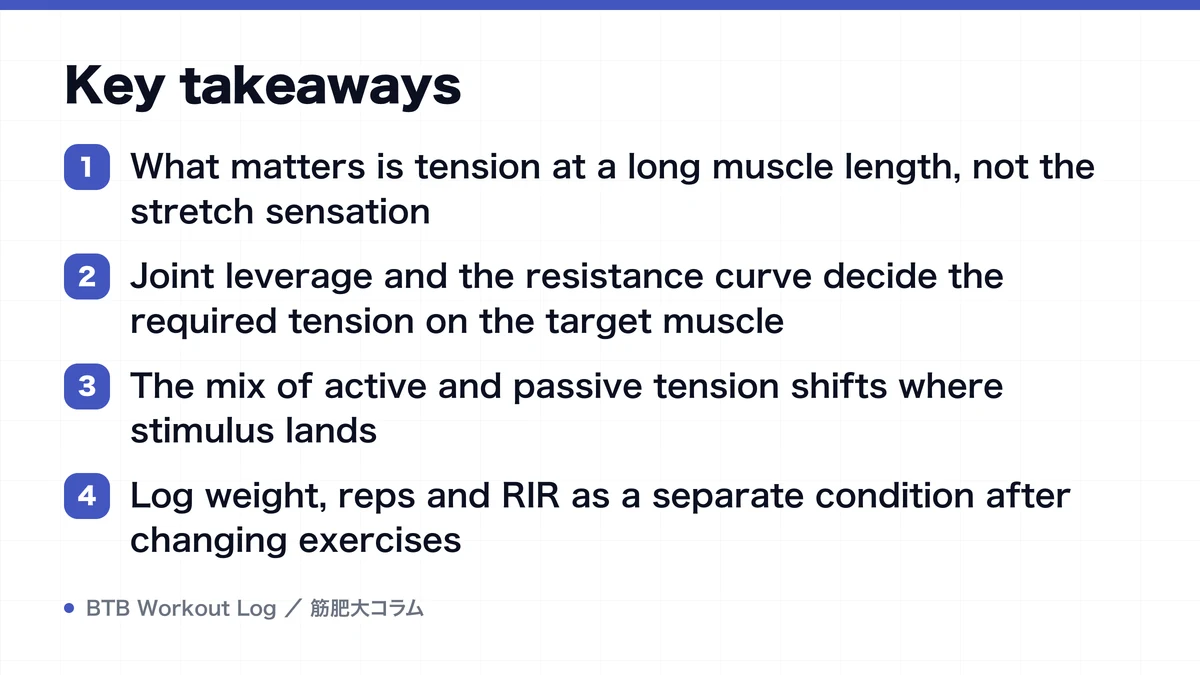
Key takeaways
- What matters is tension at a long muscle length, not the stretch sensation
- Joint leverage and the resistance curve decide the required tension on the target muscle
- The mix of active and passive tension shifts where stimulus lands
- Log weight, reps and RIR as a separate condition after changing exercises
References
- The Mechanisms of Muscle Hypertrophy and Their Application to Resistance Training
- Mechanisms of Muscle Hypertrophy: Current Understanding and Future Directions
- The Influence of Frequency, Intensity, Volume and Mode of Strength Training on Whole Muscle Cross-sectional Area in Humans
- Low- vs High-load Resistance Training for Strength and Hypertrophy: Meta-analysis
- Muscle Hypertrophy Is Independent of Load Across Upper and Lower Limbs When Effort Is Matched