How Does a Plateau Actually Happen? | It Doesn't Hit Overnight: The Process Behind Stalled Hypertrophy
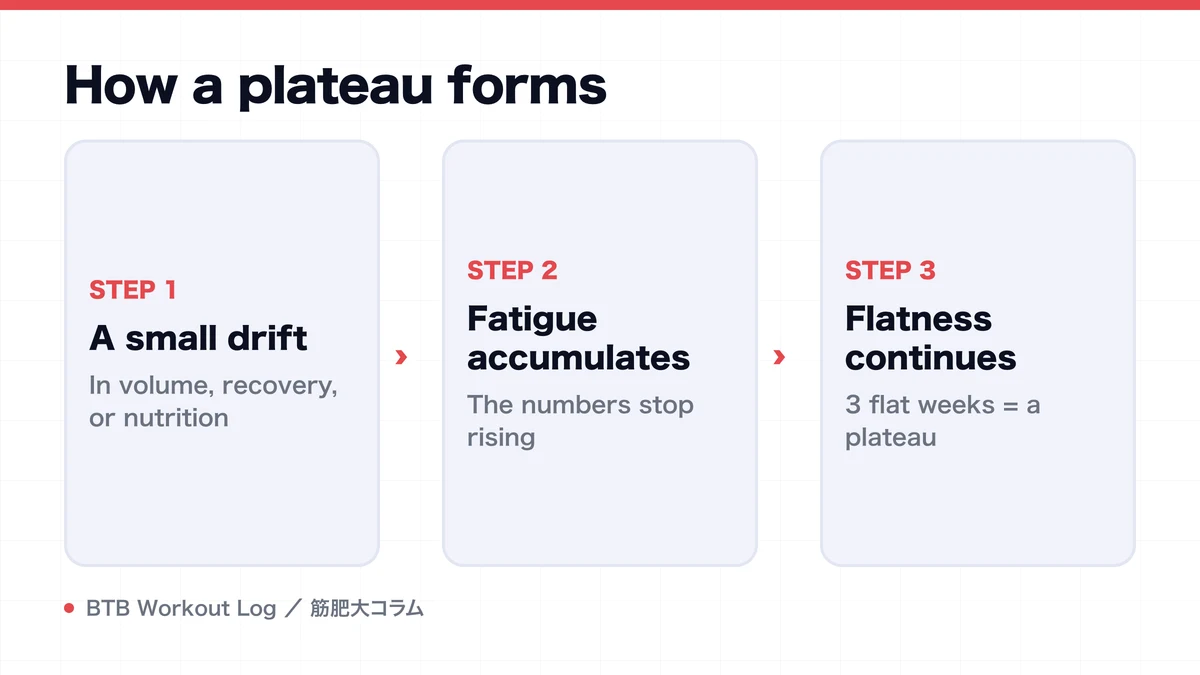
A plateau isn't a phenomenon where muscle suddenly stops responding. It surfaces as the result of the body adapting to a stimulus that used to be sufficient, load progression slowing, and fatigue or recovery constraints compounding — with "an inability to update stimulus" persisting for weeks.
Weight not rising once isn't a plateau on its own. Separating a genuine slowdown in hypertrophy from an apparent stall where fatigue is hiding your output makes the underlying process much easier to trace.
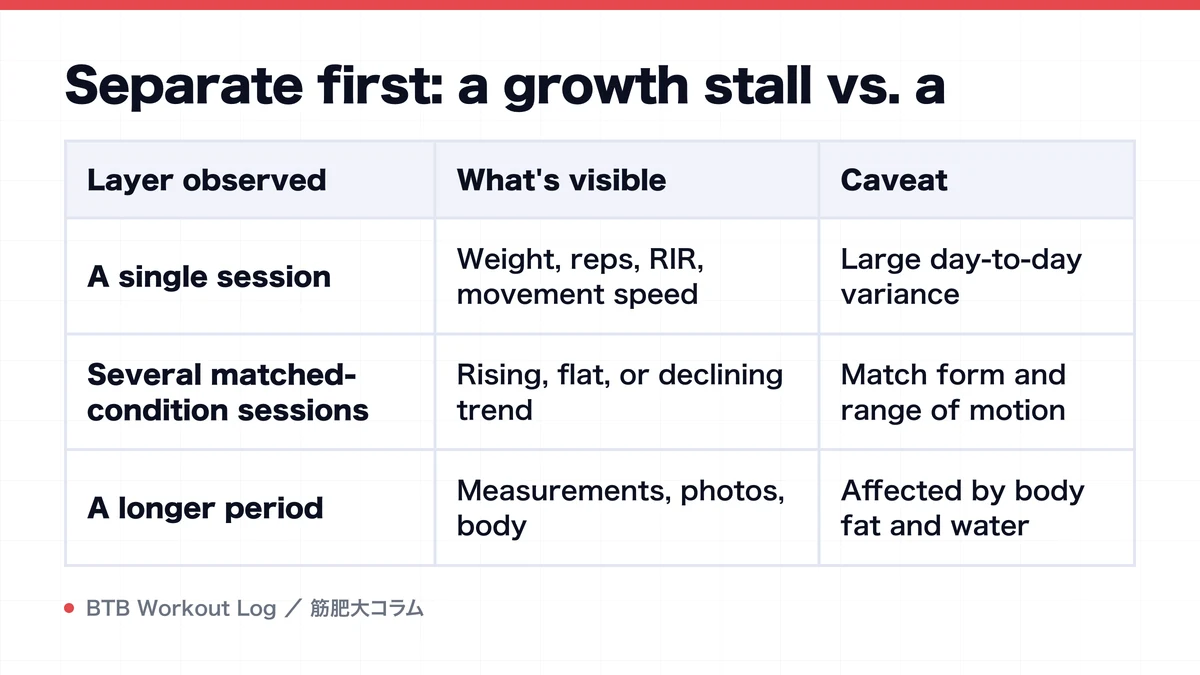
Separate first: a growth stall vs. a performance stall
"Bench press was one rep short of last time" and "my chest hasn't grown long-term" aren't the same phenomenon. The former is output capacity, which moves day to day with sleep, diet, time of day, rest between sets, and measurement error. The latter is a change in muscle mass, which needs to be judged on a much slower timescale.
| Layer observed | What's visible | Caveat |
|---|---|---|
| A single session | Weight, reps, RIR, movement speed | Large day-to-day variance |
| Several matched-condition sessions | Rising, flat, or declining trend per exercise | Match form and range of motion |
| A longer period | Measurements, photos, body weight, trend across multiple exercises | Affected by body fat and water |
So a plateau should be understood not as a single failed personal best, but as a state where several indicators fail to trend up under comparable conditions. If just one exercise has stalled while a different exercise on the same muscle group, or reps, are still rising, it might be a technical or exercise-specific stall rather than a hypertrophy one. The value of tracking weight, reps and RIR trends is covered in more depth in how logging reveals a plateau.
Stage 1: the relative stimulus of the same old prescription dilutes
When you start training, a given weight and set count are new to the body and represent a sufficiently large demand. As you continue and strength, technique, and between-set recovery all improve, you can handle the same prescription with more room to spare than before. That's evidence of growth, but it's also the entry point to the next plateau.
For example, say 80kg for 10 reps was RIR 1 — "1 rep of reserve" — at first, but becomes RIR 3 a few weeks later. The externally visible weight and reps are the same, but relative difficulty to the body has dropped. Leave it unchanged and the demand required per set shrinks, so weekly accumulated stimulus doesn't grow either.
This is where progressive overload becomes necessary — not adding weight every single time, but advancing reps, weight, set count or frequency within a recoverable range while holding intended form and range of motion. When the prescription update lags behind the body's adaptation speed, the growth curve flattens out in this order: adapt → the same stimulus becomes relatively lighter → it becomes harder to draw out new adaptation.
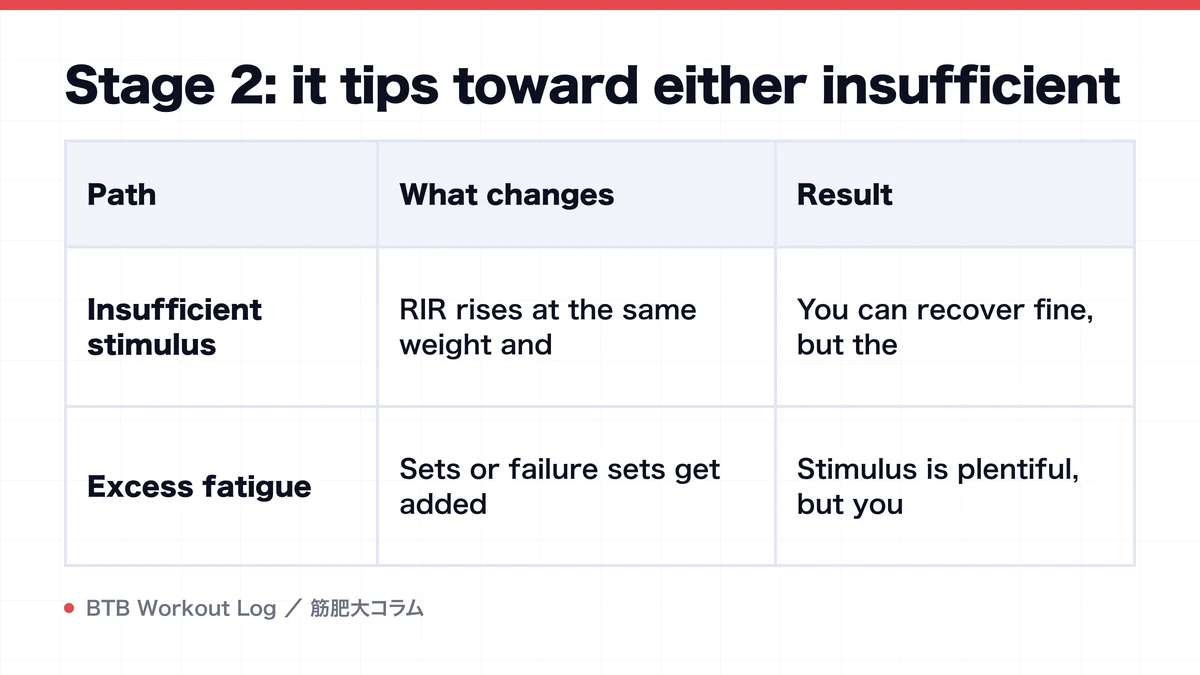
Stage 2: it tips toward either insufficient stimulus or excess fatigue
Once updating the prescription gets harder, the path to a stall broadly splits into two. On the surface, both look like "weight or reps aren't rising," but the fix needed is opposite.
| Path | What changes | Result |
|---|---|---|
| Insufficient stimulus | RIR rises at the same weight and reps; hard sets on the target muscle don't increase | You can recover fine, but the demand needed to draw out the next adaptation is missing |
| Excess fatigue | Sets or failure sets get added abruptly; output doesn't return by next time | Stimulus is plentiful, but you can't sustain high-quality reps or progression |
On the insufficient-stimulus path, since a prescription that's gotten easier doesn't get updated, the new demand on the muscle shrinks. On the excess-fatigue path, fearing a plateau leads to raising volume too much, or taking every set to failure, which lowers next-session weight and reps. If RIR — how many more reps were possible before the limit — keeps landing near 0 every time, and results decline across several exercises, that's a situation to suspect delayed recovery over insufficient stimulus. Pushing to the limit is a usable tool, but it isn't required on every set.
Sleep, energy intake, and psychological stress also shift this fork. Even the same routine can tip toward excess fatigue if recovery capacity drops, while a high set count made mostly of high-reserve reps can still leave you at insufficient stimulus. And if main-lift quality is dropping while only low-quality sets keep getting added, both paths can happen at once. High effort and updating a growth-relevant stimulus are two different things.
Stage 3: rushing progress breaks comparison conditions, locking in the stall
Once weight stops moving, it's tempting to change exercise, form, range of motion, rep range and set count all at once. But changing your comparison conditions every time makes it impossible to tell whether you genuinely got stronger than last time, whether the movement just got shorter, or whether fatigue simply cleared. With no material to judge from, it's easy to pick the adjustment that's the opposite of the actual cause.
A typical loop: no progress → add sets → fatigue drops reps → conclude it's still insufficient stimulus and push even harder. Conversely, constantly swapping exercises over a minor off-day removes the window needed to stabilize technique and build reps or weight on that exercise. Chasing weight alone while narrowing range of motion or adding momentum can update the number while conditions to the target muscle aren't the same. This kind of apparent progress connects to why weight alone can't confirm progress.
What gets locked in at this stage isn't the body's "growth ceiling" so much as an unresolved question of whether stimulus or recovery is the bottleneck. The more changes you make without comparable records, the less you can test the cause of the stall, and the more the same misjudgment repeats.
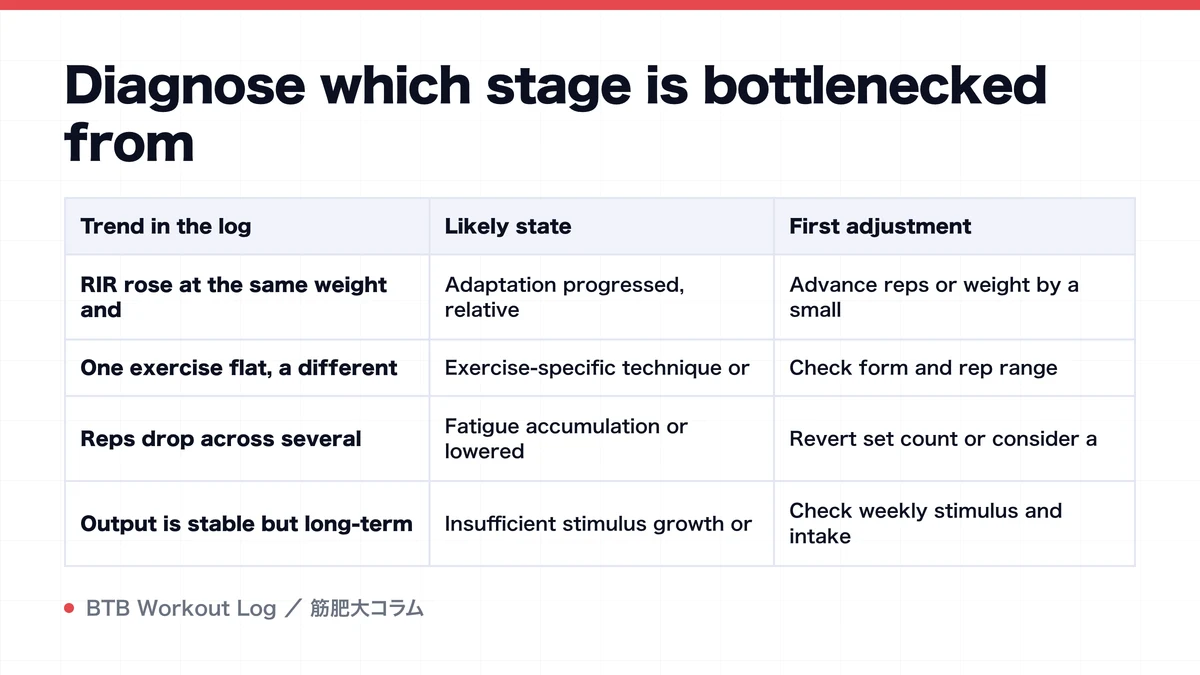
Diagnose which stage is bottlenecked from your log
The first step out of a plateau isn't raising stimulus — it's forming a hypothesis about where in the causal chain things stopped. Compare recent sessions of the same exercise, matching not just weight and reps but RIR, range of motion, rest time, and what ended the set.
| Trend in the log | Likely state | First adjustment |
|---|---|---|
| RIR rose at the same weight and reps | Adaptation progressed, relative stimulus dropped | Advance reps or weight by a small amount |
| One exercise flat, a different exercise on the same muscle group rising | Exercise-specific technique or load setup | Check form and rep range |
| Reps drop across several exercises, RIR worsens too | Fatigue accumulation or lowered recovery capacity | Revert set count or consider a deload |
| Output is stable but long-term body weight/measurements aren't moving | Insufficient stimulus growth or insufficient nutrition | Check weekly stimulus and intake separately |
Limit adjustments to one at a time. First fix comparison conditions, then check the trend across recent sessions plus weekly hard sets per muscle group, and finally layer in recovery status. If it's insufficient stimulus, advance reps or weight by a small amount; if it's excess fatigue, revert volume. After a change, observe several sessions, and if it doesn't match your hypothesis, move to the next factor. See causes of and fixes for a plateau for how to choose concrete fixes.
A workout log doesn't directly resolve a plateau, but it becomes material for not confusing insufficient stimulus with excess fatigue, and for testing one change at a time. The process of drift accumulating becomes visible earlier once you line up week-by-week numbers. BTB Workout Log is the log for building that lineup.
FAQ
- How many weeks without progress before I can call it a plateau?
- There's no number of weeks shared by everyone. Don't decide from 1–2 off sessions — compare several sessions at the same exercise, form, range of motion and rest. If weight, reps and RIR are all flat or declining together, and a different exercise on the same muscle group also isn't rising, a plateau becomes more likely.
- If weight used isn't rising, has hypertrophy stopped too?
- They don't always align. If reps are rising at the same weight, or you can move more cleanly at the same RIR, that's progress. Judge by combining not just one exercise's weight, but reps, RIR, range of motion, the trend across the whole muscle group, and longer-term measurements or body weight.
- If I hit a plateau, should I just add sets first?
- It's a candidate if your log shows RIR has room and you're recovering fine but weekly stimulus is low. Adding when several exercises' results are declining and fatigue is strong can make things worse. First separate insufficient stimulus from excess fatigue, and test raising or lowering only one factor at a time.
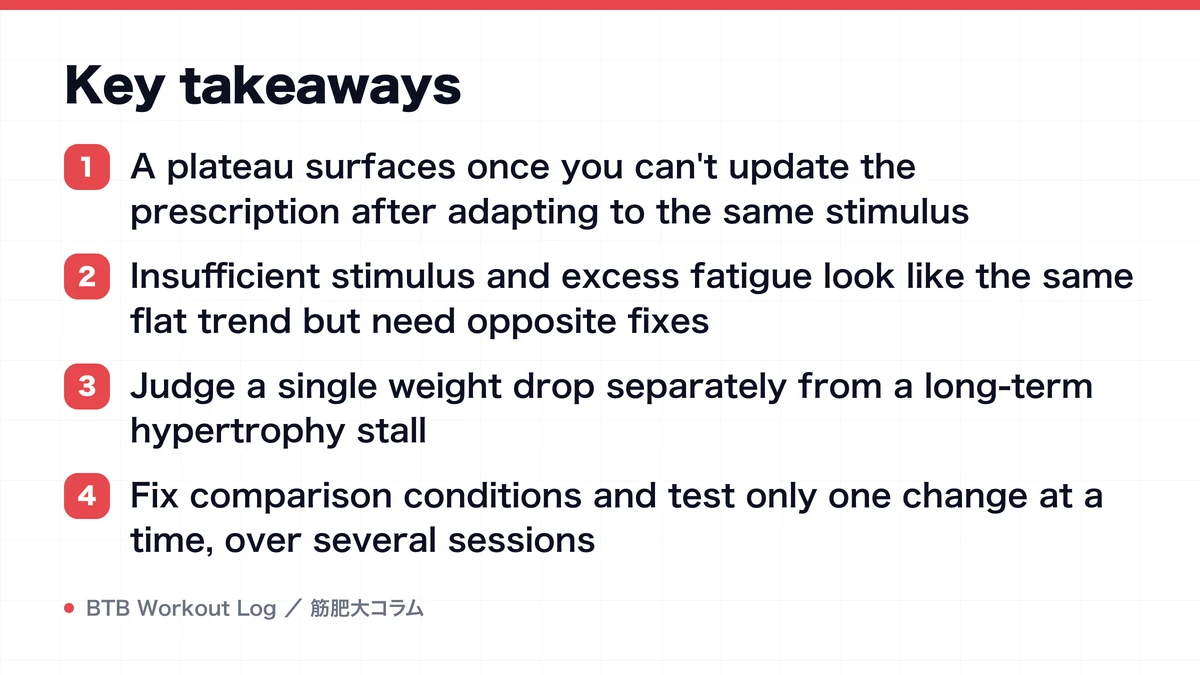
Key takeaways
- A plateau surfaces once you can't update the prescription after adapting to the same stimulus
- Insufficient stimulus and excess fatigue look like the same flat trend but need opposite fixes
- Judge a single weight drop separately from a long-term hypertrophy stall
- Fix comparison conditions and test only one change at a time, over several sessions
References
- ACSM Position Stand: Progression Models in Resistance Training for Healthy Adults
- Dose-response Relationship Between Weekly Resistance Training Volume and Muscle Mass
- Resistance Training Volume Enhances Muscle Hypertrophy in Trained Men
- Training to Repetition Failure or Non-failure: Systematic Review and Meta-analysis
- Proximity-to-Failure and Muscle Hypertrophy: Systematic Review with Meta-analysis