
When Does Muscle Start to Shrink Once You Stop Training? | Detraining Explained for Lifters Afraid to Rest
A break of a few days to about a week doesn't suddenly strip away trained muscle. What tends to change first is tightness, body water, and how an exercise feels — actual muscle-mass decline becomes more likely the longer the break continues.
That said, there's no shared boundary like "it starts declining on day X." A vacation where you're still walking around normally, and a period of illness or immobilization where you can barely move, progress very differently even as the same "training break."
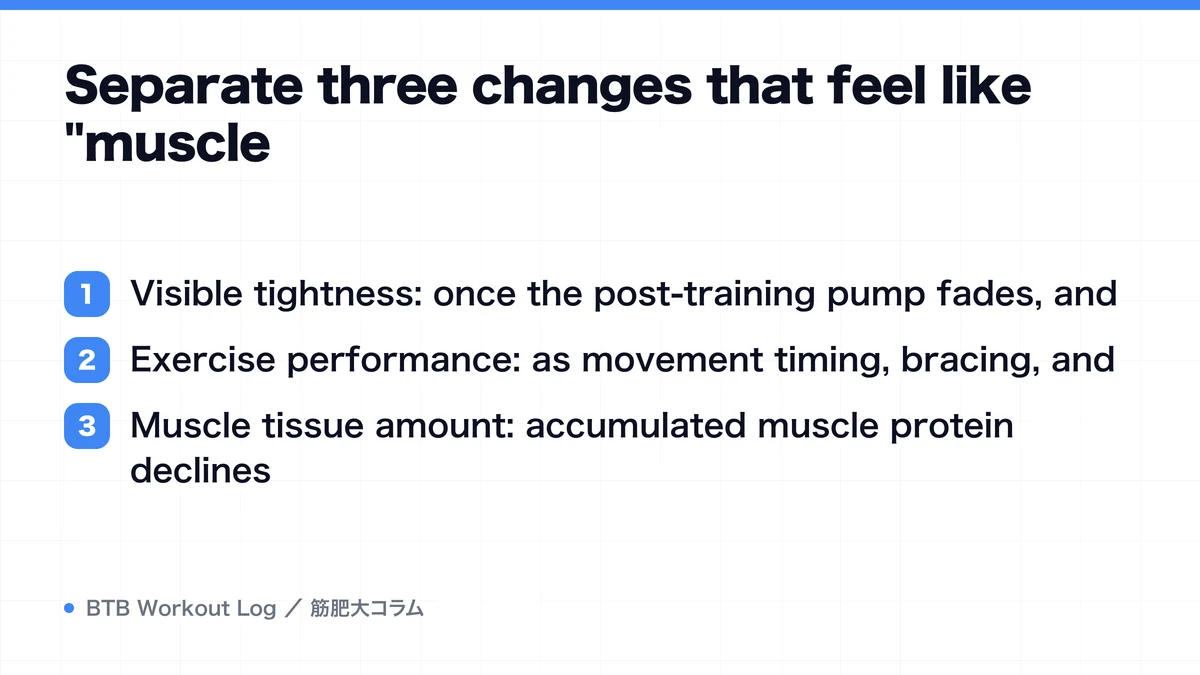
Separate three changes that feel like "muscle loss"
Before considering what changes during a break, split what "decline" actually refers to. Looking smaller in the mirror, an old weight feeling heavy, and the fiber itself actually shrinking are different phenomena.
- Visible tightness: once the post-training pump fades, and muscle glycogen plus its accompanying water drop from reduced carb intake or activity, you can look smaller even early on.
- Exercise performance: as movement timing, bracing, and familiarity with heavy load fade, weight or reps can drop without any muscle-mass loss.
- Muscle tissue amount: accumulated muscle protein declines and fiber cross-sectional area shrinks. This proceeds on a slower timescale than appearance or a single record.
Without this distinction, you might conclude "muscle is gone" just because the pump disappeared after a break, or conversely assume muscle mass held simply because body weight is unchanged. A short, planned recovery break — a deload — and detraining from a long stretch without stimulus aren't the same thing either.
What happens between your last set and actual muscle-mass decline
In training, mechanical tension on the fiber drives an intracellular response, leading to muscle protein remodeling during recovery. Post-exercise muscle protein synthesis rises temporarily, but that response isn't permanent. The rough causal order: stop training → no new tension stimulus arrives → the post-exercise synthesis response returns to baseline → the stimulus-free period accumulates → maintained muscle tissue gradually declines. Tracing the mechanics of hypertrophy in reverse makes this easier to understand.
What matters here is not equating the point where the post-exercise synthesis response settles with the start of measurable muscle atrophy. Muscle protein is constantly synthesized and broken down, receiving stimulus from diet and daily activity too. The fiber doesn't visibly shrink the instant your last training effect fades.
As a break continues, the body's need to maintain large muscle mass gradually decreases. But the speed varies with training history, age, muscle mass gained before the break, daily activity, energy and protein intake, and any illness or injury.
Days to 3 weeks: tightness and skill changes show up before muscle-mass decline
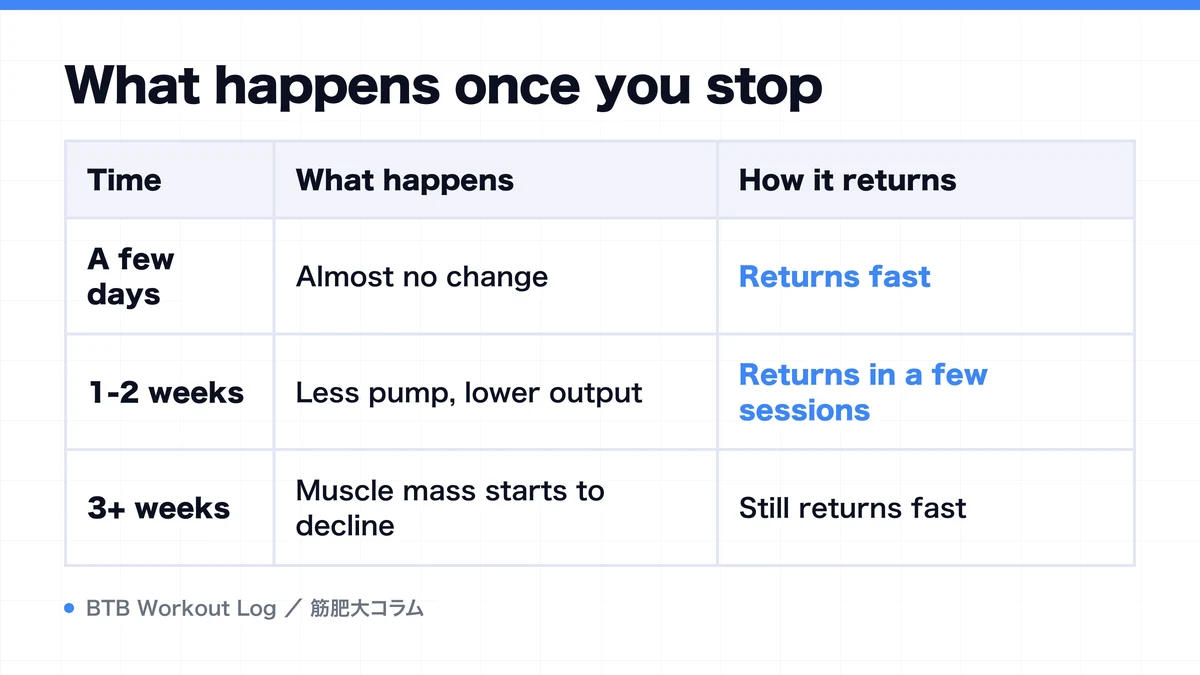
In the first few days off, accumulated fatigue clearing can actually raise performance. For someone who'd been sustaining high volume, this recovery can make the same weight feel lighter. A good result right after a short break may reflect output that was hidden by fatigue returning, rather than proof of added muscle. The mechanism overlaps with how output returns after a deload.
Meanwhile, on a vacation with reduced food or carbs, muscle tightness and body weight drop fast. Since this isn't purely a muscle-tissue change, you can't estimate atrophy amount from the mirror or one body-weight reading. On heavy lifts, movement reproducibility also gradually declines, so your old 1RM can feel heavy on the first day back — strength depends on the nervous system and skill, not just muscle mass.
Around 2–3 weeks, some studies find a decline in muscle thickness or cross-sectional area, while others detect no clear decline. Since participants, body part, pre-break training duration, and measurement method (ultrasound, MRI, etc.) all differ across studies, no line like "it starts on this day" can be drawn for everyone. If weight drops just once after a break, don't declare muscle-mass loss — compare 2–3 sessions at the same form and RIR instead. Why strength and muscle mass can diverge connects to the relationship between strength and hypertrophy.
Weeks to months: the longer the stimulus-free period, the higher the decline risk
As a break extends from weeks to months, repeated periods without tension stimulus gradually reverse the adaptation gained from training. Muscle mass, maximal strength, muscular endurance, and motor skill don't necessarily decline at the same rate. Some people lose exercise familiarity first, while for others, strength used in daily activity holds relatively well even as added muscle mass is gradually lost.
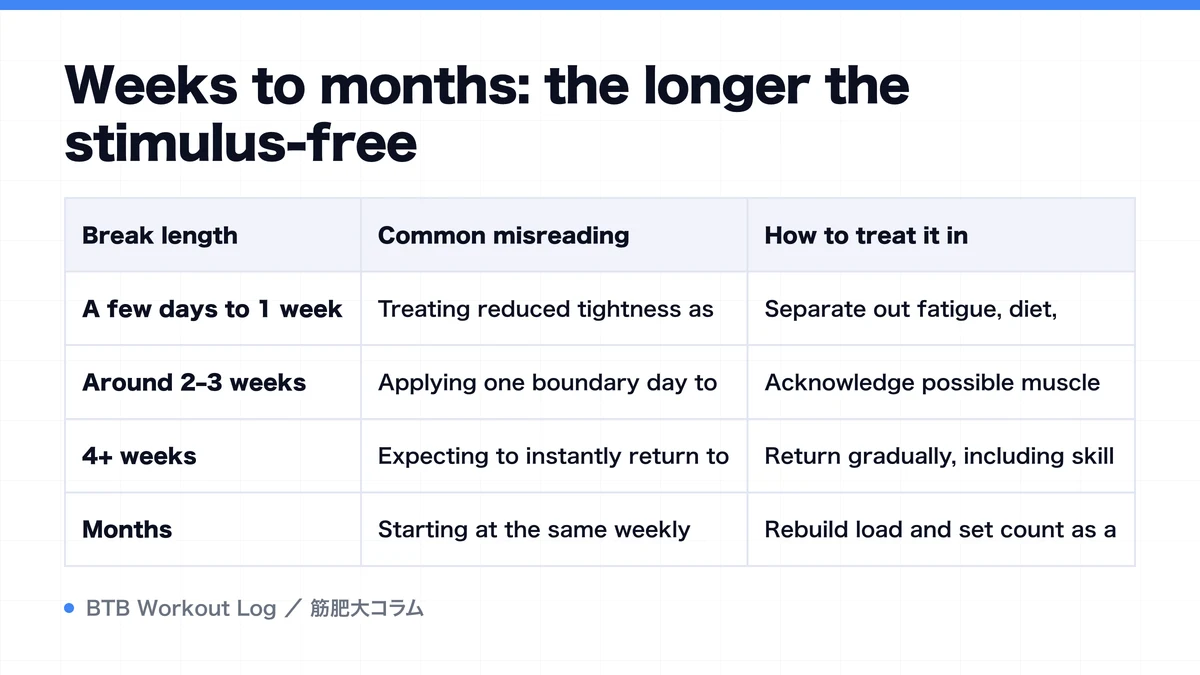
| Break length | Common misreading | How to treat it in practice |
|---|---|---|
| A few days to 1 week | Treating reduced tightness as muscle atrophy | Separate out fatigue, diet, water, and sleep |
| Around 2–3 weeks | Applying one boundary day to everyone | Acknowledge possible muscle decline while confirming from the trend after restarting |
| 4+ weeks | Expecting to instantly return to pre-break weight | Return gradually, including skill and recovery capacity |
| Months | Starting at the same weekly volume as before the break | Rebuild load and set count as a reintroduction period |
Even over the same duration, a state that barely uses the target muscle at all — hospitalization or immobilization — can decline faster than a lifestyle that still involves walking, carrying things, and using stairs daily. Conditions are harsher for older adults, during a rapid cut, or after illness with reduced appetite. Conversely, if you can maintain daily activity and keep in even a small amount of resistance exercise rather than stopping completely, you can create a maintenance-level stimulus without matching your growth-phase weekly volume.
When you need to take a break, protect the conditions you can still control, before worrying about muscle mass
If you just can't run your normal routine due to travel or being busy, you don't need to reproduce the same volume as your growth-phase weeks. If you can keep some opportunity to apply tension to the target muscle — bodyweight, bands, dumbbells — you can lean toward maintenance rather than a complete stop. Rather than pushing to failure and manufacturing soreness, choosing a few sets you can sustain without strain is the more manageable approach during a break.
For diet, the basic rule is not to slash protein just because you're resting. Also avoid an extreme energy deficit. But if activity drops, rather than fixing the same calories as your training days, adjust the whole intake while watching for a rapid body-weight change. You can use protein during a growth phase as your baseline for intake.
If the reason is injury, fever, or severe fatigue, don't force load onto the affected area or your whole body purely to protect muscle mass. Prioritize medical restrictions and recovery, and consider activity within permitted limits or exercise on unaffected areas. Trying to protect short-term muscle mass by dragging out the break usually ends up costing more time overall.
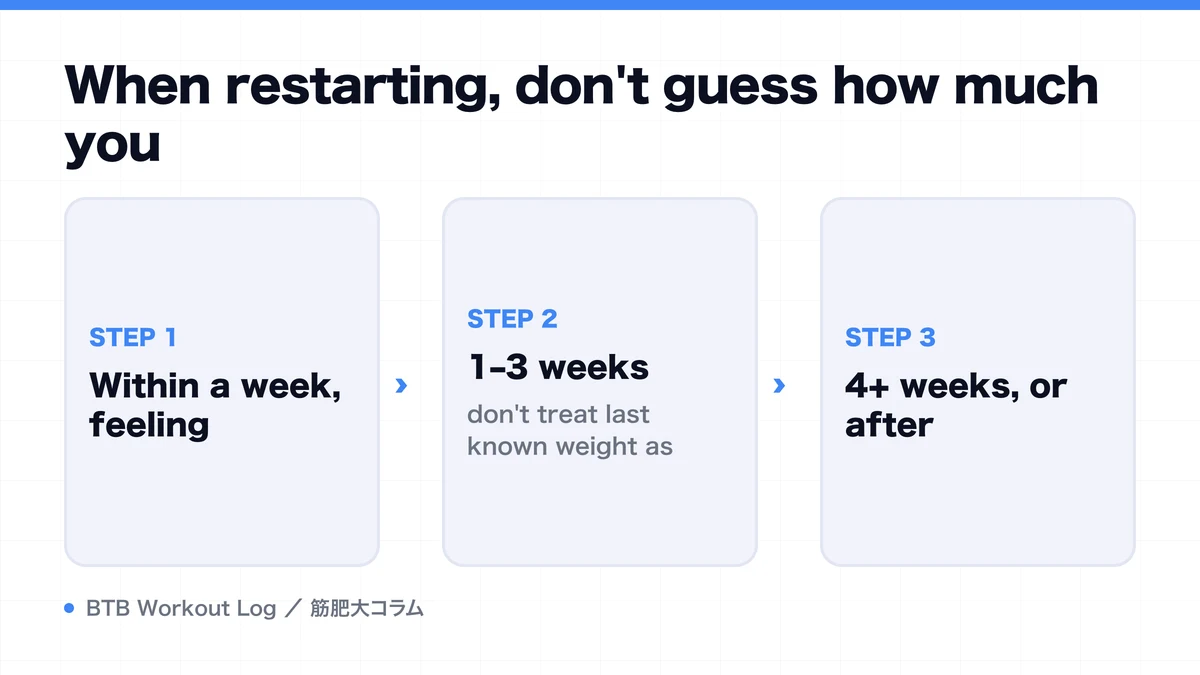
When restarting, don't guess how much you lost — rebuild from your first response
Testing your pre-break personal best on day one back doesn't tell you how much muscle remains — dulled skill and fatigue from work or travel mix in too. Set your last normal pre-break record as a ceiling, leave reserve on your first session, and decide your ramp-up speed from there.
- Within a week, feeling good: consider your pre-break routine as a candidate, but check warm-up speed and RIR. Lower weight or set count on the spot if it feels heavy.
- 1–3 weeks: don't treat last known weight as mandatory — start from a load that leaves roughly RIR 3–4, and trim accessory work or later sets.
- 4+ weeks, or after illness: don't return to your old weekly set count all at once — start clearly lower. Watch soreness, joint response, and next-time weight/reps, and build up over several sessions.
There's no need to make up for the sets you missed during the break. What matters after restarting isn't your past total volume — it's your current form and recovery capacity. If weight or reps are returning at comparable RIR, you're getting closer to a state where you can build progressive overload again.
Rather than adding sets from a single initial decline, checking the speed at which weight, reps and RIR return makes it easier to separate muscle-mass loss from the effect of skill and fatigue. Whether you actually lost anything can be told by comparing your pre-break normal values against a few sessions after restarting, under matched conditions. BTB Workout Log keeps history spanning the break.
FAQ
- Does muscle shrink if I take a week off training?
- If daily activity and diet aren't substantially disrupted, it's unlikely that trained muscle suddenly disappears in a week. Tightness, body weight and how an exercise feels can change, but that alone doesn't establish fiber atrophy.
- If muscle looks smaller after a break, does that mean muscle mass dropped?
- Not necessarily muscle-mass decline. Once the pump fades, and muscle glycogen and water drop from reduced carb intake or activity, you can look flatter even after just a few days. Judge from the change once diet and training return to normal.
- Is it OK to start back at my old weight when resuming training?
- You can try the same weight if you feel good after a short break, but don't make hitting it mandatory. Lower load if warm-up feels heavy, and leave more RIR than usual. After a long break or illness, also reduce set count and rebuild over several sessions.
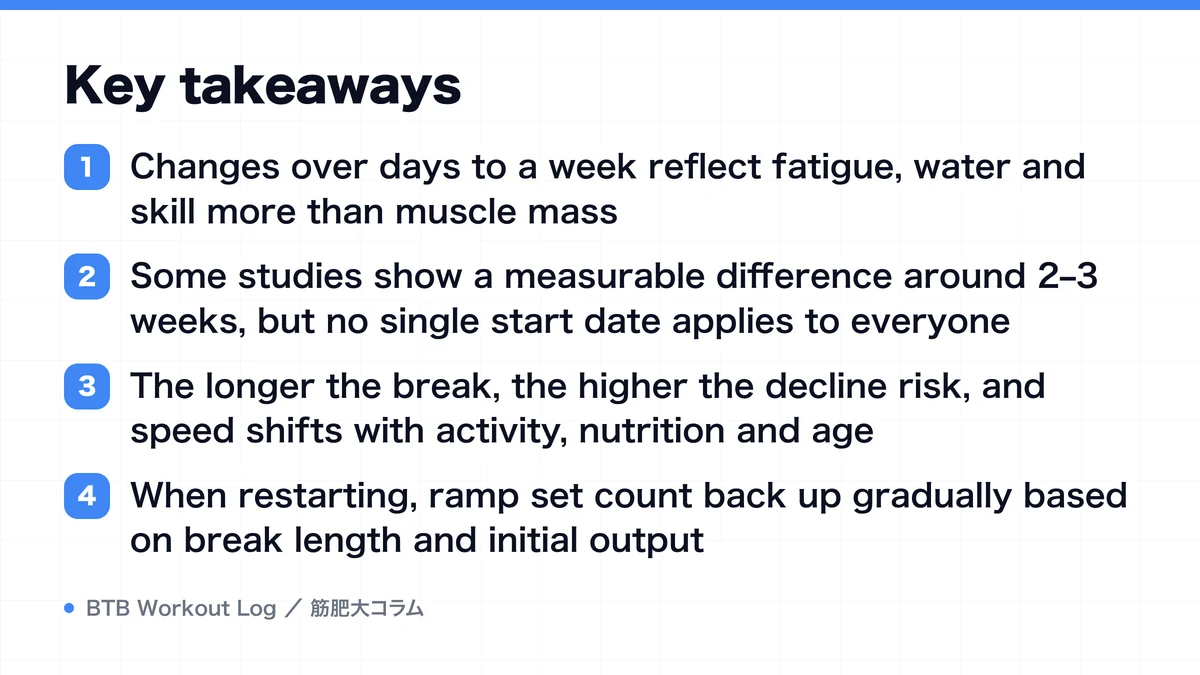
Key takeaways
- Changes over days to a week reflect fatigue, water and skill more than muscle mass
- Some studies show a measurable difference around 2–3 weeks, but no single start date applies to everyone
- The longer the break, the higher the decline risk, and speed shifts with activity, nutrition and age
- When restarting, ramp set count back up gradually based on break length and initial output
References
- Mixed Muscle Protein Synthesis and Breakdown After Resistance Exercise in Humans
- Muscle Protein Synthetic Response to Resistance Exercise: Systematic Review and Meta-analysis
- The Mechanisms of Muscle Hypertrophy and Their Application to Resistance Training
- Mechanisms of Muscle Hypertrophy: Current Understanding and Future Directions
- The Influence of Frequency, Intensity, Volume and Mode of Strength Training on Whole Muscle Cross-sectional Area in Humans