What Happens in Your Muscle When You Eat Protein? | Muscle Protein Synthesis, Explained Simply
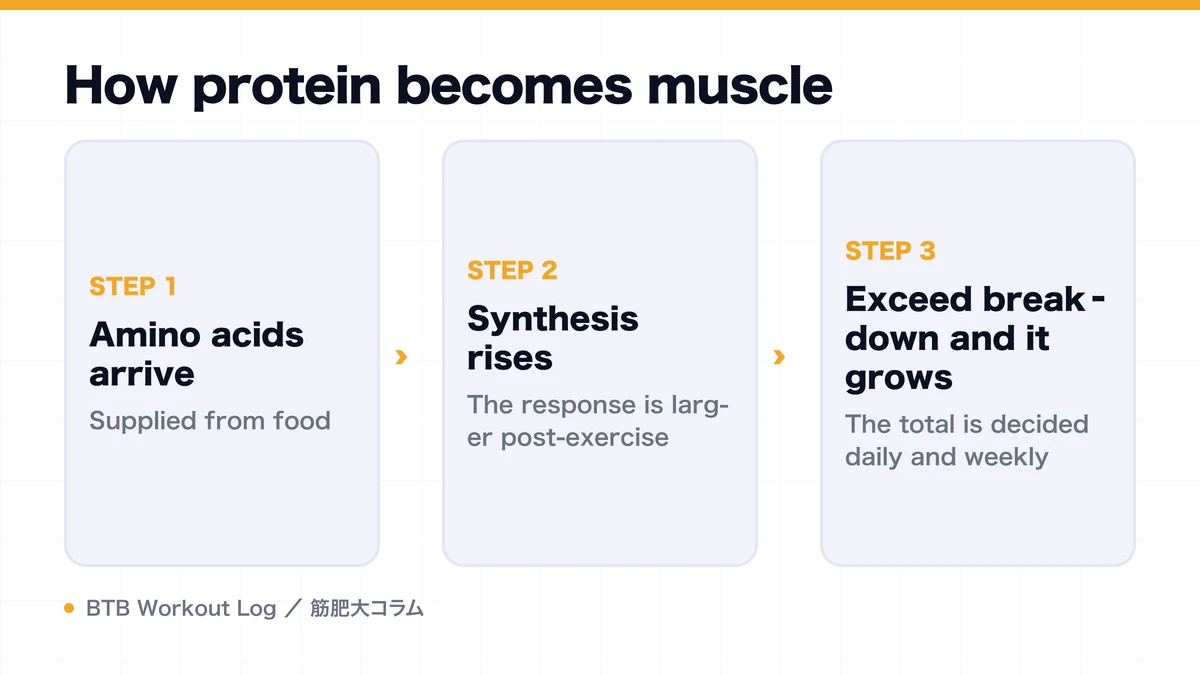
Eat protein, and the amino acids produced by digestion reach the muscle, becoming synthesis material while also prompting the reaction that builds muscle protein. But muscle doesn't grow directly from a single meal — only once the small windows where synthesis outpaces breakdown accumulate many times over does it lead to hypertrophy.
This isn't a one-step story — "protein turns into muscle." Let's trace from intake to long-term hypertrophy without skipping any steps.
Stage 1: protein gets broken down all the way to amino acids
Protein in meat, fish, eggs, dairy or protein powder is a large molecule made of many amino acids linked together. It isn't carried to the muscle fiber as is — it's broken down into peptides and amino acids in the stomach and small intestine, and absorbed from the small intestine. Blood amino acid levels rising after a meal reflects this process — usable material has entered circulation.
Not all absorbed amino acids become muscle either. They're also used in the gut and liver, going toward synthesizing a variety of proteins, including enzymes and hormones, and toward energy metabolism. Only the amino acids that then get taken up by muscle cells join the material pool used to build muscle protein.
Among these, essential amino acids, which the body can't sufficiently produce on its own, need to be supplied through diet. If you think of muscle as a factory, the protein you eat isn't the finished product — it's the parts supply used at each step. See how much protein hypertrophy needs for the required amount — here, we move on to the response that happens after supply.
Stage 2: amino acids are both material and a signal to start synthesis
When amino acids enter muscle cells from the blood, it isn't just that material inventory rose — the cell also senses that "nutrition usable for synthesis has arrived." One important input here is the essential amino acid leucine. A rise in leucine is involved in activating mTORC1, a signaling pathway that integrates several pieces of information, including nutritional status and exercise stimulus.
mTORC1 isn't muscle itself — it's a coordinator that relays the start instruction to the machinery that builds protein. Once activated, it makes it easier for "translation" — reading genetic information and assembling new protein — to begin. So the causal order is: protein intake, rising amino acids, nutrient sensing, activation of the translation machinery.
The common phrase "leucine flips the switch" is convenient, but it isn't a machine that's simply on or off. Leucine alone, without the other essential amino acids needed to build the chain to completion, means material runs out. And the mechanical stimulus from training and the nutritional input from food merge through separate pathways. Signal alone, or material alone, can't explain the whole response hypertrophy needs.
Stage 3: ribosomes line up amino acids to build muscle protein
Once the synthesis instruction arrives, the cell's ribosomes read the design information — messenger RNA — and link amino acids in the specified order. This builds new muscle protein, including the proteins that make up myofibrils, like actin and myosin. This rate of production per unit time is muscle protein synthesis (MPS).
A rise in MPS isn't just patching damaged sites — it also includes the routine turnover of protein and structural remodeling to adapt to training. So you can't treat soreness intensity and MPS as the same thing. Synthesis can occur without strong soreness, and conversely, strong soreness doesn't guarantee that all the synthesized material becomes new muscle mass.
This is the point separating an acute response from long-term adaptation. MPS rising after one meal shows "the building process sped up," but that measurement alone doesn't determine hypertrophy amount months later. The full picture from training stimulus to long-term adaptation connects to the path from training to muscle growth.
Stage 4: whether muscle grows is decided by the net balance of synthesis minus breakdown
In muscle, the reaction building new protein continues alongside a reaction breaking down old protein. Synthesis amount minus breakdown amount over a given period is the net muscle protein balance. A window where synthesis exceeds breakdown is positive; otherwise, negative. The positive from a single meal is small and temporary, but repeat training and eating, and once the long-term balance accumulates on the positive side, fiber cross-sectional area increases.
Resistance training doesn't just raise MPS — it also puts the muscle into a state that's more responsive to amino acids afterward. Protein intake supplies the material and nutritional signal into that state. So it isn't a comparison of "training or protein" — stimulus and supply hold different, complementary roles. Diet alone can't produce training-specific adaptation, and training alone gets constrained in what it can accumulate if material is lacking.
This response has a time window, but the first few dozen minutes right after training aren't the only opportunity. That said, it doesn't mean not eating anything until the next day after exercising is equally fine either. Rather than fearing a narrow window, it's an easier-to-sustain approach to secure sufficient protein throughout the day and place ordinary meals around training too. Research examples on intake timing are covered in a breakdown of amino acid intake timing.
Why BCAA or leucine alone can't complete the response
If leucine is a key input for nutrient sensing, taking BCAA alone might look sufficient. But BCAA is only 3 amino acids — leucine, isoleucine and valine — and doesn't include every essential amino acid needed to build muscle protein. Even with a signal prompting the start, if the parts needed to extend the chain as designed are missing, the synthesis response can't be sufficiently sustained.
Complete protein from food or whey supplies not just leucine but the other essential amino acids together. This is why, for someone already meeting their daily protein total through regular meals, adding BCAA separately isn't a high priority. The order for choosing supplements aligns with the priority order for hypertrophy supplements.
For the same reason, more protein doesn't keep raising MPS without limit. Once a single meal has sufficiently raised the synthesis response, additional amino acids don't keep accumulating into muscle protein at the same rate — they get used elsewhere, in other tissue or metabolism. The order that fits the mechanism: first don't let your daily total run short, split it reasonably across meals, then use protein powder for convenience as needed.
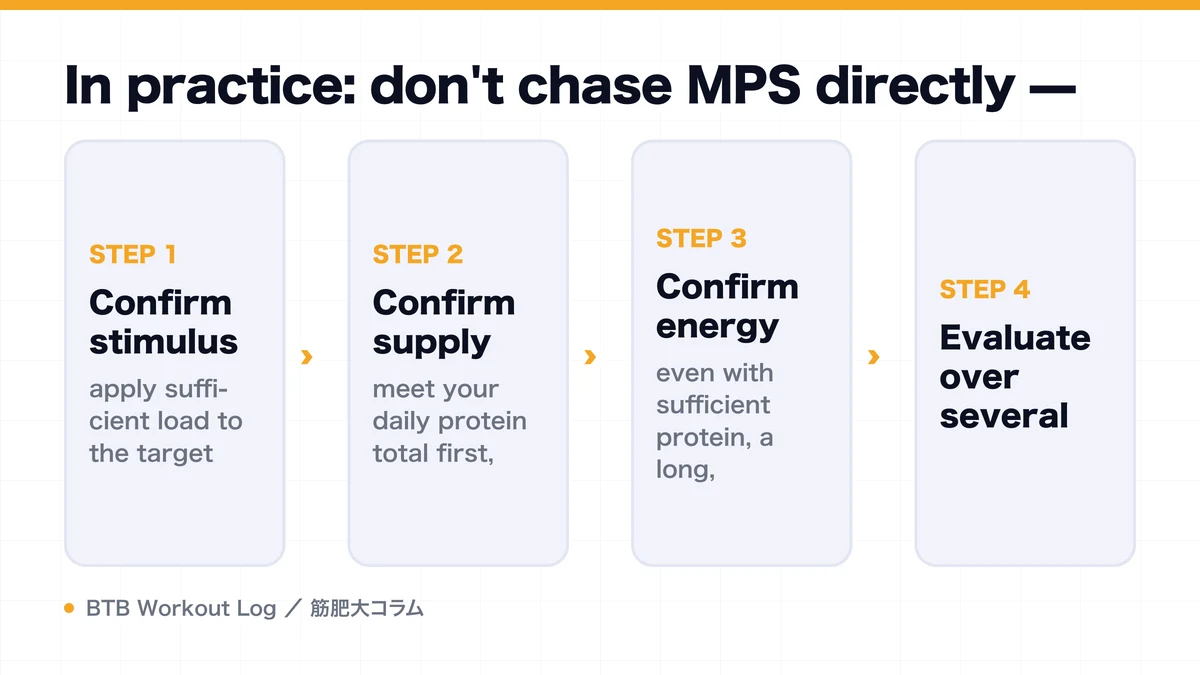
In practice: don't chase MPS directly — confirm conditions that keep stimulus and supply going
MPS can be measured in research, but it isn't something you can check by feel or with a home number in day-to-day training. You can't estimate synthesis amount from tightness right after drinking a shake, daily body-weight swings, or soreness. In practice, substitute the parts of the causal chain you can actually control and log.
- Confirm stimulus: apply sufficient load to the target muscle and check whether weight, reps and set count progress under matched conditions.
- Confirm supply: meet your daily protein total first, and sustain it without being extremely skewed toward one meal.
- Confirm energy: even with sufficient protein, a long, large calorie deficit makes accumulation difficult.
- Evaluate over several weeks: combine body-weight trend, measurements or photos, and training results under matched conditions — don't judge from a single day's response.
If intake is insufficient, there's room to improve through diet or added protein powder. If it's already sufficient, reviewing progressive overload, effective sets per muscle group, and recovery — rather than adding even more protein — makes it easier to identify the next bottleneck. During a cut, judge including not just protein but how a calorie deficit constrains hypertrophy.
Protein isn't a standalone command that produces hypertrophy — it's the material and signal that answers the adaptation demand training created. Rather than "did you drink it," watching whether you can repeat needed stimulus, supply and recovery translates the invisible MPS response into an actual decision.
FAQ
- How many hours does muscle protein synthesis last after eating protein?
- The size and duration of the response shift with meal amount and quality, recent training, age, and training history. Rather than cutting it off at a fixed time, it's more practical to meet your daily total and sustain it split across several meals.
- Do I miss out on muscle protein synthesis if I don't drink a shake right after training?
- Missing the first few dozen minutes alone doesn't eliminate the response. Getting sufficient protein across meals before and after matters more. If you trained fasted, it's reasonable not to delay your post-training meal too long.
- If muscle protein synthesis is high, does hypertrophy scale up by the same amount?
- A single acute MPS response alone can't fully predict long-term hypertrophy. It needs evaluating as the result of accumulating balance against breakdown, training-stimulus quality, total intake, and recovery over many weeks.
Key takeaways
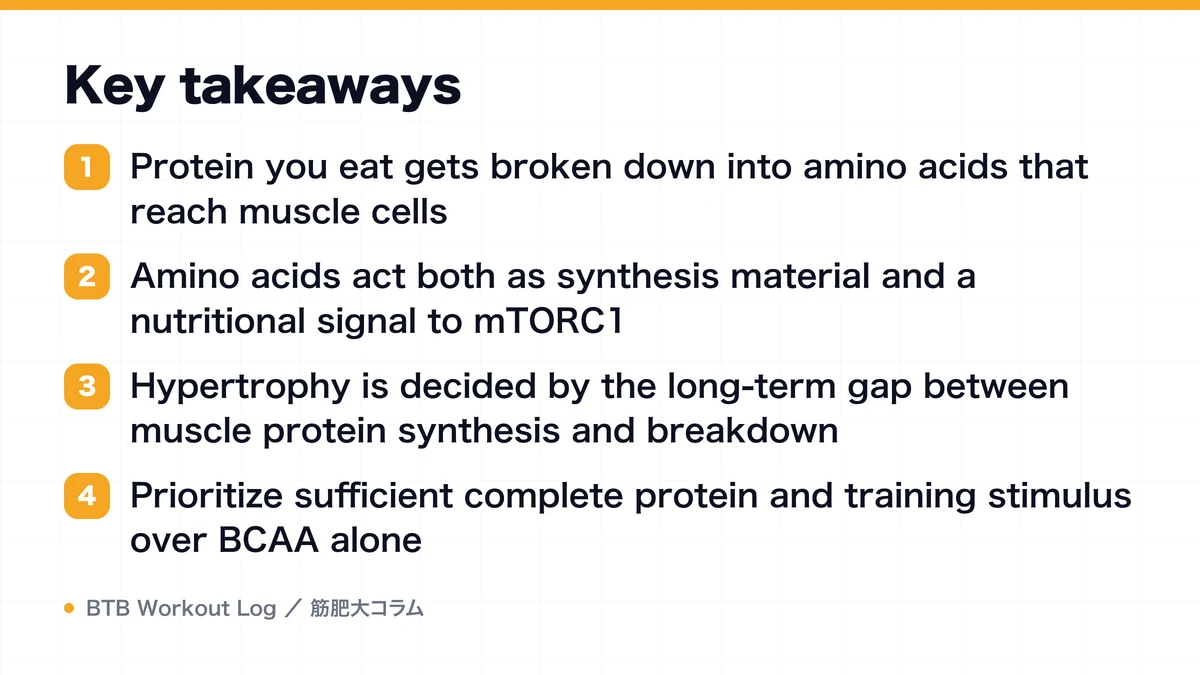
- Protein you eat gets broken down into amino acids that reach muscle cells
- Amino acids act both as synthesis material and a nutritional signal to mTORC1
- Hypertrophy is decided by the long-term gap between muscle protein synthesis and breakdown
- Prioritize sufficient complete protein and training stimulus over BCAA alone
References
- Mixed Muscle Protein Synthesis and Breakdown After Resistance Exercise in Humans
- Branched-chain Amino Acids and Muscle Protein Synthesis in Humans: Myth or Reality?
- Protein Supplementation Augments the Adaptive Response of Skeletal Muscle to Resistance-type Exercise Training
- Protein Supplementation and Resistance Training-induced Gains: Meta-analysis