What Does Poor Sleep Do to Your Training? | How Sleep Loss Drags Down Hypertrophy
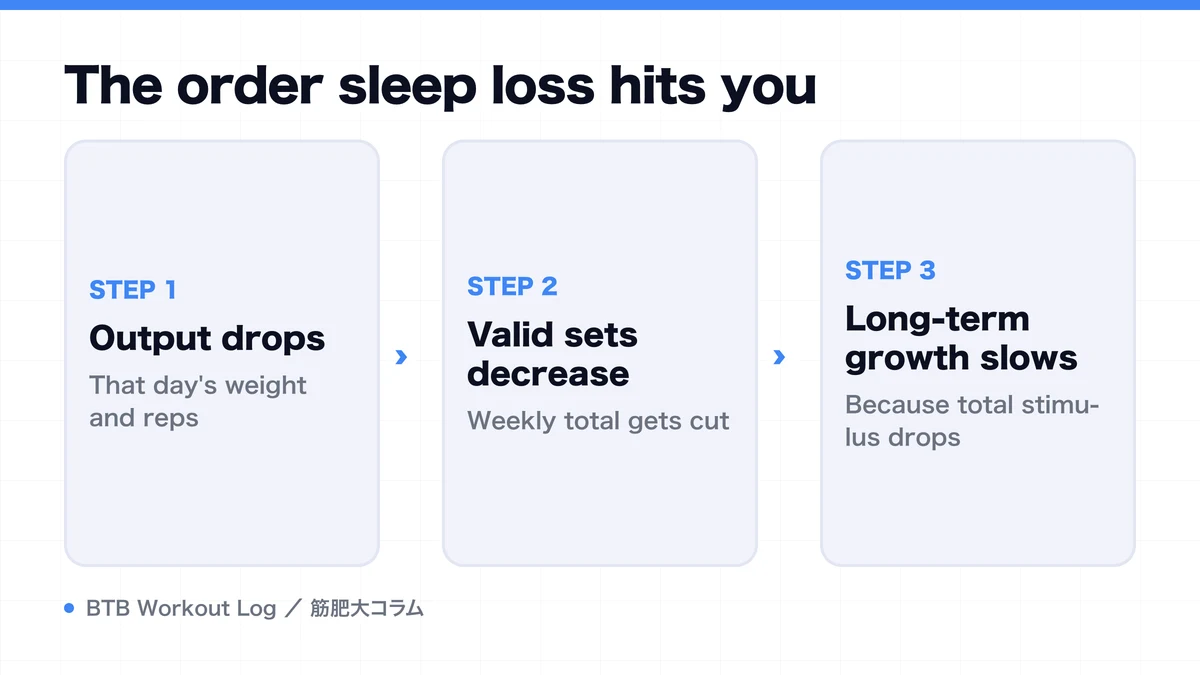
With sleep loss, your readiness for training drops first, raising the relative difficulty of the same weight. As a result, force production on compound lifts, rep count, and form reproducibility tend to break down in sequence.
One night's sleep loss doesn't erase hypertrophy. The problem is a run of low-output sessions making it harder to bank the high-quality reps progressive overload needs.
Sleep loss's effect shows up in "readiness" before muscle
Even on a morning with insufficient sleep, muscle itself doesn't suddenly shrink, and adaptation gained up to that point doesn't disappear. What tends to change first is the readiness needed to produce high output — sleepiness, sustaining focus, motivation to start moving, and subjective sense of hardness.
Readiness doesn't show up as a standalone number in your training log. It shows up as warm-up feeling heavier than usual, taking longer to focus before a set, or running out of reserve earlier than expected at the same weight. So rather than immediately concluding "strength dropped," it's closer to reality to say sleep conditions lowered the output you could draw out that day. Factors behind why a weight you managed last time suddenly feels heavier are also covered in day-to-day weight variation.
What matters here is not treating sleep loss as purely a mood issue. Training is the work of producing force with intended form and range of motion, and reproducing that across sets. Once alertness or focus breaks down, that becomes the entry point for the whole task's precision dropping.
Reduced readiness ripples into force production on compound lifts
In a study of 8 men aged 18–24 covered in Knowles et al.'s systematic review, 3 consecutive nights of 3-hour sleep didn't produce a significant drop in max lift on biceps curl, but did on bench press, leg press and deadlift. The included studies have quality limitations, so this doesn't mean the same decline occurs for every exercise and every person.
Compound lifts like squat, bench press and deadlift require coordinating multiple joints, holding posture, and producing large force along an intended path. It isn't surprising, practically, that results swing more broadly than simple muscle contraction alone can explain, on a day focus and readiness have dropped from sleep loss. But since this review didn't directly prove reduced coordination as the cause, the mechanism and the observed result need to be kept separate.
It's also premature to look at max strength alone and conclude "I hit my usual weight today, so no effect." Succeeding on the first rep is a different question from whether you can hold your normal rep range, or reproduce the same movement across later sets.
RIR shrinks and set quality declines even at the same weight
Once force production drops even slightly, the meaning of your training prescription changes. A weight that normally gives 8 reps at RIR 2 — "2 reps of reserve" — might land at 6–7 reps near RIR 0–1 on a sleep-deprived day. Displayed weight is the same, but relative intensity against that day's capability has risen.
Ignore this gap and try to force your planned rep count, and it becomes easy to compensate — shortening range of motion, adding momentum, or pushing through with muscles other than the target. Conversely, holding form means fewer reps. Either way, you can't evaluate "weight × sets on paper was the same, so stimulus was the same." Only once RIR, range of motion and form are matched can you compare against last time.
Further, the more reserve you burn through on the first set, the bigger the rep decline on later sets. Stack failure sets or extra sets trying to make up the deficit, and you raise not just local fatigue but whole-session fatigue too. The path from sleep loss to hypertrophy isn't a one-step explanation — "no sleep means no growth" — it's easier to judge as rising relative intensity → declining reps and movement → shrinking work volume you can sustain at quality.
Separate one bad night from repeated sleep loss
One poorly slept night alone doesn't make that day's training worthless. Adjust load for the day and stay within a range that holds movement quality, and you can likely still preserve stimulus. There's no need to treat a single decline as a stall and overhaul your whole routine either.
The problem grows when sleep restriction continues for several nights to weeks. If reps drop on every compound lift and your planned weekly hard sets also decline in quality, opportunities to advance weight or reps shrink. It's reasonable to think about long-term hypertrophy harm through this path of struggling to repeat progressive overload. The cited research alone can't quantify how much sleep loss reduces long-term hypertrophy amount.
A sleep-extension intervention in athletes aged 14–30 reported possible improvement in competitive performance, but few studies were included and their quality varied. This isn't "more sleep always means more gains" — it's positioned as: for someone chronically under-slept, securing more sleep opportunity may have room to help.
On a sleep-deprived day, prioritize your warm-up over the written plan
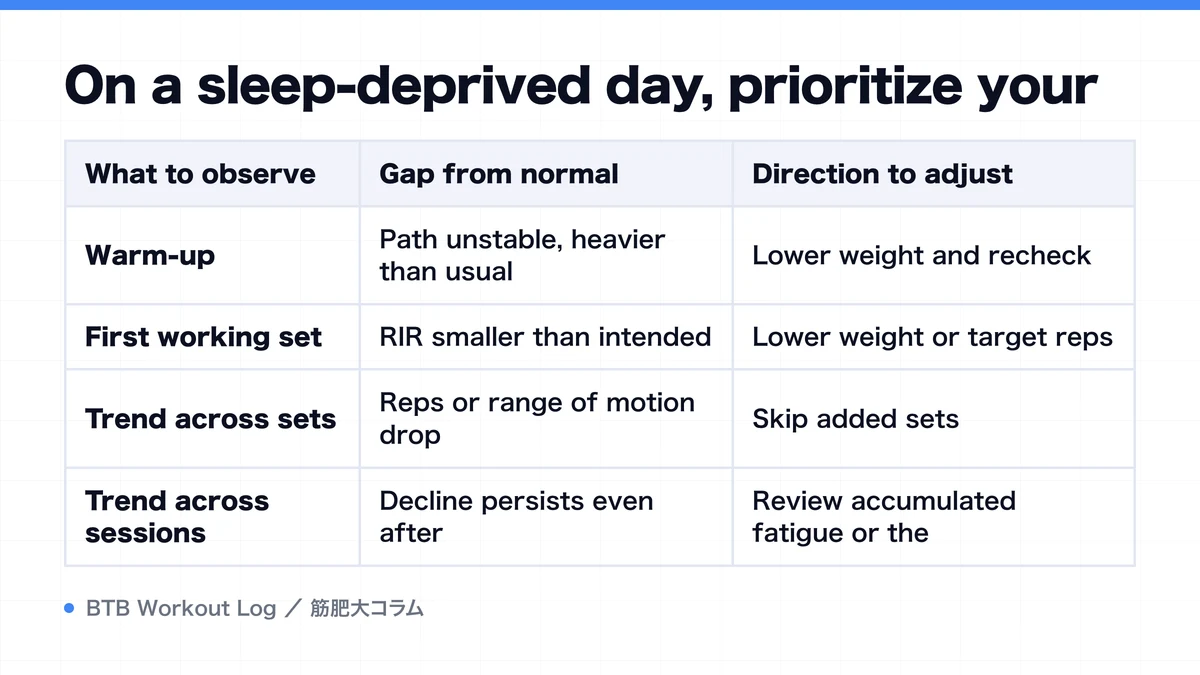
There's no need to mechanically decide rest-or-continue from that day's sleep hours alone. Use warm-up through your first working set as a test for whether you can execute the plan.
| What to observe | Gap from normal | Direction to adjust |
|---|---|---|
| Warm-up | Path unstable, heavier than usual | Lower weight and recheck |
| First working set | RIR smaller than intended | Lower weight or target reps |
| Trend across sets | Reps or range of motion drop sharply | Skip added sets |
| Trend across sessions | Decline persists even after catching up on sleep | Review accumulated fatigue or the plan |
Range where you can proceed as normal
If warm-up movement is stable and working sets land within your target RIR and rep range, there's no need to stop purely because of sleep hours. That said, it's more manageable to push a personal-best attempt, or a heavy weight that's dangerous if you fail, to a different day.
Range where you should lower load or set count
If holding form means you can't hit your target reps, if set one is already closer to the limit than planned, or if the drop between sets is large, match that day's capability. Prioritize leaving reproducible reps on the target muscle over hitting your planned weight. Once sleep returns to normal next time, you can go back to your usual settings — no need to fear that one adjustment as undertraining.
Range where prioritizing rest is the right call
Prioritize rest if strong sleepiness delays safety checks, if you can't control posture on free weights, or if it's affecting life-related judgment too. If output still doesn't return across several sessions even once sleep is secured, isolate accumulated training fatigue too, not just sleep. How output returns after a deload and how to think about rest days are your next material for checking.
Read sleep's effect from a matched-condition trend, not one weight
To judge sleep loss's effect, match sleep hours against training results. At minimum, log time from lying down to waking, subjective sleepiness, per-exercise weight/reps/RIR, and between-set rep decline. Since logged sleep time doesn't exactly match actual sleep obtained, treat it not as a precise measurement but as a marker for separating conditions.
If weight drops just once, that might be within normal day-to-day variance. If compound-lift RIR and reps repeatedly worsen on sleep-deprived days and return on well-slept days, that's more material for suspecting a sleep link. If decline persists even after sleep returns to normal, investigate other factors — volume, frequency, nutrition, pain. Rather than a fixed 48-hour rule, judge recovery from the combination of conditions and output.
7–9 hours is offered as a guideline for healthy young adults and adults, but individual need varies. Rather than whether you forced yourself to match a guideline, it's more practical to use whether you're securing the sleep amount that keeps your own output and daytime function stable as input into training decisions.
FAQ
- Should I skip training after just one night of poor sleep?
- No need to decide from sleep hours alone. Check warm-up path, the gap in heaviness from usual, and your first working set's RIR — if you can still reproduce it, adjust load and proceed. Prioritize rest if strong sleepiness makes safe movement difficult.
- By what percentage should I lower weight on a sleep-deprived day?
- There's no universal percentage. After warm-up, lower to whatever weight holds your intended rep range and RIR. If form or range of motion still isn't stable even after lowering weight, or between-set rep decline is large, also reduce set count and carry the rest to next time.
- Does hypertrophy stop if sleep loss continues?
- It won't immediately stop. But if force production on compound lifts and set quality repeatedly decline, it gets harder to advance weight, reps, and quality weekly volume. If decline persists across several sessions even after sleep returns to normal, also check accumulated fatigue.
Key takeaways
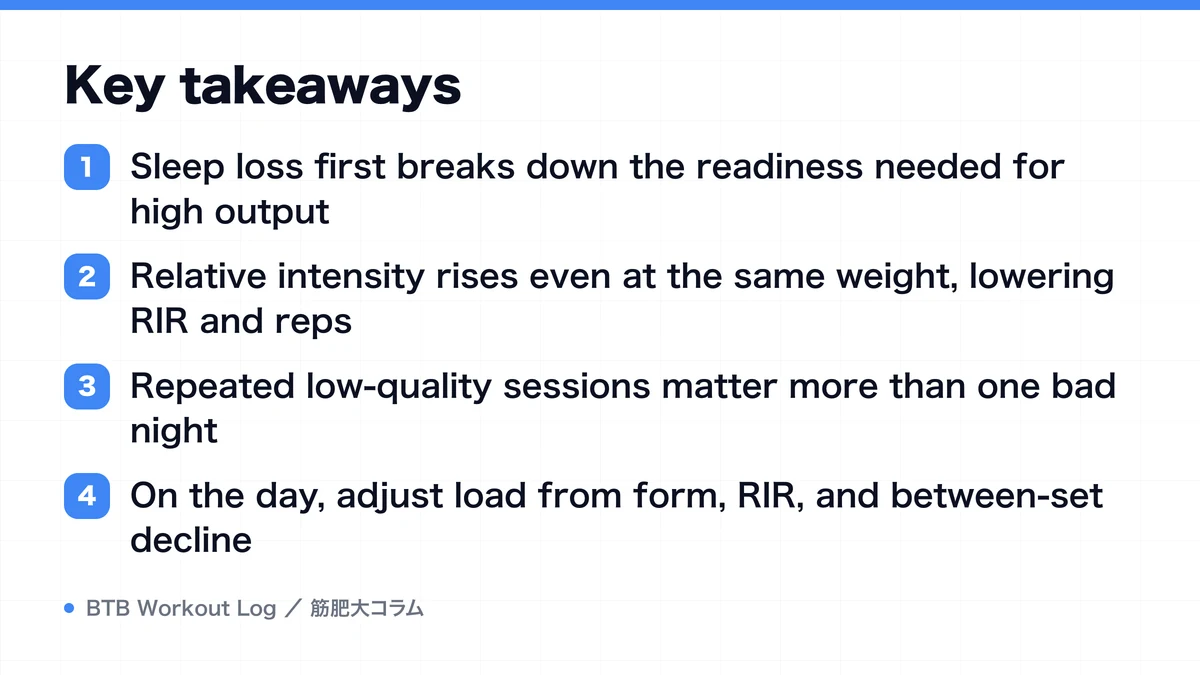
- Sleep loss first breaks down the readiness needed for high output
- Relative intensity rises even at the same weight, lowering RIR and reps
- Repeated low-quality sessions matter more than one bad night
- On the day, adjust load from form, RIR, and between-set decline