Muscle Hypertrophy: How Strength Training Builds Bigger Muscles
Muscles grow by converting mechanical tension from resistance training into growth signals, then repeatedly rebuilding muscle proteins during recovery.
A single set doesn't turn directly into muscle. Measurable hypertrophy takes an effective training stimulus, the nutrients and recovery to support growth, and consistent repetition over time. To work out which step may be holding you back, start with the full picture of how hypertrophy works.
The first change: mechanical tension on the muscle fiber
When you move a weight, the active muscle fibers produce force while resisting external load. The mechanical tension that arises inside the fiber at that moment is, in our current understanding, the central stimulus that initiates hypertrophy. What matters isn't the weight loaded on the bar itself — it's how much force the target muscle actually produced. The same 100kg won't deliver the same stimulus to the target muscle if range of motion, form, momentum, or familiarity with the exercise differ.
Heavy load tends to recruit many muscle fibers early on; light load recruits additional fibers as fatigue builds through continued reps. This is part of why hypertrophy isn't confined to one load range. But end a light set with a lot of reserve left, and it can finish without ever sufficiently loading enough muscle fibers with tension.
RIR (Repetitions in Reserve — how many more reps were left) is the yardstick for matching effort. You don't need to push every set to actual failure, but you do need to approach the limit closely enough to recruit the target muscle. See why hypertrophy doesn't require failure every time for how pushing hard and fatigue relate.
How tension turns into a growth instruction
A muscle fiber isn't just a rope — it has structures that detect the force and deformation it receives. When tension is applied, that information gets converted into intracellular chemical signals, which activate pathways involved in muscle protein synthesis and tissue remodeling. This process of translating a physical stimulus into a biological response is the intermediate stage connecting training to hypertrophy.
It's important not to mistake soreness or pump for the cause here. Muscle damage from an unfamiliar movement and metabolite buildup during a set both accompany training, but maximizing them isn't itself the goal of hypertrophy. Producing strong soreness that tanks your next session's output can actually reduce the stimulus you're able to accumulate long-term. The evolution of the mechanical tension, muscle damage and metabolic stress framework is covered in detail in this research review of hypertrophy mechanisms.
So evaluate a set not just by "did it hurt" or "did I pump", but by whether you held tension on the target muscle, sustained your intended reps and range of motion, and can bank equal or greater work once you've recovered.
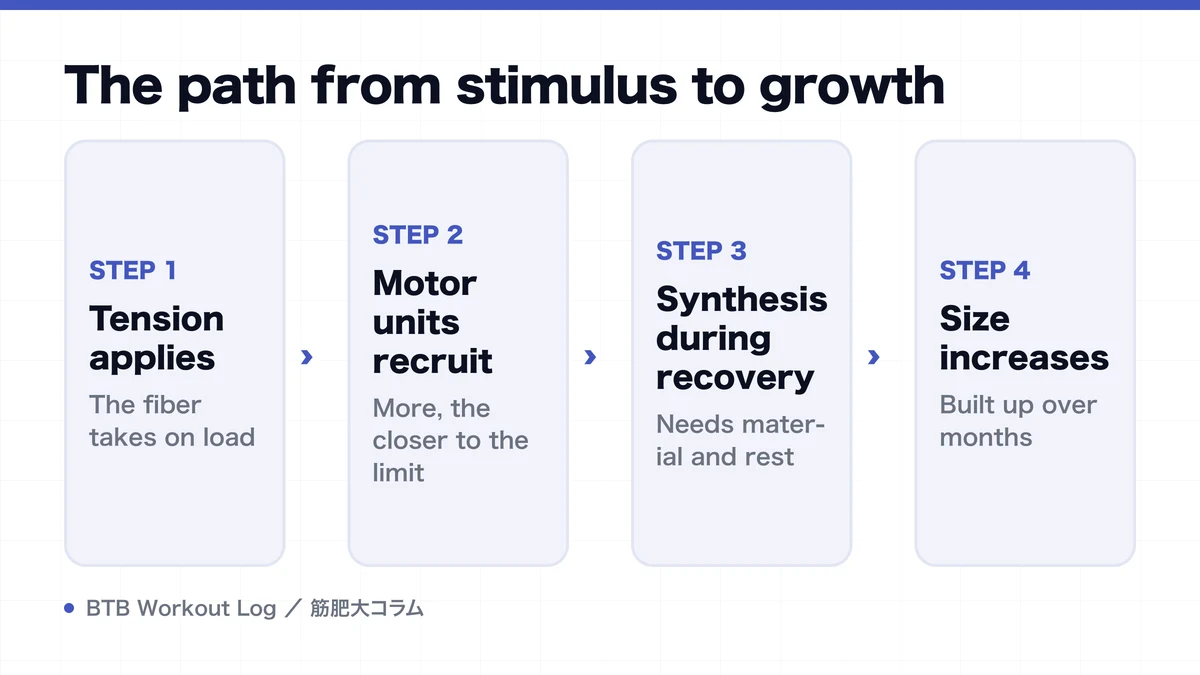
During recovery: creating a window where protein synthesis outpaces breakdown
After training, the body doesn't just repair damaged areas — it also rebuilds protein to adapt for the next load. Muscle protein is constantly being synthesized and broken down, and whatever synthesis exceeds breakdown over a given window pushes toward accumulation. The post-exercise rise in muscle protein synthesis matters, but that acute response spiking once doesn't by itself complete visible hypertrophy.
Conditions outside training factor into this stage too. Dietary protein supplies the material for rebuilding, and total energy intake affects the environment that supports synthesis and recovery. Insufficient sleep or too little time between sessions lowers next-session output and your ability to repeat the stimulus. It isn't that eating protein automatically adds muscle — it's a relationship where material gets matched to the demand training created. The detailed physiological path is covered in protein and muscle protein synthesis.
In other words, neither "stimulus alone" nor "nutrition alone" completes the causal chain. One cycle runs from delivering a recoverable amount of stimulus, through securing material and time, to returning to a state where you can produce high-quality tension again next session.
Long-term adaptation: small accumulations raise fiber cross-sectional area
As the recovery cycle repeats many times and protein accumulates within muscle fibers over the long term, fiber cross-sectional area increases. That's hypertrophy. It runs on a different timescale than the temporary thickness of a single pump or swelling from inflammation, and shows up as a change measurable only after weeks to months of training.
Strength gains and hypertrophy aren't fully synonymous either. Early in training, or on a new exercise, load and reps can rise from motor skill and neural adaptation before muscle mass changes much. Conversely, muscle mass can be rising while a specific exercise's numbers temporarily stall from fatigue or measurement conditions. See why strength and appearance don't change at the same rate for that gap.
This makes it unreasonable to judge hypertrophy from a single good session or bout of soreness. You need to layer different indicators — the trend in load and reps under matched conditions, body measurements, photos, recovery status — over a long timeframe. Since research results can also shift with participants, duration, and measurement method (like muscle thickness versus cross-sectional area), you shouldn't treat an average value as your own guaranteed growth rate.
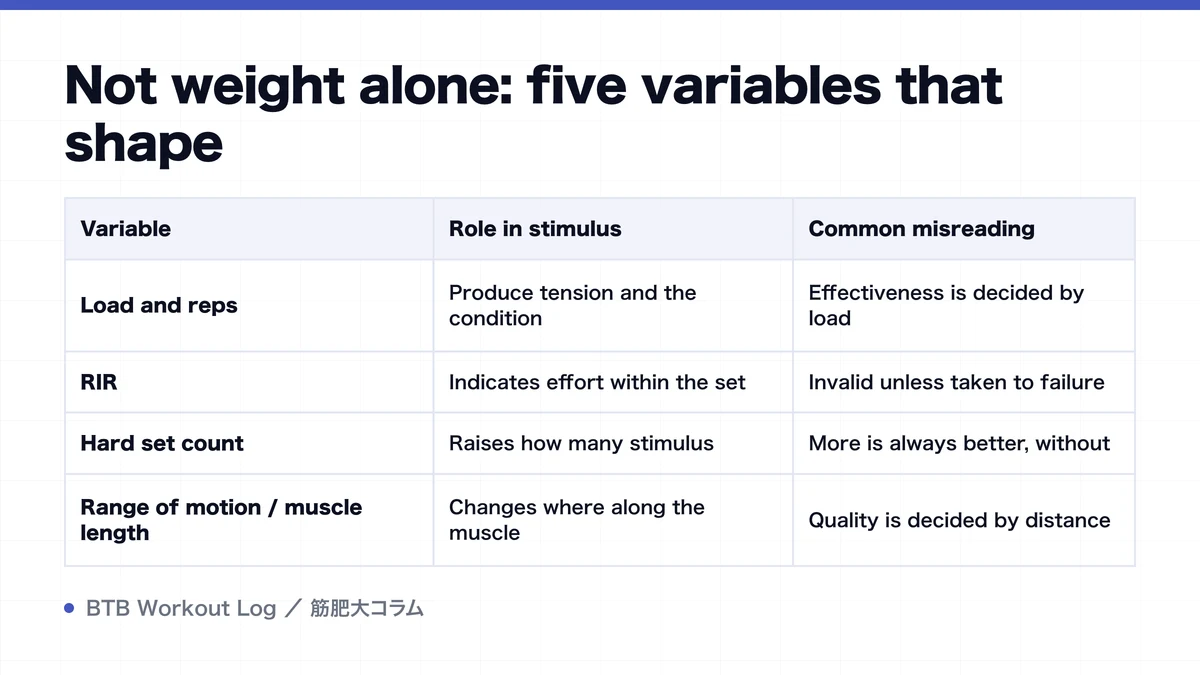
Not weight alone: five variables that shape hypertrophy stimulus
Translating the mechanism into a program means what you manage isn't just "how many kilos you lifted". Each variable acts on a different part of the causal chain.
| Variable | Role in stimulus | Common misreading |
|---|---|---|
| Load and reps | Produce tension and the condition for repeating it | Effectiveness is decided by load alone |
| RIR | Indicates effort within the set | Invalid unless taken to failure |
| Hard set count | Raises how many stimulus opportunities you bank per week | More is always better, without limit |
| Range of motion / muscle length | Changes where along the muscle length tension is applied | Quality is decided by distance moved alone |
| Rest time | Supports next-set output and rep count | Shorter always favors pump, so it's better |
Given sufficient effort, hypertrophy can occur across a wide range of loads. But heavy and light load differ in skill demand, joint stress, breathlessness and set duration, so practicality on a given exercise isn't necessarily equal. Raising set count also raises stimulus opportunities, but raises back-half output decline and recovery cost too. Weekly volume isn't a fixed correct answer to hit — adjust it from volume and how you respond in recovery.
The effective choice is whatever condition lets you consistently apply tension to the target muscle and gradually advance work over several weeks. Even where research shows an average advantage, the range that's workable for you personally shifts with pain, skill, training history, and exercise characteristics.
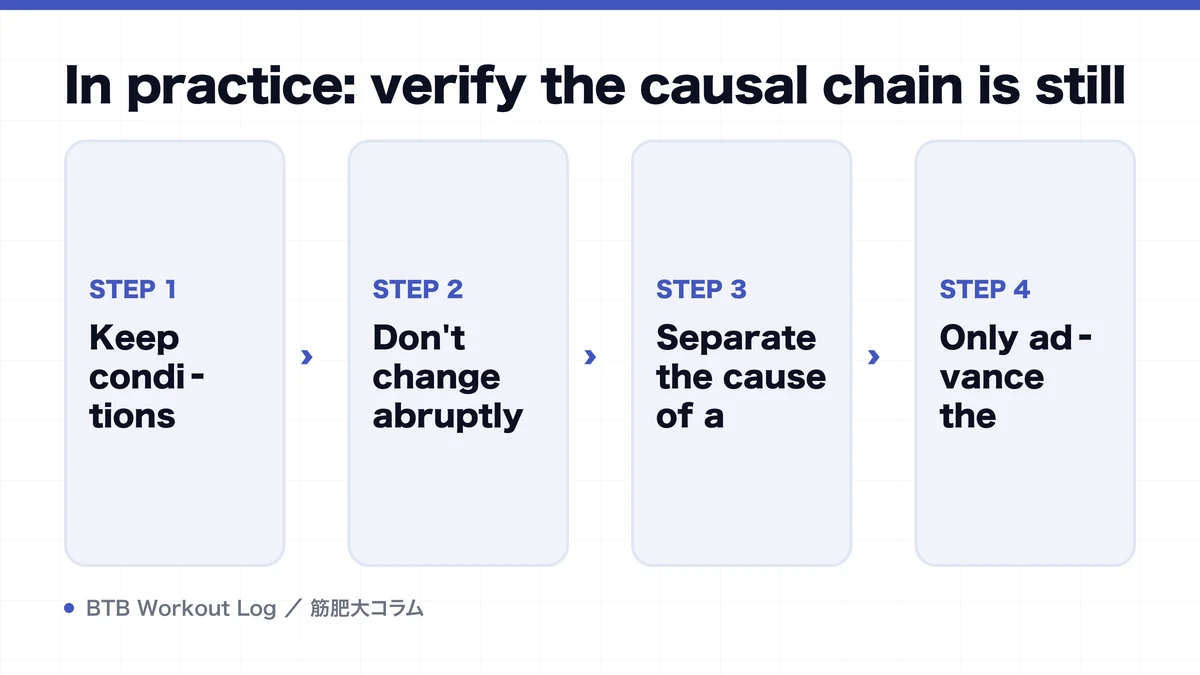
In practice: verify the causal chain is still running, using your log
The path to hypertrophy runs in this order: produce force → tension applies to the muscle fiber → intracellular signaling shifts → muscle protein gets rebuilt → repeated recoverable stimulus thickens the muscle fiber. What you can directly control through training is mainly the initial stimulus and how you repeat it. You can't score the intracellular signal by feel, so track a reproducible input and a long-term output instead.
- Keep conditions matched: log exercise, weight, reps, sets, RIR and range of motion so you have something to compare.
- Don't change abruptly while progressing: if reps or weight are rising at comparable RIR and form, and recovery is keeping pace, the stimulus-and-adaptation cycle is likely working.
- Separate the cause of a stall: if progress stops across several sessions, check fatigue, diet, sleep and any movement-condition change, not just insufficient stimulus.
- Only advance the variable that needs it: if recovery has room, nudge weight, reps, range of motion or set count up by a small amount. This is progressive overload in practice.
Checking whether you advanced the stimulus under matched conditions from last time, and whether weekly volume per muscle group hasn't swung unexpectedly, gives you the material for your next adjustment.
FAQ
- Does muscle still grow from training that doesn't cause soreness?
- Hypertrophy can occur without soreness. Since soreness is also influenced by unfamiliar movement and damage, it can't be used as a stimulus score. Prioritize checking whether load or reps are progressing under matched conditions, and whether you're banking a recoverable weekly volume.
- How soon after training does hypertrophy happen?
- The acute response, including muscle protein synthesis, begins after exercise, but hypertrophy you can confirm through appearance or muscle thickness is the result of stacking multiple recovery cycles. Don't judge from a single session — watch the trend in matched-condition data over weeks to months.
- Do I need to push every set to failure to build muscle?
- Not necessarily. Even just short of the limit, you can apply sufficient tension to the active muscle fibers. Going to failure makes effort unambiguous but also raises fatigue, so weigh that against exercise safety and the effect on later sets.
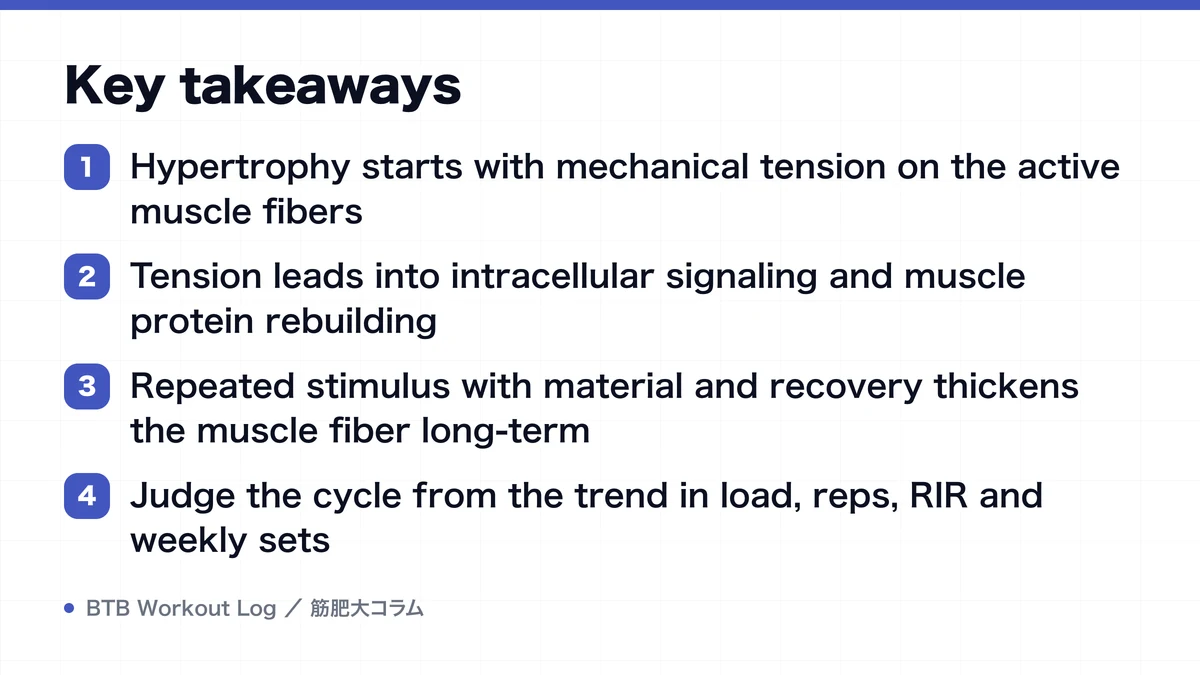
Key takeaways
- Hypertrophy starts with mechanical tension on the active muscle fibers
- Tension leads into intracellular signaling and muscle protein rebuilding
- Repeated stimulus with material and recovery thickens the muscle fiber long-term
- Judge the cycle from the trend in load, reps, RIR and weekly sets
References
- Mechanisms of Muscle Hypertrophy: Current Understanding and Future Directions
- Mixed Muscle Protein Synthesis and Breakdown After Resistance Exercise in Humans
- Muscle Protein Synthetic Response to Resistance Exercise: Systematic Review and Meta-analysis
- Low- vs High-load Resistance Training for Strength and Hypertrophy: Meta-analysis
- Muscle Hypertrophy Is Independent of Load Across Upper and Lower Limbs When Effort Is Matched