RIR and Muscle Growth: How Training Closer to Failure Changes the Stimulus
As RIR drops, you're forced to keep producing force in an increasingly fatigued state, and the tension load spreads across more of the muscle fiber — so stimulus relevant to hypertrophy generally intensifies. But that doesn't mean stimulus suddenly completes at RIR 0, or that effect rises in a straight line the closer you get to 0.
What changes isn't just "how hard it feels" — it's the force remaining, how motor units get used, rep speed, and the fatigue carried into later sets. Understanding this sequence lets you use RIR as a load-setting tool rather than just a subjective score.
RIR isn't weight — it's "distance to that set's limit"
RIR (Reps In Reserve) is an estimate of how many more reps you could do while holding your intended form and range of motion. RIR 3 means 3 reps left; RIR 1 means 1 rep left; RIR 0 means momentary muscular failure — the instant you can't complete the next rep. See the RIR basics for detail, but what matters here is not treating RIR and load used as the same thing.
At the same 80kg, for instance, someone who maxes out at 10 reps stopping at 5 is around RIR 5, while stopping at 9 is around RIR 1. The externally visible weight is the same, but the force remaining at the end of the set differs. Conversely, a heavy set of 3 and a light set of 15 could both end at RIR 1. In other words, RIR isn't "how many kilos you held" — it's a coordinate for how much of your repeated-effort capacity you used at that weight.
The limit here also isn't wherever momentum or a shortened range of motion happens to extend the reps to. Unless you set your stopping point at where your intended movement conditions actually break down, the same recorded RIR won't correspond to matched load on the target muscle.
As reps accumulate, remaining force drops and relative effort rises
Right at the start of a set, the muscle still has a large margin of force. As reps accumulate, the active fibers' contractile capacity temporarily declines, and moving the same weight through the same path gets gradually harder. This is within-set fatigue.
Even though external weight hasn't changed, the ceiling on force you can produce drops rep by rep. So a weight that felt manageable early in the set comes to represent a higher proportion of your remaining capability late in the set. RIR dropping from 5 to 2 to 1 isn't just "you completed more reps" — it's that the work has become heavier relative to the force you currently have left.
Rep speed naturally starting to slow is one external clue to this shift. But since deliberate slow tempo, form breakdown, or breathlessness can also slow speed, "a slow rep" doesn't automatically mean "exactly RIR 1." Don't judge RIR from speed alone — estimate it together with how many reps you've achieved in the past at the same weight and form.
More motor units join the work to sustain force output
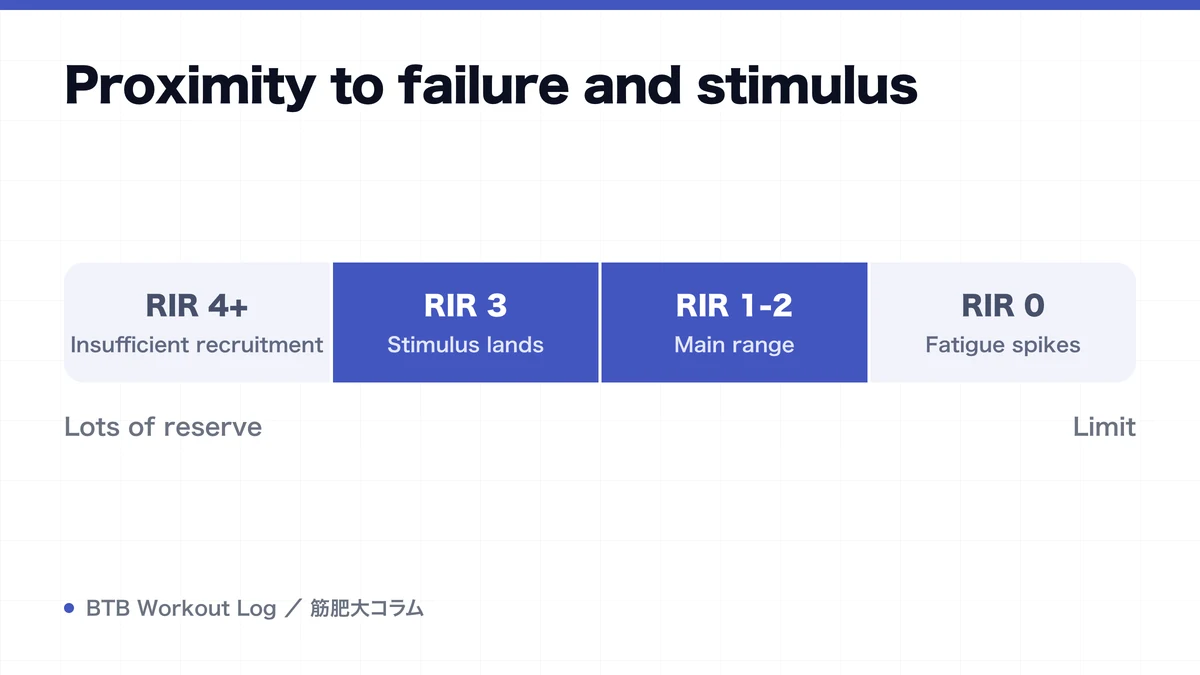
Muscle is controlled by many motor units. In an easy rep, you can produce the needed force using whichever range of motor units suffices. But once the fibers that were already working fatigue and struggle to sustain the same force, the body compensates against the external load — recruiting motor units that weren't yet sufficiently involved, or adjusting the firing of units already working.
As a result, it's thought that the range of fibers bearing tension under high effort widens as RIR drops. Mechanical tension is one central factor explaining hypertrophy, and proximity to failure draws attention not because of the discomfort itself, but because it works toward increasing the number of fibers that experience sufficient tension.
It isn't appropriate here to draw a line saying "only the last few reps count, and everything before is worthless." At heavy load, many motor units are needed from early on; at light load, involvement tends to widen as fatigue accumulates — the process shifts by load. Even using the same RIR at heavy vs. light load, rep count, local fatigue and breathlessness won't be the same.
RIR 0 isn't a special switch — it's the endpoint where stimulus and fatigue meet
Bringing a set that was far from the limit closer to it can raise the number of fibers involved in the stimulus. But pushing an already-close set from RIR 1 to 0 doesn't necessarily add stimulus by the same margin. Research summarizing the relationship between proximity to failure and hypertrophy hasn't shown evidence that momentary muscular failure beats non-failure training, suggesting the relationship may be non-linear.
Fatigue, in contrast, tends to become more visible the closer you get to the end. Going to RIR 0 confirms you used up that set's output, but it also raises next-set rep decline and difficulty holding form. What matters here isn't declaring "RIR 0 is bad" — it's weighing whether the information or stimulus gained from that last rep is worth the quality lost afterward. Research on failure training as a whole doesn't strongly support that every set needs to reach failure for hypertrophy.
So it fits reality better to use RIR as a dial that allocates stimulus against fatigue, rather than as an on/off switch for stimulus. A set taken to the limit is one option, but it can't be evaluated apart from your total weekly workload.
The same RIR means something different depending on exercise, load and what ended the set
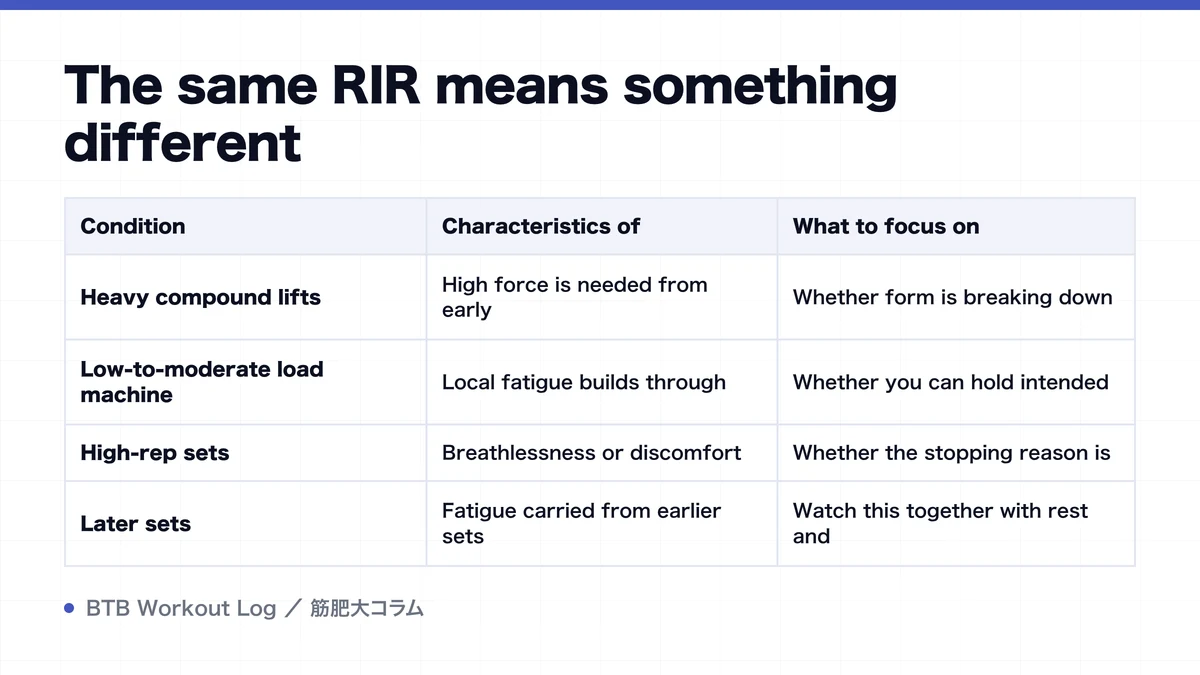
| Condition | Characteristics of lowering RIR | What to focus on |
|---|---|---|
| Heavy compound lifts | High force is needed from early on; technical breakdown and whole-body fatigue also increase | Whether form is breaking down before the target muscle reaches its limit |
| Low-to-moderate load machine exercises | Local fatigue builds through reps, making it easier to approach the target muscle's limit | Whether you can hold intended movement conditions safely |
| High-rep sets | Breathlessness or discomfort tends to stop you before the muscle's true limit | Whether the stopping reason is actually declining muscle output |
| Later sets | Fatigue carried from earlier sets lowers actual RIR even at the same weight/reps | Watch this together with rest and rep decline |
So "standardizing every exercise to RIR 1" doesn't standardize the stimulus. RIR 1 on squats, where breathing and posture break down first, and RIR 1 on leg extensions, where the quads themselves can't complete another rep, differ in what actually decided the stopping point. Likewise, if apparently lower RIR from short rest between sets is really just lost reps from carried-over fatigue, you haven't necessarily raised high-quality reps for the week as a whole.
When comparing RIR, match exercise, range of motion, tempo, rest and set order as closely as possible. RIR isn't a universal scale that converts different conditions into one number — it only gains judgment power once conditions are matched.
Work backward to your target RIR from later sets and next-time progress
In practice, starting technically demanding compound lifts at RIR 2–3 and stable machine or single-joint exercises at RIR 1–2 makes stimulus and fatigue easier to observe. This is a starting setup, not a fixed prescription. Occasionally taking the final set of a safe exercise to RIR 0 is useful material for calibrating your own RIR estimate, but it doesn't need to happen every time.
When to lower RIR by one step
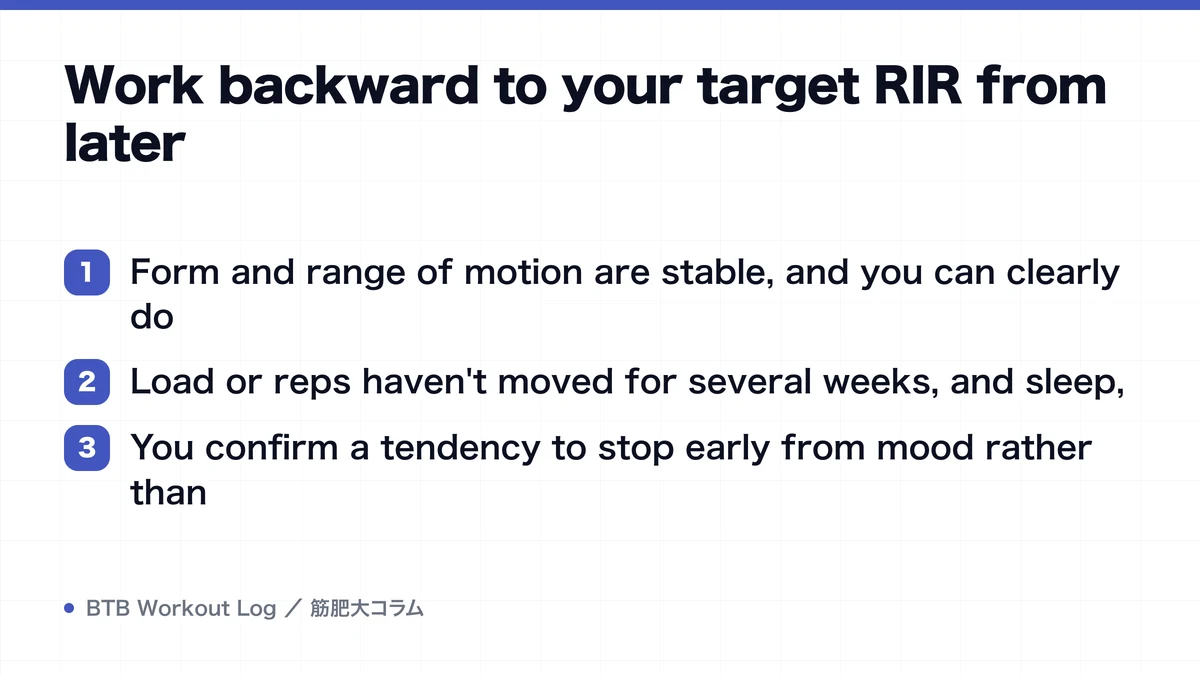
- Form and range of motion are stable, and you can clearly do more reps than your reported RIR suggests
- Load or reps haven't moved for several weeks, and sleep, nutrition and weekly set count aren't clearly the issue
- You confirm a tendency to stop early from mood rather than the target muscle
When to raise RIR by one step
- An early failure set substantially tanks later-set reps
- Output decline persists through the next matched-condition session
- Posture, joint discomfort, or an assisting muscle ends the set before the target does
Judging this needs more than just "weight × reps" — log each set's RIR, order, rest and movement conditions too. Adjust by watching not RIR alone but whether you can keep repeating progress under matched conditions.
The choice between a failure set and a set that leaves RIR isn't decided by how satisfying one set felt — it's decided by how many recoverable, high-quality sets you can repeat across the whole week. Proximity to failure is an important variable, but it isn't a simple dial where closer is always better.
FAQ
- Does a lower RIR always mean higher hypertrophy effect?
- Bringing a set that was far from the limit closer can strengthen stimulus, but going from RIR 1 to 0 doesn't necessarily add the same margin of effect. Treat the relationship as non-linear, and judge it alongside the fatigue cost — including output decline in later sets and next time.
- For hypertrophy, should every set be standardized to RIR 1–2?
- No need to standardize uniformly. Technically demanding compound lifts tend to work better with more reserve; stable machines or single-joint exercises tend to work better pushed closer to the limit. Adjust by exercise, load, set order, and recovery status.
- Is there a way to check whether my RIR estimate is accurate?
- Keep continuous records of load and reps at the same form and range of motion, and cross-check your reported RIR against next time's result. Occasionally taking a safe machine exercise to true failure and comparing predicted remaining reps against the actual count also works for calibration.
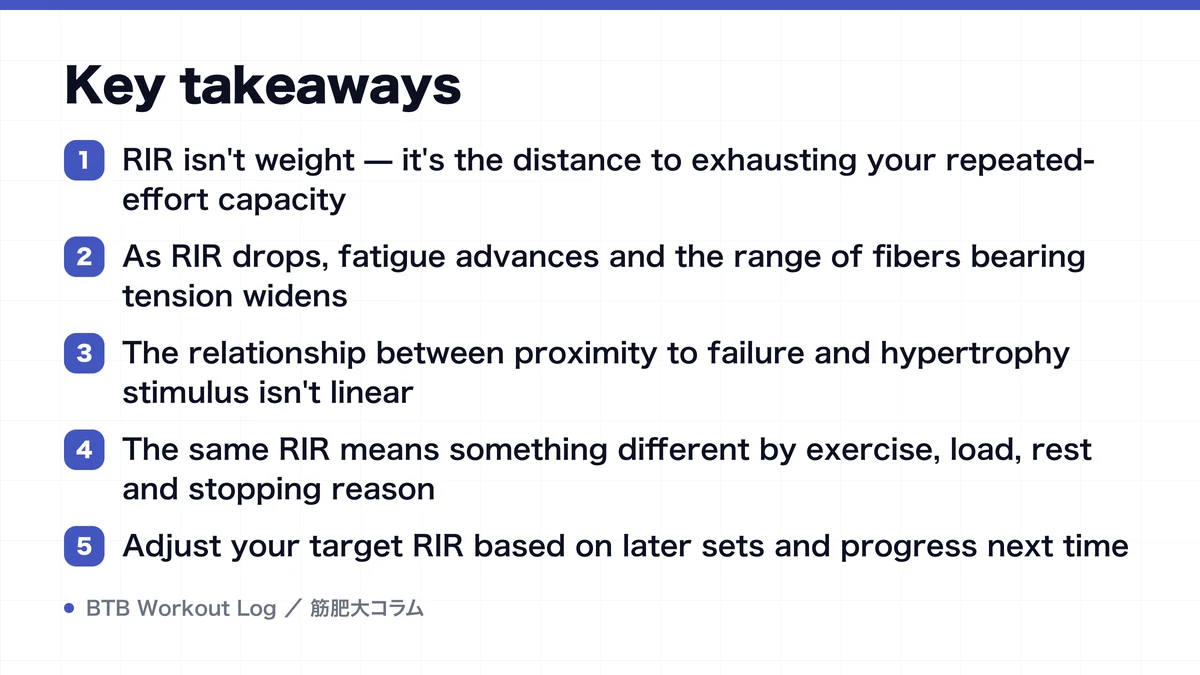
Key takeaways
- RIR isn't weight — it's the distance to exhausting your repeated-effort capacity
- As RIR drops, fatigue advances and the range of fibers bearing tension widens
- The relationship between proximity to failure and hypertrophy stimulus isn't linear
- The same RIR means something different by exercise, load, rest and stopping reason
- Adjust your target RIR based on later sets and progress next time
References
- Proximity-to-Failure and Muscle Hypertrophy: Systematic Review with Meta-analysis
- Training to Repetition Failure or Non-failure: Systematic Review and Meta-analysis
- Repetitions in Reserve Is a Reliable Tool for Prescribing Resistance Training Load
- The Mechanisms of Muscle Hypertrophy and Their Application to Resistance Training