The Complete Guide to Deloading | For Lifters Afraid to Rest: How to Set Frequency, Duration, and Load
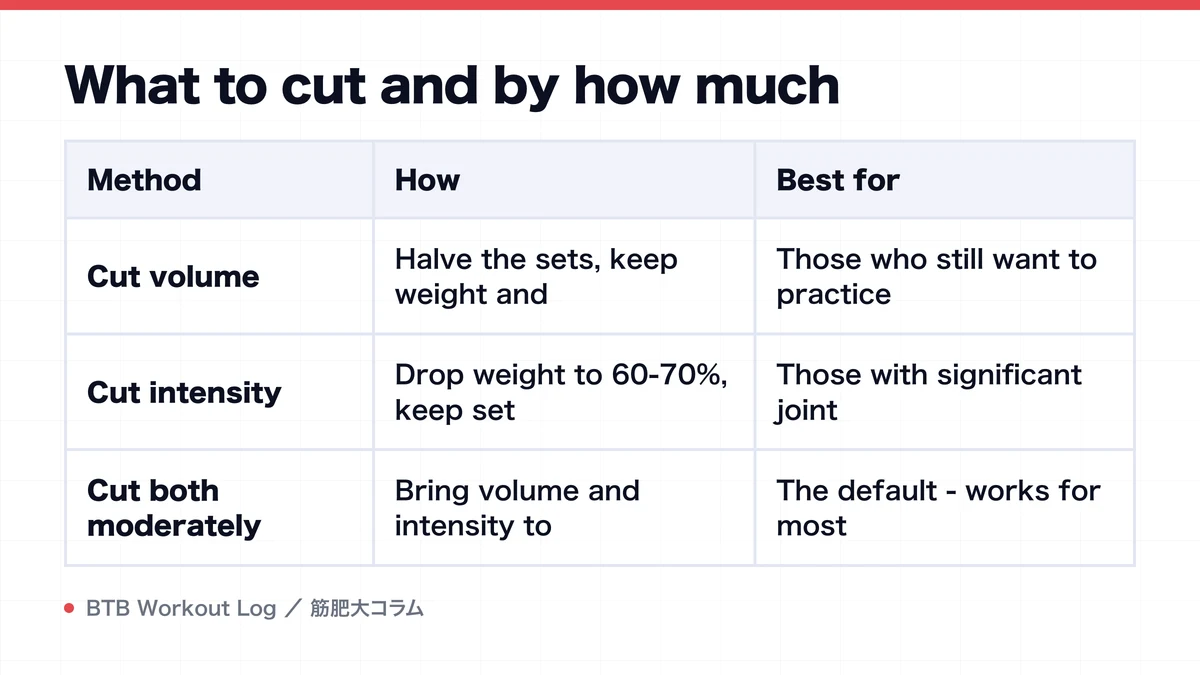
A deload is a planned recovery week where you dial back your training load to drain accumulated fatigue. As a rough guide, reduce volume or intensity by roughly half every 4-8 weeks, and your progress will bounce back stronger.
"Taking it easy kills your gains" is wrong. Uncleared fatigue is what actually causes plateaus and injuries.
What a deload is and why you need one
Training creates stimulus through fatigue, and recovery turns that fatigue into growth. But as you stack hard weeks together, fatigue accumulates faster than it clears, and at some point you can no longer express your actual strength - performance plateaus. A deload is a deliberate reduction in load that clears the accumulated fatigue and lets your accumulated adaptations finally surface. After a deload, you'll find that topping your pre-deload numbers comes quickly. One week of lighter training will not cost you any meaningful muscle mass.
When to deload (the signs to watch for)
The rough guideline is every 4-8 weeks, but your body's signals matter more than a calendar. Take a deload when several of these show up at once:
- Your usual weights or reps drop below last session
- Joints and tendons feel chronically tight or achy
- Sleep quality, appetite, or motivation noticeably decline
- Even the warm-up sets feel heavy
Your log will often spot it before you do - two consecutive sessions where weights dropped is an objective deload signal.
What to cut and by how much
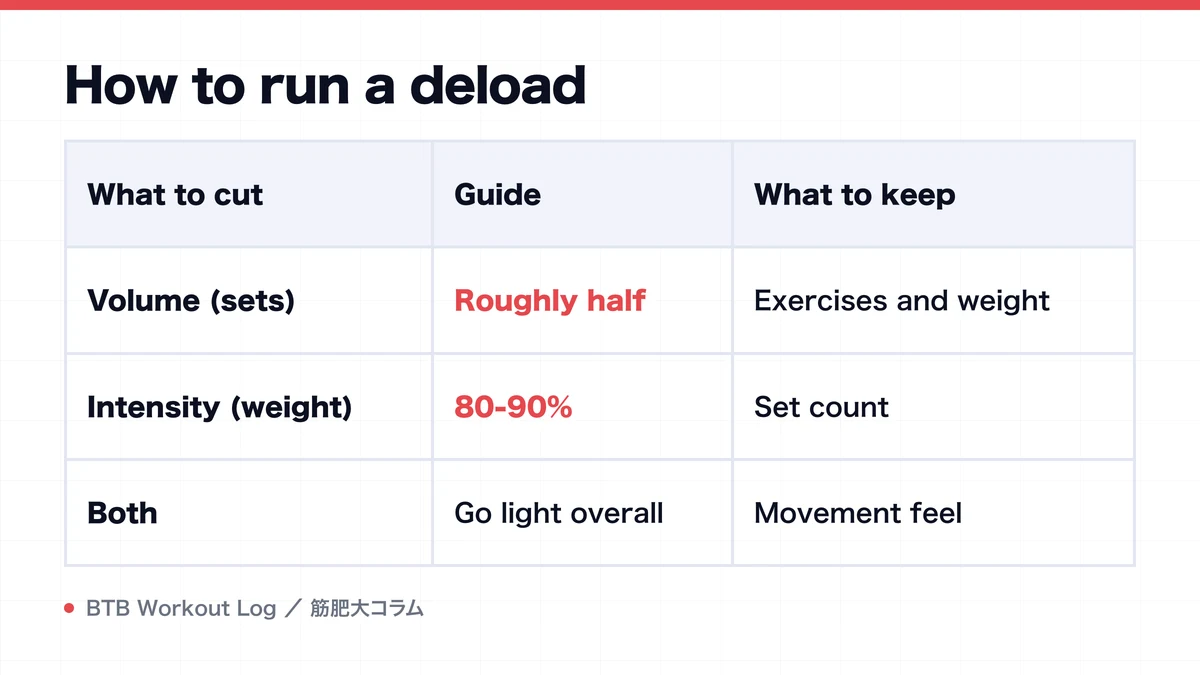
| Method | How | Best for |
|---|---|---|
| Cut volume | Halve the sets, keep weight and reps the same | Those who still want to practice the movement patterns |
| Cut intensity | Drop weight to 60-70%, keep set count the same | Those with significant joint soreness |
| Cut both moderately | Bring volume and intensity to about 70% | The default - works for most people |
Complete rest isn't necessary or ideal. Light movement keeps blood flow up, skill stays sharp, and it's easier psychologically to return to full training.
How to train after the deload
After a deload, restart from your pre-deload weights and reps rather than testing a new max immediately. With fatigue cleared, the same numbers will feel noticeably lighter, and most people find they push past their previous best within 1-2 weeks. For that return to work, you need to know where you left off - which means your log matters both going into and coming out of a deload. Run deloads as a planned part of your training cycle, not as something you only do when things break down (programming guide).
FAQ
- Will I lose muscle during a deload?
- Not meaningfully. One week of reduced training does not cause muscle loss. What actually kills gains is the plateau and injury risk that come from never clearing your fatigue. Fear of losing gains is the wrong thing to worry about.
- How often should I deload?
- Every 4-8 weeks is the general guideline, but be responsive to your body. The more intense your training, the more frequently you'll need one. If your log shows two consecutive weeks of dropping weights, that's your cue.
- What if I feel fine? Do I still need to deload?
- If you genuinely feel good and your numbers are rising, you can push the deload back by 1-2 weeks. But fatigue can be deceptive - it often shows up as a performance drop in your log before you feel it subjectively. If the numbers start dipping, deload proactively rather than reactively.
Key takeaways
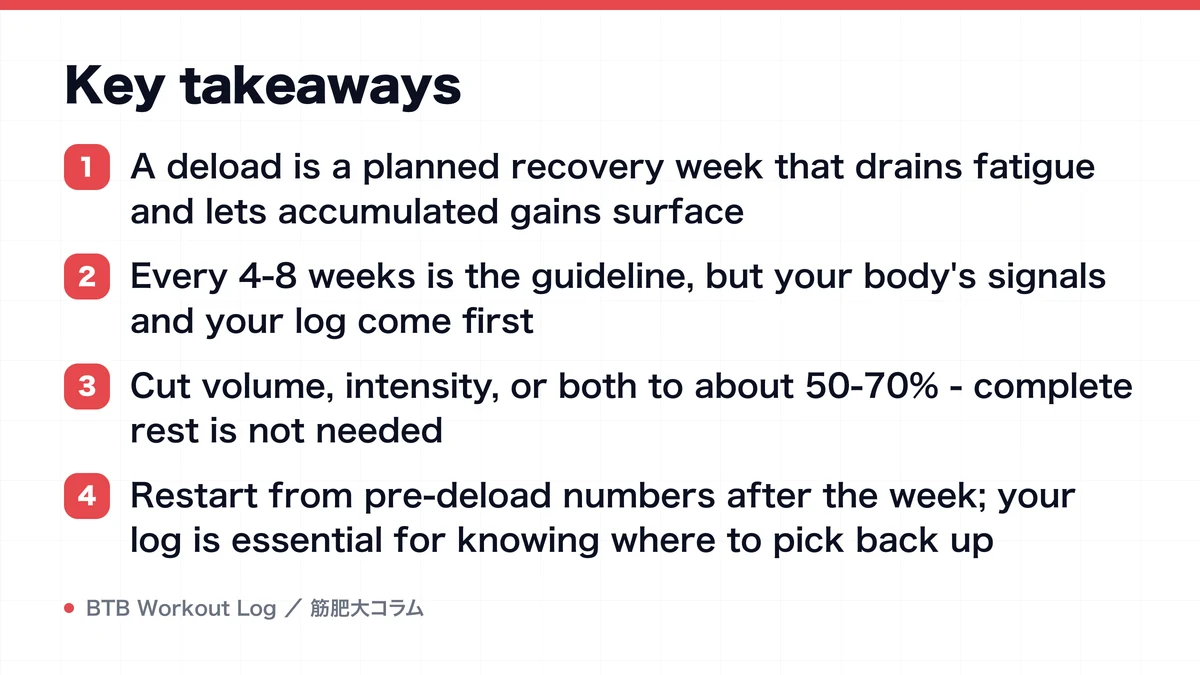
- A deload is a planned recovery week that drains fatigue and lets accumulated gains surface
- Every 4-8 weeks is the guideline, but your body's signals and your log come first
- Cut volume, intensity, or both to about 50-70% - complete rest is not needed
- Restart from pre-deload numbers after the week; your log is essential for knowing where to pick back up
References
- Periodization, Strength and Muscle Hypertrophy: Systematic Review and Meta-analysis
- ACSM Position Stand: Progression Models in Resistance Training for Healthy Adults
- Mixed Muscle Protein Synthesis and Breakdown After Resistance Exercise in Humans
- Muscle Protein Synthetic Response to Resistance Exercise: Systematic Review and Meta-analysis