Why a Calorie Deficit Makes Hypertrophy Harder | Why Training Doesn't Always Pay Off While Cutting
A calorie deficit doesn't make hypertrophy harder because the material for building muscle suddenly disappears. It's because the body shifts into a state that fills its energy gap, making it harder both to net-increase muscle protein and to repeat high-quality training.
Calorie balance isn't an on/off switch for hypertrophy — it's a condition that makes growth easier or harder to sustain. We'll trace where the constraint actually lands, from the balance inside the muscle to weekly performance.
Hypertrophy happens when synthesis outpaces breakdown
Muscle protein isn't a fixed structure — it's constantly being synthesized and broken down. Over a long enough window, if muscle protein synthesis outpaces breakdown and that gap accumulates, the fiber gets bigger. Resistance training is the trigger that raises the synthesis side; dietary protein supplies the material for new tissue. See what happens inside the muscle after eating protein for the detailed synthesis response.
But sufficient protein doesn't mean calorie balance can be ignored. Synthesizing protein, repairing damaged tissue, restoring glycogen, and whole-body recovery for the next session all involve energy. A calorie deficit is a state where intake over a given period falls below expenditure. The gap gets filled mainly from stored energy like body fat, so one day's deficit alone doesn't stop muscle synthesis.
What matters is whether you can sustain the cycle — training stimulus → muscle protein remodeling → sufficient stimulus again after recovery — for weeks on end. The larger or longer the deficit, the more the body tends to allocate resources toward filling that gap rather than toward gaining weight. That's why the room to net-increase muscle shrinks.
In a state of filling a gap, it's harder to bank muscle protein
After resistance exercise, muscle protein synthesis rises above resting levels, and that response can continue past 24 hours. But an acute synthesis response occurring and muscle actually being up weeks later aren't the same thing. The balance — including every round of synthesis and breakdown — needs to stay net positive over the long term.
In a calorie deficit, the body mobilizes stored tissue to cover the gap while also funding basal metabolism, body temperature, daily activity, training, and recovery. A post-training synthesis response can still occur in this state, but the conditions for continuing to add new tissue are less favorable compared to an energy-replete state. This is why the deeper the deficit, the more preserving existing tissue becomes the realistic goal rather than adding muscle.
It's not quite accurate to think "calories become the material for muscle." The core material is amino acids — calories support the environment that lets that material get used for remodeling. So sufficient protein is necessary, but it can't fully offset a large energy deficit on its own. Evaluate total calories and protein together, not as separate factors.
A calorie deficit also constrains growth right at training's entry point
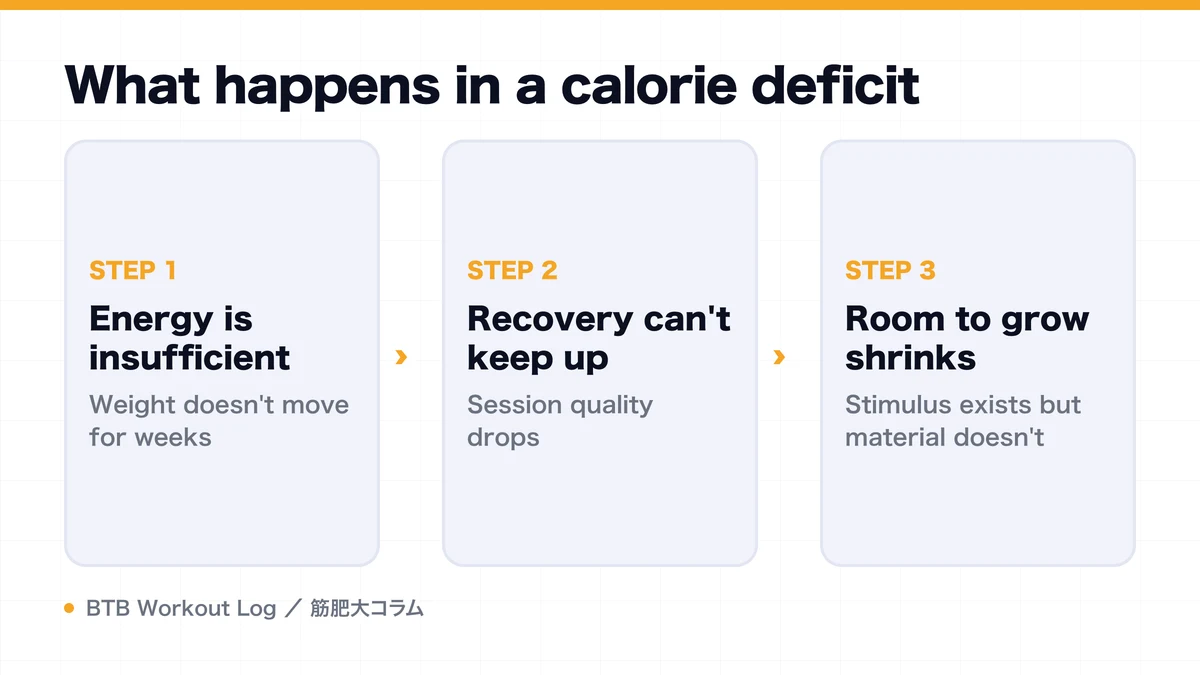
The impact on hypertrophy doesn't end at synthesis within the muscle. Sustained low intake, depending on diet composition and training volume, can make it harder to fully restore muscle glycogen, lowering session output and between-set recovery. A calorie deficit isn't the same as low-carb, but the more limited your total intake, the less room there is to allocate carbohydrate around training.
The causal chain runs: insufficient energy intake → lower recoverable workload → fewer reps or high-quality sets at the same weight → lower stimulus banked for the week. For example, even stopping at the same RIR 2 — 2 reps of reserve before the limit — an exercise that was 100kg for 8 reps before cutting might drop to 6, and if that persists over several weeks, the work delivered to the muscle has shrunk.
You can't declare a calorie deficit from one off session alone. Sleep, stress, exercise order and rest time all shift reps too. And losing body weight can actually raise reps on bodyweight exercises. What to judge from is how weight and reps at the same exercise, range of motion, rest and RIR move over several weeks. This idea of matching comparison conditions is shared with managing progressive overload.
Some people growing muscle in a deficit isn't a contradiction
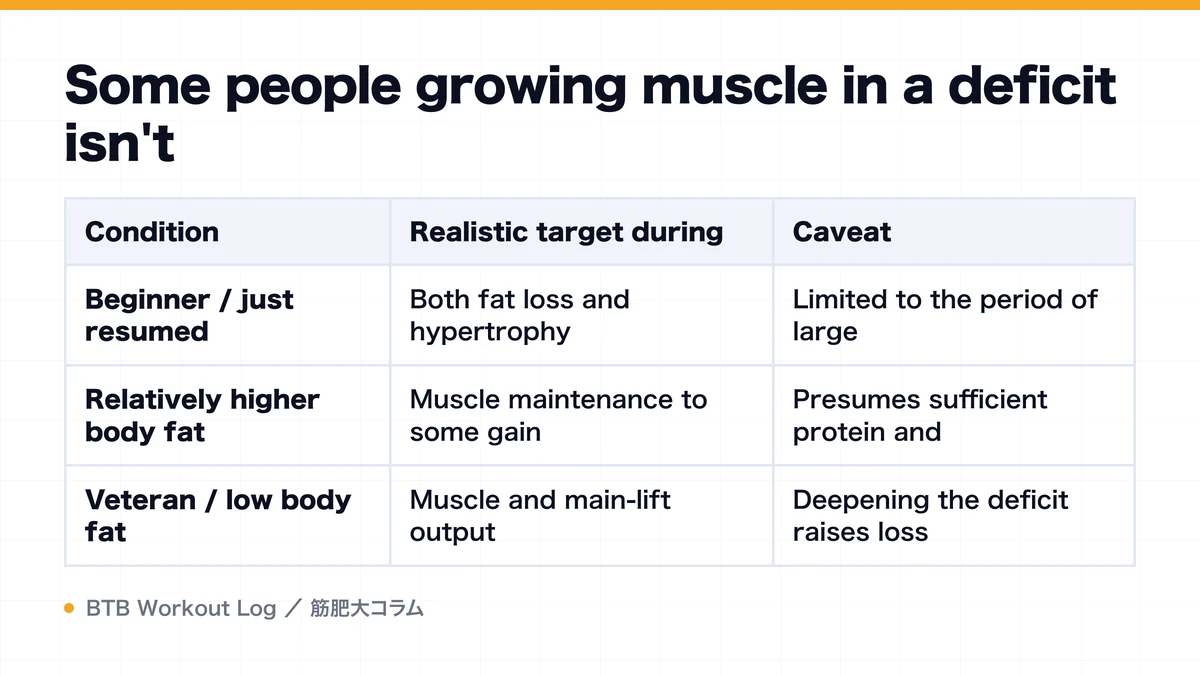
A calorie deficit isn't an absolute condition that makes hypertrophy impossible. For training beginners, people returning from a long break, people who were under-trained before, or people with more available body fat, resistance training's new stimulus can be large enough that they can still gain muscle while using stored energy — so-called body recomposition, losing fat while raising lean mass.
Conversely, the longer your training history, the lower your body fat, and the closer your ongoing stimulus is to your current muscle mass, the smaller the room for new hypertrophy. This is why the same deficit size produces different results for a beginner versus a veteran, or someone with high versus low body fat. An experienced lifter maintaining muscle during a cut, and a beginner gaining muscle during a cut, shouldn't be treated as the same condition.
| Condition | Realistic target during a cut | Caveat |
|---|---|---|
| Beginner / just resumed | Both fat loss and hypertrophy | Limited to the period of large new stimulus |
| Relatively higher body fat | Muscle maintenance to some gain | Presumes sufficient protein and resistance training |
| Veteran / low body fat | Muscle and main-lift output maintenance | Deepening the deficit raises loss risk |
Note too that early-cut lean-mass decline also mixes in muscle glycogen and its accompanying water loss. Don't declare muscle loss from a short-term body-composition scan alone — watch the multi-week average of body weight, measurements, photos, and training results together.
The same stall calls for a different verdict during a bulk vs. a cut
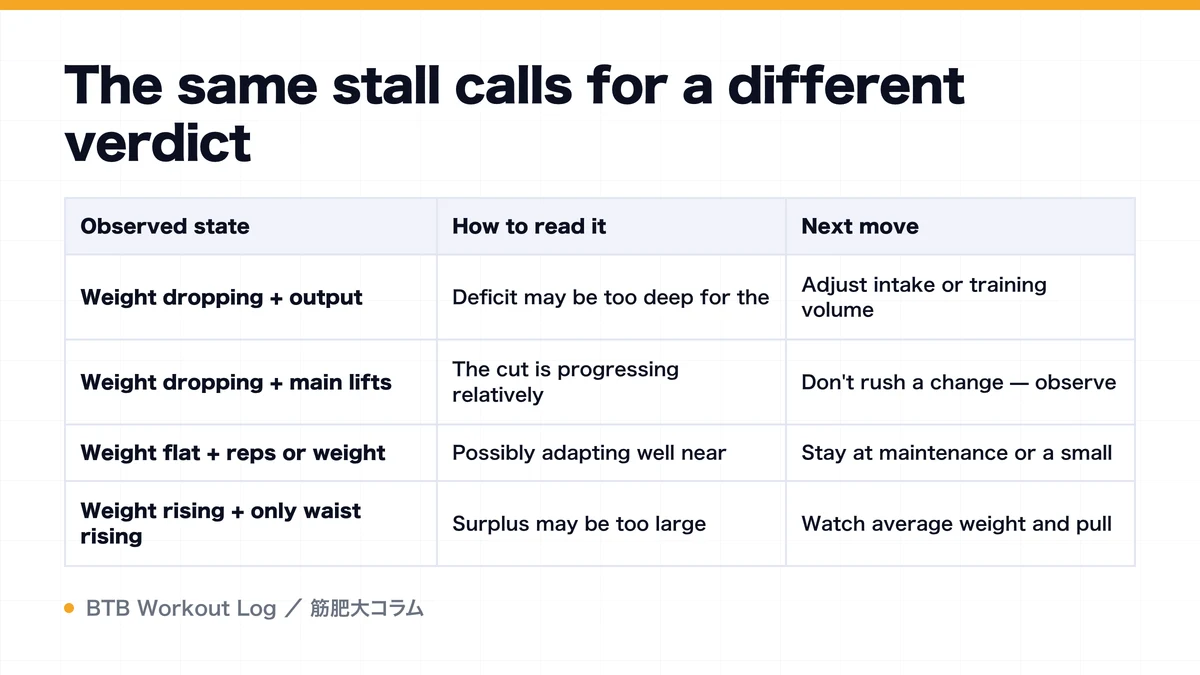
Whether to raise intake should be worked backward from your current goal. If hypertrophy is the top priority but body weight keeps falling and main-lift weight or reps are dropping too, a calorie deficit is a candidate for correction. Return toward maintenance, or shift to a small surplus, and reassess body weight and performance. See how to think about bulking calories for deciding the surplus.
If fat loss is the top priority, you don't need to keep beating personal bests during a cut. Hold main-lift weight and form as steady as possible, and if needed, trim high-fatigue accessory exercises or set count a little. The deeper the deficit and the faster the weight loss you're pushing for, the harder it gets to protect training output and lean mass — so a slower pace tends to be easier to manage, especially for someone already at low body fat.
| Observed state | How to read it | Next move |
|---|---|---|
| Weight dropping + output declining, ongoing | Deficit may be too deep for the goal | Adjust intake or training volume by a small amount |
| Weight dropping + main lifts holding | The cut is progressing relatively well | Don't rush a change — observe under the same conditions |
| Weight flat + reps or weight improving | Possibly adapting well near maintenance | Stay at maintenance or a small surplus, depending on hypertrophy priority |
| Weight rising + only waist rising fast | Surplus may be too large | Watch average weight and pull intake back slightly |
Whether during a bulking diet or a cutting diet, a calculator app's expenditure estimate is only a hypothesis. Your actually measured body-weight trend and training results are what checks that hypothesis against reality.
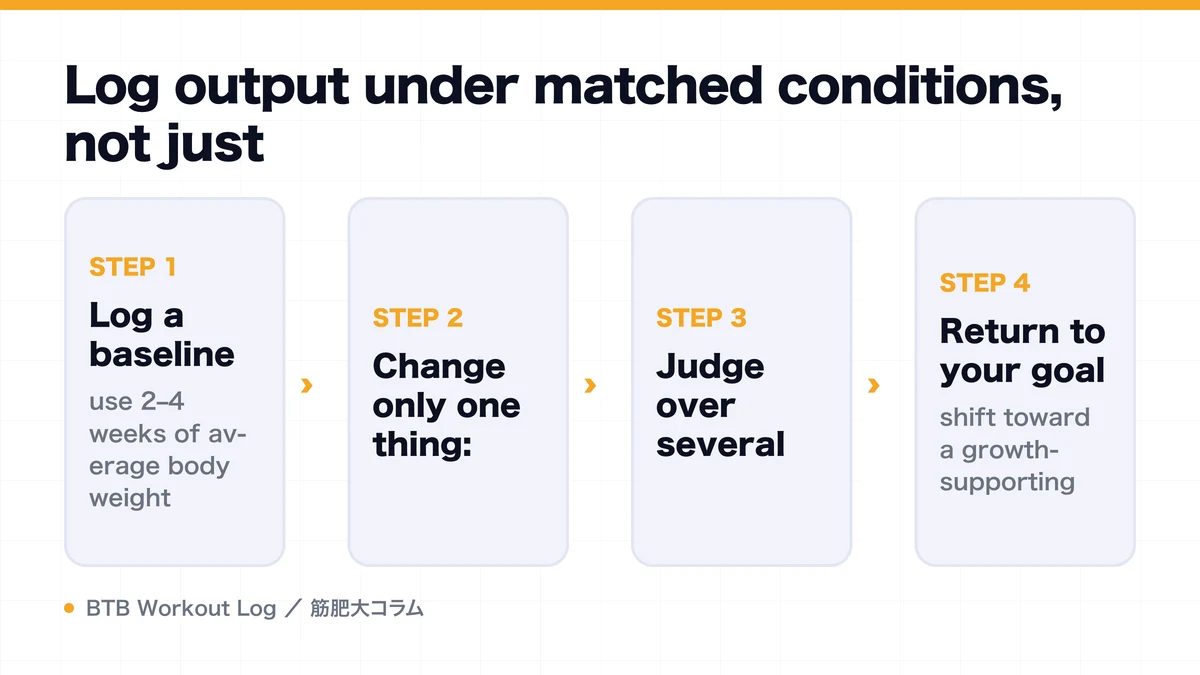
Log output under matched conditions, not just body weight
To identify the effect of a calorie deficit, weigh yourself in the morning under as-matched conditions as possible and watch the 7-day-average trend. Layer main-lift weight, reps and RIR, plus weekly hard sets per body part, on top of that. Since poor sleep also lowers output, separate out sleep loss and performance for any week sleep changed substantially.
- Log a baseline: use 2–4 weeks of average body weight and main-lift set records as your reference.
- Change only one thing: during a week you adjust intake, don't also change exercise, rest, and RIR at the same time.
- Judge over several weeks: watch body-weight direction and whether matched-condition weight/reps recovered.
- Return to your goal: shift toward a growth-supporting balance if hypertrophy is the priority, or protect maintainable output if fat loss is.
Comparing the same exercise's trend before and after a diet change turns "I'm anxious because I'm losing weight" into a concrete judgment about whether stimulus is being maintained.
What a calorie deficit first costs isn't necessarily muscle itself. Room to bank synthesis, recoverable workload, and the output you can reproduce next session all narrow bit by bit. Once that continues, hypertrophy slowdown or difficulty maintaining muscle mass shows up — which is why tracking body weight and training records together matters.
FAQ
- Can hypertrophy still occur in a calorie deficit?
- Yes. Beginners, people returning to training, and people with relatively more body fat can gain muscle while using stored energy. But it gets harder the more experienced and lower-body-fat you are, and the deeper the deficit, the more maintaining muscle mass becomes the realistic goal.
- Can eating more protein offset a calorie deficit?
- Sufficient protein matters for preserving muscle during a cut, but it doesn't fully cancel out a large energy deficit. Consider it together with training that protects main-lift output, a non-excessive rate of weight loss, and sleep.
- How do I judge whether calories are insufficient?
- Don't decide from one day's meals or one off session. If your 2–4-week average body weight is falling and weight or reps keep declining too at the same exercise, range of motion, rest and RIR, consider that intake may be too low for your goal.
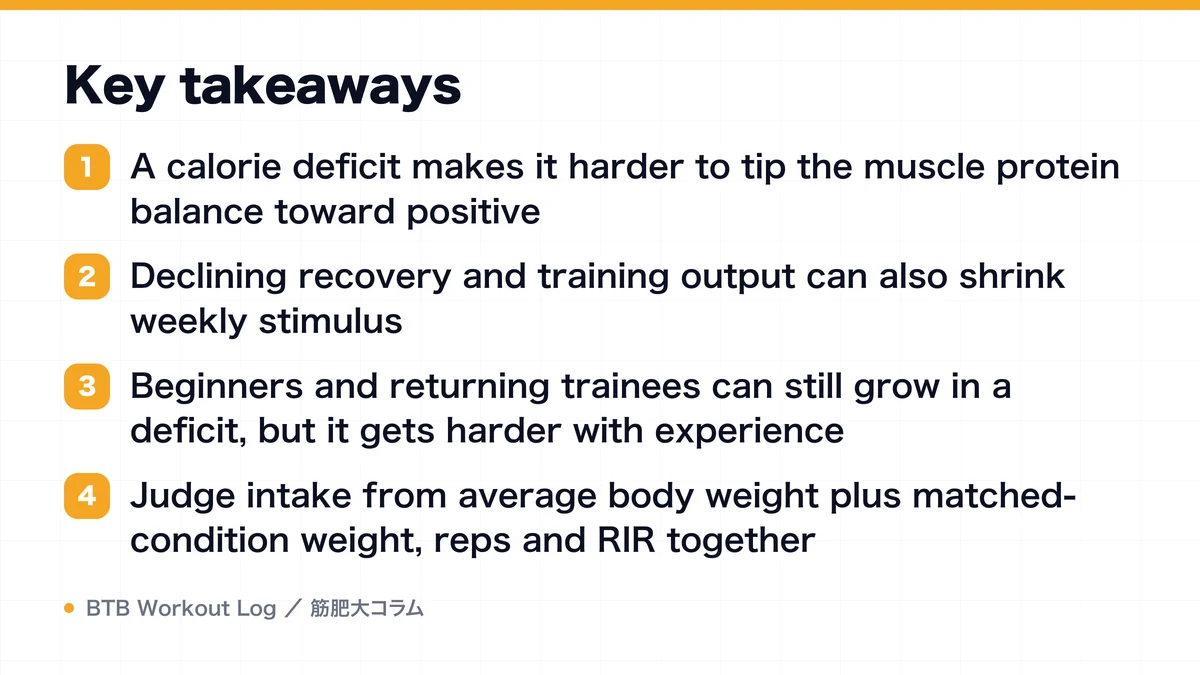
Key takeaways
- A calorie deficit makes it harder to tip the muscle protein balance toward positive
- Declining recovery and training output can also shrink weekly stimulus
- Beginners and returning trainees can still grow in a deficit, but it gets harder with experience
- Judge intake from average body weight plus matched-condition weight, reps and RIR together