
How Many Rest Days Does Hypertrophy Need? | Are You Overresting Because of "Supercompensation"? Recovery Times by Muscle Group
48-72 hours between sessions for the same muscle is a manageable rough guide. But this is not a timetable that guarantees recovery is complete - it is a starting point for distributing the sets you need in a week while keeping their quality.
Training is the process that applies the stimulus, and adaptation mainly progresses during the recovery period that follows. Don't decide where to place rest days on time alone; judge it together with whether you can reproduce your weights and reps in the next session.
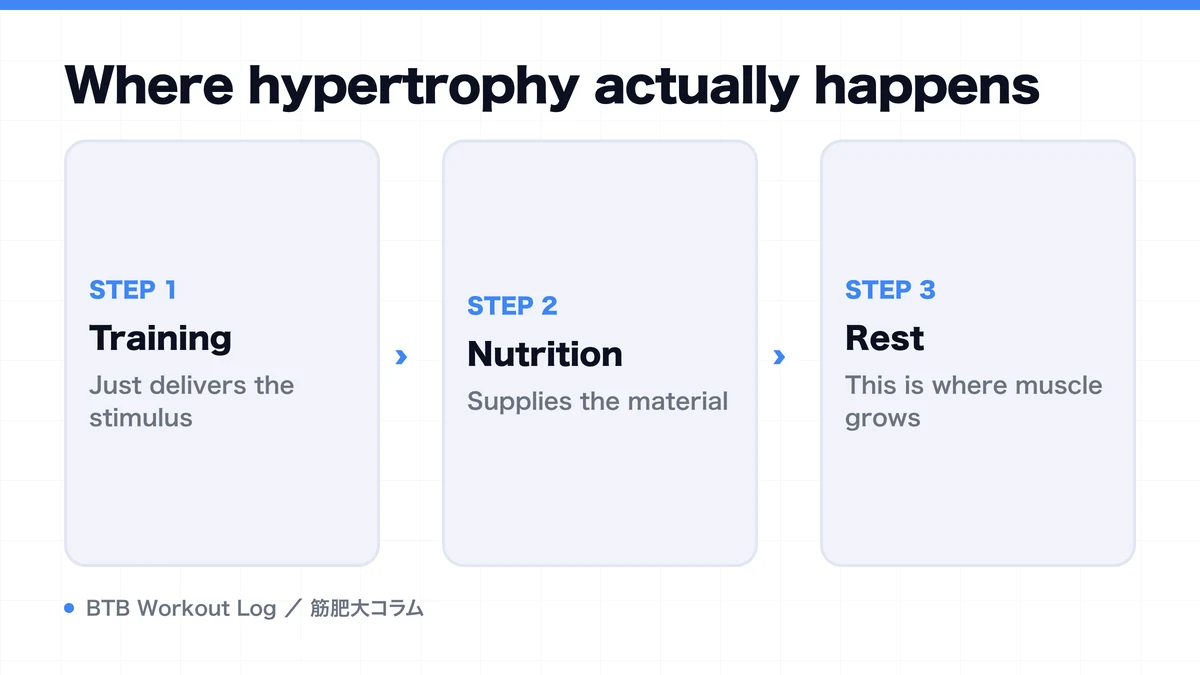
Muscle growth happens in the recovery phase
Training is just the trigger: it stimulates muscle fibers and causes microscopic damage. Muscle protein synthesis and growth happen during the recovery phase that follows, supported by adequate rest and nutrition. Rest isn't slacking off; it's an essential part of turning training into growth. Hypertrophy requires all 3: a stimulus (training), building materials (nutrition), and time (rest).
Your next session tells you more about recovery than the clock does. If you can match your previous reps at the same weight, that muscle group is ready for another stimulus. If you repeatedly need to lower the weight to hit those reps, either your training spacing or volume isn't right for you at the moment. A single session where the same weight feels heavier isn't a concern. Adjust when it becomes a trend over several weeks.
Recovery also happens at different rates across muscle groups. It's normal for your arms to feel fine the day after a hard leg session. A rest day doesn't have to mean taking the whole day off training; it can mean giving a particular muscle group time before you train it again.
How long each muscle group takes to recover
| Muscle group | Estimated recovery time | Time before training again |
|---|---|---|
| Large muscle groups (chest, back, legs) | 48–72 hours | 2–3 full days between sessions |
| Small muscle groups (shoulders, arms) | 24–48 hours | 1–2 full days between sessions |
| Abs, calves | Around 24 hours | Can tolerate high training frequency |
These differences reflect the total workload in each session and how much you use each muscle in daily life. Training large muscle groups involves heavier weights and multiple joints, contributing more to whole-body fatigue even with the same number of sets. Your abs and calves work regularly during walking and maintaining posture. The loads used in isolation exercises for these muscles are also relatively light, making higher training frequencies easier to tolerate.
A practical baseline is therefore to train each muscle group twice a week, with 1–3 full days between sessions, rather than every day (the science of training frequency).
What supercompensation really means
Supercompensation describes a temporary drop in performance after training, followed by recovery to a level above your starting point. It's a useful broad picture, but an oversimplification. Adaptation doesn't follow a neat wave after every workout; it develops through weeks of accumulated training and recovery. Training again before recovery allows fatigue to build, while waiting too long for recovery lets the effect of the stimulus fade. For practical purposes, think of 48–72 hours as the sweet spot between those extremes.
The misleading part of a supercompensation diagram is that it shows one wave for each workout. In practice, the effects of multiple sessions overlap, so you don't need to wait for all fatigue from your last session to disappear. Training again with some fatigue remaining makes it easier to fit in your weekly sets. However, include a deload before that residual fatigue builds to the point where your performance stops returning to its previous level.
Is soreness a guide? How do you know if you're resting too much?
Muscle soreness (DOMS) is not an accurate indicator of recovery or hypertrophy. Strong soreness doesn't mean the session worked well, and no soreness doesn't mean it didn't. It's safer to avoid training while strong soreness remains, but if it's only light tightness you can move on to the next stimulus. Conversely, the signs of resting too much are gaps so long that every session feels like a reset, and not being able to secure your weekly frequency. The most objective way to judge the balance between recovery and stimulus is whether the weights and reps in your log are progressing steadily.
When you want to refine your rest design further
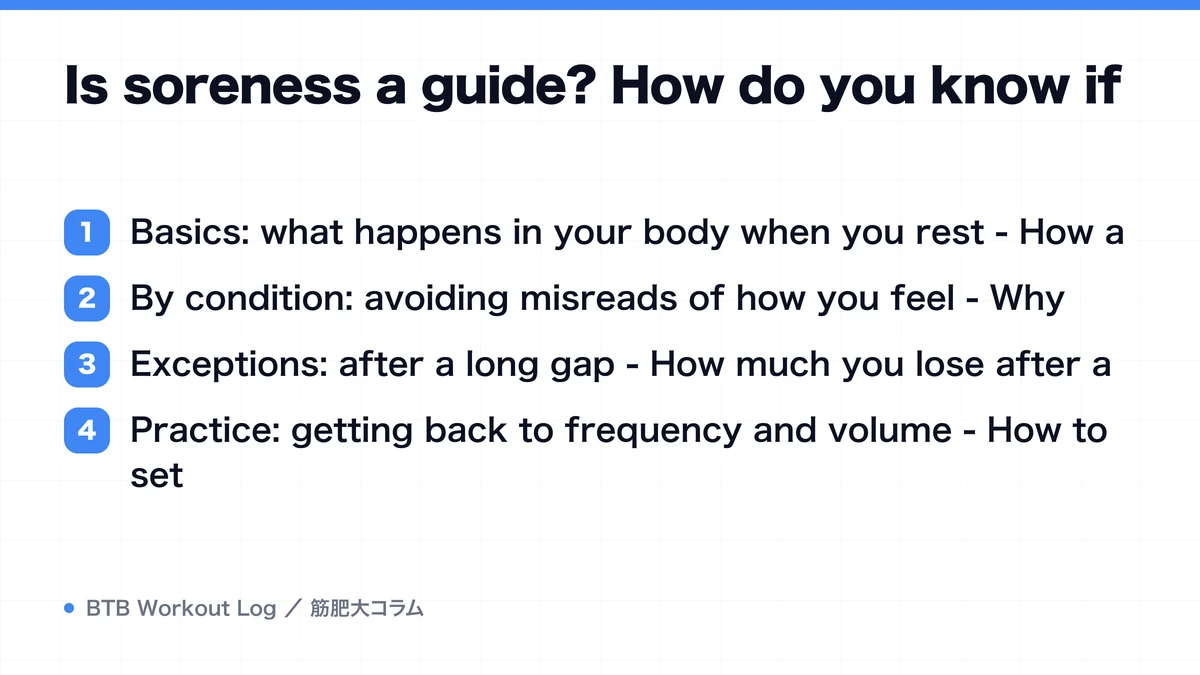
The parts that interval alone can't settle are split by condition in the following articles.
- Basics: what happens in your body when you rest - How a deload brings recovery back / How long it takes sleep loss to show up in training
- By condition: avoiding misreads of how you feel - Why hypertrophy happens without soreness / Why yesterday's weight feels heavy today
- Exceptions: after a long gap - How much you lose after a week off / When muscle starts to decline once you stop
- Practice: getting back to frequency and volume - How to set frequency per muscle group / How to distribute weekly sets
FAQ
- Should I skip training if I'm sore?
- Severe soreness in a muscle is a reason to avoid working it directly. Mild tightness is not. DOMS isn't a reliable recovery indicator, so judge by whether you can actually perform the lift, not purely by how sore you feel.
- Can I train every day if I work different muscles each session?
- Yes, if each muscle group gets adequate rest between its sessions. Keep in mind that systemic fatigue accumulates regardless of which muscles you target, so one complete rest day per week and occasional deloads when fatigue builds up are good practice.
- Is complete rest on recovery days better than light activity?
- Active recovery - light cardio, stretching, a walk - promotes blood flow and can actually speed recovery. You don't need to stay on the couch. Just avoid high-intensity resistance training on those days.
Key takeaways
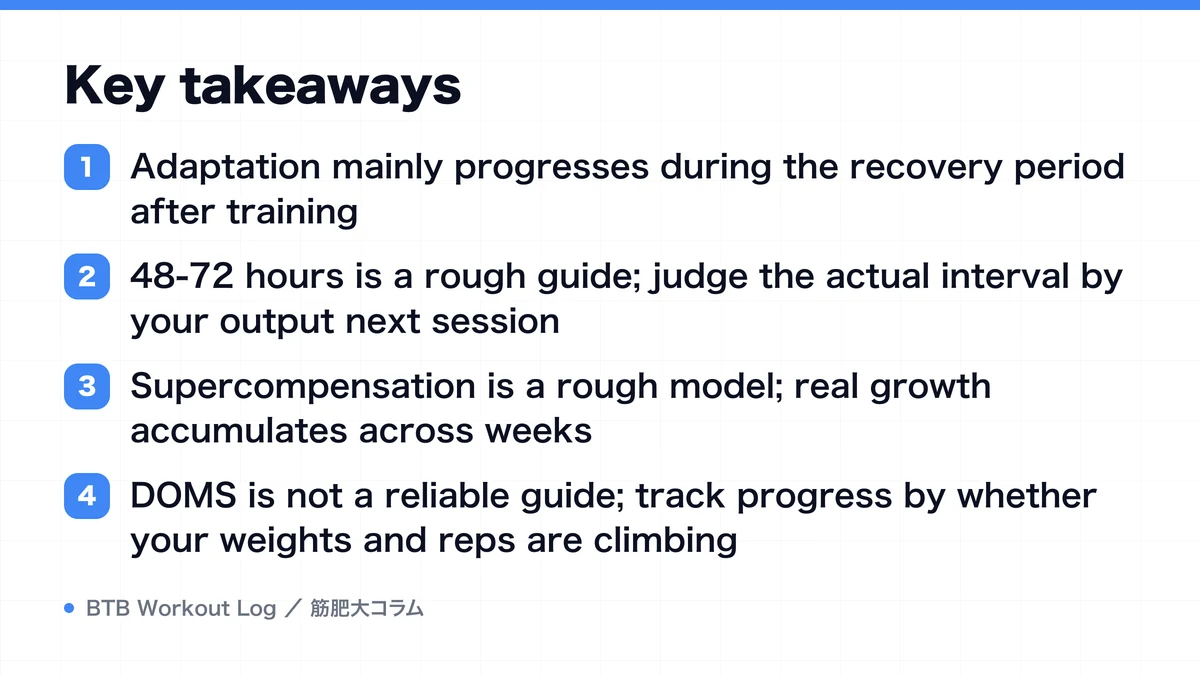
- Adaptation mainly progresses during the recovery period after training
- 48-72 hours is a rough guide; judge the actual interval by your output next session
- Supercompensation is a rough model; real growth accumulates across weeks
- DOMS is not a reliable guide; track progress by whether your weights and reps are climbing
References
- Mixed Muscle Protein Synthesis and Breakdown After Resistance Exercise in Humans
- Muscle Protein Synthetic Response to Resistance Exercise: Systematic Review and Meta-analysis
- National Sleep Foundation Sleep Time Duration Recommendations
- Inadequate Sleep and Muscle Strength: Implications for Resistance Training
- Effects of Resistance Training Volume on Physical Function, Lean Body Mass and Lower-Body Muscle Hypertrophy and Strength in Older Adults: Systematic Review and Network Meta-analysis of 151 Randomised Trials