Exercise Order and Hypertrophy: Why Your First Exercise Has the Advantage
The exercise you do first gets high output and stable technique with the least fatigue in the way, which is exactly the advantage when you want to prioritise that exercise or its prime mover.
That doesn't mean going first automatically grows more muscle. What order changes is the set quality and room for progress you can hand to each exercise.
Order changes the distribution of hypertrophic stimulus
Exercise order isn't an independent switch for building muscle. Within the same session, the first exercises meet less physical and mental fatigue, and later ones inherit more of what came before. Reorder things and load, reps, RIR (reps left in reserve), range of motion and form repeatability all shift per exercise.
Hold that for weeks and the front-loaded exercise accumulates quality hard sets more easily, while the one pushed back can stall. The chain runs order → fatigue at that point → set output and movement quality → accumulated stimulus and progressive overload → long-term result. A blanket rule like "big muscles first" or "compounds first" is less accurate than treating it as a programme design question: which outcome do you want the good state handed to?
The ACSM progression model treats resistance-training exercise order as a variable to design around your goal. Direct hypertrophy comparisons of order alone are limited, so order shouldn't be assumed to produce a large effect by itself. In practice, judge it through the output changes described below.
How an earlier exercise erodes later output
An earlier exercise leaves its mark not just on the prime mover but on assisting muscles, postural muscles, grip, breathing and focus. The effect on what follows mainly runs through three routes.
- Local fatigue: using the same muscle means the next exercise starts with less in reserve already. Stack another chest exercise after chest presses and RIR at the same load falls.
- Fatigue in assisting muscles: the target can still be fresh while a different muscle finishing the movement is near its limit. Tire the triceps on pressdowns before bench press and triceps, not chest, can become the limiter. How triceps end up limiting a chest day is covered in the article on shared movements and pre-fatigue.
- Systemic fatigue: after squats or a high-rep multi-joint exercise, breathlessness, trunk fatigue or reduced focus outside the target muscle can limit the next set.
The result on later exercises: reduced load, missed target reps, a shorter range of motion, or compensating form. This is the same rep decline you see within a set, just stretched across exercises — the mechanics are shared with why reps fall through a set.
A lighter load here doesn't automatically mean less effective. Plenty of fatigued sets still put real tension on the target. The problem is when something other than the target ends the set first, or when the weekly work you can repeat shrinks.
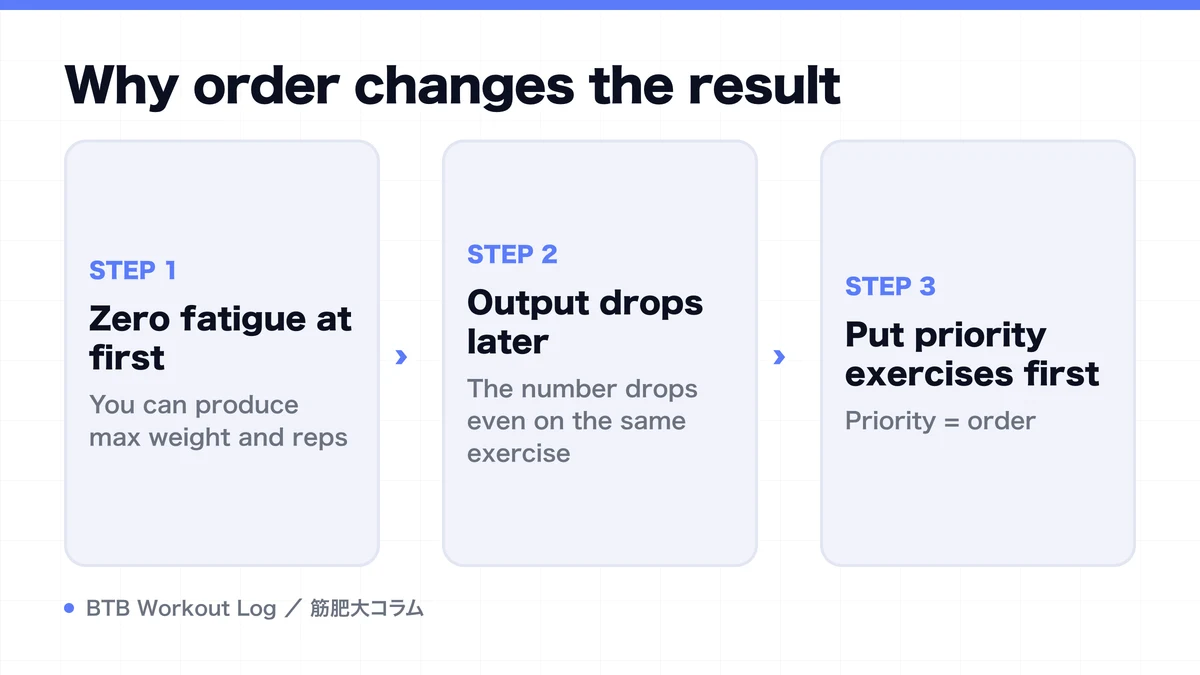
What the first exercise gets that later ones don't
1. Load and reps are easier to hold
Fresh early on, you can handle more load or reps at the same RIR. Since weekly training volume and hypertrophy show a dose-response relationship, repeating quality sets on a priority exercise matters — as long as you're still holding the intended range of motion and form, not just padding the set count. See how to think about weekly sets for that framing.
2. Technique is easier to reproduce
Technical lifts like bench press, squat and rows lose position and path more readily when fatigued. Doing them fresh keeps load on the intended muscle and keeps conditions comparable with last time.
3. Progress is easier to read
An exercise you place near-first every session carries less pre-fatigue noise, so changes in load and reps are easier to follow. Reorder frequently and you can't tell whether a drop is a real plateau or just fatigue carried over from what came before. Fixing your priority exercise's position for a stretch is what makes reading progressive overload possible.
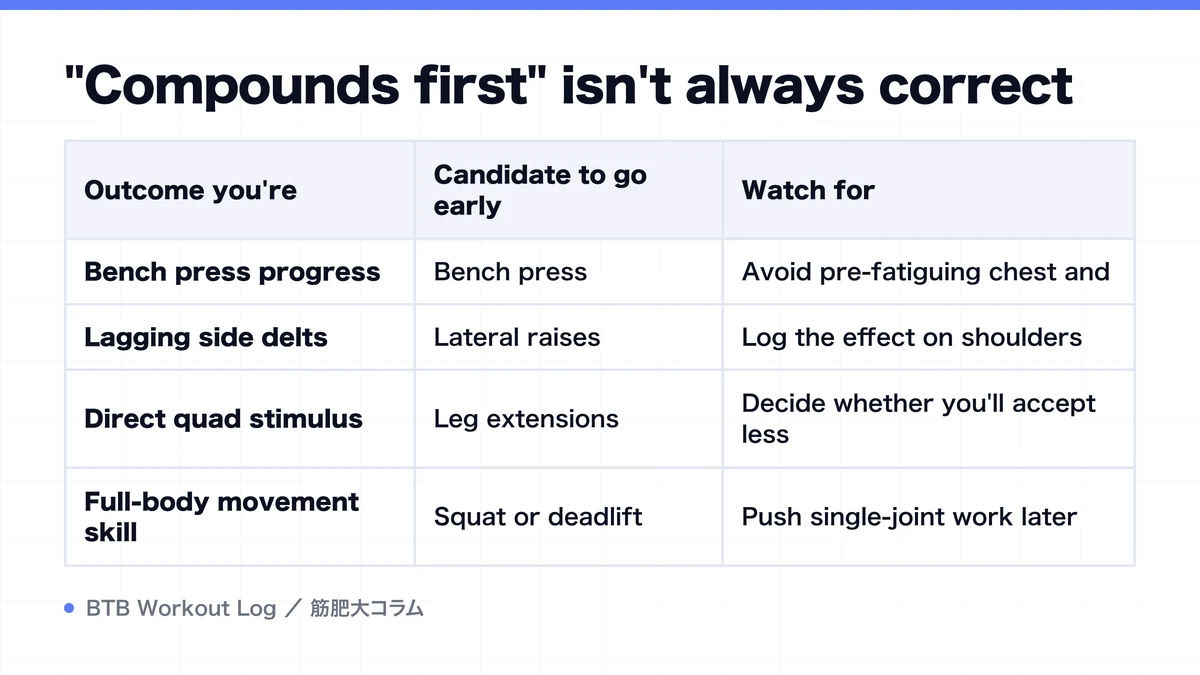
"Compounds first" isn't always correct
Putting multi-joint, heavy, technical exercises first is generally sound — they use many muscle groups, and form breakdown under fatigue affects both results and safety more. But a clear hypertrophy priority justifies exceptions.
| Outcome you're prioritising | Candidate to go early | Watch for |
|---|---|---|
| Bench press progress | Bench press | Avoid pre-fatiguing chest and triceps |
| Lagging side delts | Lateral raises | Log the effect on shoulders during later pressing |
| Direct quad stimulus | Leg extensions | Decide whether you'll accept less load on squats after |
| Full-body movement skill | Squat or deadlift | Push single-joint work later |
Pre-exhaust — a single-joint exercise before the compound — can sharpen the mind-muscle connection, but that alone doesn't guarantee more hypertrophy. If load and reps fall on the compound afterward and an assisting muscle limits out first, there's a real trade-off. Don't call it a win on pump or feel alone — check whether hard sets and progress on the target actually hold.
With several priorities, you don't have to cram them into one day. Training twice a week, you can lead Day A with chest presses and Day B with shoulders or arms. If later exercises lose a lot of reps, also check rest between sets, not just order.
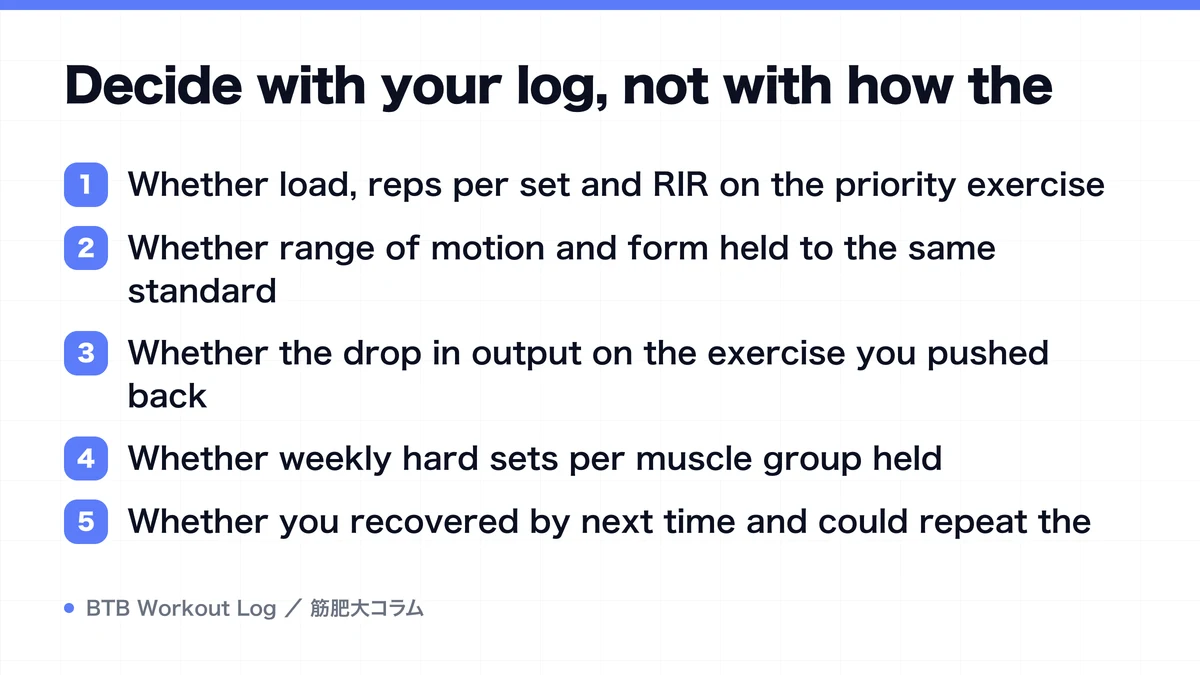
Decide with your log, not with how the session felt
Test a reorder as one hypothesis, without changing your whole programme at once. Name your priority area first, move that area's main lift earlier, and hold that position for at least a few weeks. What you compare isn't how satisfying the session felt - it's these.
- Whether load, reps per set and RIR on the priority exercise trended up
- Whether range of motion and form held to the same standard
- Whether the drop in output on the exercise you pushed back is acceptable
- Whether weekly hard sets per muscle group held
- Whether you recovered by next time and could repeat the same layout
If the promoted exercise progresses and the cost to what follows is small, that order fits your goal. If the main lift improves but another important area's set quality drops a lot, redesign - split them across days, alternate priority, or trim an unnecessary early exercise.
Your log doesn't decide the right answer itself - it tells you whether the change worked for the priorities you actually chose.
FAQ
- For hypertrophy, should compounds always go first?
- That's sound when your priority is a main lift's progress or its technique, but it isn't a hard rule. On a day you want to prioritise a lagging area with single-joint work, put that first — just log how much load, reps and form suffer on the compound that follows and decide from there.
- Does pre-exhaust increase hypertrophy in the target?
- Pre-fatiguing the target can sharpen the feel of the exercise, but it doesn't guarantee more growth. Output on what follows can fall, and a different muscle can become the limiter. Judge by weekly hard sets on the target and progress over several weeks, not the sensation.
- How long should I hold an order before comparing?
- Don't decide from one day's form. Hold the same order for at least a few weeks, compare load, reps per set, RIR and range of motion together, and weigh the priority exercise's gain against the cost to what follows before deciding to keep it or revert.
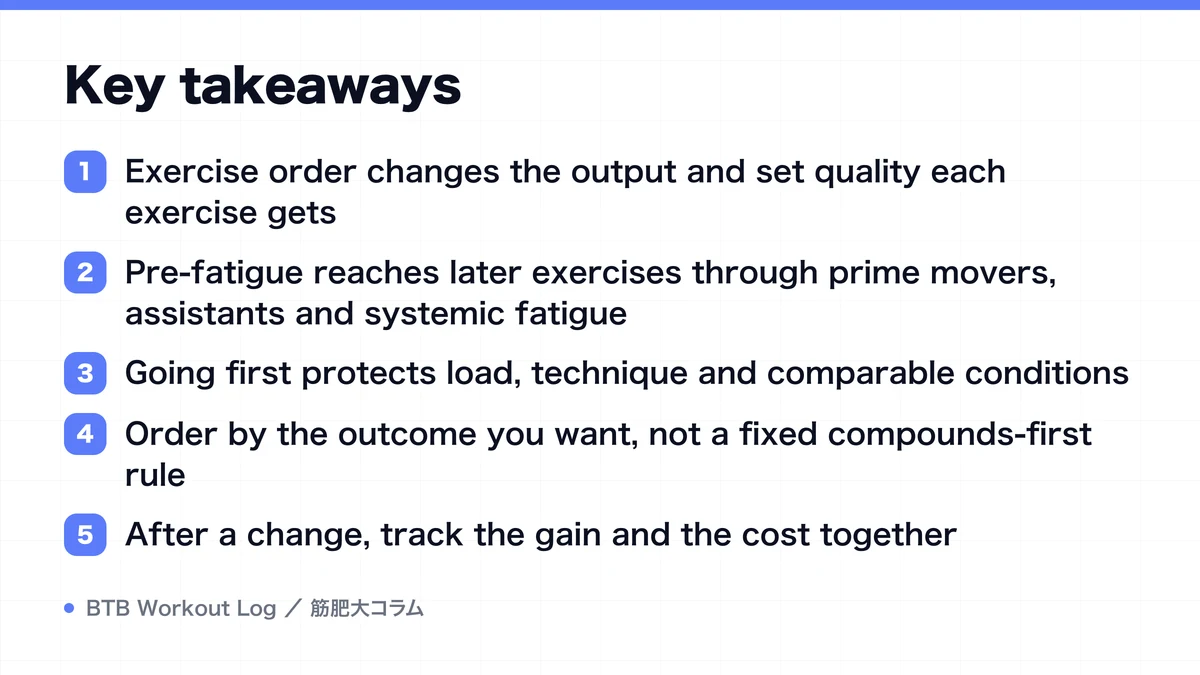
Key takeaways
- Exercise order changes the output and set quality each exercise gets
- Pre-fatigue reaches later exercises through prime movers, assistants and systemic fatigue
- Going first protects load, technique and comparable conditions
- Order by the outcome you want, not a fixed compounds-first rule
- After a change, track the gain and the cost together