
Is That Gym Wisdom Actually True? | 20 Common Beliefs Put to the Research Test, With Surprising Results
Most gym common wisdom isn't outright wrong — it's "true under certain conditions, but assumed to still apply once those conditions no longer hold." That's why rejecting it entirely, or swallowing it whole, both lead you astray.
Here we split common beliefs into four groups and map out where each one is true, and where it stops being true.
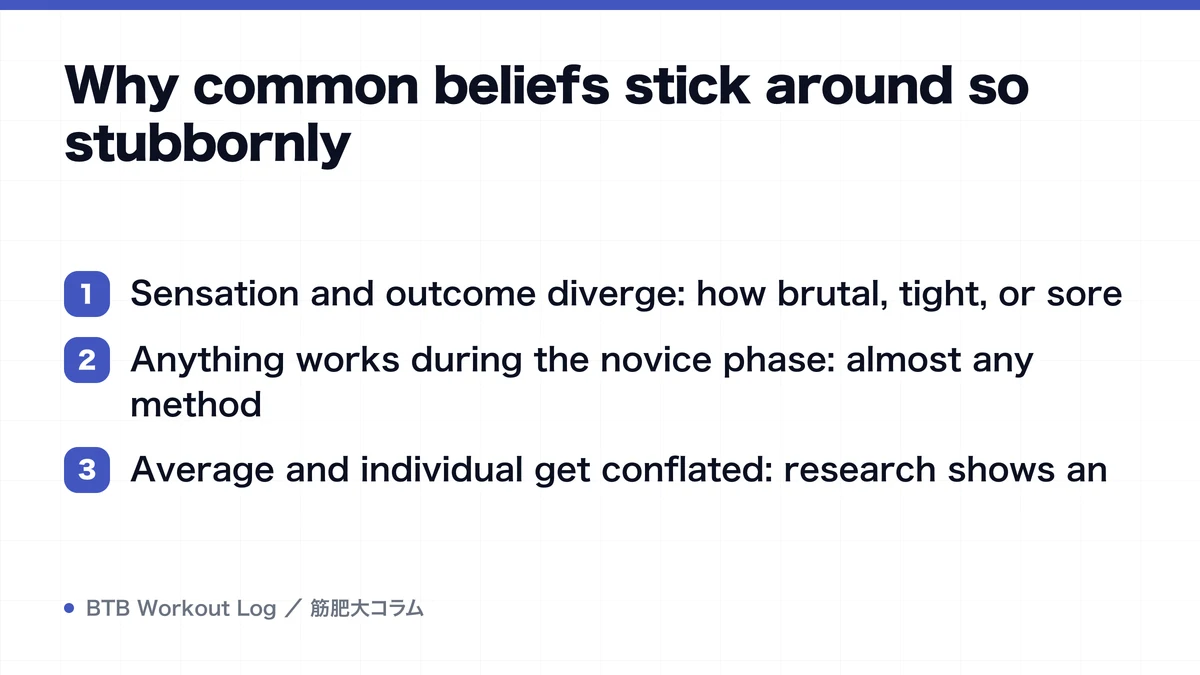
Why common beliefs stick around so stubbornly
There are a few reasons gym common wisdom doesn't go away.
- Sensation and outcome diverge: how brutal, tight, or sore something feels can move for reasons unrelated to that day's stimulus.
- Anything works during the novice phase: almost any method produces results in the first few months, so method quality can't be tested.
- Average and individual get conflated: research shows an average difference across a group, and that difference is often small.
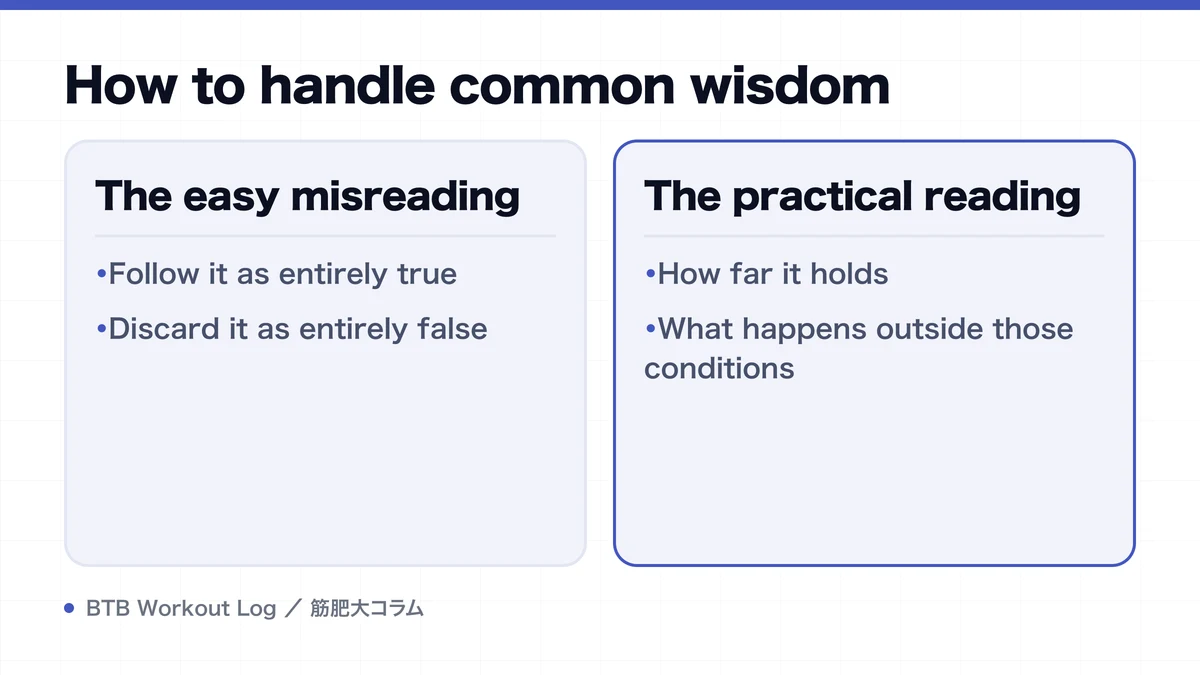
Given these three, the right way to handle common wisdom isn't "true or false" — it's checking "under what conditions does it hold."
The "hard means it's working" family of myths
The most common misconception is treating subjective hardness as a proxy for effectiveness. Muscle damage isn't considered a required condition for hypertrophy, and going to failure hasn't been shown to be required either.
- Does soreness mean a good workout?
- Does pushing to failure build more muscle?
- Does a pump mean you're growing?
- Is a stronger "I can feel it working" a better exercise?
- Are longer workouts more effective?
The common thread: sensation reflects that day's condition, not several weeks of progress. Sleep, the previous day's food, an unfamiliar exercise, a change in range of motion — all of these move sensation substantially, but none of them are hypertrophy stimulus itself.
That doesn't mean sensation is meaningless, though. Signals like "unusually brutal" or "my usual weight clearly feels heavier" work as an early warning that fatigue hasn't cleared. The use case is gauging condition, not measuring effectiveness.
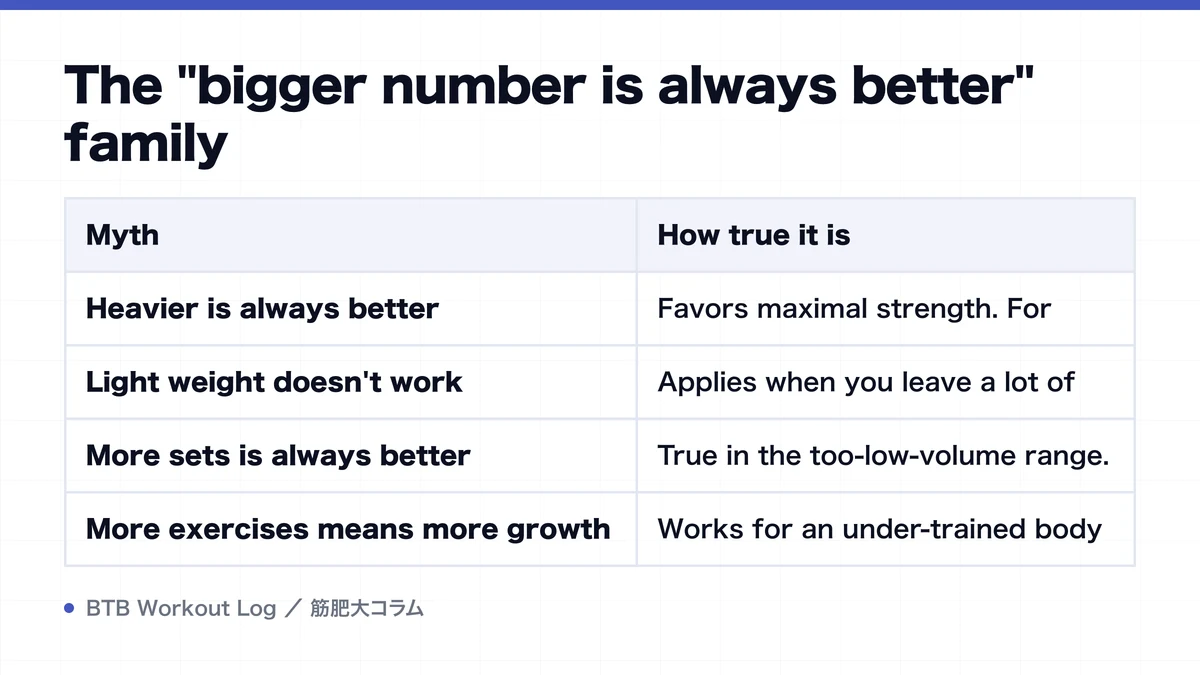
The "bigger number is always better" family of myths
Weight, set count, exercise count, time — none of these keep paying off the more you raise them, and each increase adds recovery cost.
| Myth | How true it is |
|---|---|
| Heavier is always better | Favors maximal strength. For hypertrophy, with effort matched, the difference is small |
| Light weight doesn't work | Applies when you leave a lot of reserve. Pushed close to the limit, it's still stimulus |
| More sets is always better | True in the too-low-volume range. The added benefit diminishes as you raise it |
| More exercises means more growth | Works for an under-trained body part. Too many makes progress hard to track |
| Volume = weight × reps × sets | Useful for tracking within one exercise. Not usable for comparing across exercises |
| 3 sets of 10 is the answer | Reasonable as a starting point. Not the one optimal answer |
Reading the right column of this table, you can see how each myth came about. Every one is correct advice for someone who's doing too little, and it genuinely works to get them out of that state. It breaks down once you keep raising the same number even after the deficit is resolved. Any move that raises a number always comes with recovery cost attached, so once the added benefit shrinks, it's time to move to a different variable.
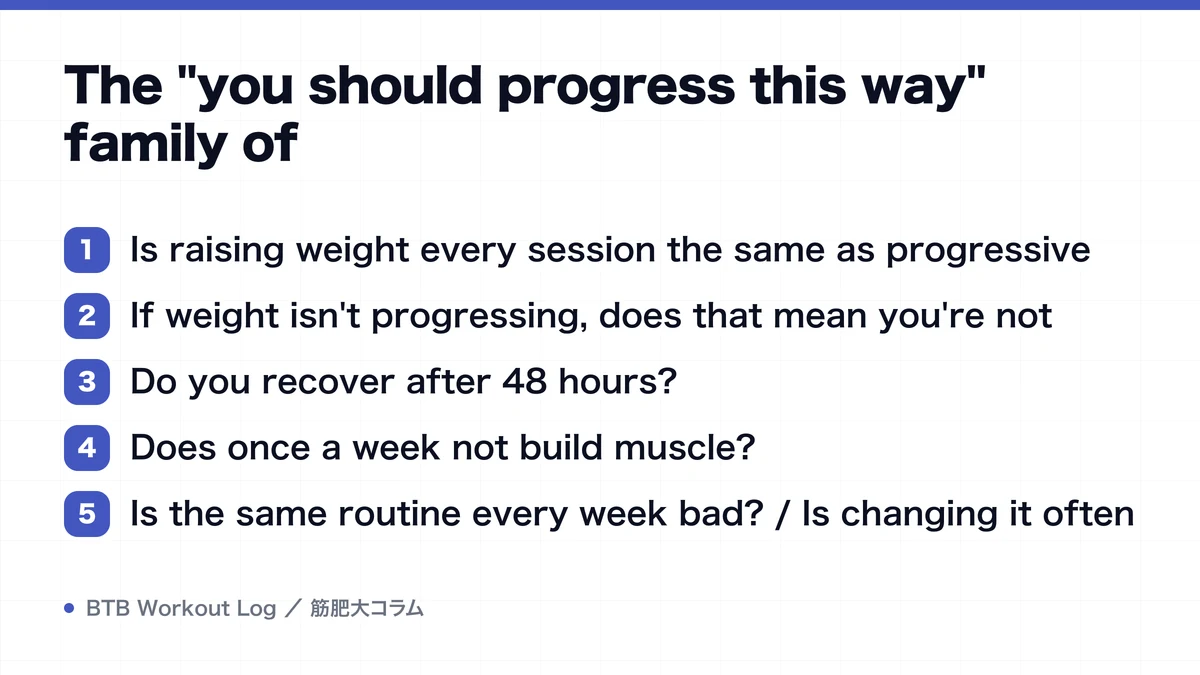
The "you should progress this way" family of myths
Myths around progression and recovery are an area where a number easily takes on a life of its own. Even the "48 hours to recover" guideline actually shifts with exercise, intensity and volume.
- Is raising weight every session the same as progressive overload?
- If weight isn't progressing, does that mean you're not growing?
- Do you recover after 48 hours?
- Does once a week not build muscle?
- Is the same routine every week bad? / Is changing it often better?
The last two are an example of opposite myths being believed at the same time, and both only hold conditionally. If you're still progressing on the same routine, there's no reason to change it; if you've stalled, there's a reason to. In other words, the deciding factor isn't "how many weeks you've run it" — it's "are the numbers still moving."
The recovery guideline works the same way — 48 hours is only an average guide. Even for the same body part, the needed interval differs between a heavy compound lift taken close to the limit and a light single-joint exercise left with reserve.
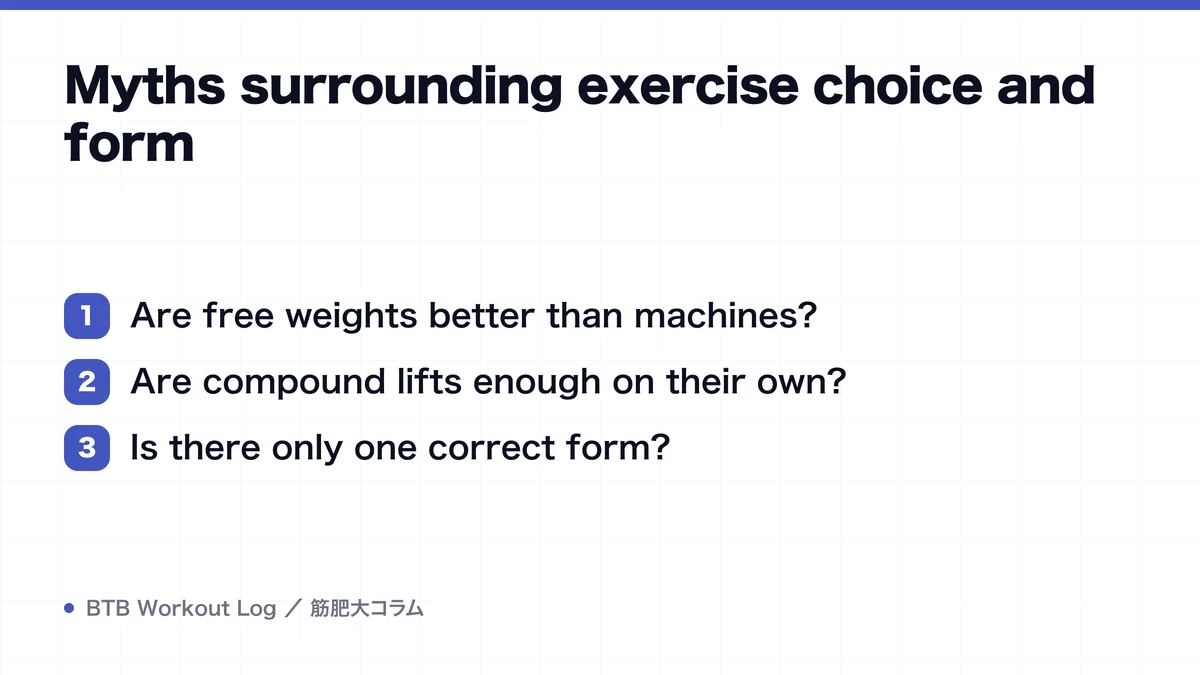
Myths surrounding exercise choice and form
Which equipment or exercise is "better" is, in practice, usually just a difference in role within your program.
- Are free weights better than machines?
- Are compound lifts enough on their own?
- Is there only one correct form?
Work through these myths one at a time, and what's left at the end is the question "what about my own case." Research can't settle that for you — from here, all you can do is keep a record of weekly set count and per-exercise load and reps, and compare before and after any change.
FAQ
- Is it fine to ignore common gym wisdom entirely?
- No. Much of it is true under limited conditions, and it works well enough as a guideline for beginners. The problem is continuing to apply the same judgment once you've stepped outside those conditions.
- Should I trust research or gym anecdotes more?
- They serve different roles. Research tells you a group's average tendency and how large that difference actually is. Anecdotes are one example of what happened under specific individual conditions. It's realistic to start from the average and verify against your own records.
- How can I notice which myth I'm caught up in?
- It helps to write down the first fix you think of when progress stalls. If the only basis for that fix is how it feels, you're likely judging by common wisdom rather than evidence.
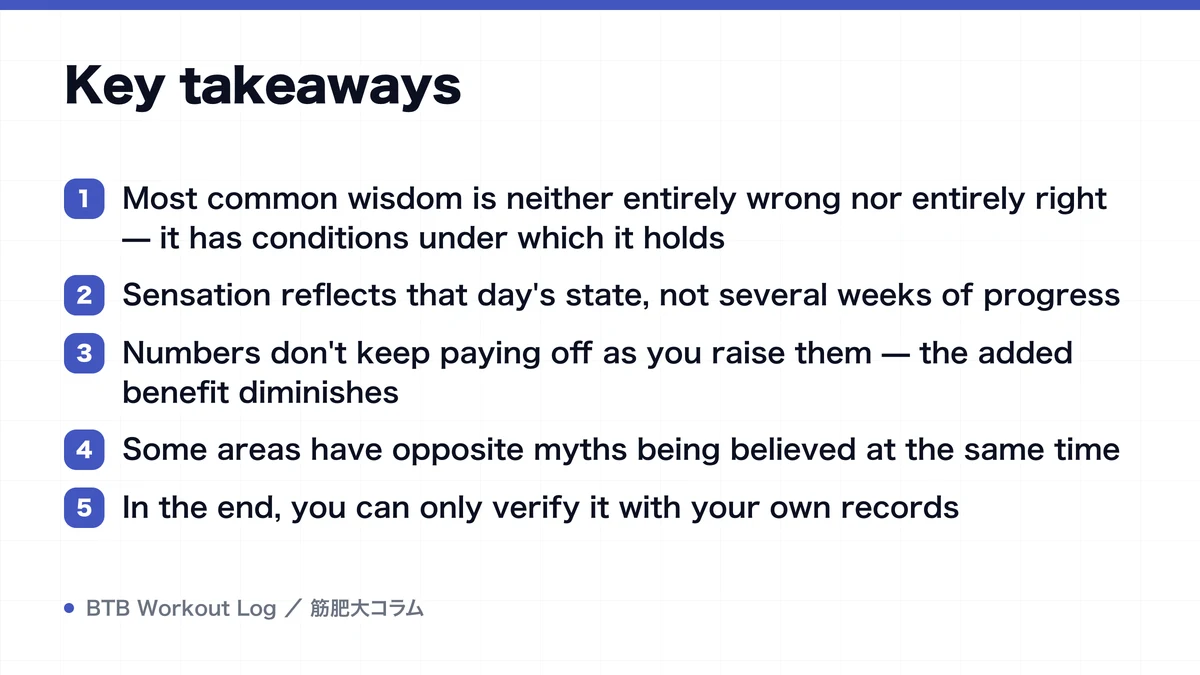
Key takeaways
- Most common wisdom is neither entirely wrong nor entirely right — it has conditions under which it holds
- Sensation reflects that day's state, not several weeks of progress
- Numbers don't keep paying off as you raise them — the added benefit diminishes
- Some areas have opposite myths being believed at the same time
- In the end, you can only verify it with your own records