
Why Reps Drop in Later Sets: Fatigue, Not a Lack of Grit
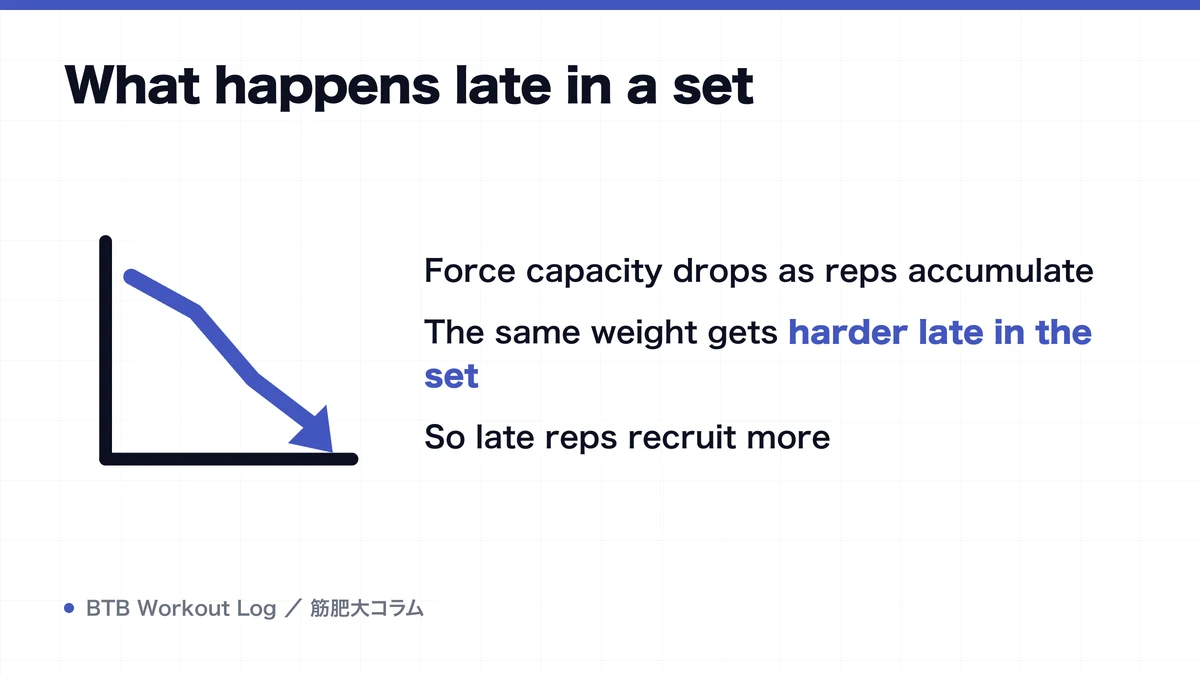
Reps drop in later sets because the output capacity lowered by earlier sets doesn't fully return during rest, making the same weight relatively heavier.
Rep decline itself isn't abnormal. What matters more than how much it dropped is distinguishing whether it happened while form and range of motion held, stopping at your intended RIR.
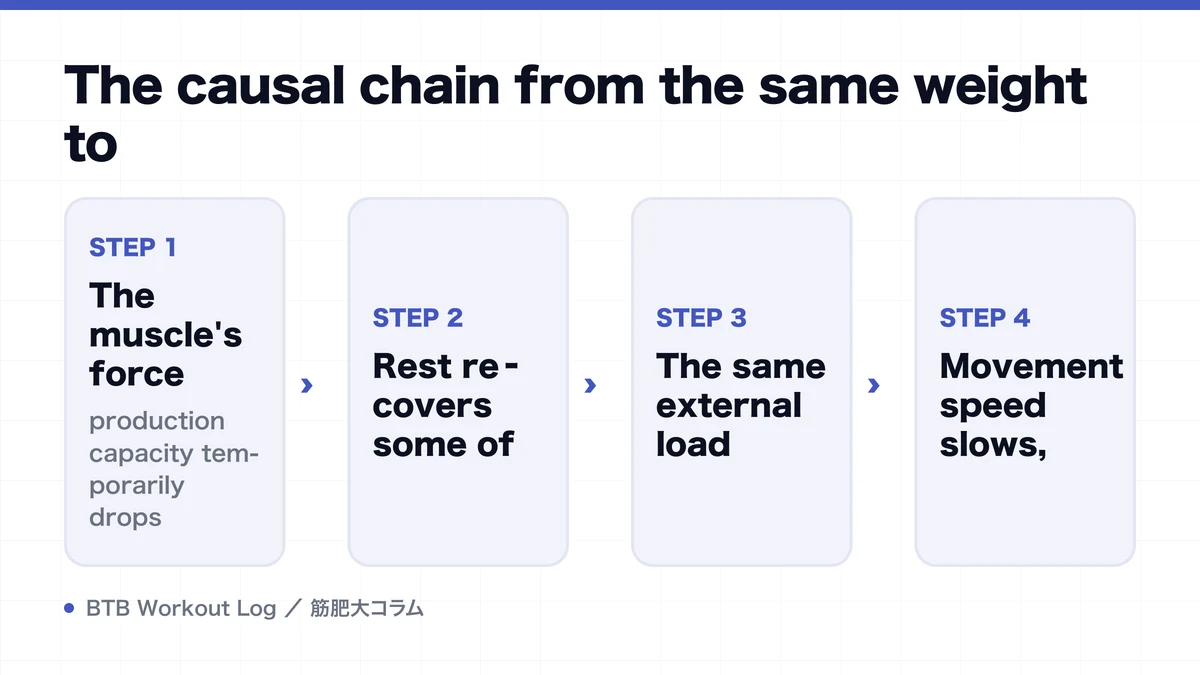
The causal chain from the same weight to fewer reps
Say you do the bench press at the same 100kg: 10 reps on set one, 8 on set two, 7 on set three. The weight hasn't changed, but "the capacity to repeat that weight" at the start of each set isn't the same.
- The muscle's force-production capacity temporarily drops with each rep: repeating high tension changes the energy supply supporting contraction and conditions within the muscle, so the same nerve signal produces less force.
- Rest recovers some of it, but not necessarily all the way back to baseline: even once breathing settles, local output capacity may not have fully recovered. This gap tends to remain larger the shorter the rest.
- The same external load becomes relatively heavier: a weight that felt manageable before fatigue now sits closer to your current maximum capability under insufficient recovery.
- Movement speed slows, and you reach your target RIR sooner: RIR is an estimate of how many more reps were possible. Even stopping at the same RIR 2 as set one, later sets reach that point after fewer reps.
In other words, dropping reps isn't weak willpower — it's the result of reduced starting capacity moving your stopping point earlier. Conversely, forcing every set to the same rep count means RIR quietly shrinks only in later sets, and you end up compensating with a failed rep or a form change at the end. See the mechanics of proximity to failure for how RIR factors into stimulus.
Fatigue isn't one substance — it's a state of reduced output capacity
Fatigue during training doesn't just mean a specific substance accumulating in the muscle. It's more practically useful to think of it as a temporary state of reduced ability to produce the demanded force. Its content roughly splits into two.
Local fatigue within and around the muscle
Producing large force in a short time shifts the use and resynthesis of creatine phosphate — which helps resupply ATP — metabolite changes like inorganic phosphate, calcium release from the sarcoplasmic reticulum, and the workings of the contractile machinery, all together. It's not that any single one alone decides rep count — the net result is reduced force capacity in the fiber. Recovery proceeds during rest, but its speed varies with load, time under tension, muscle mass trained, and exercise.
Neural and whole-body constraints
Sustained high effort also means neural drive to the muscle isn't constant either. And in multi-joint exercises, something other than the target muscle — grip, breathing, posture-supporting muscles, or synergists — can become the limiter first. Breathing hitting its limit before the legs on squats, or grip giving out before the back on rows, are examples. Even the same "dropping reps" calls for a different set structure depending on what actually ended it.
An explanation that pins fatigue on lactate alone can't account for these multiple pathways. Burn or pump are cues that local load continued, but they aren't, on their own, a metric for recovery status or hypertrophy stimulus. What to watch is the reps, movement, and RIR you can reproduce on the next set.
Five conditions that widen rep decline
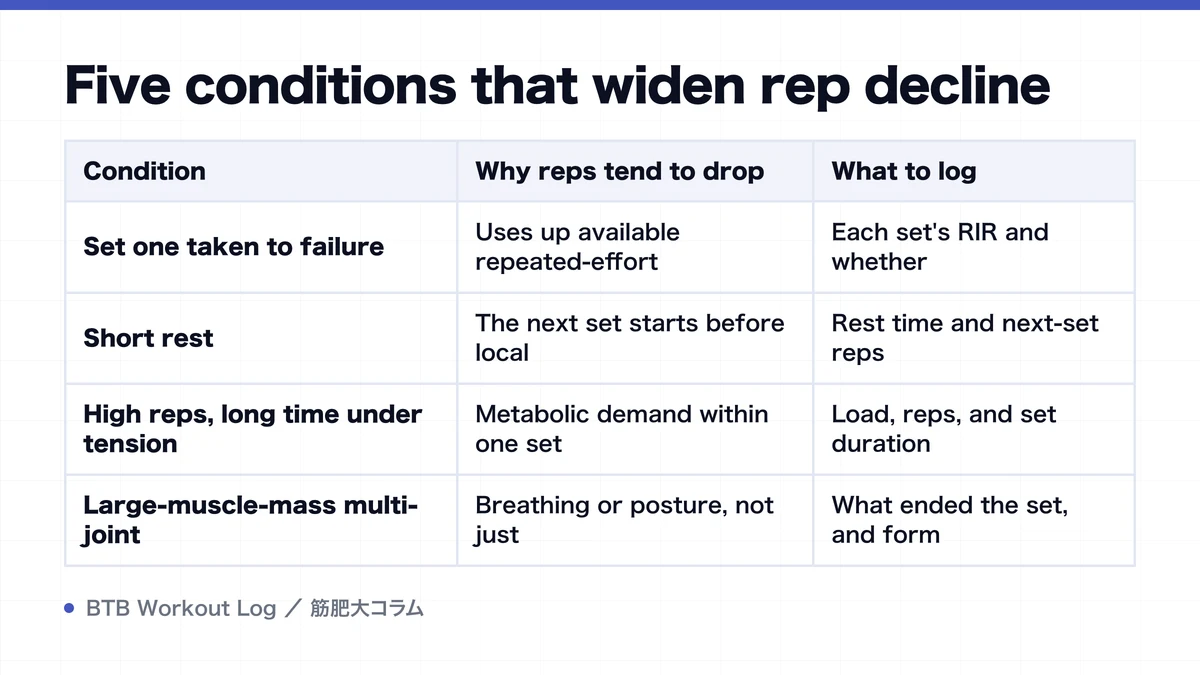
The decline between sets doesn't happen at the same rate every time. The more the following conditions stack, the more fatigue tends to remain at the start of later sets.
| Condition | Why reps tend to drop | What to log |
|---|---|---|
| Set one taken to failure | Uses up available repeated-effort capacity, leaving less for later sets | Each set's RIR and whether failure occurred |
| Short rest | The next set starts before local output capacity has recovered | Rest time and next-set reps |
| High reps, long time under tension | Metabolic demand within one set tends to be larger | Load, reps, and set duration |
| Large-muscle-mass multi-joint exercises | Breathing or posture, not just the target muscle, tends to become a constraint | What ended the set, and form |
| Later exercise order | Fatigue in the same or synergist muscles carries over from earlier exercises | Exercise order and that day's full set list |
The path by which shorter rest lowers reps is covered in more depth in the mechanics of how shorter rest changes training. A study comparing 1- and 3-minute rest in 21 young trained men found the 3-minute group favored bench press and back squat 1RM gains and increases in anterior thigh muscle thickness. But that doesn't establish that 3 minutes is needed on every exercise — some people can hold output even shorter on single-joint exercises. Rather than fixing a number of seconds, it's more reasonable to decide by whether next-set reps and movement suffice for your purpose.
And while a failure rep on set one tends to widen the decline, it isn't a required condition for hypertrophy. A meta-analysis of 15 studies comparing failure and non-failure reps in young adults found no significant difference overall in strength or hypertrophy. Rather than maximizing reps on every single set, you need a mindset that allocates valid effort across later sets too.
How much rep decline counts as normal?
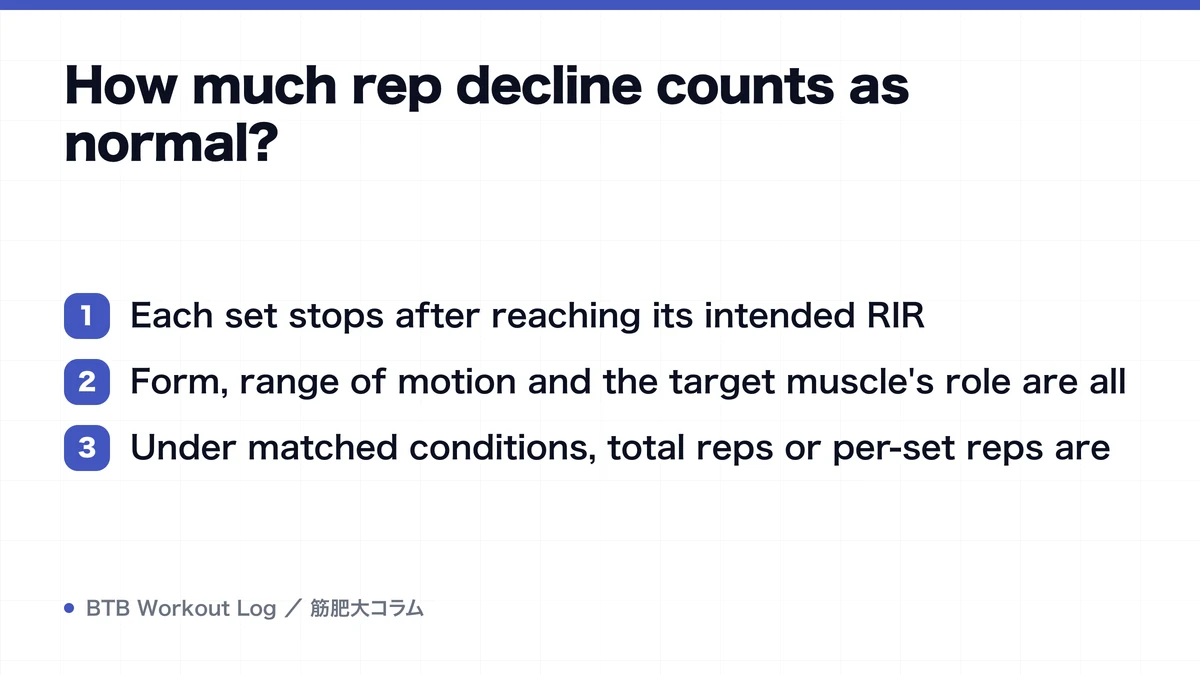
There's no boundary shared by every exercise for "how many reps dropped is too many." A drop from 10 to 8 and a drop from 5 to 3 are both 2 reps but different proportions, and it means something different on a single-joint machine versus a free-weight compound lift. Rather than judging from absolute rep count alone, split it into these two patterns.
The pattern that can be treated as intended fatigue
- Each set stops after reaching its intended RIR
- Form, range of motion and the target muscle's role are all preserved
- Under matched conditions, total reps or per-set reps are holding or improving over several weeks
In this pattern, there's no need to force away a decline like 10, 9, 8 reps. Even the later sets are reaching close to the limit at a lower rep count and can still count as hard sets. Narrowing range of motion or adding momentum to force matched rep counts would actually break the comparison conditions.
The pattern that calls for reviewing your setup
- Only later sets fail earlier than intended, and form breaks down too
- Breathing, grip, or synergists — not the target muscle — consistently stop you first
- Rep decline keeps widening session to session and doesn't return by next time
- Adding sets barely increases valid reps in the back half
In this pattern, try one change at a time, in this order: extend rest by 60–90 seconds, stop set one just short of failure, move accessory work later, or split sets across a separate day. Only lower weight if you still can't hold your intended rep range after adjusting rest and effort allocation. Changing several things at once makes it impossible to tell what actually restored the reps.
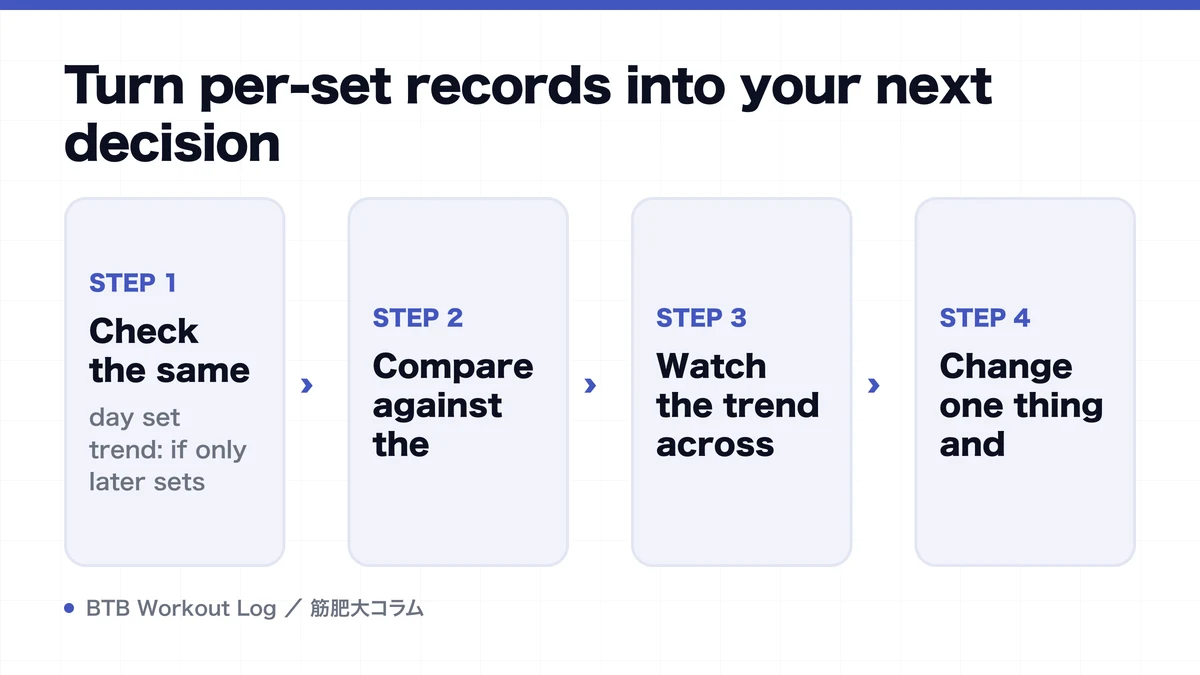
Turn per-set records into your next decision
Managing fatigue means watching not just total reps per exercise but weight, per-set reps, RIR and rest time lined up together. Where possible, also briefly note sets where form or range of motion changed, or where something other than the target muscle ended the set. A study in young novice men found high test-retest reliability for load prescription using 1 RIR on bench press and deadlift. RIR carries individual and exercise-specific error, so it's more appropriate to treat it not as an absolute value but as a general-trend guide used alongside weight, reps and rest time.
Judging in this order keeps things clear.
- Check the same-day set trend: if only later sets drop, suspect between-set recovery and set-one's effort allocation first.
- Compare against the same exercise last time: if total reps rose at the same weight, rest and RIR, you're progressing even with within-session decline.
- Watch the trend across multiple sessions: if every set keeps dropping below last time, check recovery factors outside the session too — sleep, the previous day's load, weekly set count.
- Change one thing and remeasure: if extending rest restores later-set reps, recovery time was the main constraint; if adjusting set-one's RIR restores them, effort allocation was.
The log itself doesn't produce hypertrophy, but it lets you infer the cause of a rep decline and gives you material for adjusting rest or RIR next.
FAQ
- Should I match later sets to the same rep count as set one?
- No need to match them. Stopping at the same RIR naturally means later, more-fatigued sets reach that stopping point at fewer reps. Rather than forcing a rep count, hold form and range of motion, and compare per-set reps and RIR against the same conditions last time.
- If reps drop a lot, should I lower weight right away?
- First check rest time and how hard you pushed set one. If rest is short, or you already went to failure on the first set, try extending rest or stopping at RIR 1–2 without changing weight. Only consider a small weight reduction if you still can't hold your intended range afterward.
- Are later sets still useful for hypertrophy even with fewer reps?
- Even at lower reps, a later set can still work as a hard set if the target muscle reaches your intended RIR while form and range of motion hold. But if only grip or breathing stops you, movement breaks down, or the decline carries into next time, fatigue cost may be outweighing the stimulus.
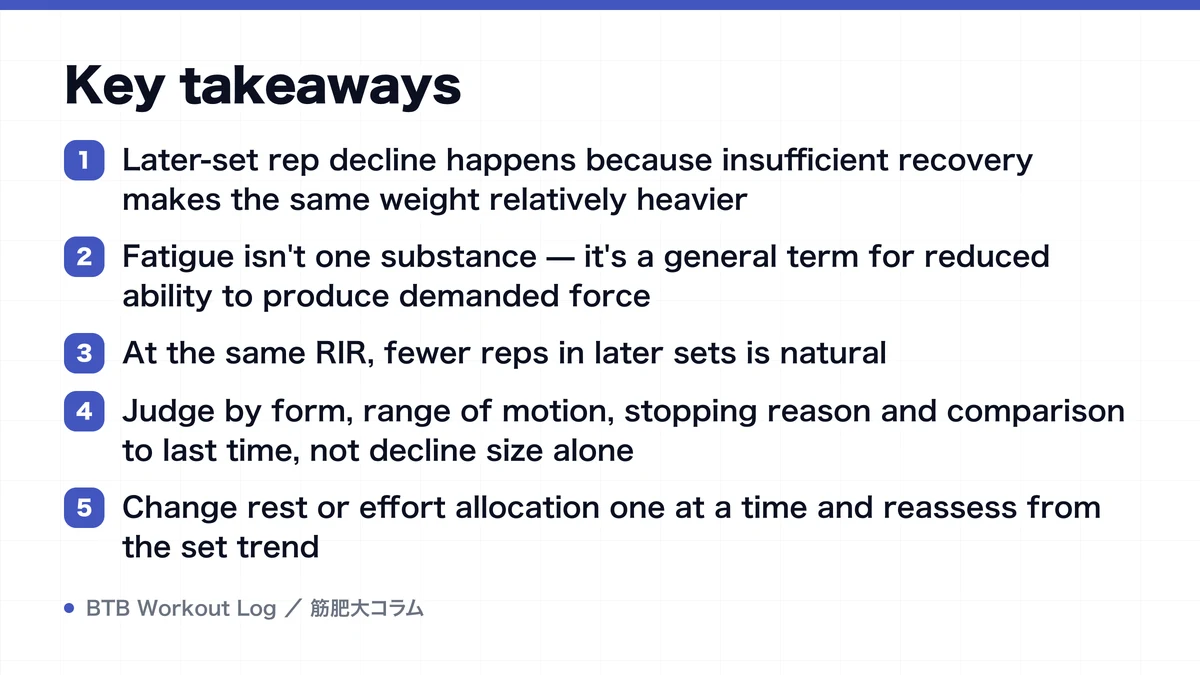
Key takeaways
- Later-set rep decline happens because insufficient recovery makes the same weight relatively heavier
- Fatigue isn't one substance — it's a general term for reduced ability to produce demanded force
- At the same RIR, fewer reps in later sets is natural
- Judge by form, range of motion, stopping reason and comparison to last time, not decline size alone
- Change rest or effort allocation one at a time and reassess from the set trend