Is the "48-Hour Recovery Rule" Actually True? | For Some Lifters, That Rule of Thumb Just Doesn't Apply
48 hours can serve as a starting point for the interval before training the same muscle group again, but it isn't a guaranteed time that ensures "recovery complete."
How long recovery actually takes shifts with last session's set count and how hard you pushed, exercise, training history, sleep and nutrition. Judge not just by the clock but by whether you can reproduce the same movement and output level next time.
How far "wait 48 hours" actually helps
This guideline isn't entirely baseless. Muscle protein synthesis tends to rise after resistance exercise, and studies of healthy, non-obese adults performing a single bout of exercise, in fasted or fed-and-absorbed states, have reported cases where it stays above resting levels out to 48 hours. Recent systematic reviews have also confirmed studies where the response continues out to 48 hours. So not training the same muscle group hard every day, and leaving roughly a day in between, is a practical starting setup.
Even for the same person, a day with a few sets left with reserve and a day with many sets of an unfamiliar exercise taken close to the limit don't leave the same fatigue by next time. 48 hours isn't a fixed personal capability — its meaning shifts with the last stimulus's size.
But what research showed was the duration over which a rise in muscle protein synthesis was observed under specific conditions. It didn't show that everyone's strength, soreness, joint stress, and whole-body fatigue all simultaneously return to normal after 48 hours. Conversely, it doesn't mean you can't introduce any new stimulus at all until the synthesis response returns to baseline either. See how many rest days hypertrophy needs for the general rest-day picture, while treating 48 hours as a provisional interval rather than a hard boundary.
Why "recovered" can't be decided on a single clock
The word "recovery" bundles together states that move independently. Judging "recovered" from just one of them misreads next time's quality.
| What to watch | What to check | Relationship to 48 hours |
|---|---|---|
| Intramuscular response | Muscle protein synthesis/breakdown and tissue remodeling | How long it stays elevated varies by condition |
| Local output | Can you reproduce the same weight, reps and range of motion? | How it returns shifts with last session's load |
| Local symptoms | Does strong soreness, tightness, or joint discomfort interfere with movement? | Can't be judged from time alone |
| Whole-body readiness | Is sleep loss or fatigue from other body parts lowering focus or lift performance? | Can persist even after resting the same body part |
For example, even with mild soreness, warm-up can feel clearly heavier than last time and reps can drop at the same weight. Conversely, even with mild tightness, range of motion and output can hold as usual. Soreness is supporting information — its intensity doesn't directly represent recovery level or hypertrophy effect. This separation is shared with the myth that soreness means a good workout.
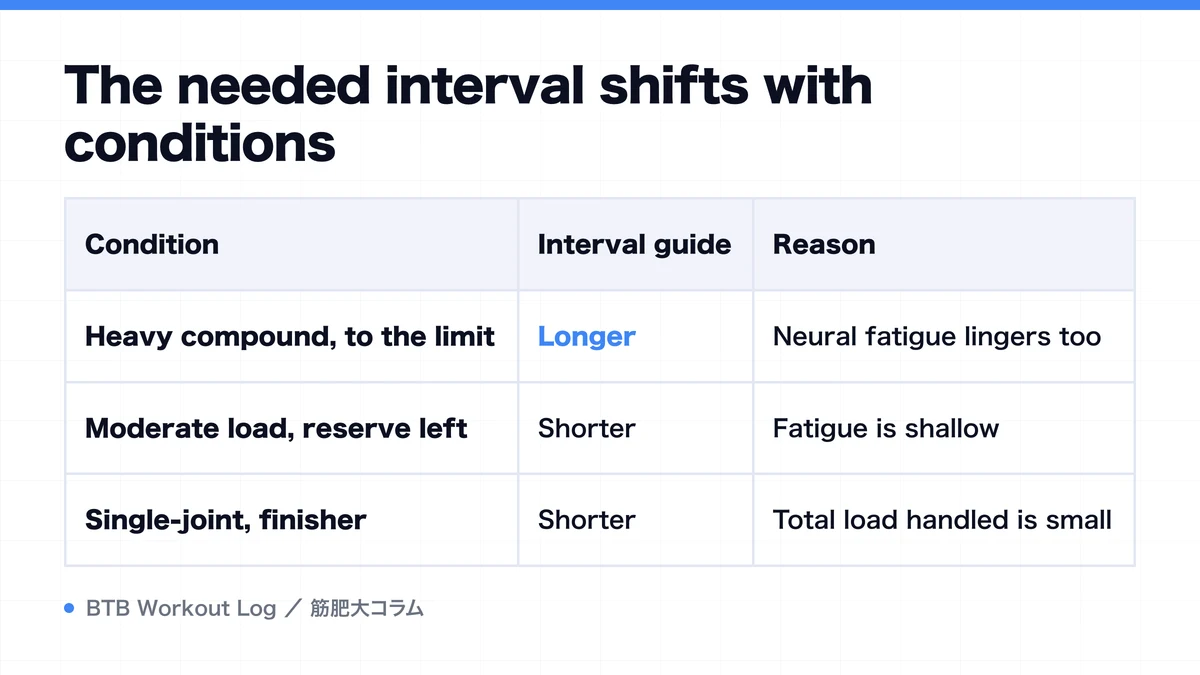
Research doesn't show "everyone recovers alike in 48 hours"
A 2024 systematic review, covering studies of healthy, non-obese adults doing a single bout of resistance exercise in fasted or fed-and-absorbed states, showed a clear rise in muscle protein synthesis, along with large variation across studies in its size and duration. Age, training experience, and exercise intensity, workload and effort level can all be involved in that time course. In other words, the number "48" is convenient for describing the observed range, but it isn't an automatic timer determining whether a given individual can train again.
Long-term hypertrophy frequency research also doesn't support a simple 48-hour rule. A meta-analysis matching weekly total volume found no significant, meaningful difference in hypertrophy between low and high frequency. Frequency is a design variable for how to distribute your recoverable weekly set count across days. See training frequency and total volume for detail, and why raising frequency doesn't necessarily speed up hypertrophy for cautions when raising frequency.
What to be careful of here is not reading "a small frequency difference" as "recovery can be ignored." Even at the same weekly total, cramming it into one session can lower back-half quality, and splitting it across too many sessions can let residual fatigue stack onto next time. A research average is material for narrowing candidates — your own right interval is decided from your actual ability to repeat.
Why it turned into "recovery complete at 48 hours"
This misconception spreads easily because three separate things got bundled into one. First, the physiology that muscle protein synthesis stays elevated for a while after exercise. Second, the supercompensation diagram — recovering from fatigue and adapting to a higher level than before. Third, the calendar convenience of "every other day," which makes it easy to schedule the same body part 2–3 times a week.
Each is a useful hint for program design. But the diagram's peak doesn't arrive at the exact same time every session, and a muscle-protein-synthesis measurement doesn't directly translate into the recovery time for lift performance. Treating a day with a high set count, a day with an unfamiliar exercise, and a day sleep fell apart all under the same 48 hours discards important conditions in exchange for simplicity.
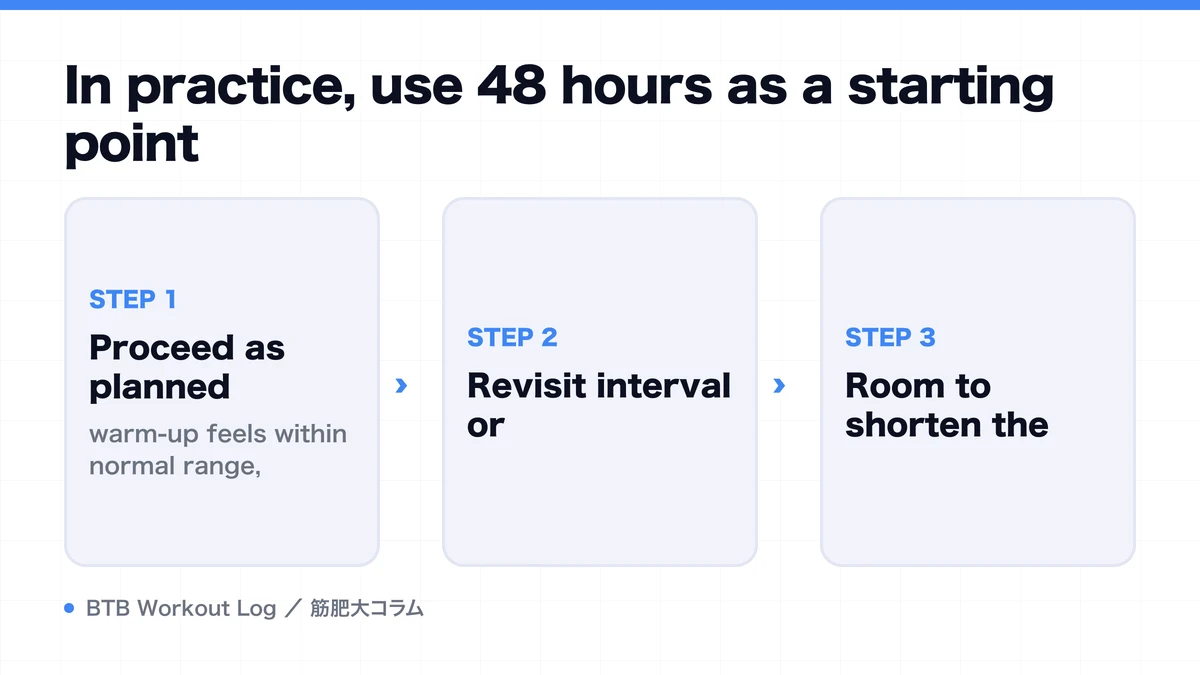
In practice, use 48 hours as a starting point and adjust from next-time quality
Start by spacing main sessions on the same muscle group roughly 48–72 hours apart, and watch the response for 2–4 weeks without substantially changing placement. Then use the first main exercise next time as a "recovery test." Match comparison conditions — exercise, form, range of motion, rest time, and target RIR (reserve — how many more reps were possible) — as closely as possible.
- Proceed as planned: warm-up feels within normal range, and you can reproduce comparable weight, reps and RIR to last time.
- Revisit interval or volume: reps drop under matched conditions, and strong tightness or movement restriction persist across several sessions. Push next time back 24 hours, or reduce last session's hard sets.
- Room to shorten the interval: output is stable every time, and quality holds even late in the session. If you want to spread weekly sets out, trial raising frequency by lowering per-session volume.
It also matters not to change your routine from one off day alone. Daily output swings with sleep, diet and work fatigue. If it declines in the same direction for 2–3 sessions running, first check weekly hard sets and how they're distributed per session. If decline spreads across several muscle groups and exercises, it can be easier to manage by lowering overall fatigue with a deload rather than adding interval per body part.
Pressing exercises use shoulders and triceps too, not just chest; pulling exercises use biceps too, not just back. Think in terms of "chest got 48 hours" including the indirect sets involved. If there's sharp pain, swelling, or a symptom that interferes with daily movement, stop training rather than pushing through it as normal fatigue adjustment, and consult a medical professional as needed.
As a method for using your log as material, watch output across several weeks at the same interval, not just one check 48 hours later. You can tell your own needed interval from output during a week you changed it. BTB Workout Log keeps the same exercise's dates and results paired for this.
FAQ
- Should I rest if soreness remains even after 48 hours?
- You can't confirm recovery from soreness alone. But if pain changes range of motion or form, or output drops substantially from warm-up on, postpone that body part or lower load. If mild tightness still lets movement and output stay normal, you can proceed gradually.
- Is it wrong to train the same body part again after 24 hours?
- Not wrong universally. It can work if you keep per-session set count restrained, manage weekly total volume including indirect stimulus, and next time's weight, reps and RIR stay stable. The purpose of higher frequency isn't raising stimulus — it's spreading a recoverable total across more sessions.
- Is resting more than 72 hours every time too much rest?
- Not necessarily a problem if you secure your needed weekly volume and each exercise keeps progressing. Conversely, if cramming too much into one session is what's taking so long to recover from, consider reducing per-session volume and spreading it out before extending the interval further.
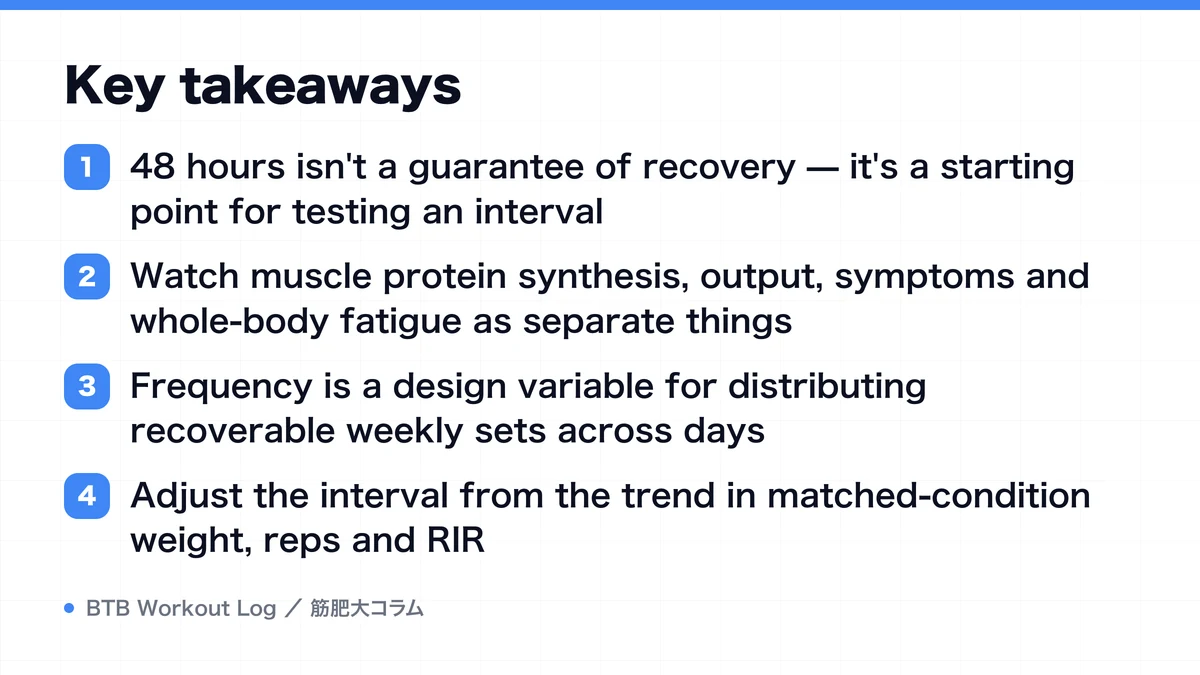
Key takeaways
- 48 hours isn't a guarantee of recovery — it's a starting point for testing an interval
- Watch muscle protein synthesis, output, symptoms and whole-body fatigue as separate things
- Frequency is a design variable for distributing recoverable weekly sets across days
- Adjust the interval from the trend in matched-condition weight, reps and RIR