Progressive Overload: Why You Don't Need to Add Weight Every Session
Adding load every session is one way to achieve progressive overload — it isn't the definition. The core of it is adjusting load, reps and set structure over the long term to match adaptation that's actually occurred.
Turn a load increase into a quota you owe every session and it's easy to sacrifice range of motion, form and RIR just to update a number. What matters isn't the plate you added today — it's the trend in performance under matched conditions and recoverable stimulus.
How far the idea of adding load holds
Adding external load is the most legible way to achieve progressive overload. Run the same exercise at the same range of motion and form, hold reps and RIR steady, and go from 80 kg to 82.5 kg, and you've probably genuinely become capable of handling more. RIR estimates how many reps you had left — RIR 2 means roughly two more were available.
Early on, motor learning and neural adaptation move fast enough that adding load session to session is realistic. Linear progression in that phase is simple and rarely ambiguous. But that's because the capacity to improve is there every session — the act of adding weight itself doesn't guarantee hypertrophy. As training history lengthens, adaptation slows, and the assumption of steady increases at the same pace stops fitting.
So adding load isn't a metric to discard — it matters especially if strength is part of the goal. The myth begins the moment "a load increase under matched conditions" gets swapped for "an increase owed every session regardless of conditions".
Adding a plate doesn't guarantee the stimulus advanced
Progressive overload means advancing stimulus in step with the body's adaptation — not forcing a load increase and calling it settled. Say last time you did 80 kg for 8 at RIR 2 at a consistent range of motion, and this time you finished 82.5 kg for 6 at RIR 0 with a shallower range. The bar got heavier, but reps, effort and movement conditions all changed at once, so you can't simply compare it as hypertrophy-relevant progress.
Load alone can't settle this because several variables decide stimulus and fatigue together. An apparent successful increase can come with form that lets load slip off the target, a shortened range at a shorter muscle length, or more assisting-muscle involvement — none of which confirm stimulus on the intended muscle actually rose.
| Change in the log | Conditions that make it read as progress | Watch out for |
|---|---|---|
| Load rose | Reps, RIR, range of motion and form matched | The number alone can rise from momentum or a shorter range |
| Reps rose | Load and movement conditions matched | Sets far from failure are hard to compare with each other |
| Sets increased | Each set holds quality and you recover within the window | Fatigue alone can rise if late-set quality breaks down |
| Performance held | Conditions got harder — a cut, high fatigue, etc. | Treat separately from a genuine long plateau in normal conditions |
What matters isn't whether you raised some single number every time — it's how training capacity moved under comparable conditions.
Research doesn't make every-session increases mandatory
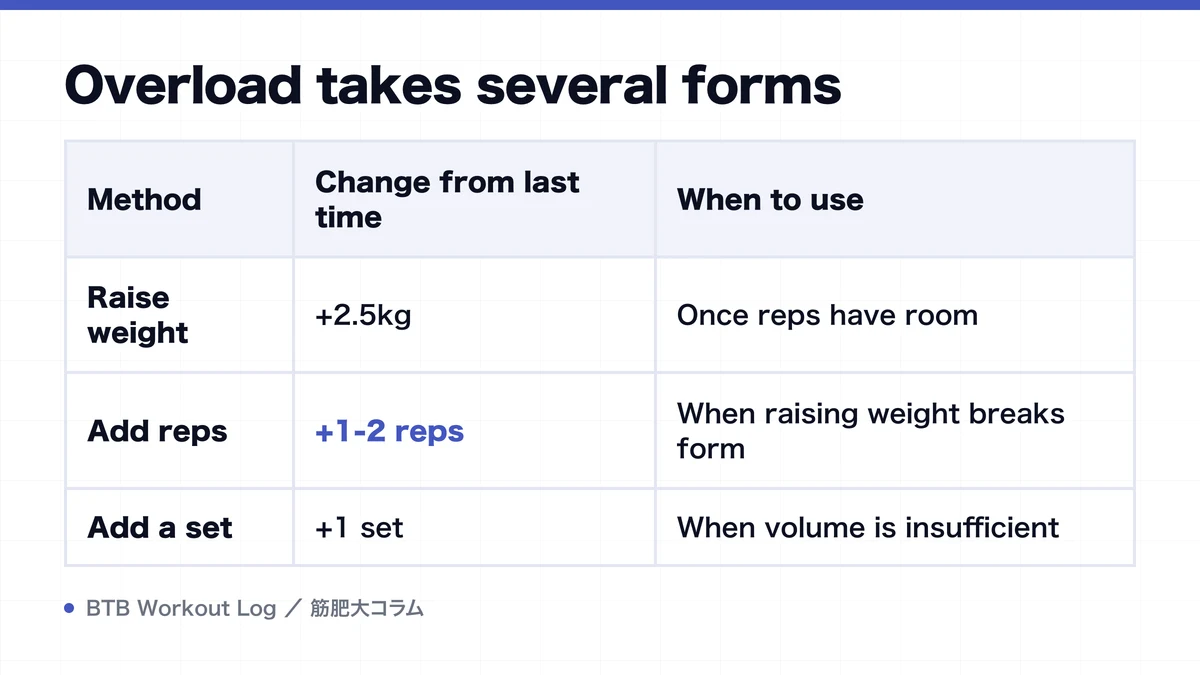
The ACSM progression model describes raising load by 2–10% once you've exceeded your target rep count by one or two reps for two consecutive sessions at the current load. The order here is: confirm you've adapted to the current load, then raise it. It isn't a prescription for mechanically adding a plate every time. The range in increment size exists because a reasonable step differs by exercise, training history and the load you're handling.
Schoenfeld et al.'s 2017 meta-analysis, pooling studies where every set was taken to momentary failure, found comparable hypertrophy between low and high load, while 1RM strength gains favoured higher load. That doesn't mean load is unnecessary — the fair reading is that heavier and "more hypertrophy stimulus" can't be treated as the same claim. Given how specific strength adaptation is, practising heavy loads still has clear value.
A 2022 meta-analysis comparing periodised and non-periodised training with total volume equated found periodised load variation favoured 1RM strength while showing no clear hypertrophy difference. Load can go up and down week to week or day to day and hypertrophy can still progress if the long-term design holds. What matters is the combination of stimulus, total volume and recovery over weeks to months, not any single session's increase.
None of this shows "any approach works the same". Results can shift with participants, exercises, how close to failure and how volume was matched. Even so, it's not grounds for making every-session load increases a required condition for progressive overload.
Why progressive overload shrinks to "add weight every time"
Load is objective — success or failure is visible on the spot. It's simpler to look at whether you added a plate than to evaluate reps, RIR, form, range of motion and weekly sets together. The clarity of linear progression from strength programmes sometimes gets carried across the entire hypertrophy timeline unchanged.
But real performance has day-to-day noise. Sleep, recovery from last time, food, time of day and warm-up alone change how the same load feels. Force an increase purely to keep the plan on schedule on a day your usual weight feels heavy and you risk exceeding your target RIR or breaking down your movement. Calling one off day a regression is just as premature as calling one personal best hypertrophy.
Equipment increments reinforce the myth too. Go from a 20 kg dumbbell per hand to 22 kg and that's a 10% jump per side — a large step even though it feels like "just a bit more" to an intermediate lifter. Not adding load every time isn't weak willpower — sometimes the equipment's step is simply bigger than your adaptation range. Turn load increases into a scorecard of diligence and you tend to accumulate unnecessary failed sets.
In practice, decide the trigger for an increase in advance
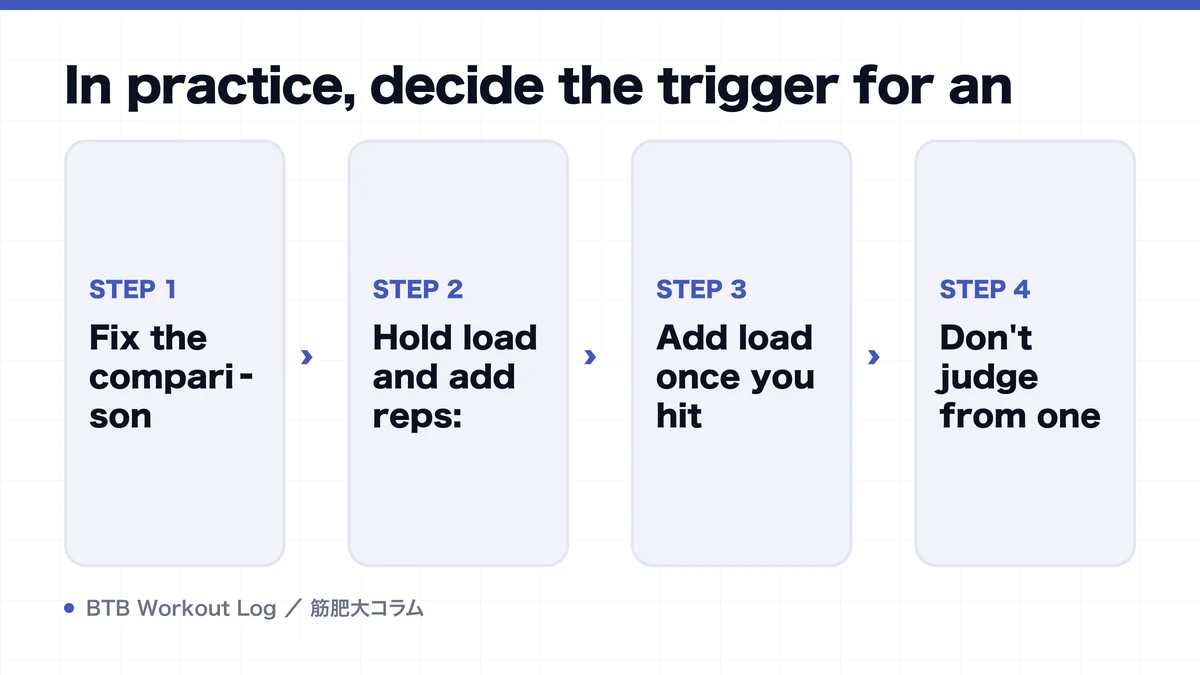
Instead of adding load every time, decide "what has to happen before I add load". A rep range combined with RIR is a practical method. Targeting 8–12 reps at RIR 1–3, say, confirm every set is landing near the top of the range at the same form and range of motion, with room left at your target RIR, before adding the smallest available increment. Reps dropping back toward the bottom of the range after that increase is expected, not a failure.
- Fix the comparison conditions: exercise, equipment, range of motion, form and rest period matched as far as possible.
- Hold load and add reps: check whether reps rose at the same RIR. This overlaps with why reps matter too.
- Add load once you hit the top: choose the smallest increment that still lets every set hold quality.
- Don't judge from one session: watch several under matched conditions to average out a lucky or unlucky day.
RIR estimates aren't perfect, but a study by Lovegrove et al. found good test-retest reliability in young, novice men selecting loads at an estimated 1 RIR across 3-, 5- and 8-rep sets of bench press and deadlift. The population was limited, so it shouldn't be generalised to everyone unchanged — but as a general habit, logging reserve at the end of a set alongside load and reps gives you something to review under matched conditions. If you're still new to RIR, occasionally checking your prediction against actual reps to failure on the same exercise helps calibrate the estimate.
If neither load nor reps have moved for weeks, check fatigue, rest, exercise stability and energy intake before reflexively adding a set. If stimulus is genuinely short, adding a set is an option — but adding volume on top of poor recovery deepens a plateau instead.
Judge progressive overload from the trend, not one session
Your log gets clearer read across three timescales. At the set level, log load, reps, RIR and range of motion. Across several sessions, check whether matched-condition reps or total reps are trending up. At the programme level, check hard sets per muscle group, fatigue and how well you bounce back after a deload. One session's load increase is only the first data point — whether progressive overload is actually working shows up in the second and third.
Holding steady has value too. If you maintained performance at the same range of motion and RIR through a cut, a stretch of poor sleep, or the tail end of a high-volume block, you may have held capability against worsening conditions. Conversely, if several indicators stay flat for a long time under favourable conditions, that's when strategies for breaking a plateau are worth considering. One session where you couldn't add load isn't reason to overhaul the whole programme.
A log doesn't produce hypertrophy — it stops you confusing a day to add load, a day to hold, and a time to redesign the programme. Even in a week where load doesn't move, overload is still happening if reps or set count do. BTB Workout Log keeps all three side by side.
Not "could I add a plate every time" but "is the work I can do under matched conditions rising over the long run, and am I recovering from that stimulus" — only once you're checking that can you say you're actually running progressive overload.
FAQ
- If the same load holds for several weeks, has progressive overload failed?
- Not immediately. If reps or total reps are rising at the same form, range of motion and RIR, that's progress. If load, reps and RIR are all flat across several sessions and recovery conditions look fine, revisit set count, exercise selection or programme structure.
- Doesn't lowering load for a deload work against progressive overload?
- Not necessarily. A deload deliberately lowers stimulus temporarily to clear fatigue and set up higher-quality training afterward. Even with a short-term load drop, the long-term design holds if capability and stimulus trend upward over the following weeks to months.
- If I add sets instead of load, is that still progressive overload?
- Adding sets can be a way to raise stimulus, but it isn't automatically effective. Each set still needs sufficient effort and movement quality, and you still need to recover by next time. If recovery is short or late-set quality is falling, address rest or distribution before adding volume.
Key takeaways
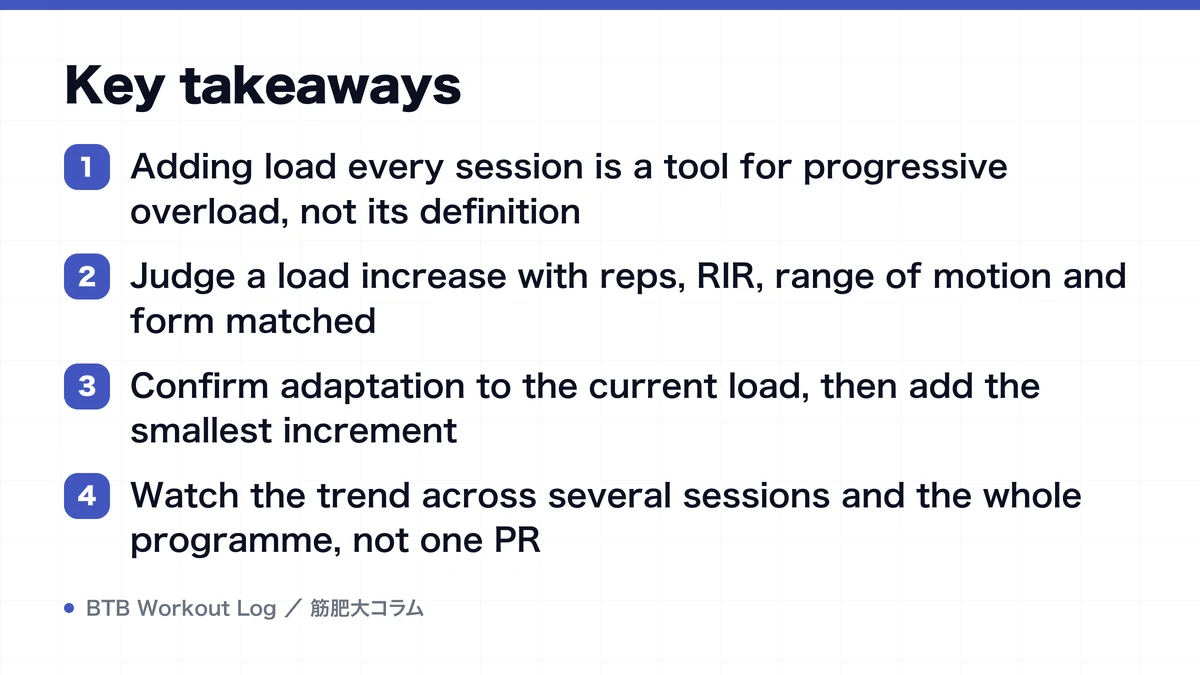
- Adding load every session is a tool for progressive overload, not its definition
- Judge a load increase with reps, RIR, range of motion and form matched
- Confirm adaptation to the current load, then add the smallest increment
- Watch the trend across several sessions and the whole programme, not one PR