Why 3 Sets of 10 Stops Working | Hypertrophy Has No Single Formula
"3 sets of 10" is a convenient starting point — it isn't a prescription that represents the right answer for hypertrophy. The same 10 reps carry different reserve to failure, and the same 3 sets carry different stimulus to the target and different weekly totals.
You don't need to throw the numbers out. Read reps, RIR (reps left in reserve), weekly sets and progress together, and 3×10 stops being a fixed rule and becomes an adjustable template.
Why "3 sets of 10" became the default
Ten reps sits away from extreme heavy load or long high-rep ranges, so it's manageable for practising form and handling load on many exercises. Three sets gets more reps in than one without eating too far into session time. It's easy for a coach to explain and easy for a lifter to remember, which is exactly why it spread as shared vocabulary for a first programme.
That practicality doesn't need dismissing. The problem is letting a convenient default quietly become a necessary condition for hypertrophy. Ten reps and three sets only tell you the planned rep count and the number of working sets. They don't tell you how heavy it was, how much the target actually worked, how many sets you did across the week, or whether you progressed from last time.
So 3×10 works as "coordinates to start a programme from" — it isn't "proof the stimulus was appropriate". Not treating a prescription and an evaluation as the same thing is the first step away from the fixed-rep myth.
How far are 10 reps and 3 sets actually correct?
On an exercise that loads the target reliably, keeps stable movement, and lets you estimate RIR per set, around 10 reps works perfectly well. Three sets is reasonable too, as long as form and output hold to the last one. In practice, when you're establishing a baseline on a new exercise, starting from 3×10 is easier to compare than changing conditions every time.
But the same 10 reps can mean very different things. Stop at 10 on a load you could manage 15 on and RIR is around 5; stop at 10 on a load where an 11th rep is genuinely hard and RIR is around 1. And 10 reps of squat and 10 reps of lateral raise don't share the same breathing demand, joint load or local fatigue. Handling reps by exercise belongs with rep ranges, and reading reserve belongs with RIR — keep them separate.
Three sets differs too: someone who can still hit the target on set 3 and someone who shifts to momentum or assisting muscles from set 2 aren't doing the same thing. Confirming each set still holds the same purpose matters more than defending the number itself.
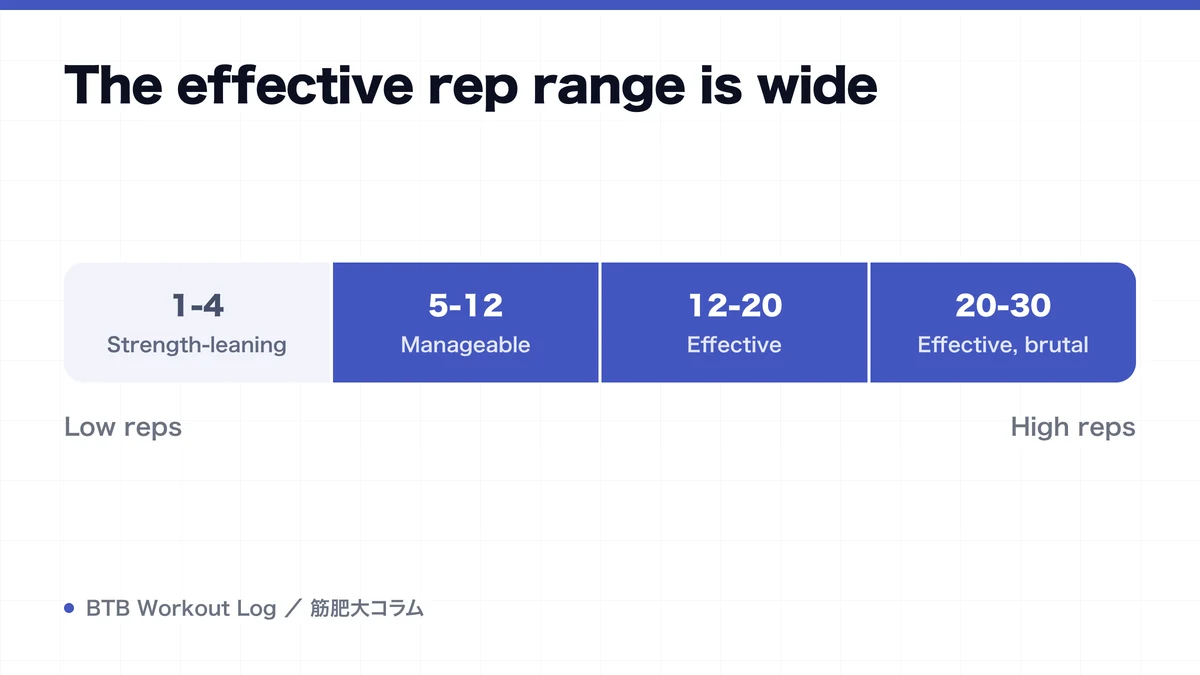
What "10 reps" and "3 sets" leave out
| Visible number | What the number alone can't tell you | What to check as well |
|---|---|---|
| 10 reps | Distance to failure, form, range of motion | RIR, movement conditions, breakdown in rep speed |
| 3 sets | Contribution to the target, late-set decline | Load and reps per set, the exercise's role |
| 3 sets of one exercise | Weekly total including other exercises and frequency | Weekly hard sets per muscle group |
| This session's completion | Multi-week progress and recoverability | Comparison with last time, next-session output, pain or fatigue |
Do 3 sets of bench press on chest day, and if you also do dumbbell press another day, your weekly chest volume isn't 3 sets. Conversely, if triceps fatigues first on bench press and chest's actual contribution is small, counting those 3 sets straight as "3 chest sets" is a crude read too. Weekly sets need tallying per muscle group, distinguishing direct exercises from ones that only work a muscle indirectly.
Blend warm-up into your working-set count, add a rep with a shortened range as if it were the same as a full one, or let short rest quietly wreck only the later sets, and hitting "3×10" stops being comparable with last time. A number only becomes evidence once it's measured under matched conditions.
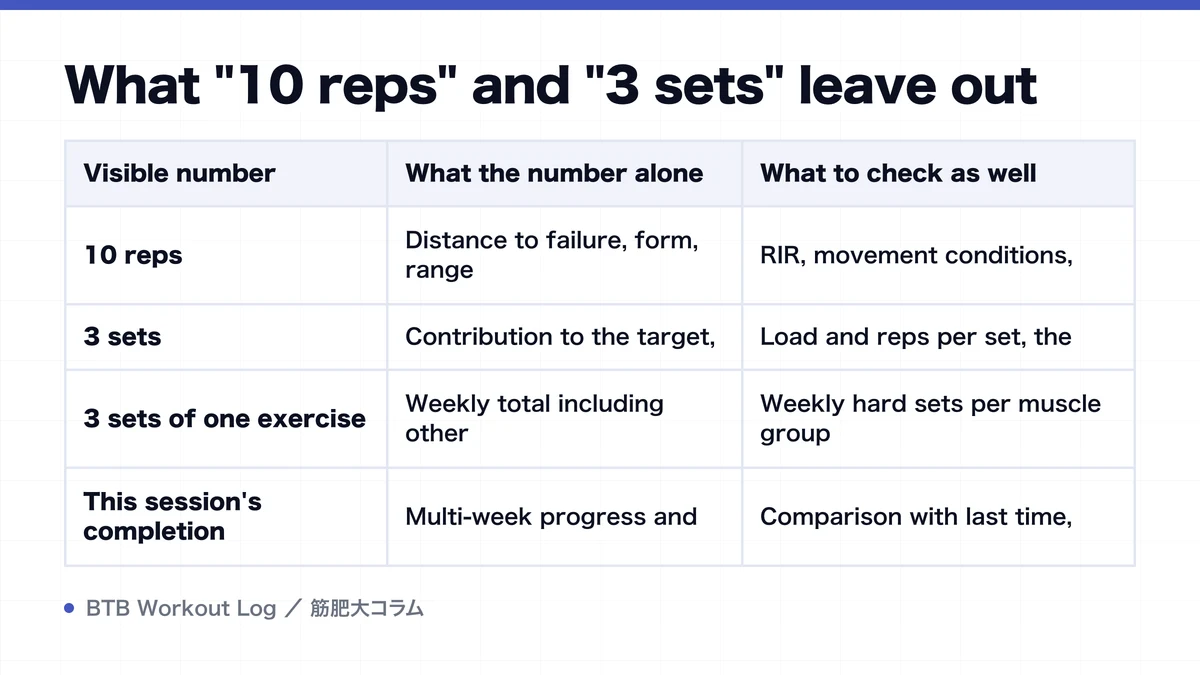
Research doesn't support "only 3 sets of 10"
Schoenfeld et al.'s 2017 meta-analysis, comparing low and high load where sets were taken to muscular failure, found comparable hypertrophy changes while maximal strength favoured high load. That isn't "any rep count works the same" — but it does show hypertrophy isn't confined to a narrow band around 10 reps. Which load and rep count suit you best shifts with whether strength is also a goal and whether an exercise can safely be pushed near failure.
A separate meta-analysis on weekly volume found an average dose-response trend — more sets, more hypertrophy. That doesn't establish 3 sets of one exercise as "too few" or "too many" on its own. What the research addresses is total weekly volume; whether 3 sets is right for you depends on frequency, other exercises, training history and recovery combined. That's why training volume is worth reading at the weekly level, not as a single-session prescription.
A 2023 meta-analysis on proximity to failure found no clear evidence that taking every set to momentary muscular failure beats non-failure training for hypertrophy. So neither "stop at 10" nor "push past 10 to failure" is a fixed rule. Studies differ in participants, exercises, volume and how failure was defined, so be careful not to convert an average result straight into a fixed personal prescription.
Why a simple prescription looks like the right one
3×10 has the appeal of an instant verdict — did 10 or not, filled three lines or not. RIR, contribution to the target, weekly volume and recovery all need observation and interpretation and don't collapse into one clean number. So the metric that's easiest to track can feel like the one that matters most.
Sample programmes also present a safe setting most people can execute. 3×10 as an example is useful, but the context for individual adjustment tends to disappear as an example gets quoted over and over. Like a standard recipe: the starting quantities exist to get you cooking, not as a rule you can never adjust for your ingredients or your stove.
What deserves dropping isn't 3×10 — it's the assumption that hitting the number finishes the prescription. If someone is progressing on 3×10, they don't need to change it. If someone isn't, they don't need to change reps, sets and load all at once either. Keeping the template as a comparable baseline and filling in whatever variable is missing is the more sensible route.
How to rebuild "3×10" in practice
1. Turn a fixed rep count into a rep range
Decide a range you can reliably hold per exercise. As examples: 6–10 for multi-joint lifts where form matters most, 8–15 for stable machine work, 10–20 for single-joint exercises. This is a starting point, not a ranking. If a joint feels off or systemic fatigue is high, pick a different range that still trains the same muscle.
2. Attach a target RIR to every set
Replace "10 reps" with "8–12 reps at RIR 1–3" — combine reps with reserve. Don't make failure mandatory every session; pick a load that lets you hold your intended reserve and form. If your RIR estimate feels unreliable, don't chase precision from day one — keep repeating the same exercise and learn from the gap between your estimate and reality.
3. Set set count at the weekly, per-muscle-group level
Don't isolate 3 sets of one exercise — add it to the weekly frequency of every other exercise hitting the same muscle group. If current volume is producing rising load or reps and you're recovering by next time, there's no reason to add sets. If progress has stalled for several weeks with no major issue in sleep, nutrition or movement conditions, and late-set quality still holds, add one or two sets a week and watch the response.
4. Judge a change against last time
Once you hit the top of your rep range at the same form, range of motion, rest and RIR, add a small load increment next time and restart near the bottom. That's the operation that makes progressive overload observable. If only the later sets suddenly lose reps, revisit rest or load selection before adding sets. When you change 3×10, move one variable at a time so you can actually trace the cause.
Your log doesn't make a prescription correct — it's the evidence for deciding whether to keep the current prescription or adjust it.
FAQ
- Is it fine for beginners to start with 3 sets of 10?
- Yes. It's a manageable setup for learning exercises and establishing a baseline load and rep count. Just log RIR and form at rep 10, and adjust load or rep range if there's too much reserve or if movement starts breaking down.
- If load or reps are rising on 3 sets of 10, should I change it?
- No need. If you're progressing at matched movement conditions and your target RIR while recovering by next time, that prescription is working for you right now. Holding the baseline until progress stalls is easier to compare than adjusting sets or reps to match general advice.
- Is it a problem if I can't hit 10 reps on all three sets?
- Some rep decline on later sets is natural. Ten, then nine, then eight isn't a failure if each set stays within your intended range and RIR with form intact. If the drop is sharp, check for insufficient rest, too much load, or fatigue carried from the previous exercise.
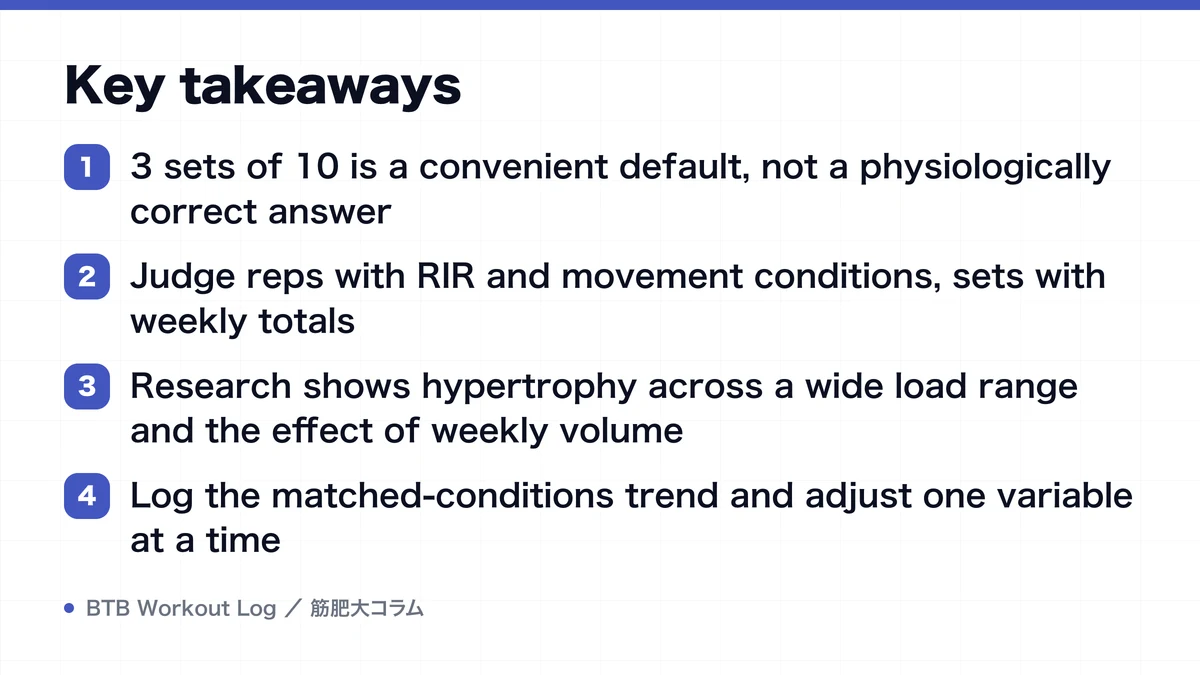
Key takeaways
- 3 sets of 10 is a convenient default, not a physiologically correct answer
- Judge reps with RIR and movement conditions, sets with weekly totals
- Research shows hypertrophy across a wide load range and the effect of weekly volume
- Log the matched-conditions trend and adjust one variable at a time