Hypertrophy: Heavy Weights or High Reps? What Meta-Analyses Say and How to Use Both
Bottom line: as long as you push close to failure, heavy low-rep and light high-rep training produce equivalent muscle growth - that's what the meta-analyses show.
"Heavier is better" and "chase the pump with light weights" are both wrong. The key isn't load - it's how close to failure you take each set.
What the meta-analyses actually found
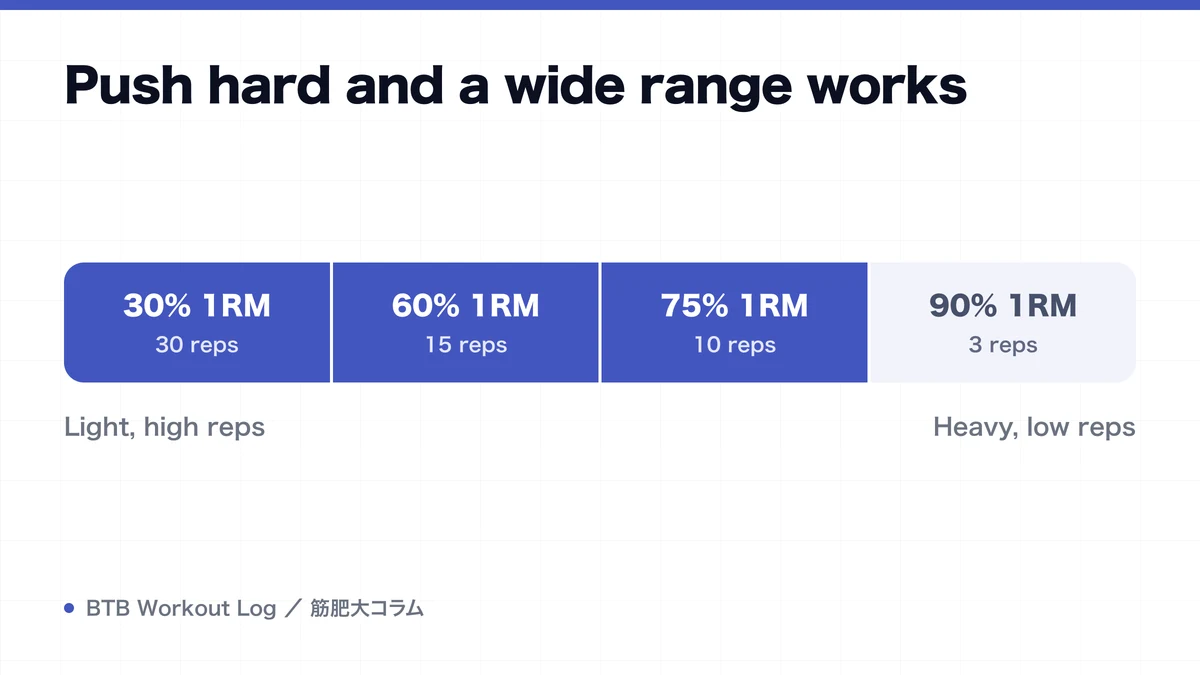
Multiple studies and their meta-analyses comparing low-load, high-rep training (e.g., around 30 reps) with high-load, low-rep training (e.g., around 8 reps) consistently find that when sets are taken to or near failure, muscle growth is not significantly different. Muscles don't respond to the load itself - they respond to the stimulus delivered to the muscle fibers when they're pushed close to their limit. Hypertrophy occurs across a wide load range, roughly 30-85% of 1RM, as long as you get close enough to failure.
That said, strength is a different story
While muscle growth is similar across the load range, maximal strength responds clearly better to heavier loads. Specificity - training at the same load range you want to get stronger at - and neural adaptations both favor high-load, low-rep work for peak strength. So: if you want to move heavier weight, train heavy; if the goal is muscle growth, the rep range barely matters. Most people want both, so mixing rep ranges is the practical answer.
A smart way to divide the load ranges
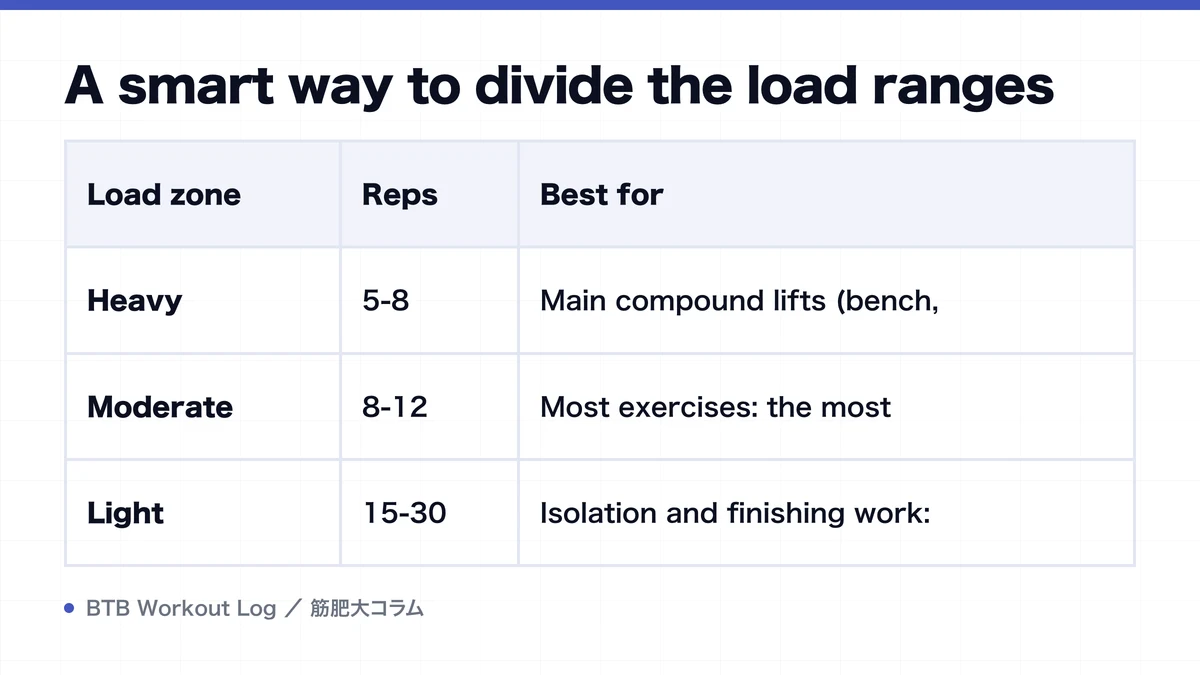
| Load zone | Reps | Best for |
|---|---|---|
| Heavy | 5-8 | Main compound lifts (bench, squat, etc.): strength + muscle growth |
| Moderate | 8-12 | Most exercises: the most volume-efficient zone for muscle growth |
| Light | 15-30 | Isolation and finishing work: joint-friendly, great for chasing a pump |
Exercises that put a lot of stress on the joints - or isolations where form breaks down with heavier loads - are safer and more effective in the higher-rep zone. Heavy compound lifts suit a lower-to-moderate rep count. Match the load to the exercise's characteristics.
The conditions that apply regardless of load
No matter which load zone you choose, two things are non-negotiable: push close to failure on every set (RIR 1-3), and beat what you did last session. Easy, comfort-zone sets don't produce meaningful growth even at high rep counts. And heavy weight isn't progress if the reps aren't going up. Whatever load range you choose, the principle stays the same: track your previous numbers and apply progressive overload.
Even when hypertrophy is equal, low reps and high reps are not the same
What the meta-analyses show goes only as far as this: once you match proximity to failure, the difference in hypertrophy is small - it does not mean that low reps and high reps are exactly the same tool. Even if they reach the same amount of hypertrophy, the cost of getting there differs.
Low reps (roughly up to about 5 reps per set) put a large load on joints and tendons per rep, and how consistently you can reproduce your form drives the result. Warming up also takes time. On the other hand, each set is short and the target muscle tends to reach its limit before your breathing or concentration does, so judging progressive overload becomes easy to read plate by plate.
High reps (the zone above 15 reps) reduce the per-rep load on your joints, but the discomfort late in the set is strong, and your cardiovascular system or grip can give out first, leaving the target muscle short of its limit. Each set also takes longer. So the axis of choice is not which one works, but which one lets you use the intended muscle close to its limit on that exercise.
When to choose heavy loads and when to choose light loads
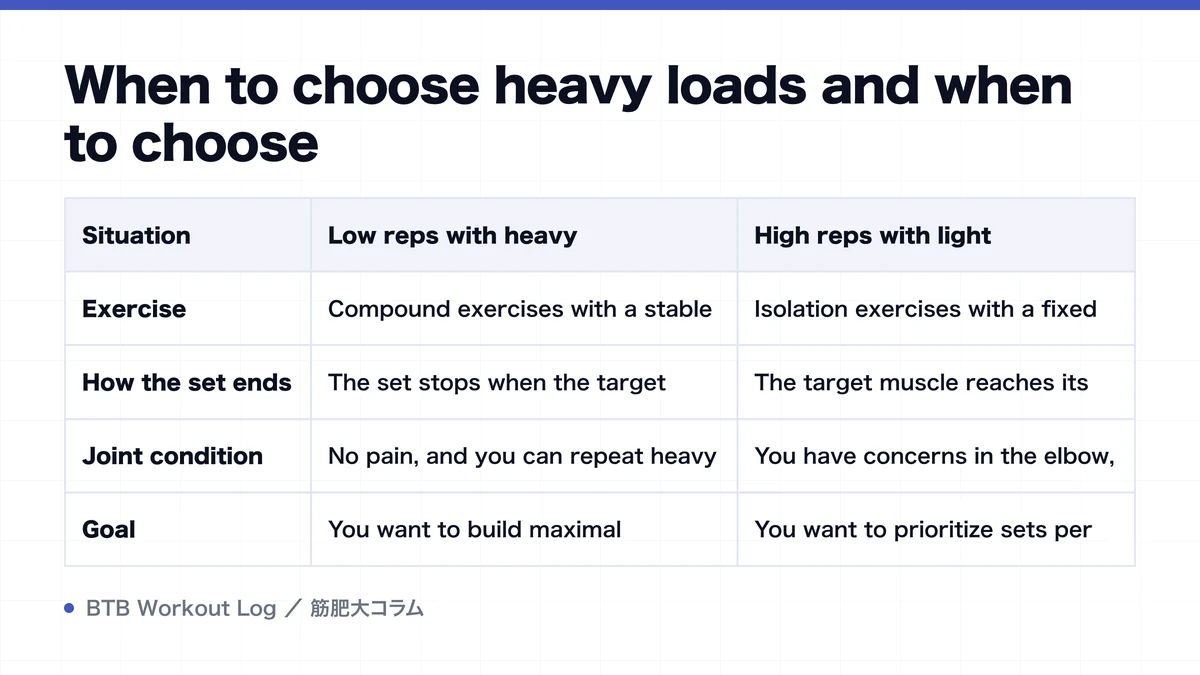
| Situation | Low reps with heavy load fits | High reps with light load fits |
|---|---|---|
| Exercise | Compound exercises with a stable groove, such as squats, bench press, and rows | Isolation exercises with a fixed path, such as raises, curls, and cable work |
| How the set ends | The set stops when the target muscle gives out | The target muscle reaches its limit before your cardio or grip does |
| Joint condition | No pain, and you can repeat heavy loads | You have concerns in the elbow, shoulder, or knee and want to spread the load |
| Goal | You want to build maximal strength at the same time | You want to prioritize sets per unit of time or movement quality |
In most cases, rather than pushing everything to one side, it is easier to design your program by splitting roles: low to moderate reps on the main lifts, moderate to high reps on accessory and finishing work. A partial change, such as raising the rep range only on the exercises where a joint feels off, is also realistic.
What you are deciding here is not the correct rep count, but the range in which you can keep comparing under matched conditions on that exercise. If you move the rep range often, you lose the ability to read whether you improved or just changed load zones.
Judge the load range that suits you from a few weeks of logs
Which of low reps and high reps suits you is not settled by an average value from research. What settles it is whether weight, reps, and RIR moved when you fixed the rep range on the same exercise for a few weeks.
The procedure is simple. Pick a rep range on one exercise (for example 5-8 reps, or 12-15 reps) and progress only within that range for 4 weeks. Every time, record the weight you used, the reps you completed, your RIR at the end, and the reason the set stopped (the target muscle, your grip, or pain). If either weight or reps has trended up after 4 weeks, that rep range is working for you.
Conversely, if the numbers are flat and the reason the set stops has not changed either, it is worth shifting the rep range. What the judgement needs is your previous values rather than your memory, so in a setup like a workout log app, where the previous weight and reps are visible on the spot, this comparison takes a few seconds between sets.
FAQ
- Is the pump a reliable indicator of muscle growth?
- Not directly. A pump is a temporary change in blood flow and fluid - it doesn't correlate with actual muscle growth. That said, it often comes with high-rep, short-rest work and can signal you're getting close to failure. The real indicator to track is your previous session's weight and reps.
- Can you really build muscle with light weights?
- Yes. Close to failure, low-load high-rep training produces equivalent muscle growth to heavy work, according to multiple studies. The practical downside is that high reps are harder to push close to failure and take more time.
- Which load zone should beginners start in?
- Moderate weight in the 8-12 rep range is the best balance for beginners: it builds muscle efficiently while giving you room to learn technique. Add heavier and lighter work as you progress, matched to each exercise.
Key takeaways
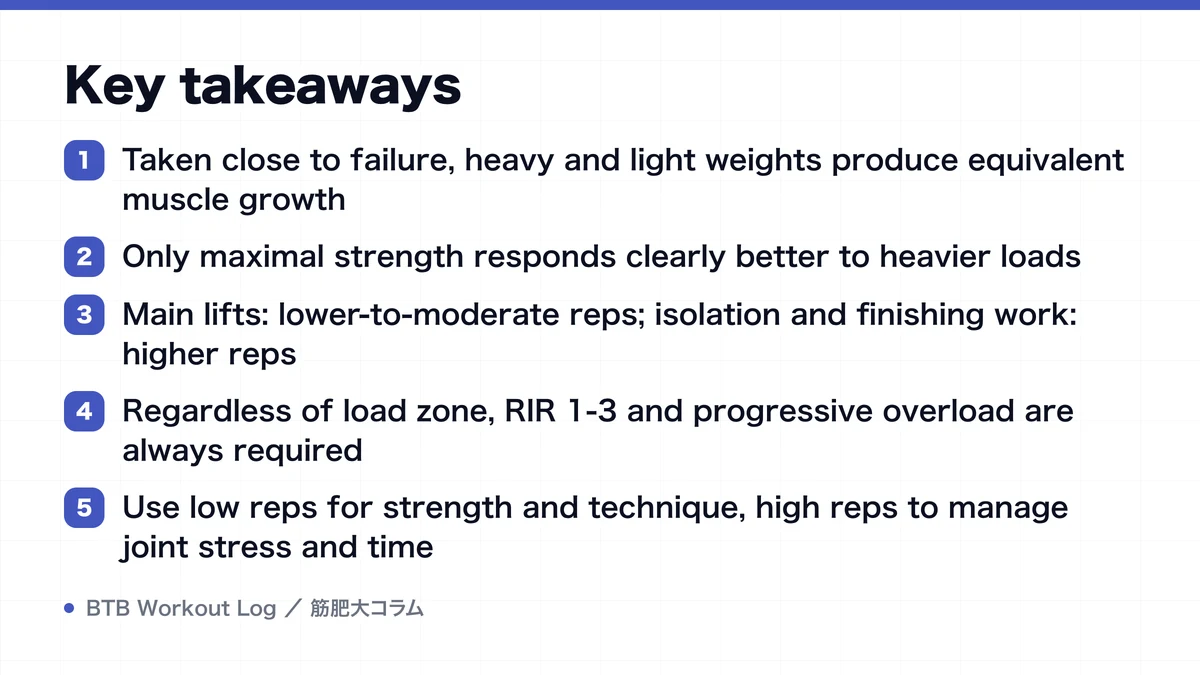
- Taken close to failure, heavy and light weights produce equivalent muscle growth
- Only maximal strength responds clearly better to heavier loads
- Main lifts: lower-to-moderate reps; isolation and finishing work: higher reps
- Regardless of load zone, RIR 1-3 and progressive overload are always required
- Use low reps for strength and technique, high reps to manage joint stress and time
- Decide which suits you from a few weeks of weight, rep, and RIR trends