Same Workout Every Week? When Sticking With It Pays Off
Repeating the same programme week to week isn't what blocks hypertrophy. Holding exercises, order and rep ranges steady is exactly what makes changes in capability easy to read and progressive overload easy to accumulate.
The problem isn't that the programme looks the same. It's leaving load, reps and set quality unchanged while your body has stopped responding — and not adjusting.
How far "your muscles get used to it" holds
Keep applying the same stimulus and the body adapts, so the response gets smaller than it was. There's something right in that. Repeat the same load, reps, sets, range of motion and RIR for a long stretch and the relative intensity does fall. RIR is your reserve — how many reps you had left. If a weight that used to be RIR 1 now feels like RIR 4, the same set has become lighter as far as your body is concerned.
But you can't get from there to "so change exercises every week". What adapts isn't the exercise name on the sheet — it's the load actually applied. Same squat, form and range of motion held, load or reps rising: the stimulus isn't what it was. Swap only the exercise name while tension on the target and weekly hard sets barely move and you haven't necessarily advanced anything.
Getting "used to" training also has an upside: the movement stabilises. Less variation in form means load lands on the target more reliably, which makes your set-to-set comparisons sharper. Start by refusing to treat "less novel" and "no longer effective" as the same thing.
The same programme and the same stimulus aren't the same thing
What a fixed programme preserves is the frame you need for weekly comparison. Keep exercises, order, target rep range, range of motion and rest periods roughly aligned and changes in load and reps become readable. Advancing load inside that frame as capability allows is progressive overload.
| What this week looks like | How to read it | What to do |
|---|---|---|
| Load or reps rising on the same exercise | Same frame, but capability and stimulus have advanced | Keep the programme |
| Same load and reps at a higher RIR | The same work has more margin in it | Advance load within the target range |
| Numbers flat but range of motion or momentum worsening | Maintenance in appearance only; conditions have drifted | Fix form or adjust the load |
| Repeated drops plus poor recovery | Fatigue, volume or nutrition need checking | Isolate the cause |
Not adding weight every session is fine — more reps, or the same work with more margin, is progress. Drop the belief that only added load counts as overload and you start finding the small changes inside a fixed programme.
Conversely, picking different exercises each week doesn't automatically increase stimulus. When the reference point keeps moving, you can't tell whether a load change came from strength, from the difficulty of the exercise, or from simply getting familiar with it. Fixing things isn't stagnation — it's the experimental condition that makes progress measurable.
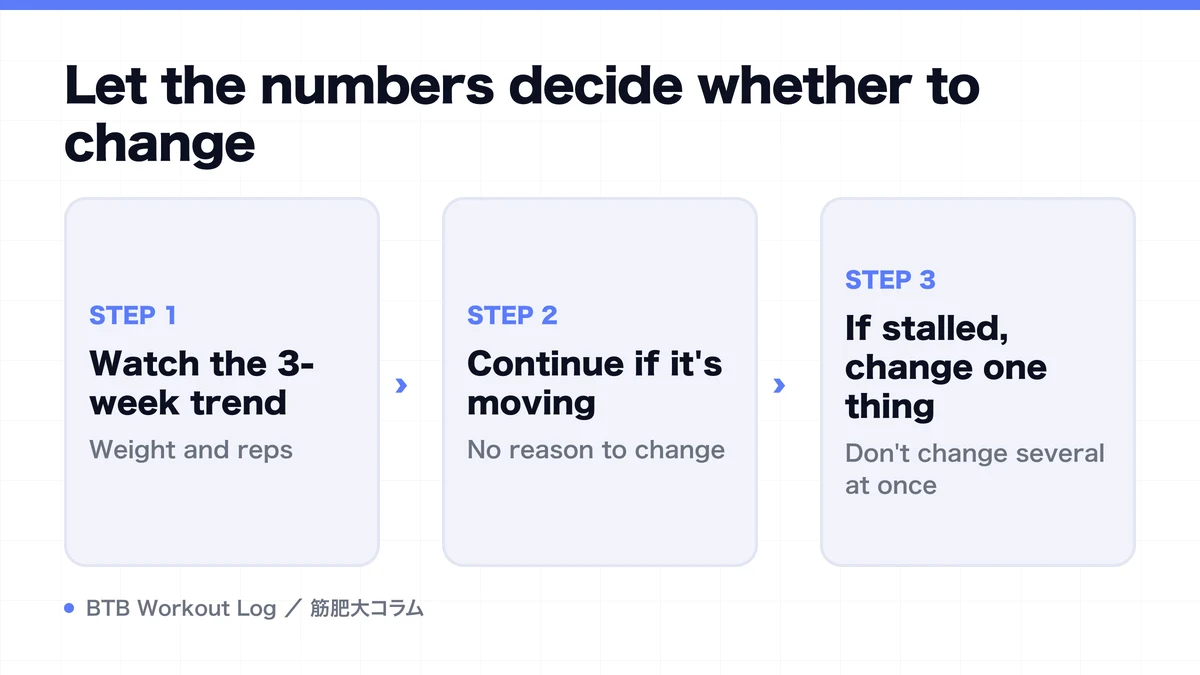
Periodisation research doesn't say "swap exercises weekly"
Periodisation gets cited whenever programme changes come up. Periodisation means planned variation in load, reps and sets across a defined period. It is not a synonym for replacing your entire exercise list every week. Keeping the same main lifts while alternating heavier phases and volume phases is also periodisation.
In systematic reviews and meta-analyses of studies with training volume equated, periodisation tends to favour 1RM strength while possibly showing no clear advantage for hypertrophy. That isn't a conclusion that variation is pointless, nor that a fixed programme is always best. When you design for hypertrophy, novelty is only one input alongside stimulus to the target and a recoverable total volume.
Periodisation in the research also includes changes in load and volume, and the actual programmes, participant experience and study durations differ. So there's no universal deadline for "swap exercises after N weeks". In fixed programme versus rotation too, what's worth comparing isn't novelty but progress, fatigue, time efficiency and individual response.
What you can change while keeping the same exercises
- Load and reps: add weight once you reach the top of the rep range.
- Set count: raise or lower it for specific muscle groups based on progress and recovery.
- RIR: leave more in reserve in an introductory week, then approach your target intensity as weeks pass.
- How volume is distributed: hold weekly volume while adjusting per-session set quality.
So "same programme or varied programme" isn't a binary. You can keep the skeleton for comparison and move only the variables you meant to move.
Why new exercises feel more effective
An unfamiliar exercise tends to produce more soreness, more pump and more local fatigue. That "different from usual" sensation is easy to read, so it looks like the fixed programme stopped working and the new exercise restarted growth. But a strong sensation on the day and greater hypertrophy over weeks to months are separate claims.
Changes made during a plateau muddy things further. Swapping an exercise usually coincides with lighter loads, fewer sets, a pain-free path, and renewed motivation. If numbers rise afterwards, "because the exercise was new" isn't established. Fatigue clearing, or simply being able to load the target more easily, may be doing the work.
Of course, if boredom wrecks your focus and consistency, planned variation genuinely helps — enjoyment is a real variable in adherence. Just keep the purpose separate: changing to relieve boredom and changing to raise the hypertrophic stimulus are different decisions.
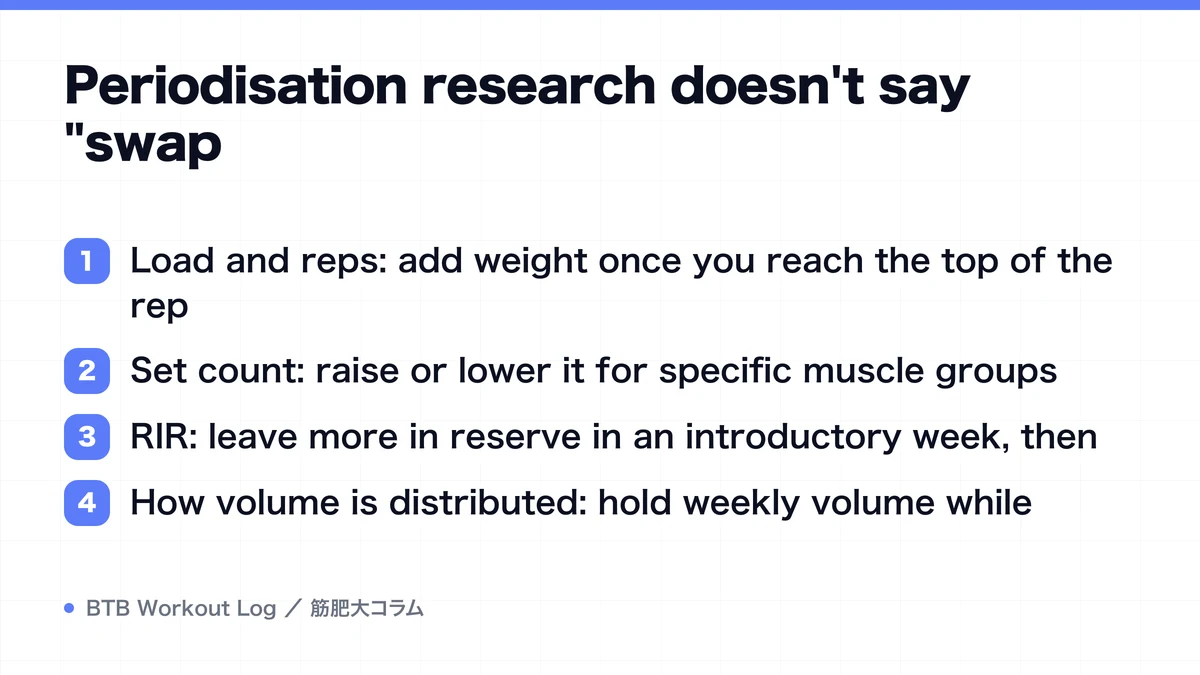
Separate your reasons for keeping from your reasons for changing
Judge on whether the current programme is doing its job, not on a deadline. And one bad session is never a reason to replace everything: sleep, food, what you did beforehand and measurement noise all make the same exercise fluctuate day to day.
| Reasons to keep | Reasons to change |
|---|---|
| Load, reps or margin trending up under the same conditions | Progress stalled across several comparisons and other variables didn't move it |
| You load the target muscle reliably | Persistent pain or discomfort that path adjustments don't fix |
| Weekly volume is recoverable and next-session quality holds | Overlapping roles are dragging late-session quality down |
| It fits your equipment and your life | Facilities, time or motivation make it unsustainable |
When you do change, state the problem in one sentence first. "I can't target upper chest", "my knee keeps complaining in squats", "late-session quality drops" — each of those narrows the options. If the reason is only "I might be adapting", check load, rep, RIR and weekly volume trends before touching anything.
Then change the smallest unit. Keep the main lift and swap one accessory; move only the rep range; cut only the set count. Change everything at once and you'll never know what helped. Why too many exercises blurs progress and exercise count and hypertrophy connect here through the same idea: preserve the conditions for comparison.
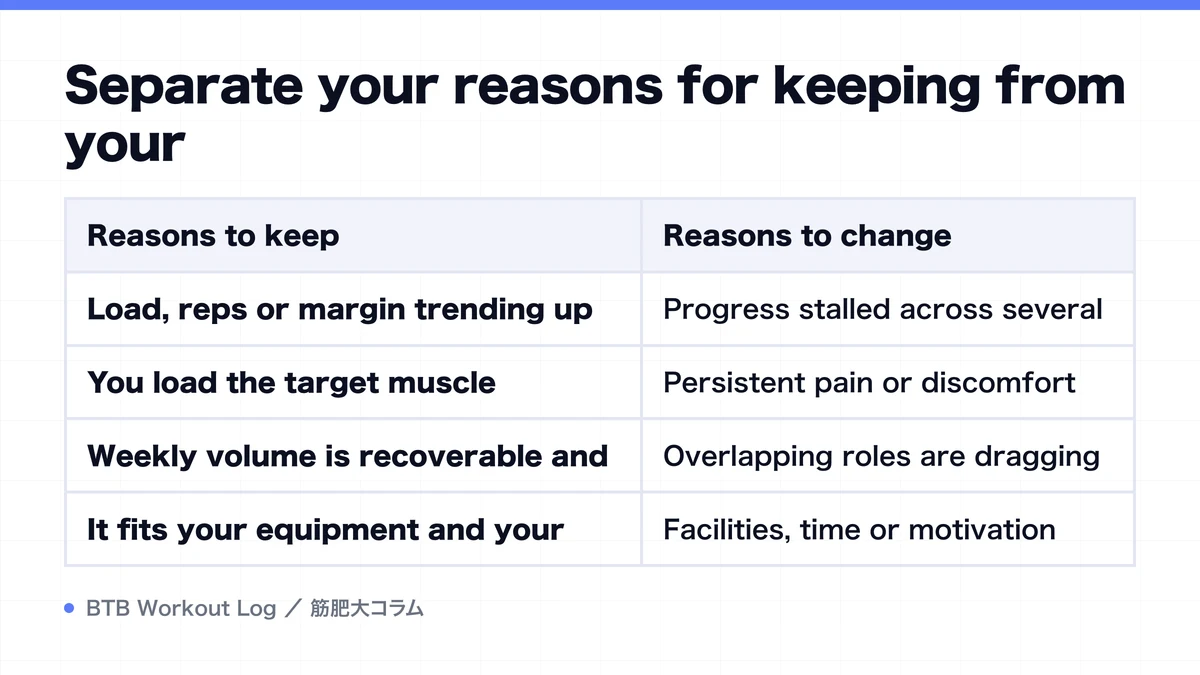
Run the same programme as your measure of growth
In practice, hold main lifts and basic conditions steady in multi-week blocks and compare load, reps, RIR and range of motion set by set. On an exercise targeting 8–12 reps, accumulate reps at the same load, hold your target RIR, and add a small increment once you hit the top. After the increase you build again from the bottom of the range. The sheet looks identical while the stimulus keeps updating with your capability.
If, on the other hand, several sessions decline under the same conditions, check weekly sets, sleep, nutrition, rest periods and RIR drift before swapping exercises. Everything falling at once points to recovery; one exercise stalling alone points to technique or exercise fit. Having a fixed reference is precisely what lets you localise a plateau.
Using your log as evidence makes it easier to tell inertia from steady repetition. Whether you can keep running the same programme comes down to one thing — whether the numbers are moving — and BTB Workout Log is where that evidence lives.
Changing your programme is a means, not proof of growth. Keep what's progressing inside the frame, and change only the part with a clearly named problem. Run it that way and stability and variation stop being opponents.
FAQ
- How many weeks can I run the same programme?
- There's no universal limit. You can keep going while load or reps trend up at the same form, range of motion and RIR, there's no pain or poor recovery, and it fits your life. Judge changes on several sessions of data, not one off day.
- Once my muscles adapt, do I have to change exercises to keep growing?
- Changing the exercise name isn't required. Advance load, reps, sets and RIR on the same exercise in line with your capability and the stimulus updates. When numbers stall and fixing recovery and load selection doesn't move them, then a change is a candidate.
- Should I rebuild the whole programme when I plateau?
- First establish whether every exercise stalled or just one. Everything at once points to recovery or weekly volume; a single exercise points to technique or fit. Change only the variable that's implicated — a full rebuild destroys the link between cause and effect.
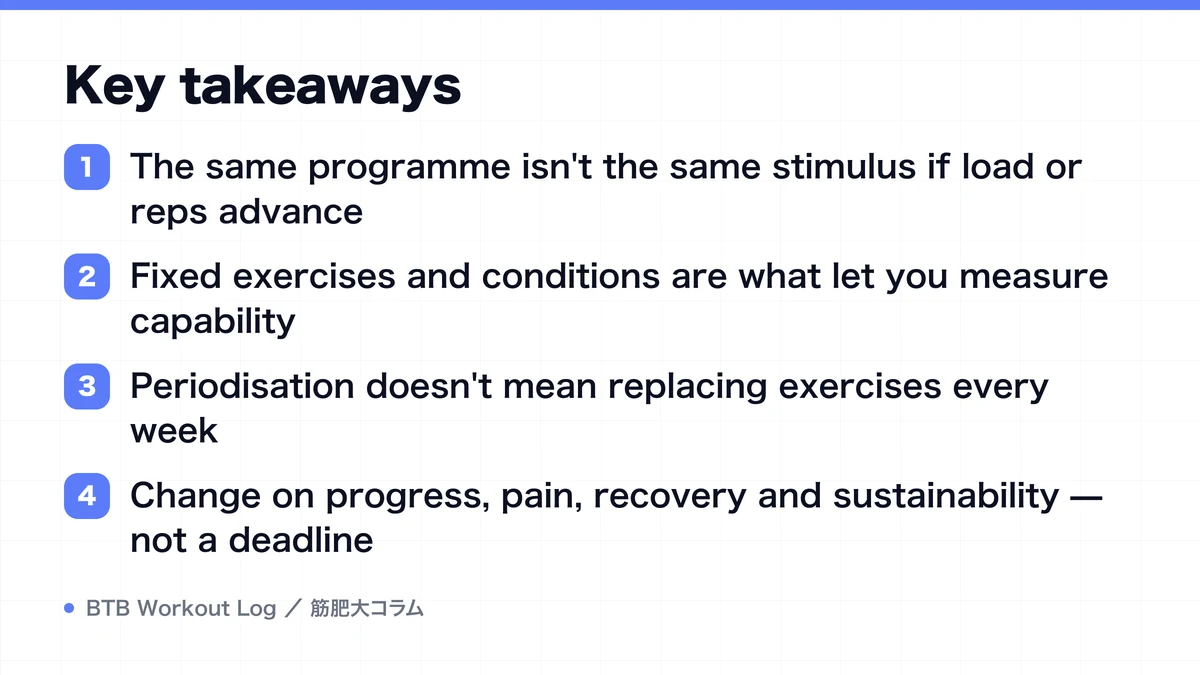
Key takeaways
- The same programme isn't the same stimulus if load or reps advance
- Fixed exercises and conditions are what let you measure capability
- Periodisation doesn't mean replacing exercises every week
- Change on progress, pain, recovery and sustainability — not a deadline
References
- ACSM Position Stand: Progression Models in Resistance Training for Healthy Adults
- Periodization, Strength and Muscle Hypertrophy: Systematic Review and Meta-analysis
- Linear vs Daily Undulating Periodized Training and Hypertrophy: Meta-analysis
- The Influence of Frequency, Intensity, Volume and Mode of Strength Training on Whole Muscle Cross-sectional Area in Humans