Hypertrophy: Is Heavier Always Better? | What the Research Says
Heavy load is an important tool for hypertrophy, but going heavier doesn't make the stimulus bigger. It's more sensible to choose a manageable load per exercise within what lets you reach sufficient effort, hold stable movement, and sustain a recoverable amount of volume.
Separate the question of building maximal strength from the question of building muscle, and you can see where heavy load genuinely helps — and where a lighter load actually banks more quality sets on the target.
How far the case for heavy load holds
Heavy load has clear value. First, building the ability to lift near your 1RM — maximal strength — is favoured by genuinely practising heavy loads. The skill of stabilising a heavy bar and producing high force quickly is fairly specific, and light sets alone won't fully train it.
Second, a heavy set demands high force from the first rep. You reach high effort without needing the long rep counts a light set requires, which can shorten set duration. On exercises with a stable position that still lets you keep load on the target when heavier — squat, bench press, rows — heavy load is a practical way to chase strength and hypertrophy at once.
And handling more load than before, over the long run, at the same reps, RIR and range of motion, is genuine, valuable progress. RIR describes how many reps you had left at the end of a set — RIR 2 means roughly two more were available. A load increase under matched conditions is a real sign your training capacity has risen.
The mistake starts when you leap from "heavy favours strength" and "a load increase can count as progress" to generalising that heavier means more hypertrophy on every exercise. Being able to choose heavy load isn't the same as always having to.
Hypertrophy stimulus isn't decided by the number on the plates alone
What matters for hypertrophy isn't the external load itself — it's whether you repeat sets that put sufficient tension on active fibres and then recover from that stimulus. Heavy loads demand high force from early on. Light loads recruit motor units that weren't participating at first as you approach failure, so the final reps still reach high effort. The mechanisms and exact conditions differ, but that's ultimately why hypertrophy can occur across a wide load range.
This is the central point in comparing heavy and light. Just don't read "lighter can work" as "stopping short is fine". The lighter the load, the more reps to failure it takes, and leaving a lot of RIR can mean you never reach sufficient effort. Why light load can build muscle isn't unconditional support for light load — it's a claim that includes the effort needed to actually complete the set.
Heavier doesn't automatically mean a better-quality set either. Raise load and you can end up with a shorter range of motion, more momentum, an assisting muscle or your posture limiting out before the target, or too few reps per set for day-to-day performance to stay stable. A load you can only manage 3 reps on can still produce hypertrophy — that doesn't mean every hypertrophy set should live in that zone. See testing loads you can only manage 3 reps on for the specific conditions.
Load is one variable that shapes stimulus. You can't rank a set's value by kilograms alone while ignoring reps, RIR, range of motion, form, set count, rest and frequency.
Research doesn't show a straight line from heavier to bigger
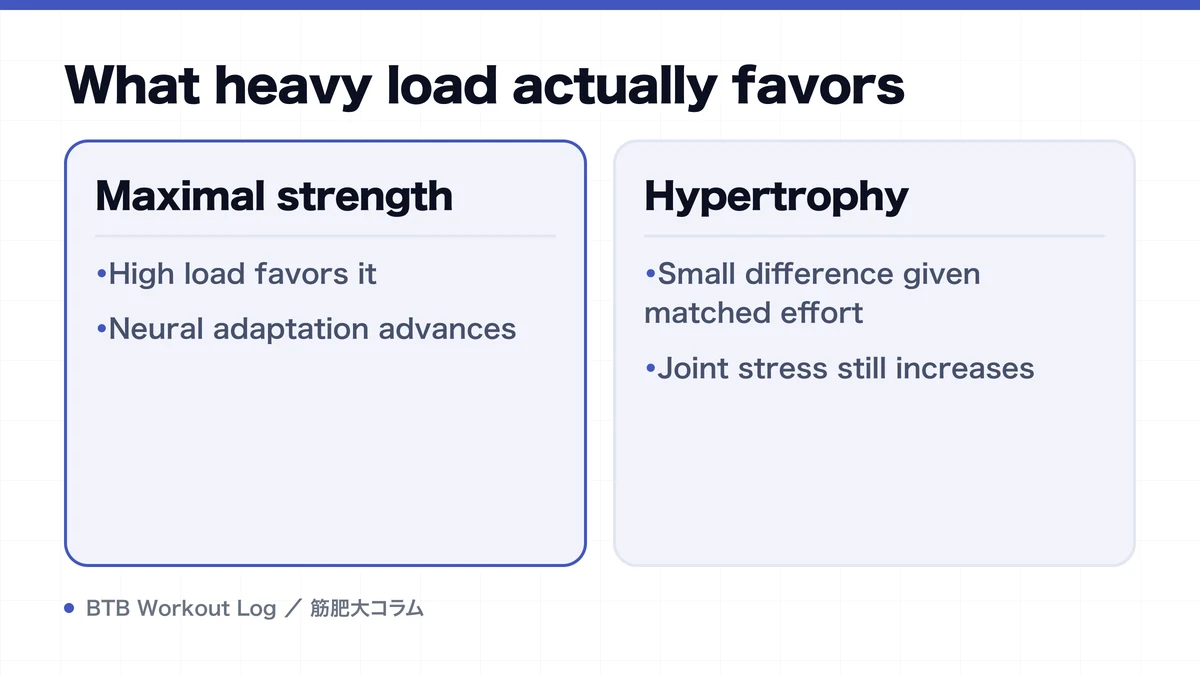
Schoenfeld et al.'s 2017 meta-analysis, pooling studies defining low load as ≤60% 1RM and high load as >60%, found a small hypertrophy difference while 1RM strength gains tended to favour higher load. The included studies took sets to momentary muscular failure — they weren't simply comparing a lighter load at matched reps. The fair reading is "given sufficient effort, hypertrophy can form across a wide load range" — not "load and how hard you push don't matter at all".
Mitchell et al.'s 2012 study of unilateral knee extension in young men found no between-group difference in quadriceps hypertrophy after 10 weeks comparing 30% 1RM for 3 sets against 80% 1RM for 1 or 3 sets, all taken to failure. A 2025 study on bicep curls and knee extension in healthy young men likewise found comparable hypertrophy between 30–40% 1RM and 70–80% 1RM taken to failure. Studies across different eras converge on the same direction: load alone doesn't decide the size of the gain.
None of this applies unchanged to every person and every exercise. Proximity to failure controlled in a study isn't necessarily something you reproduce precisely in everyday training, and how much breathlessness or discomfort high reps on a light load cause varies by person. Different participants, measurement sites, exercises and durations can still shift the response.
What the research pushes back on isn't heavy load itself — it's the oversimplification that "heavier always means more hypertrophy regardless of other conditions". Even with average hypertrophy comparable, strength, time, joint stress and how sustainable a set is aren't the same — so in practice, the choice still needs to fit your goal and exercise.
Why heavy load looks like the hypertrophy scorecard
Load is the most visible number. Whether you added a plate is obvious on the spot; hypertrophy takes weeks to months and can't be confirmed in one session. That gap in timing makes it tempting to treat a short-term strength result as hypertrophy itself.
The genuine link between mass and strength reinforces the myth. Bigger muscle raises the ceiling on force output, but 1RM isn't decided by mass alone — motor technique, neural adaptation, range of motion and familiarity with the equipment all move it too. Conversely, change rep range or exercise and hypertrophy that's genuinely progressing may not show up immediately in a specific exercise's 1RM. Two correlated changes shouldn't be treated as one phenomenon.
Heavy load also produces a stronger sense of "I really went for it" — pre-set tension, heavy bracing, bar speed visibly slowing all feel like effort. A moderate-load set that holds form and pushes the target close to failure looks modest by comparison when you only look at the number. But visual drama or a sense of accomplishment isn't a direct measurement of stimulus to the target.
Add the myth that every-session load increases equal progressive overload on top and lowering load starts to look like regression. In reality, if you changed exercise, widened range of motion, tightened form, or adjusted for a high-fatigue day, a lower kilogram figure alone doesn't establish reduced capability.
In practice, choose a reproducible rep range over the heaviest weight
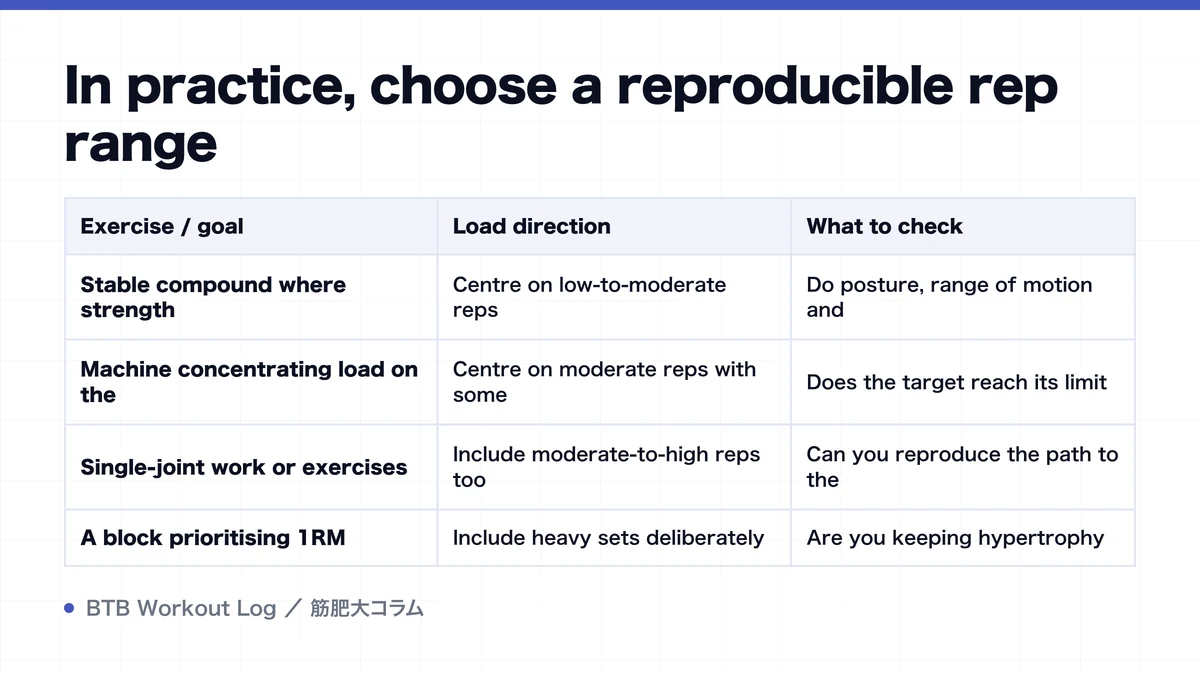
Choose load not by "how many kilos can I move" but by whether you can bank quality reps on the target and still attempt progress next time. Start by finding, per exercise, a rep range where form and range of motion stay stable and target RIR is easy to judge. There's no absolute right answer, but splitting roles like this makes it manageable to design.
| Exercise / goal | Load direction | What to check |
|---|---|---|
| Stable compound where strength also matters | Centre on low-to-moderate reps | Do posture, range of motion and RIR hold as load rises? |
| Machine concentrating load on the target | Centre on moderate reps with some range | Does the target reach its limit before assisting muscles do? |
| Single-joint work or exercises where you want less joint stress | Include moderate-to-high reps too | Can you reproduce the path to the end without momentum? |
| A block prioritising 1RM | Include heavy sets deliberately | Are you keeping hypertrophy volume separate from skill practice? |
If lateral raises pick up more momentum and trap involvement every time you add load, dropping load and building reps on a consistent path is easier to compare. If chest press past 15 reps gets limited by breathlessness before your chest nears failure, adding a bit of load and lowering reps is a reasonable choice. Don't treat heavy or light as a belief — fit the choice to whatever's actually constraining that specific exercise.
Decide your criteria for adding load in advance too. Once you hit the top of your chosen rep range at matched range of motion, form, rest and target RIR, add the smallest increment next time. If you can't hold the bottom of the range afterward, revert and build reps back up. This isn't a way of avoiding heavy load — it's a way of running progressive overload alongside movement quality.
Judge load choice by later sets and multi-week trend
You can't judge whether a load is right from a single top set. On a given exercise, check load, reps per set, RIR, range of motion, any form breakdown and rest period together. If only the first set succeeds after raising load while later sets crash in reps, and you can't sustain your weekly hard sets, that choice is worth reconsidering for hypertrophy purposes.
Over a two-to-four-week comparison, check three things. First, are reps rising at the same load and RIR? Second, does the raised load still let you hold your target rep range and movement quality? Third, has joint discomfort or next-session output decline increased? If you progress on either a heavier or lighter setup, choose by preference, time and exercise fit. If progress stalls on one, that fact narrows down the load that actually suits you.
A log's job isn't celebrating heavy load — it's confirming whether a load change actually led to quality reps and continued progress.
Keep heavy work where strength is also a goal; lean toward moderate-to-high reps where load on the target or joint stress becomes the problem. Rather than applying one view of load to every exercise, matching the choice to purpose and data is the practical way out of "heavier is always better".
FAQ
- Which is better for hypertrophy — 5 reps or 12?
- Both work for hypertrophy given sufficient effort and movement quality. Five reps tends to favour strength as well; 12 tends to make banking reps easier. Choose by exercise stability, joint stress, how easy RIR is to judge, and reps on the exercises that follow.
- Does a light load I can do 30 reps on build muscle the same way as heavy load?
- It can, given reps taken genuinely close to failure while holding movement on the target. But high reps make it easier to stop early from breathlessness or burn, and harder to judge RIR accurately. Don't read the average result as "an easy 30 reps works just as well".
- If load is rising, can I assume my load selection is correct?
- It's a strong sign, but load alone doesn't confirm it. Check whether it rose at matched range of motion, form, reps and RIR. If momentum or assisting-muscle involvement increased, stimulus to the target may not have advanced — check later sets and the multi-week trend too.
Key takeaways
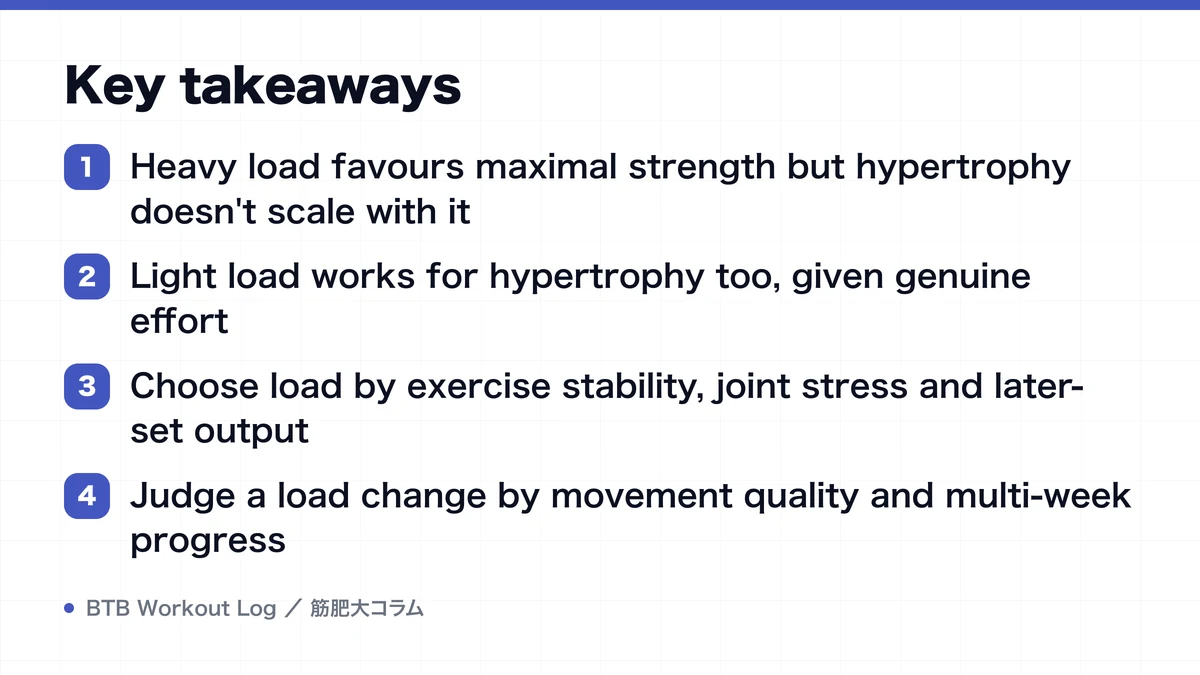
- Heavy load favours maximal strength but hypertrophy doesn't scale with it
- Light load works for hypertrophy too, given genuine effort
- Choose load by exercise stability, joint stress and later-set output
- Judge a load change by movement quality and multi-week progress