Free Weights vs. Machines: Are Free Weights Really Better? What Research Shows
As tools for hypertrophy, free weights aren't categorically better than machines. Any clear advantage shows up when you compare specifics — target muscle, stability required, how well the movement fits you, and whether you can keep driving load up — not when you compare equipment categories.
Barbells and dumbbells have real strengths, but that doesn't make machines a second-rate option. What matters isn't which you used; it's whether you can accumulate quality reps on that exercise.
Free weights win when the goal lines up with them
This belief has some practical basis. Exercises using free weights, such as squats, bench presses, and deadlifts, require you to control the movement path and your body position. They involve coordination across multiple joints and muscle groups, letting you train a large portion of your body with relatively few exercises. If your goal is to get better at lifting free weights, practicing those exact movements is the most direct approach. Many training beliefs follow this same pattern: they hold true under certain conditions. You can use the same framework to evaluate other training myths.
A movement path that isn't fully fixed can also be an advantage. You can make small adjustments to the path of a barbell or dumbbell to suit your shoulder width, limb length, and joint mobility. For some lifters, that makes it easier to find a comfortable movement. Free weights also offer plenty of options for adjusting loads and choosing exercises with minimal equipment, making them particularly practical for home gyms.
None of this means free weights are always better for hypertrophy. The stability and movement skills you develop with free weights are valuable, but hypertrophy isn't judged by how technically demanding an exercise is. What matters is whether you can give the target muscles enough stimulus and repeat it while allowing adequate recovery.
The myth starts by lumping two equipment groups together
"Free weights versus machines" is too coarse for exercise selection. Dumbbell flyes and barbell squats are both free weights, yet differ hugely in target muscles, stability demands, resistance profile and usable load. Machines vary just as much: some fit your body, some don't adjust enough, some are cables with plenty of freedom. The equipment label explains almost nothing about the actual stimulus.
The usual argument is "free weights train stabilisers too, so they're better". But a higher stabilisation demand isn't the same as more stimulus to the muscle you're targeting. If balance, grip or your trunk fails first, the set can end with the target muscle still holding reserve. A machine with a stable path can reduce the postural burden and let you keep repping the target.
A fixed path is neither inherently good nor bad. If it fits, it improves repeatability; if it doesn't, it produces joint discomfort. The refusal to crown one appearance as correct is the same idea as in individual differences in form. What to evaluate isn't free versus fixed — it's whether that path suits your body and your goal.
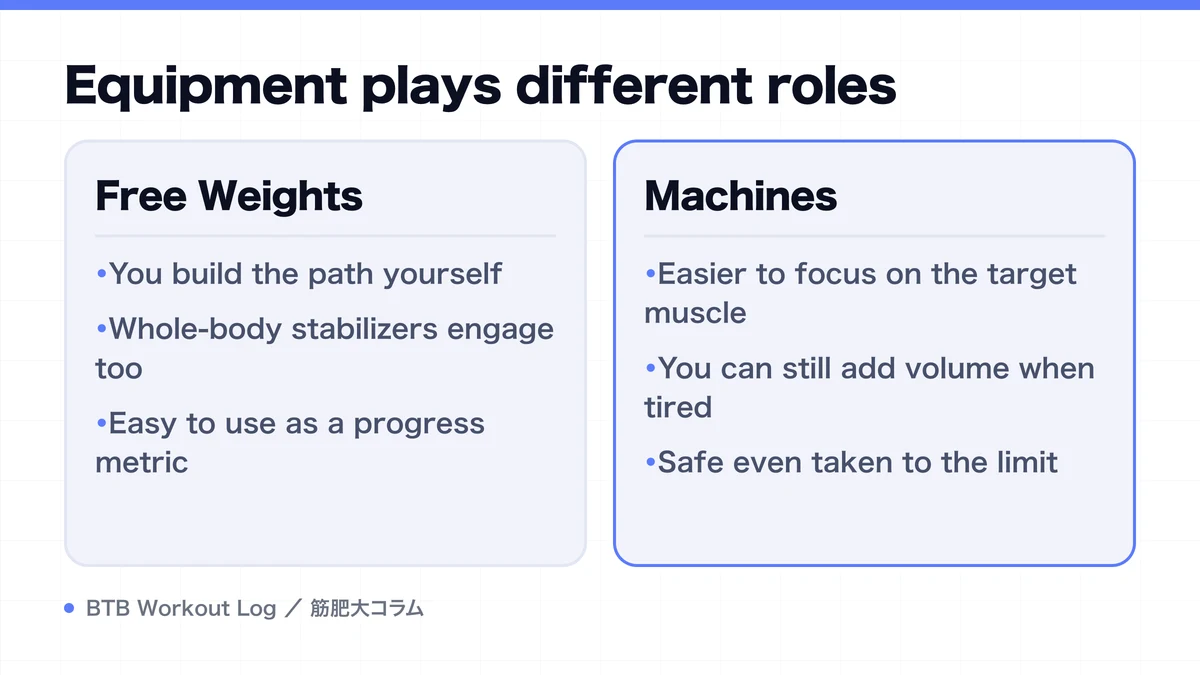
Nothing in the hypertrophy criteria ranks equipment
You can grade an exercise for hypertrophy on at least these conditions — worth checking before equipment preference when you build a programme.
- You can use the target muscle: another muscle group or balance isn't the limiter, so you keep repping with what you're training.
- You can repeat it: range of motion, position and tempo stay close enough to last time.
- You can reach sufficient effort: with form intact, you can bring RIR — reps left in reserve — into a useful range.
- You can create progress: not only load, but reps, range of motion and stability improving over time.
- You can recover: joint discomfort and systemic fatigue stay acceptable relative to the stimulus delivered.
Free weights and machines can both satisfy these. Since hypertrophy occurs across low and high loads at least when sets are taken close to failure, "this equipment handles heavy weight, so it grows muscle better" is hard to sustain. Load selection isn't settled by the numbers in heavy versus light alone — effort and rep quality belong in the judgement.
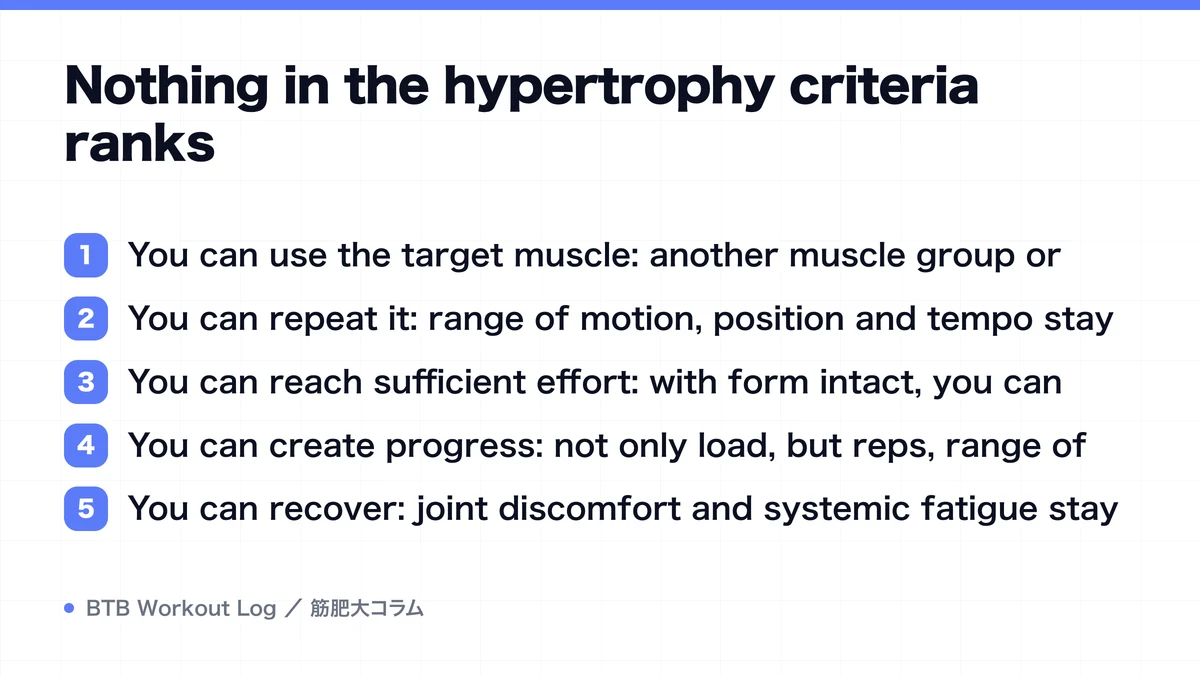
Treat them as tools with different weaknesses
| Situation | Likely tool | What to check |
|---|---|---|
| You want to raise a free-weight lift | That same free-weight exercise | Does the specificity, technique included, match the goal? |
| Balance or trunk fatigues before the target | Machine | Does more stability improve reps on the target? |
| A fixed path irritates a joint | Free weights, cables, a different machine | Does the same spot complain even at lighter loads? |
| You want to push close to failure alone, safely | Machine | Can you set safeties and range of motion properly? |
| You want several muscle groups per exercise | Multi-joint, free weight or machine | Can you still allocate enough sets to the primary target? |
You don't have to standardise on one. Placing technique-heavy work that needs concentration early and stable exercises later is a reasonable structure. Equally, if free weights are loading the target reliably and progress continues, there's no obligation to bolt a machine on.
Using machines isn't avoiding technique. Choosing free weights isn't justified by the word "functional" alone. The practical framing is: remove difficulty your goal doesn't need, keep difficulty it does.
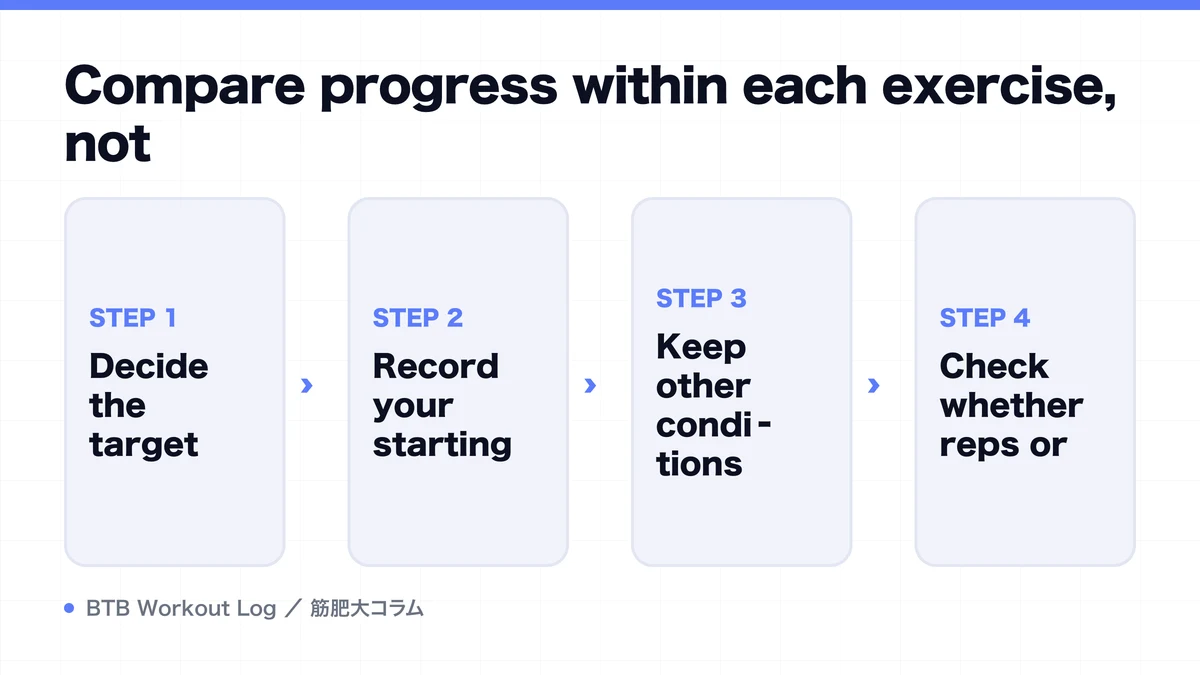
Compare progress within each exercise, not the load on the pin
Swap barbell bench for a chest press and the displayed weights aren't comparable. Lever ratios, pulleys and starting positions differ per machine, and the load means something different again from a barbell or dumbbells. Don't run a cross-equipment contest in kilos — check whether each exercise is progressing on its own terms.
- Decide the target muscle and the exercise's job — "accumulate chest volume", "maintain squat skill" — in concrete terms.
- Record your starting load, reps, sets, RIR, range of motion and how joints responded.
- Keep other conditions as steady as you can and repeat the same exercise for several weeks.
- Check whether reps or load rose, whether something other than the target was the limiter, and whether you recovered by next time.
- If progress stalls, don't blame the equipment category first — separate technique, load, volume and recovery.
How to advance load or reps in steps is the same as in progressive overload. Swapping exercises frequently shortens every comparison window, so before concluding "machines don't work" or "free weights are what grew me", give yourself enough time to observe.
In the end, can you explain each exercise's job?
When you review your programme, don't demand a reason why each exercise must use that equipment. Demand that you can say what each exercise is for. Free weights securing basic movement skill and multi-muscle stimulus with machines adding sets for a specific muscle is one valid combination; a machine-led programme built around joint responses or the gym you have access to is another.
If you're torn, fix one anchor exercise per muscle group and change only the accessories. Comparing set count, RIR, load and rep trends and joint response across the change gives you evidence beyond preference.
Free weights or machines is an exercise-selection question, not a belief system. If the tool delivers stimulus to the target, lets you recover, and lets you progress a little each time, it's working for your current goal.
FAQ
- Should beginners start with free weights?
- Not necessarily. If you want free-weight skill, there's value in getting your hands on them early — but if hypertrophy is the main goal, learning target muscles and effort levels on machines that fit you also works. Pick exercises you can repeat safely and progress in steps.
- Machines don't train stabilisers, so aren't they insufficient?
- Machines reduce postural demand, which isn't the same as reducing stimulus to the target. If you need stability, train it in another exercise. Don't ask one movement to deliver hypertrophy, balance and skill at once — let the whole programme cover what you need.
- Should I include both free weights and machines?
- Including both isn't a requirement. If roles overlap and you exceed recoverable set counts, the addition adds little. Choose exercises that complement each other in target, range of motion, stability and joint response, and keep the count low enough to track progress on each.
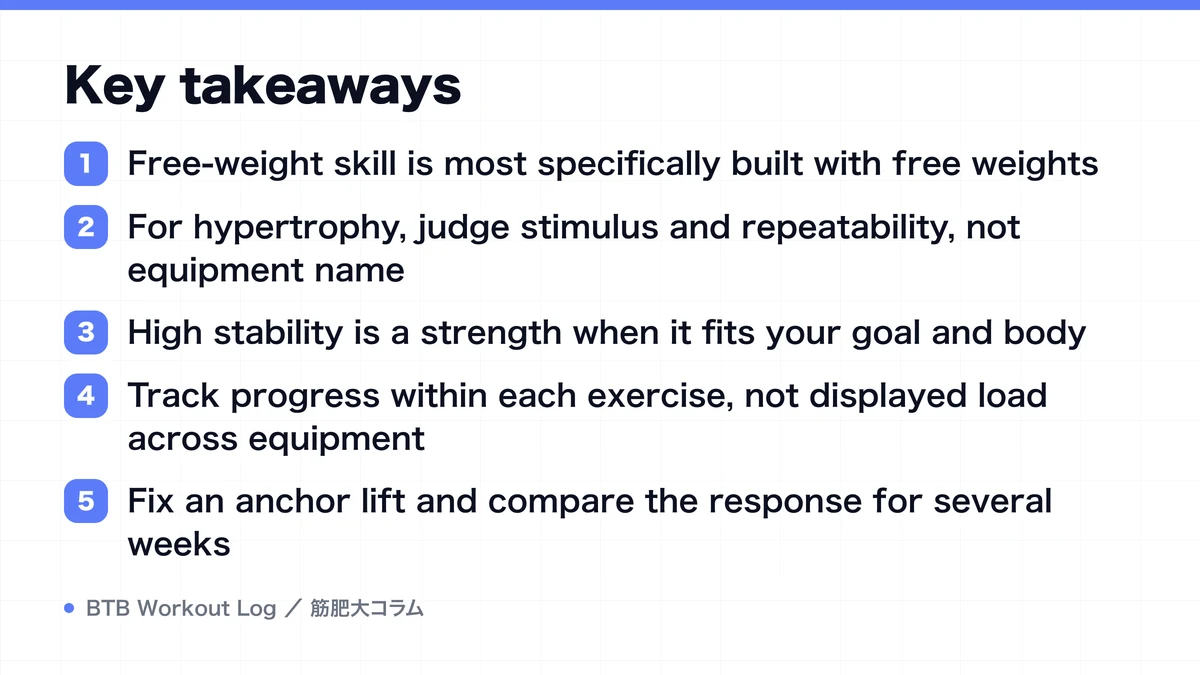
Key takeaways
- Free-weight skill is most specifically built with free weights
- For hypertrophy, judge stimulus and repeatability, not equipment name
- High stability is a strength when it fits your goal and body
- Track progress within each exercise, not displayed load across equipment
- Fix an anchor lift and compare the response for several weeks