2-Hour Workouts: Why Training Longer May Not Build More Muscle
Longer isn't necessarily more effective. Hypertrophy is decided not by the clock itself but by whether you bank the sets your target muscle needs, with sufficient effort and reproducible movement, and then recover from them.
Extending a session is worth it when it's too short to secure enough work. But if the extra length just comes from lower-quality sets or piling on similar exercises, more time spent isn't grounds to call it better for hypertrophy.
"Trained longer" doesn't mean "stimulated more"
A long session looks like proof of effort, and leaving early can feel like you skipped something. But session time includes warm-up, waiting for equipment, rest between sets, changing plates, logging, and conversation. Two people who spent 90 minutes in the gym didn't necessarily get the same stimulus, and comparing 60 minutes against 90 alone doesn't evaluate the content.
For hypertrophy purposes, what to look at first is the number of hard sets done for the target muscle, the load and reps of each, range of motion, and RIR — how many reps were left in reserve at the limit. Time that ignores this content is only a crude proxy for training volume. There's no reason to count a session as "more effective than last time" just because prep and waiting grew while training volume itself didn't.
Length helps when it protects necessary work
There's a correct part to this belief too. If someone keeps running out of time before finishing their planned sets, extending the session to secure that necessary volume can genuinely favor hypertrophy. If a chest-focused plan trains it multiple times a week but you're rushing and cutting a few sets of the main lift every time, extending has a clear purpose. That said, the weekly sets needed aren't a fixed number shared by everyone — they shift with training history, exercise, RIR, frequency and recovery status.
Length can also grow from taking sufficient rest between sets. A study comparing 1-minute and 3-minute rest in trained lifters found the 3-minute condition favored strength and some measures of muscle thickness. That doesn't mean 3 minutes is the right answer for every exercise, but it does show that cutting rest to prioritize finishing time, at the cost of next-set reps or movement quality, isn't sensible. Decide rest intervals by whether you can reproduce the intended output, not just by whether you've caught your breath.
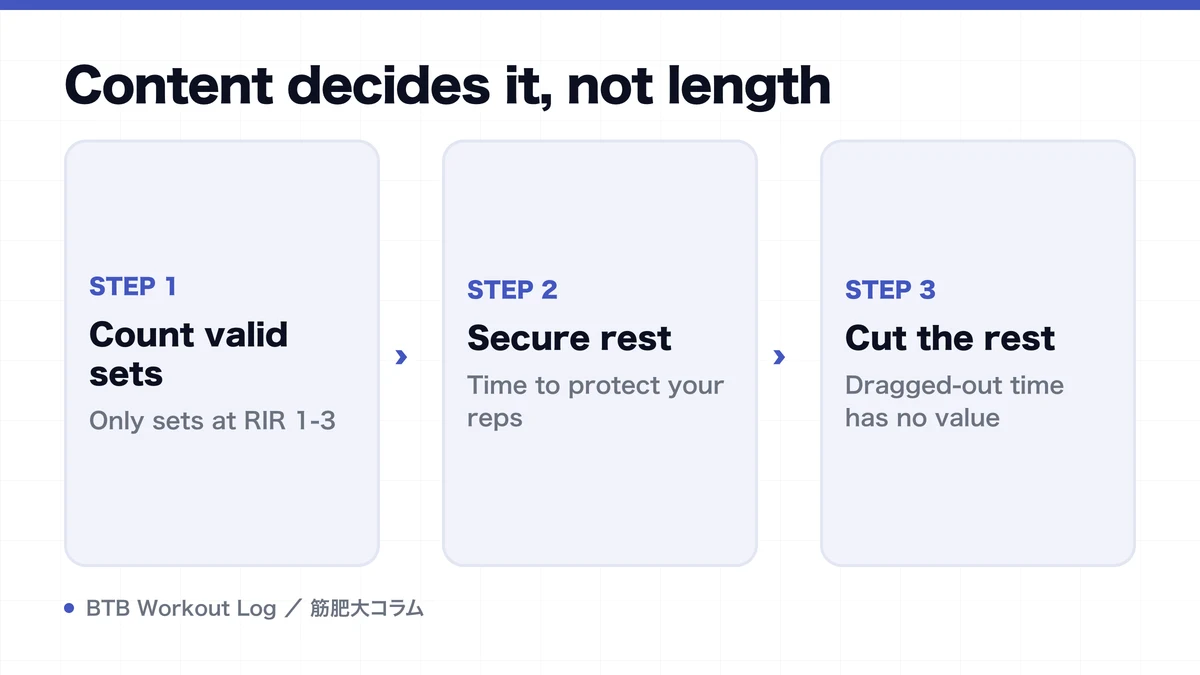
Added time isn't necessarily added stimulus
The myth starts from treating the act of extending a session as inherently beneficial. Piling on exercise after exercise with a similar path for the same muscle, continuing sets after reps and range of motion have already broken down, taking every set to failure and tanking later exercises — extensions like these don't scale up valid stimulus in proportion to the added volume.
The line between sets you can still use for hypertrophy and sets that mainly add fatigue isn't a fixed fraction. Judge it by whether the target muscle still carries the load, whether intended range of motion and RIR hold, in later sets too, and whether you recover enough to reproduce load and reps by next time. Reaching failure every set isn't mandatory, and the point of diminishing returns from adding sets can't be separated from the problem of doing too many sets. If extending the session leaves you worse off going into the next one, what needs fixing is the content, not the clock.
Research measures volume and conditions, not minutes
Hypertrophy research centers on variables like weekly sets, load, proximity to failure, frequency and rest. A dose-response relationship has been reported between weekly training volume and muscle gain, and some studies found higher volume favored trained lifters. But that doesn't establish "the longer you're in the gym, the more you grow" — what increased was the managed workload as a study condition, not time itself.
Frequency works the same way — it's a tool for splitting weekly total volume across multiple days. If cramming it all into one session degrades quality in the back half, splitting the same weekly sets across separate days can be more manageable. In other words, these studies don't establish a universal boundary saying 90 minutes should become 60, or 60 should become 120.
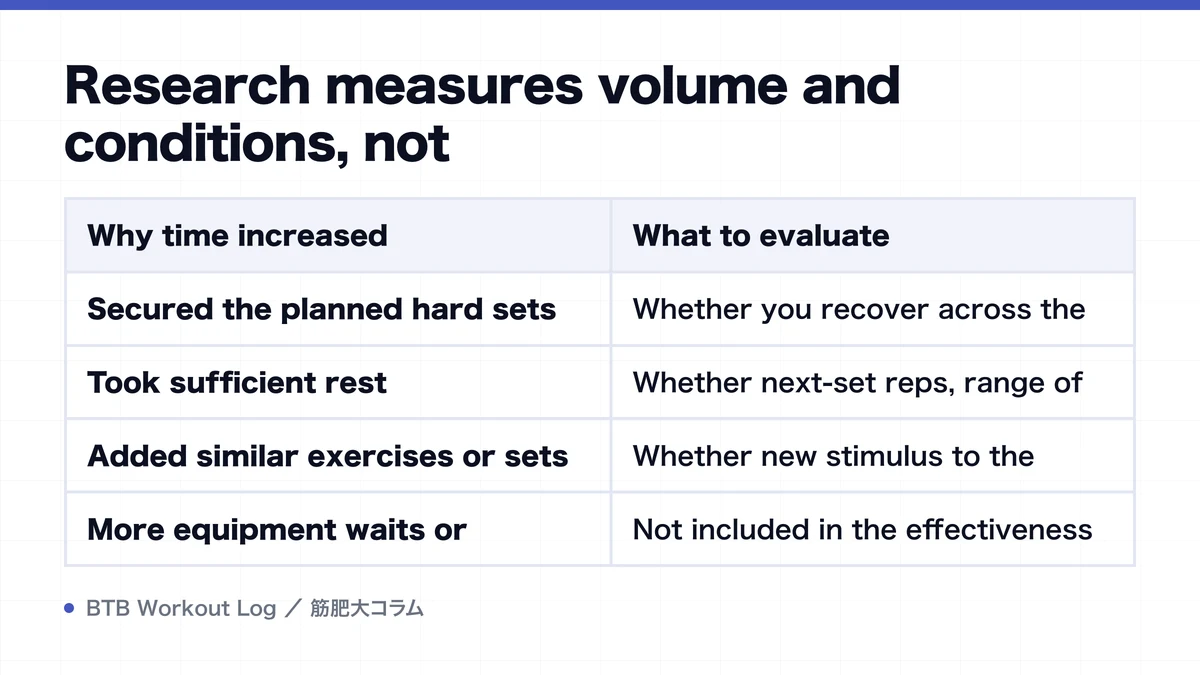
| Why time increased | What to evaluate |
|---|---|
| Secured the planned hard sets | Whether you recover across the week and can repeat progress |
| Took sufficient rest | Whether next-set reps, range of motion and RIR held |
| Added similar exercises or sets | Whether new stimulus to the target actually increased |
| More equipment waits or conversation | Not included in the effectiveness measure |
Even for the same person on the same routine, you can't compare across weeks unless you record why only the length changed. A week where you took sufficient rest and a week where you added extra sets carry different meanings behind the extension. Treating time not as an independent cause but asking "what changed, that made it take this long" is what lines up the research with day-to-day adjustment.
Why longer feels like it worked better
Time is measurable on the spot; hypertrophy shows up as a change over weeks to months. That gap makes it easy to overweight the clear number in front of you. Training longer tends to bring more sweat, more pump, more exhaustion, and it's tempting to equate those with valid stimulus to the muscle. But "it was brutal" and "it builds long-term progress" are different judgments.
Care is also needed before copying an experienced lifter's long session purely for its length. If that length comes from a gradual warm-up for heavy lifts, longer rest, and planned sets for weak points, length isn't their goal — it's a byproduct. Conversely, a short session isn't automatically efficient either; rushing rest and skipping necessary sets is simply insufficient. Looking at multi-week trends rather than one session's feel is what frees you from clock-watching.
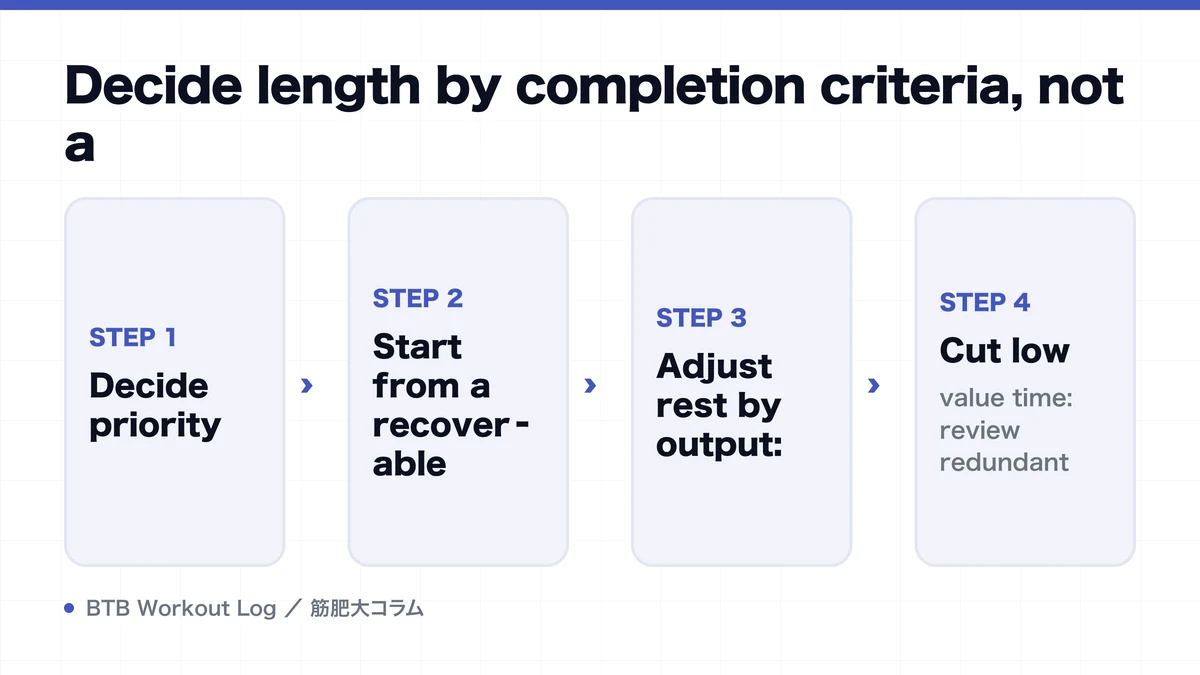
Decide length by completion criteria, not a stop time
When setting session length, place your completion criteria first, not a target number of minutes.
- Decide priority exercises: put the main lift for the muscle group you want to grow early, while focus is high.
- Start from a recoverable set count: add more only when needed, watching output in the back half and next session.
- Adjust rest by output: don't cut it by the clock alone — wait until you can reproduce intended reps, range of motion and RIR.
- Cut low-value time: review redundant exercises, excessive equipment waits, and aimless extra sets.
After changing anything, check how load, reps, sets and RIR on the same exercises moved over several weeks. If progressive overload continues and weekly workload plus recovery both hold even after shortening, that shortening worked. If progress returns after extending, that time has a real role.
Using a log as your evidence lets you compare not how long you stayed, but whether the extra time you added actually led to progress next time.
FAQ
- What's the ideal session length for hypertrophy?
- There's no number shared by everyone. Needed time shifts with exercise count, sets, load, rest and how busy the gym is. The right length for a given routine is whatever finishes your planned quality sets while holding back-half output and recovery by next time.
- Can a short, roughly 30-minute session still build muscle?
- Yes. It works if you narrow to priority exercises, spread the needed weekly sets across other days, and hold RIR and movement quality on each set. But if you're cutting rest or key sets just to fit 30 minutes and output drops, you're over-prioritizing shortness.
- Is a 2-hour session too long?
- Length alone can't decide that. It's acceptable if it's needed for warming up into heavy lifts, sufficient rest, and planned sets across multiple muscle groups, while back-half quality and next-session recovery both hold. If it comes from aimless extra exercises or a large drop in reps, it's worth reviewing.
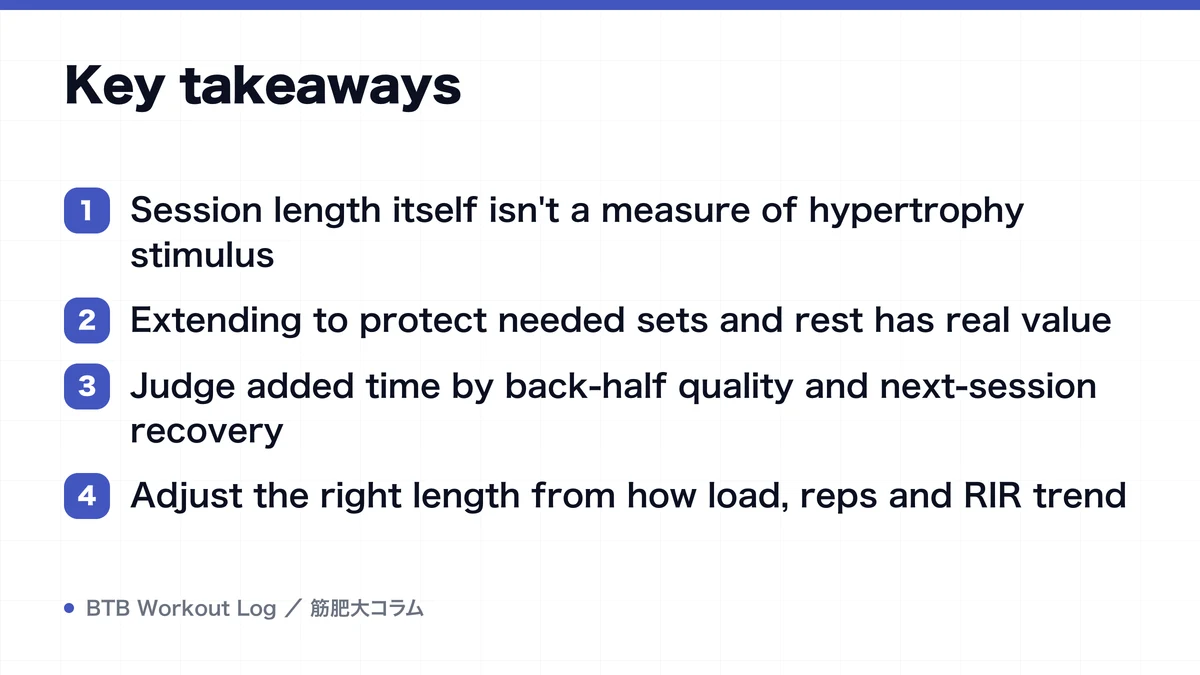
Key takeaways
- Session length itself isn't a measure of hypertrophy stimulus
- Extending to protect needed sets and rest has real value
- Judge added time by back-half quality and next-session recovery
- Adjust the right length from how load, reps and RIR trend
References
- Dose-response Relationship Between Weekly Resistance Training Volume and Muscle Mass
- Resistance Training Volume Enhances Muscle Hypertrophy in Trained Men
- Longer Interset Rest Periods Enhance Strength and Hypertrophy in Trained Men
- Resistance Training Frequency and Muscle Hypertrophy: Systematic Review and Meta-analysis