Hypertrophy: Training Once vs. Twice a Week With the Same Number of Sets
Match weekly sets and per-set effort and the average hypertrophy difference is small — both once and twice a week work. But if cramming volume into one day wrecks your late sets, go twice; if you progress on modest volume and don't want more sessions, once is fine.
What to compare isn't the number of exposures. It's whether the distribution lets you keep doing the required work at high quality.
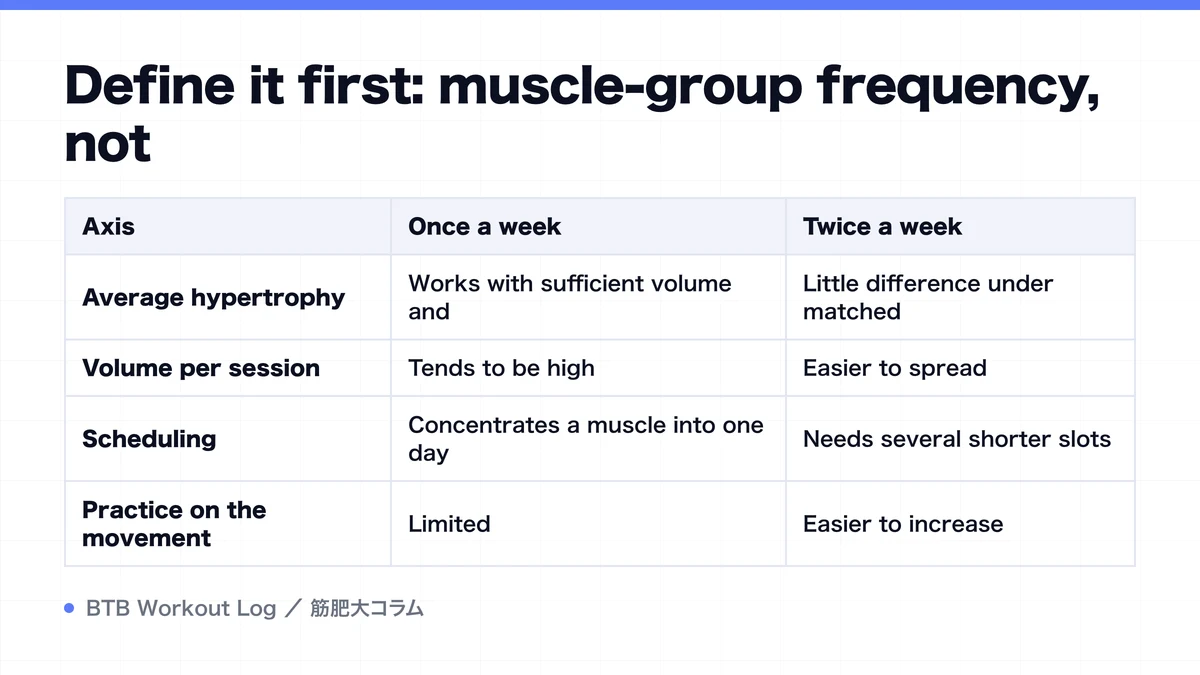
Define it first: muscle-group frequency, not gym days
Once or twice a week here means how often hard sets reach the same muscle group, not how often you visit the gym. Train four days but keep chest on Monday and chest is once; split it across Monday and Thursday and it's twice. Presses feed triceps and rows feed biceps indirectly, so direct-exercise days alone don't settle it.
For a fair comparison, match weekly sets, exercises, range of motion, rep range and RIR as far as you can. RIR is the reserve at the end of a set — how many reps you had left. Eight chest sets once a week versus eight sets twice a week changes frequency and doubles volume. Here we hold weekly sets fixed: eight in one day, versus four and four across two.
| Axis | Once a week | Twice a week |
|---|---|---|
| Average hypertrophy | Works with sufficient volume and effort | Little difference under matched conditions |
| Volume per session | Tends to be high | Easier to spread |
| Scheduling | Concentrates a muscle into one day | Needs several shorter slots |
| Practice on the movement | Limited | Easier to increase |
Hypertrophy: with volume equated, no clear winner
Frequency research looks contradictory if you read only the headlines. The 2016 meta-analysis suggested that training each muscle twice a week may beat once a week. Later analyses, however, concluded that once weekly total volume is equated, frequency's independent contribution is small. The difference between the early studies and the later work is unpacked in re-examining the frequency meta-analysis.
What follows from this is not that frequency is meaningless. What the research isolated is the effect of splitting the same workload across one day or two. In real programmes, splitting across two days can preserve reps and range of motion in the later sets, or let you complete volume that never fitted into one session. That improvement isn't a direct effect of the frequency number - it's the effect of distribution making effective work easier to execute.
Conversely, if you can perform your required sets at your target RIR and form right to the end of one weekly session, and load or reps have climbed for weeks, switching to twice a week won't necessarily accelerate growth. The conditions under which hypertrophy happens on once a week are covered later in this article; the question here isn't feasibility but which of the two distributions fits your current constraints.
Fatigue and time: two short sessions versus one concentrated one
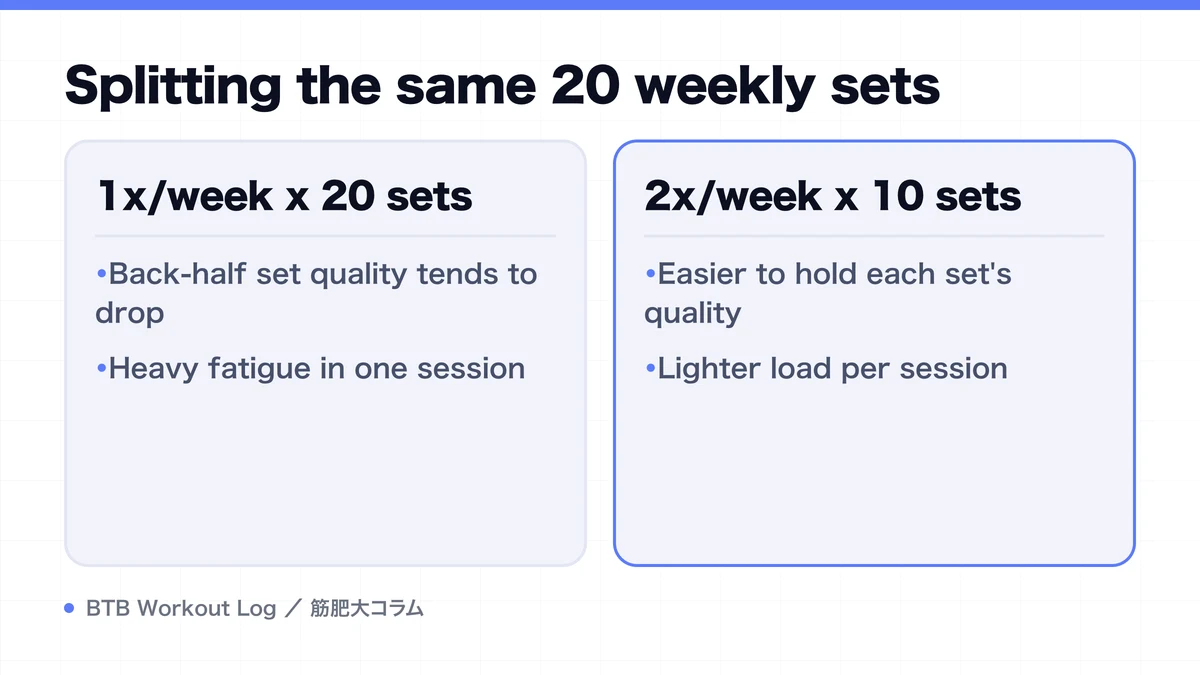
Once a week concentrates a muscle's exercises into a single day, so you don't repeat travel, changing and setup. If a modest number of sets for chest and back is producing progress, weekly time including setup is easy to keep low. But the more sets you pile into one muscle, the more local fatigue costs you load and reps late on — and focus or postural endurance can limit out before the target does.
Twice a week splits the sets, so the muscle starts fresher each time and late-session quality holds up better. If the last four of ten sets collapse in reps and range of motion every week, splitting into five and five has a clear rationale. On the other hand you warm up and travel twice, and you have to account for indirect fatigue from the previous day. Separating chest on Monday and shoulders on Tuesday still stacks pressing onto triceps and front delts.
So neither "twice a week is always faster because sessions are short" nor "once a week is always efficient because it's fewer days" holds. Measure weekly total time including setup and rest, the share of planned sets you actually completed, and how far late sets fall. If more frequency only adds low-quality sets before you've recovered, you've landed in the conditions where more frequency doesn't speed growth.
Loading and strength: twice a week makes roles easier to split
If you want strength on specific lifts as well as size, more exposures to the movement is an advantage of twice a week. Splitting a heavier day from a moderate-rep day means you aren't cramming heavy skill practice and hypertrophy volume into one session. If you're still learning a movement, or care about your bench press number, that practice frequency deserves weight in the decision.
You don't need both sessions heavy and close to failure, though. Make one 5–8 reps and the other 8–12, and as long as exercises, range of motion and target RIR stay fixed for a few weeks you can still track progress. Conversely, if hypertrophy is the goal and a once-weekly machine or single-joint exercise already loads the target reliably, extra practice frequency buys less.
Changing frequency, exercises, loads and set counts together makes the outcome unreadable. Change the distribution first, and split the two days into distinct roles only when strength is also a goal. Use comparing splits to place the days and check for overlap between muscle groups and assisting muscles.
When to choose once, and when to choose twice
Once a week suits you when
- Your current weekly sets fit in one day without load, reps or range of motion collapsing late
- Your main lifts progress over multi-week blocks and you recover by the next session
- Adding training days costs a lot in travel and scheduling
- Indirect stimulus on other days means it isn't truly once a week anyway
Twice a week suits you when
- You can't hold reps, form or target RIR in the back half of a session
- Fitting the required weekly sets into one day makes it far too long
- You also want strength or skill on specific lifts and need more practice
- Several shorter sessions fit your life better
Twice a week is the easier default if you're unsure — but that's a starting point, not a verdict. Decide using weekly sets, RIR per set, load and reps on your main lifts, how far late sets fall, and recovery into the next session. Soreness and the day's pump don't settle which distribution is better.
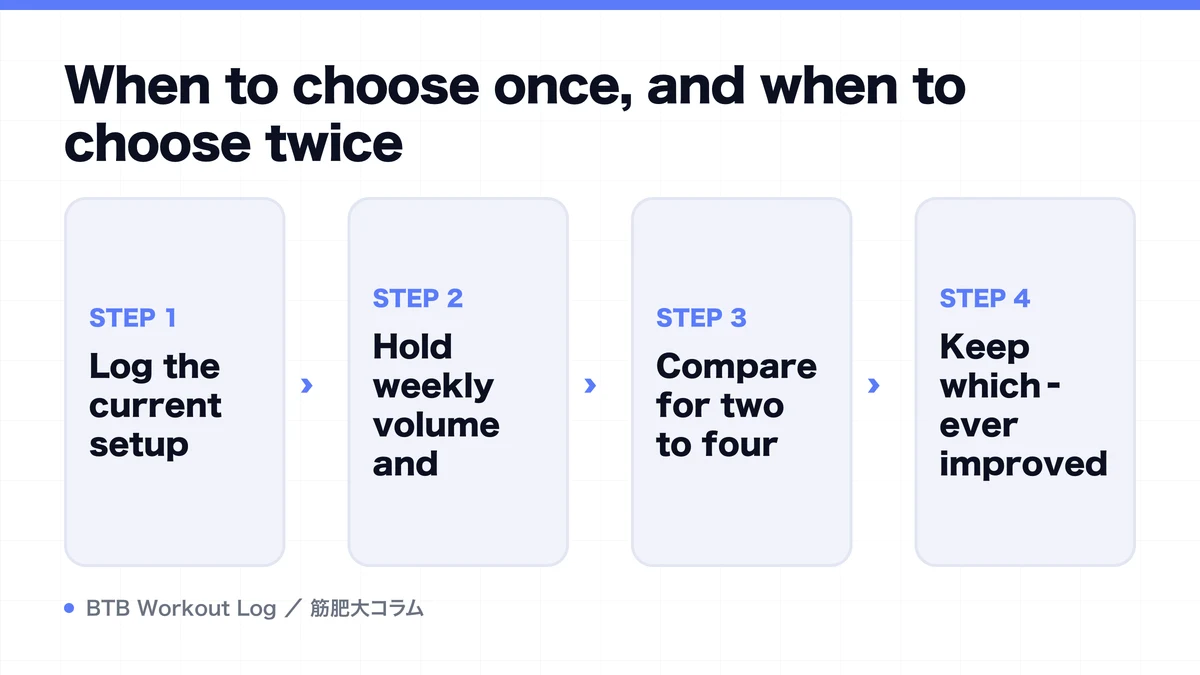
- Log the current setup for two to four weeks: weekly sets for the muscle and output on the main lifts.
- Hold weekly volume and change only distribution: eight weekly sets becomes four and four.
- Compare for two to four weeks under the same conditions: late-session drop-off, next-session output, weekly time, and the share of sessions you completed as planned.
- Keep whichever improved something: if nothing differs, take the one that fits your life.
Your log isn't there to crown a general winner between one and two — it's there to find the side that lets you sustain the same volume at better output. Which suits you can only be answered with volume equated, and BTB Workout Log lets you compare distribution while holding weekly volume constant.
Is "once a week doesn't build muscle" actually true?
Hypertrophy still happens when you train the same muscle only once a week. Differences tend to be small in comparisons that line up frequency conditions because what matters is how much work you accumulated across the week while holding its quality more than frequency itself. "You don't grow on once a week" and "once a week is sometimes not optimal" are completely different claims.
Once a week tends to work when you can get through the weekly sets that muscle needs in that single session while holding output right to the end. It tends to work against you when you cram so much into one session that load and reps clearly drop in the later sets, when you run so many exercises that each muscle group gets thin coverage, or when missing that one session removes a whole muscle group from the week.
You can make this call with numbers rather than feel. Hold your weekly sets fixed, run once a week and twice a week for 2-4 weeks each, and compare the load and reps on the last set of each session, plus your output on the first set the following week. Whichever shows the smaller late-session drop-off is the distribution that fits you right now.
FAQ
- Moving from once to twice a week, should I also increase sets?
- Not at first. Eight weekly sets becomes four and four, with exercises, rep range and target RIR held as steady as possible. After comparing output and recovery for two to four weeks, consider adding volume as a separate change if you need it.
- How many days apart should the two sessions be?
- Rather than a fixed number, judge by whether load, reps and range of motion on your main lift have returned. Start with roughly two to three days between, and adjust the gap or the per-session volume if local or assisting-muscle fatigue stops you hitting your target RIR.
- Can I mix once and twice a week across muscle groups?
- Yes. Chest and back, where late quality tends to fall, can go twice a week while arms progressing on few direct sets stay at once. Just check weekly totals and recovery per muscle group, including indirect stimulus from compound lifts.
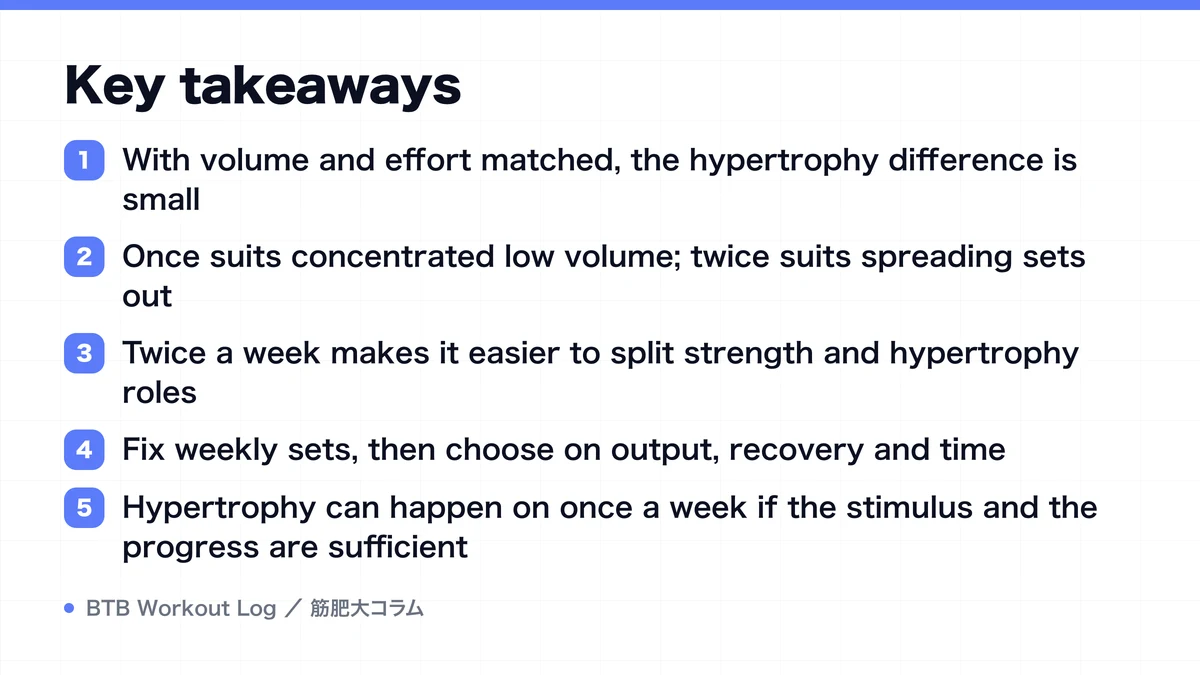
Key takeaways
- With volume and effort matched, the hypertrophy difference is small
- Once suits concentrated low volume; twice suits spreading sets out
- Twice a week makes it easier to split strength and hypertrophy roles
- Fix weekly sets, then choose on output, recovery and time
- Hypertrophy can happen on once a week if the stimulus and the progress are sufficient
References
- Effects of Resistance Training Frequency on Muscle Hypertrophy: Systematic Review and Meta-analysis
- Resistance Training Frequency and Muscle Hypertrophy: Systematic Review and Meta-analysis
- The Resistance Training Dose Response: Meta-Regressions Exploring the Effects of Weekly Volume and Frequency on Muscle Hypertrophy and Strength Gains