Are the BIG3 Enough? Muscles Compound Lifts Alone May Leave Behind
As a base for training the whole body efficiently it's largely right. As a prescription for developing every muscle you care about, it's incomplete. Build around compounds, then add isolation only for the areas where you can see a weak point or a shortfall in stimulus.
Rather than multi-joint versus single-joint, think about which muscle each exercise is responsible for growing. That's what separates the exercises you need from the ones you can drop.
"Do the big lifts and everything gets hit"
Squats, bench press, deadlifts, rows and pull-ups move several joints at once, which is what makes them compound or multi-joint exercises. One movement loads several muscle groups and load and reps advance readily, so there's good reason to build a hypertrophy programme around them.
From there comes the claim that a handful of main compounds makes single-joint isolation unnecessary. If time is short and the goal is broad whole-body development, that simplification works. Pressing trains not just chest but triceps and front delts; pulling trains not just back but the elbow flexors — so one set does duty for several regions.
But several muscles participating isn't the same as all of them receiving equally effective stimulus. When you think about weekly sets per muscle group, counting one bench press set mechanically as one set each for chest, triceps and delts can badly overstate the real stimulus.
Conditions where compounds alone genuinely suffice
Compounds alone work best when goal and constraints are clear. If you want whole-body mass and baseline strength while keeping sessions short, concentrating on one multi-joint movement per pattern has real value. Fewer exercises means more practice on each, which makes load, reps and RIR (how many reps you had left) easy to compare with last time.
It also holds when the intended prime mover really is what decides the set, and that muscle's performance keeps improving. If a press aimed at your chest produces plenty of local chest fatigue and reps or load are rising at the same range of motion and RIR, there's no urgency to add flyes. Confirm you can still run progressive overload on what you have before adding anything.
It suits phases where repeating a few exercises for a long time beats detailing weak points: early on, coming back after a break, maintenance during a busy week. "Enough" here doesn't mean maximising every muscle evenly — it means meeting the goal within the time available.
A muscle taking part isn't a muscle being trained enough
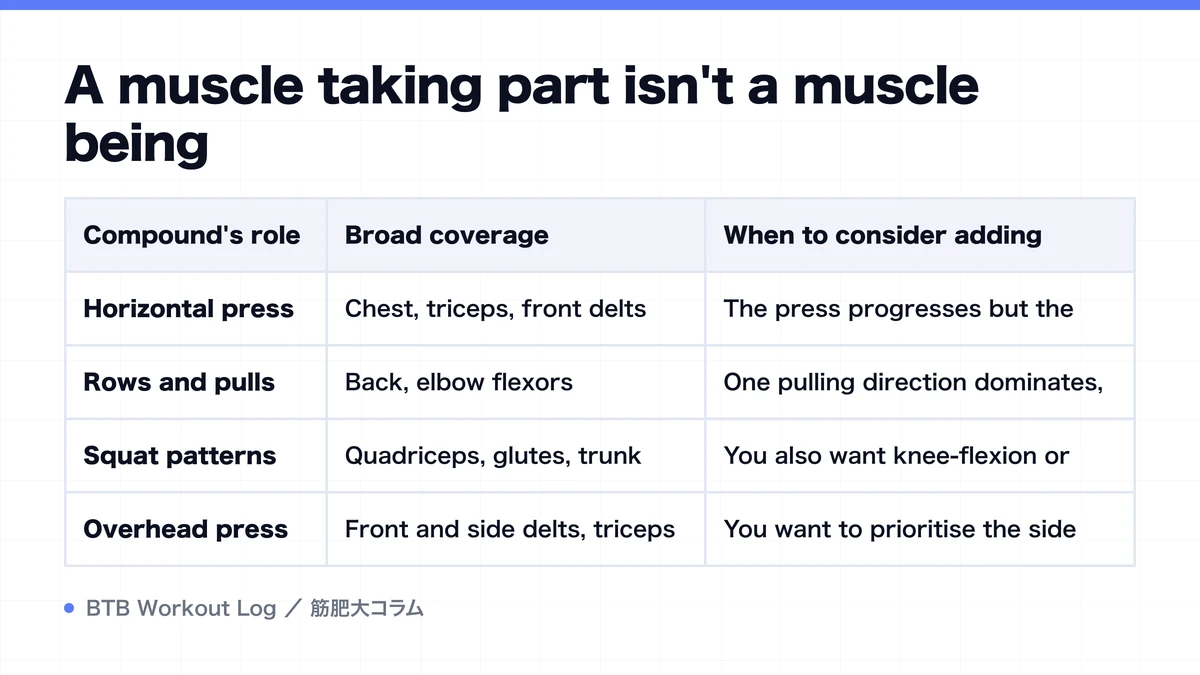
In a compound, several muscles and joints complete each rep together — and the one that ends the set isn't necessarily the one you're targeting. Your chest can have reserve left while triceps fatigue stops the press; your back can have reserve while grip or elbow flexors reach their limit and stop the pull. The weak link in the shared movement can cap the stimulus another muscle receives.
The reverse isn't automatic either. Add direct sets to the front delts of someone already doing a lot of pressing and recovery or joint load becomes the problem before development does. Indirect stimulus is neither zero nor equivalent to a direct set; the contribution shifts with exercise, form, range of motion and individual movement strategy. As in why triceps fatigue before chest, you need to know which muscle actually limited the set.
| Compound's role | Broad coverage | When to consider adding |
|---|---|---|
| Horizontal press | Chest, triceps, front delts | The press progresses but the target region doesn't |
| Rows and pulls | Back, elbow flexors | One pulling direction dominates, or arms fatigue first |
| Squat patterns | Quadriceps, glutes, trunk | You also want knee-flexion or ankle-driven muscles |
| Overhead press | Front and side delts, triceps | You want to prioritise the side or rear of the shoulder |
The research doesn't say "multi-joint only"
The ACSM position stand on resistance training includes both single-joint and multi-joint exercises in programme selection. There are contexts where compounds take priority, but it isn't a framework that excludes isolation for hypertrophy. Prescriptions are expected to change with goal, capability and training history.
Activation research gives you material for thinking about how exercises differ. Across bench press, shoulder press and lateral raises, front, side and rear deltoid activity tends not to be uniform. At minimum, "any multi-joint movement involving the shoulder covers all three heads equally" is hard to defend. Building the shoulder by role is covered in training the delts separately.
On the other hand, an exercise with high activation can't be declared superior for long-term hypertrophy on that basis. Activation is a point-in-time measurement; muscle thickness or cross-sectional area months later is a different outcome. In quadriceps and elbow flexors, hypertrophy tends to occur across several training modes once frequency, intensity and volume are adequate. So in programme design, rather than treating one family of exercises as sacred, the question is how to allocate the stimulus each target muscle needs.
Why compounds alone look sufficient
First, compounds produce visible numbers. Squat and bench going up feels like proof the whole programme works. But lifted load reflects technique, coordination and familiarity with the range of motion as well as the mass of the muscles involved. A personal best is real progress; it doesn't certify that each region developed the way you intended.
Second, early on nearly everything responds to a few exercises, so differences stay invisible. As you accumulate experience and start caring about specific regions or visual balance, gaps appear that big whole-body movements don't cover. What you need then isn't unlimited exercises — it's identifying the missing job.
Third, simple rules travel well. "Build around the basics" is useful advice; "anything beyond the basics is wasted" drops the goal. The opposite claim — more exercises means more complete stimulus — has the same defect. As in the myth that more exercises means more growth, what to evaluate isn't names or counts but the role each exercise plays and what happens after you add it.
Compounds as the base, isolation when a gap shows
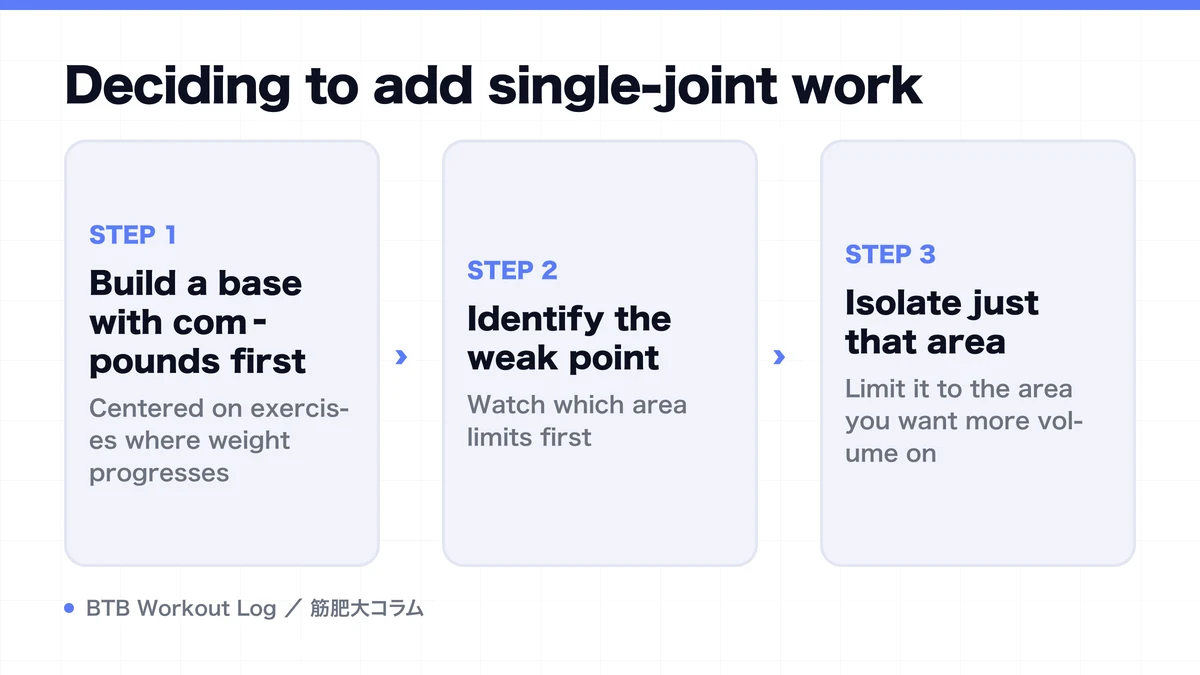
Start by placing the main patterns — push, pull, squat/hinge — as compounds. Then, for each region, pick one exercise you'll use to judge that muscle's progress. Press for chest, row or pull for back, lateral raise for side delts: even when one exercise touches several regions, don't leave the thing you're grading ambiguous.
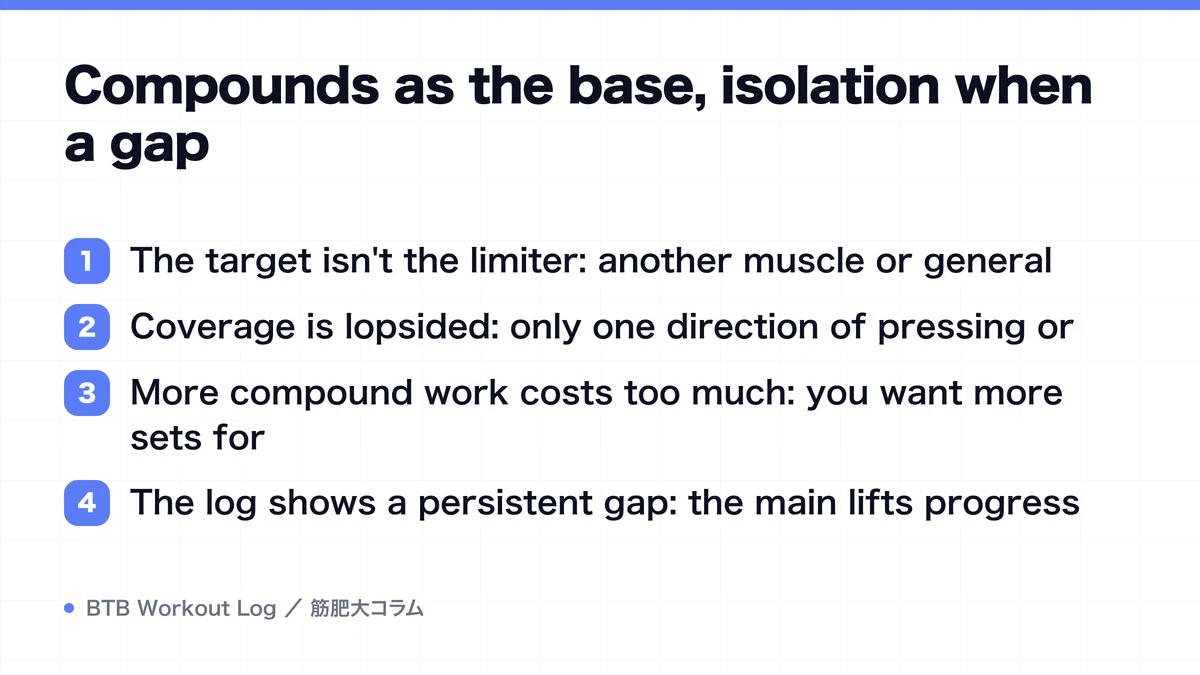
Grounds for adding isolation look like this.
- The target isn't the limiter: another muscle or general fatigue ends the compound while the target still has reserve.
- Coverage is lopsided: only one direction of pressing or pulling, with nothing serving the region you want to develop.
- More compound work costs too much: you want more sets for the target, but lower back, grip, breathing or joints fatigue first.
- The log shows a persistent gap: the main lifts progress while strength or size indicators for the target don't move.
If that applies, add a small amount of single-joint work with a non-overlapping role and watch for several weeks without changing much else. Keep it if load and reps rise on it while your main lifts hold their quality and you still recover. Roll it back if the main lifts fall and all you gained was local fatigue. Pump and soreness are supporting information, not the reason to keep something.
Choosing between compound and isolation on ideology gets you nowhere. Choosing on which configuration keeps the target progressing while you still recover gets you the smallest programme that works.
FAQ
- Can beginners start with compounds only?
- It's a workable structure while you're training the body efficiently and learning the basic movements. Once you can see gaps — a specific muscle fatiguing first, or no way to judge stimulus to side delts or calves — add a small amount of single-joint work.
- If I want bigger arms, are presses and pulls enough?
- Triceps and elbow flexors get indirect stimulus, but that isn't necessarily enough when arms are the goal. Check whether your arms limit the set before chest or back, or whether they finish with reserve, then decide whether to add direct elbow flexion and extension work.
- Does a compound set count as a set for the assisting muscles?
- Avoid counting it mechanically as one set equal to a direct set for the prime mover. The contribution to assisting muscles shifts with exercise and form, so log direct sets separately from indirect stimulus and adjust direct set counts from the target's progress and recovery.
Key takeaways
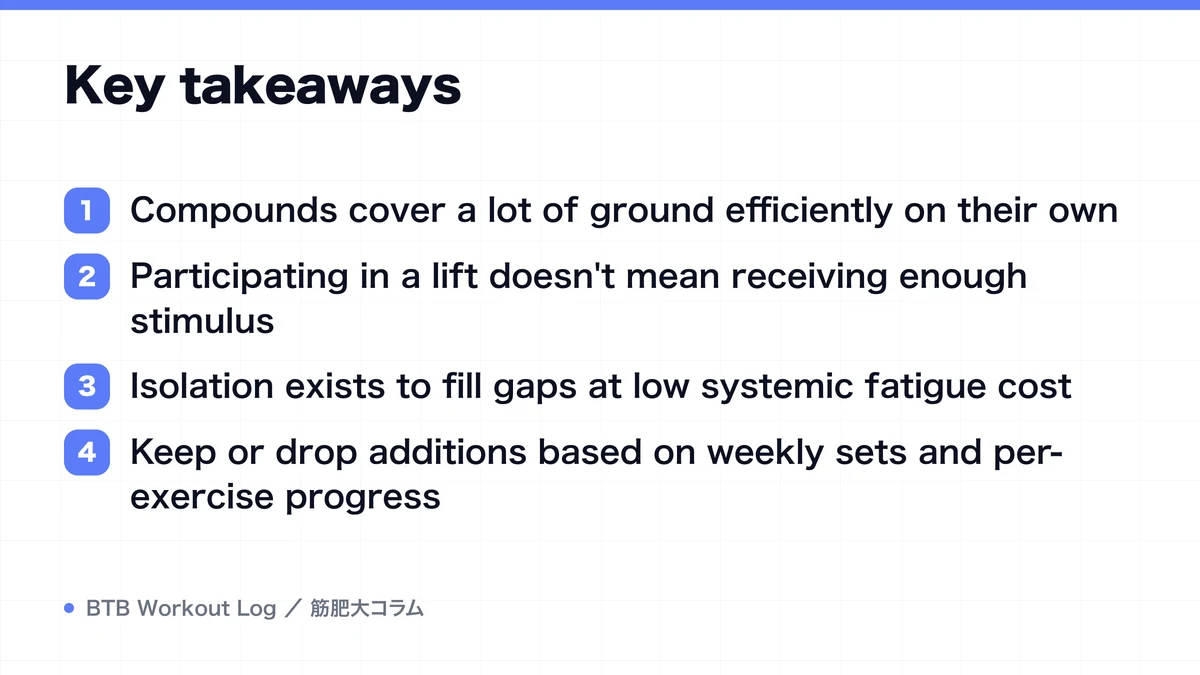
- Compounds cover a lot of ground efficiently on their own
- Participating in a lift doesn't mean receiving enough stimulus
- Isolation exists to fill gaps at low systemic fatigue cost
- Keep or drop additions based on weekly sets and per-exercise progress