Do Muscles Adapt to Your Routine? Why Changing Workouts Too Often Can Stall Growth
You don't need to change your programme constantly to "shock" the muscle. What hypertrophy needs isn't novel exercise names — it's sufficient load on the target and a way to keep advancing that load over time.
Variation has its uses. But keeping an exercise you can compare against and adding changes with a purpose beats replacing everything on a whim, because it leaves progress readable.
How far "you need new stimulus" holds
Keep training the same way and the body adapts. A load that used to be near your limit becomes comfortable, and you finish the same reps with more in reserve. Keep the load and reps identical and RIR rises as you adapt — you drift further from failure, so relative stimulus falls. To hold RIR constant you have to raise load or reps. RIR is your estimate at the end of a set of how many reps you had left.
So far this matches the instinct to avoid adaptation. But changing exercises isn't the only response. One more rep on the same exercise, a slightly heavier load, the same load with steadier form — progressive overload updates the challenge too. The sheet can be identical while the actual stimulus isn't.
And adaptation isn't a failure to avoid in hypertrophy training — it's the outcome you were after. Getting familiar with a movement stabilises form and makes it easier to put load on the target, which is worth something. The question isn't "has it become familiar" but has the current load become insufficient as a result of adapting.
Load progression, periodisation and exercise swaps are different operations
"Changing the programme" covers so much ground that arguments about it blur together. Separating these three layers makes it clear what should move, and how often.
| Layer of change | Examples | Main purpose |
|---|---|---|
| Set-level progression | Adjusting load, reps, RIR, range of motion | Advance overload on the current exercise |
| Planned load variation | Heavy days and rep days, accumulation and intensity phases | Distribute stimulus and fatigue over time |
| Exercise swaps | Replacing bench press with another press | Solve a problem: pain, plateau, coverage, equipment |
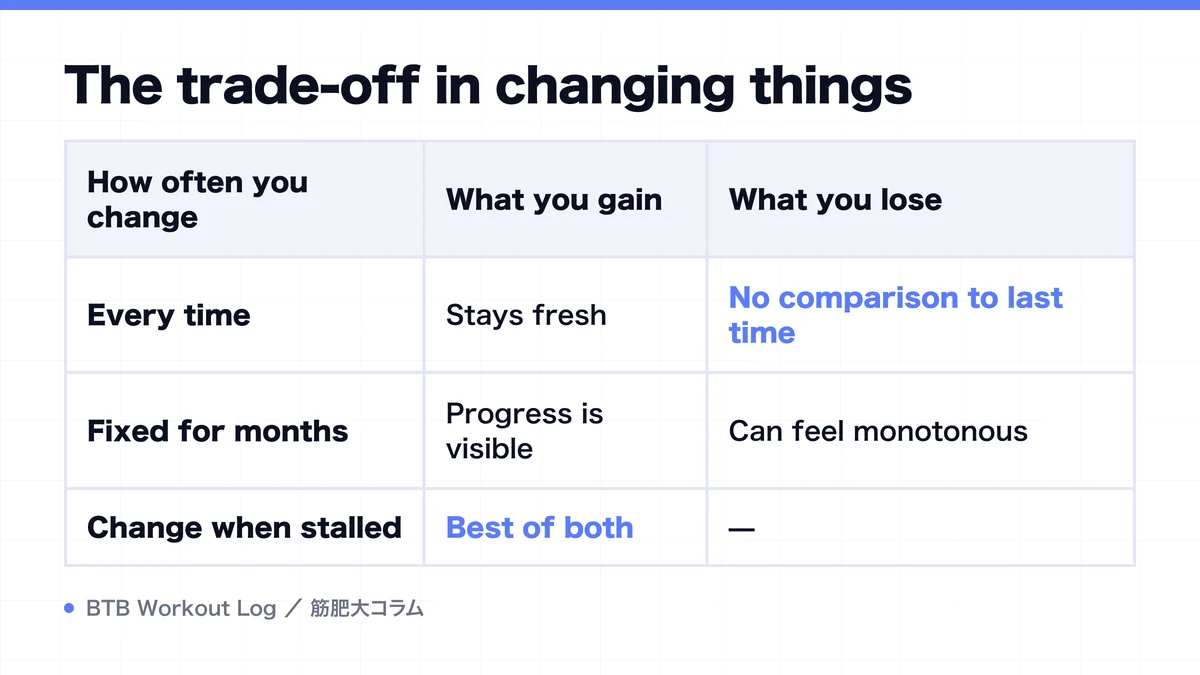
The first layer you can adjust every session. The second you decide in advance according to the purpose of the day, week or block. Move the third every session and conditions differ too much to tell whether capability rose or the exercise was simply easier.
So it isn't "variation or fixed". Keeping your main lifts as a reference while advancing load and reps inside them is itself a legitimate form of variation. As with whether repeating a programme is bad, you have to hold the exercise name and the actual load apart.
Periodisation research doesn't back random wholesale swaps
The ACSM progression model holds that continued adaptation requires progressive resistance training, and describes deliberately using a range of loads for trained lifters. Broadly, advancing load, reps, sets and frequency in line with goal and experience is the basis of programme design.
In systematic reviews and meta-analyses of periodisation with training volume equated, periodisation tends to favour maximal strength while showing no clear difference from non-periodised training for hypertrophy. The periodisation in question is mainly planned variation in intensity and volume. It isn't the same thing as replacing every exercise each week to "surprise the muscle".
That result doesn't say variation is unnecessary, nor that a fixed programme is the only right answer. Generally, periodising intensity and volume doesn't by itself add hypertrophy. Hypertrophy and maximal strength are different outcomes, and participant experience and study lengths vary, so no universal swap interval can be extracted from the literature. The planned comparison belongs in fixed programme versus rotation.
Novelty looks like evidence of effectiveness
A new exercise often leaves an unusual area tight and produces strong soreness. Loads and reps differ from your usual work too, which makes it feel like you finally hit a muscle you'd been missing. That experience turns into the story that changing often produces growth.
But the feedback from a novel exercise includes plain unfamiliarity. Reps rising over the first few sessions may be you learning the path and how to produce force, not muscle appearing in a fortnight. Equally, a lower load doesn't mean weaker stimulus. Numbers from a period where conditions weren't yet comparable are hard to read as hypertrophy at all.
Soreness deserves the same separation: a sign you did something unusual is not evidence of superior long-term growth. As in the myth that more soreness is better, the dramatic sensation of the day stands out — while one extra rep on the same exercise is quiet. That difference in visibility is what makes random change attractive.
Swap exercises when a problem appears, not when a timer expires
"It's been four weeks, replace everything" isn't a sufficient reason. If your main lifts are progressing, nothing hurts, you can load the target, and you're recovering, there's a good case for leaving it alone. Dropping an exercise that's working means voluntarily surrendering accumulated skill and comparison data.
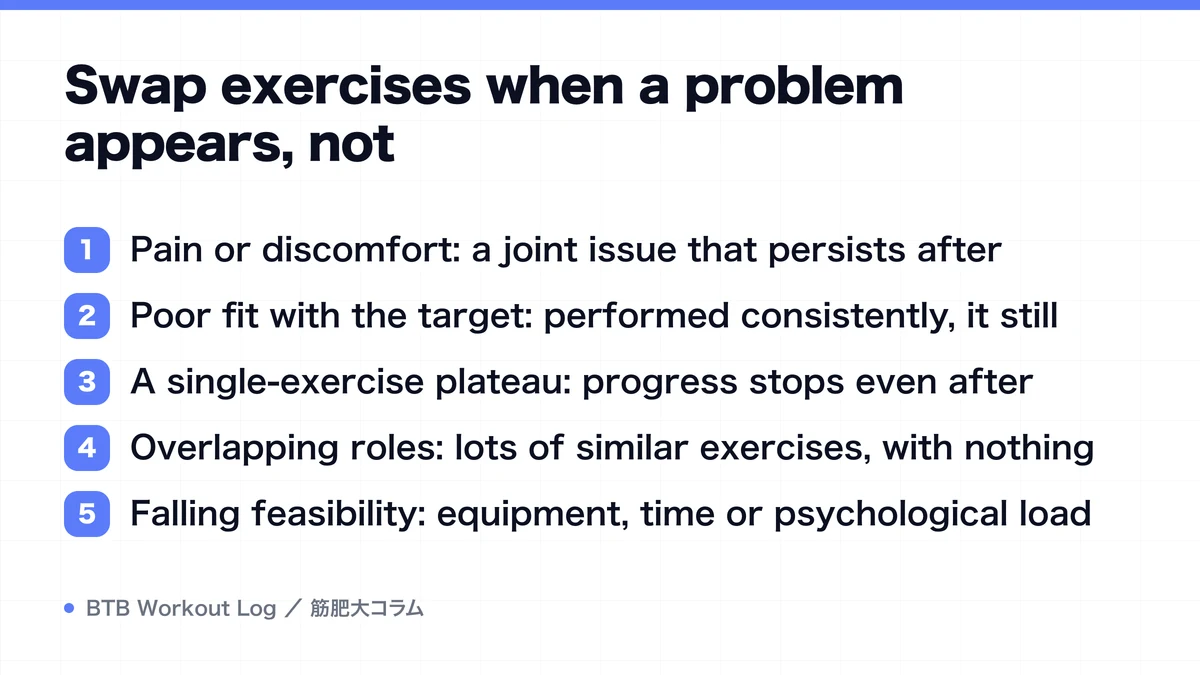
Any of the following persisting, though, makes a change worth considering.
- Pain or discomfort: a joint issue that persists after adjusting load and form.
- Poor fit with the target: performed consistently, it still can't make the target muscle the limiter.
- A single-exercise plateau: progress stops even after checking recovery, RIR and volume.
- Overlapping roles: lots of similar exercises, with nothing covering the missing movement or muscle length.
- Falling feasibility: equipment, time or psychological load make it hard to sustain.
Framed that way, a change isn't random stimulus-adding — it's a tool for solving a named problem. If your numbers are falling across the board, fatigue and nutrition deserve suspicion before boredom does. Isolating causes works the same way as in breaking a plateau: one hypothesis at a time against one symptom.
If you change, make it a small comparable experiment
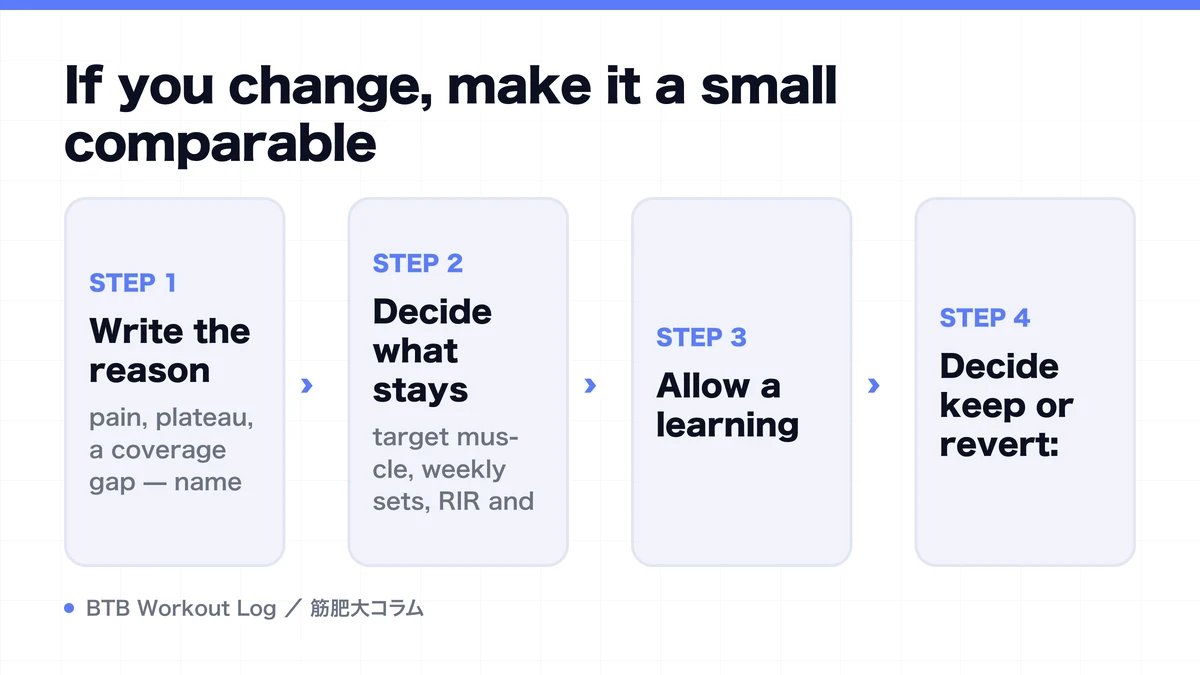
When a change is warranted, don't move the whole programme — swap one candidate with a similar role. If a chest press irritates a joint, hold weekly sets and your other chest work and switch to a press with a different grip or implement. Narrow what moves and you can actually read whether the problem improved.
- Write the reason: pain, plateau, a coverage gap — name the one problem you're solving.
- Decide what stays: target muscle, weekly sets, RIR and session order held as far as possible.
- Allow a learning period: don't judge on the first session's numbers; wait until path and load selection settle.
- Decide keep or revert: judge on pain, reps, load, target engagement and recovery.
Whether overload can be managed while changing exercises every time leads into testing progressive overload with rotating exercises. At minimum, fewer like-for-like records means lower confidence in your decision. To say a change worked, you need the baseline that preceded it — and BTB Workout Log keeps those pre-change numbers directly referenceable.
Don't make changing the goal. Keep the part that measures progress, and test only the variation you actually need. That way novelty doesn't drive the programme, and you learn whether the change helped.
FAQ
- How many weeks should I keep the same programme?
- There's no shared deadline. You can continue while load, reps and RIR are advancing, nothing hurts, and you can load the target. Judge on progress, recovery and how sustainable it is rather than elapsed time.
- Is it fine to change exercises because I'm bored?
- Changing to protect consistency is reasonable. Just don't swap everything at once — keep your main lifts and rotate accessories, so you preserve something comparable while still enjoying the training.
- Should changing exercises be my first move when I plateau?
- Check recovery, RIR, weekly sets, form and nutrition first. If other exercises are progressing and only one has stalled despite those adjustments, then try swapping in a similar-role exercise — one at a time.
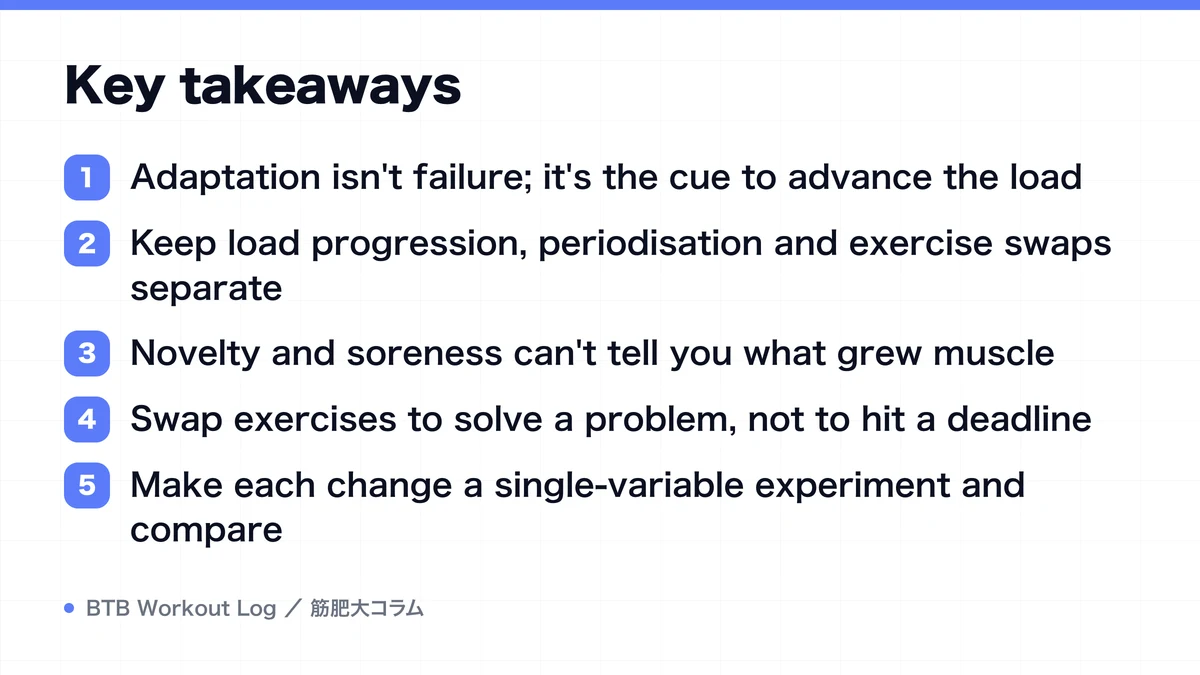
Key takeaways
- Adaptation isn't failure; it's the cue to advance the load
- Keep load progression, periodisation and exercise swaps separate
- Novelty and soreness can't tell you what grew muscle
- Swap exercises to solve a problem, not to hit a deadline
- Make each change a single-variable experiment and compare