Hypertrophy Rep Ranges: Is 8–12 a Myth? What Research Says About Training in the 6–20 Range
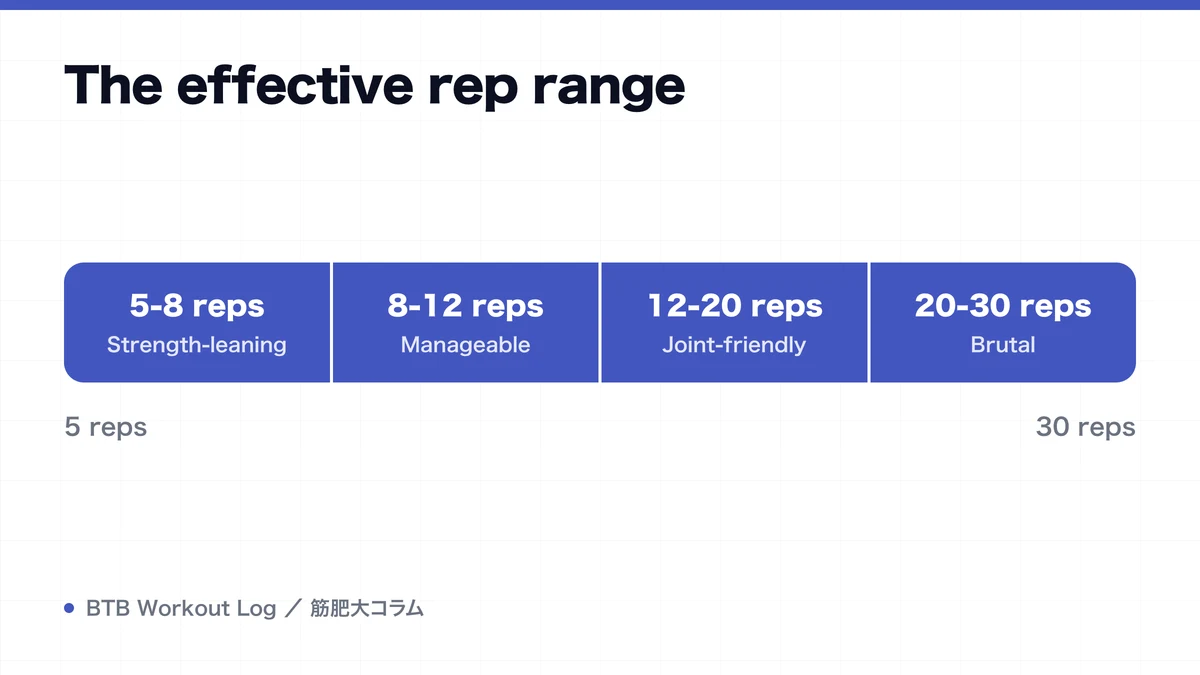
The rep range usable for hypertrophy is broad - roughly 5-30 reps - and 8-12 is not the only range that works. In practice you center on 6-20 reps and choose between them by looking at proximity to failure, how stable the exercise is, and fatigue.
8-12 reps is the range where it is easiest to balance load, time, and joint stress across most exercises. But it is not the boundary of what is correct - the center of the judgement is whether you can improve your numbers under matched conditions within the range you chose.
How true is "8-12 reps is the optimal range"?
8-12 reps sits between low reps, where the weight is heavy enough that form breaks down easily, and high reps, where breathlessness and long set times become the first problem. Because it is manageable on both compound and isolation exercises, it has long been used as the standard prescription. Being a convenient starting point is a different thing from having a special hypertrophy effect found only there.
Taken together, the research shows that when sets are brought close enough to failure, hypertrophy can occur anywhere from light loads to heavy loads. What matters in a comparison of low reps and high reps is matching effort, not just the rep number. Comparing a set of 20 with a lot of reps in reserve against a set of 6 taken to just short of being unable to complete another rep is not a comparison of rep ranges.
Schoenfeld et al.'s meta-analysis on load also limited itself to studies that went to the point of being unable to complete another rep when comparing hypertrophy at light and heavy loads. You cannot drop that condition and read it as saying that a light weight finished comfortably gives the same result. Dropping the 8-12 myth does not mean ignoring rep counts; it means looking at the conditions that make the result hold.
Heavy and light loads differ in properties other than hypertrophy
Even though heavy and light loads show only a small average difference in hypertrophy when performed with enough effort, they are not equally practical. Heavy loads produce large force in few reps, so they favor gains in maximal strength, and set times are shorter. On the other hand, in exercises where joint or posture limits show up first, the set can end before you have used up the muscle you were targeting.
Light loads keep external load low and make it easier to pile up reps on the target muscle with isolation exercises or stable machines. But it takes more reps to approach failure, and local burning, breathing, and concentration become likely reasons the set stops. In a comparison of heavy and light loads, you need to evaluate not only hypertrophy but also strength, time, fatigue, and how easy progress is to measure, exercise by exercise.
Mitchell et al.'s light-load study compared 3 sets of single-leg knee extension at 30%1RM taken to the point of being unable to complete another rep against 3 sets at 80%1RM in young men. It is a strong example that hypertrophy can occur at light loads, but rather than generalizing it to the same result for every person, exercise, and reps-in-reserve setting, translate the conditions into your own program.
The conditions where light loads work, and the limits of extreme rep counts
The reason light loads can still build muscle is that as reps continue and fatigue builds, more motor units join in producing force. But if the set stops from grip, breathing, pain, or form breakdown before the target muscle does, being inside the theoretically effective range does not necessarily make it a good set. The lighter the load, the more what ended the set matters over how many reps you did.
Even loads around 30 reps are an option if you can use the target muscle, get close to your limit with stable movement, and keep progressing over several weeks. But 30%1RM and 30RM do not mean the same thing, and 30 reps is not a boundary of effectiveness. If your concentration breaks in long sets, cutting the reps and raising the load is easier to reproduce.
Conversely, heavy loads around 3 reps can also be a hypertrophy stimulus, but it is a range with few reps, long preparation and rest, and where technique and joints tend to become the constraint. Keeping a low-rep slot as strength practice while filling in weekly volume with moderate-rep sets tends to be easier to manage. That both extremes are usable is not a reason to push every exercise toward the extremes.
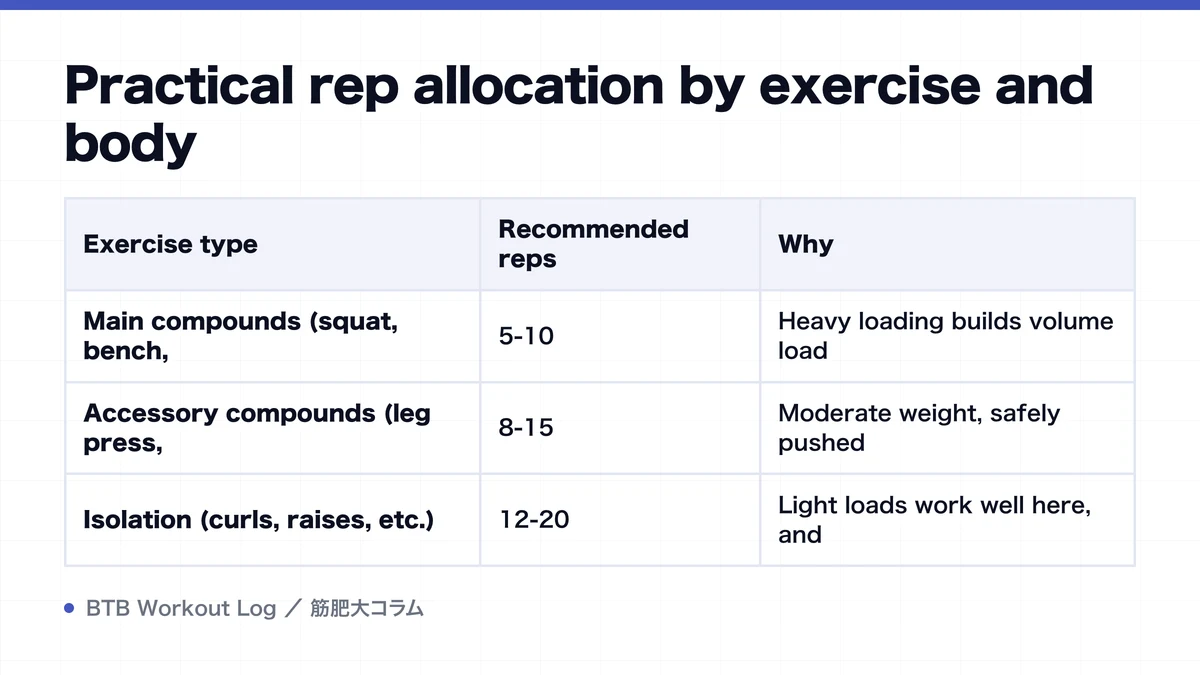
Practical rep allocation by exercise and body part
| Exercise type | Recommended reps | Why |
|---|---|---|
| Main compounds (squat, bench, etc.) | 5-10 | Heavy loading builds volume load efficiently and develops strength |
| Accessory compounds (leg press, etc.) | 8-15 | Moderate weight, safely pushed close to failure |
| Isolation (curls, raises, etc.) | 12-20 | Light loads work well here, and they are joint-friendly |
This table is a starting point, not a prescription fixed by exercise name alone. For example, a stable chest press makes higher reps easier to use than a bench press, and even on a lateral raise, if momentum creeps in, lowering the reps can make comparison easier. Prioritize the range where the muscle you are targeting is the reason the set stops and you can hold your range of motion and form.
It is neither true that heavier is always better for hypertrophy nor that light weights are pointless. Even for the same person, the position that fits changes with the exercise. Watch joint discomfort, movement quality late in the set, and the drop in reps on the next set, and move up or down within the table.
Know that the same 10 reps can be a different stimulus
Reps are a yardstick for setting load, but on their own they do not describe the quality of a set. 10 reps at RIR 1 is close to failure, while stopping at 10 with a weight you could lift 15 times is around RIR 5. And if range of motion, momentum, rest, or fatigue outside the target muscle differ, the same weight for the same 10 reps is no longer the same basis for comparison.
3 sets of 10 is a convenient default, but it is not the correct prescription. It only becomes usable for adjustment once you combine reps, RIR, weekly hard sets, and the comparison with last time. If you shorten your range of motion to hit the planned reps, or fail on the third set every time, the 3x10 lines up on paper but there is no reproducibility.
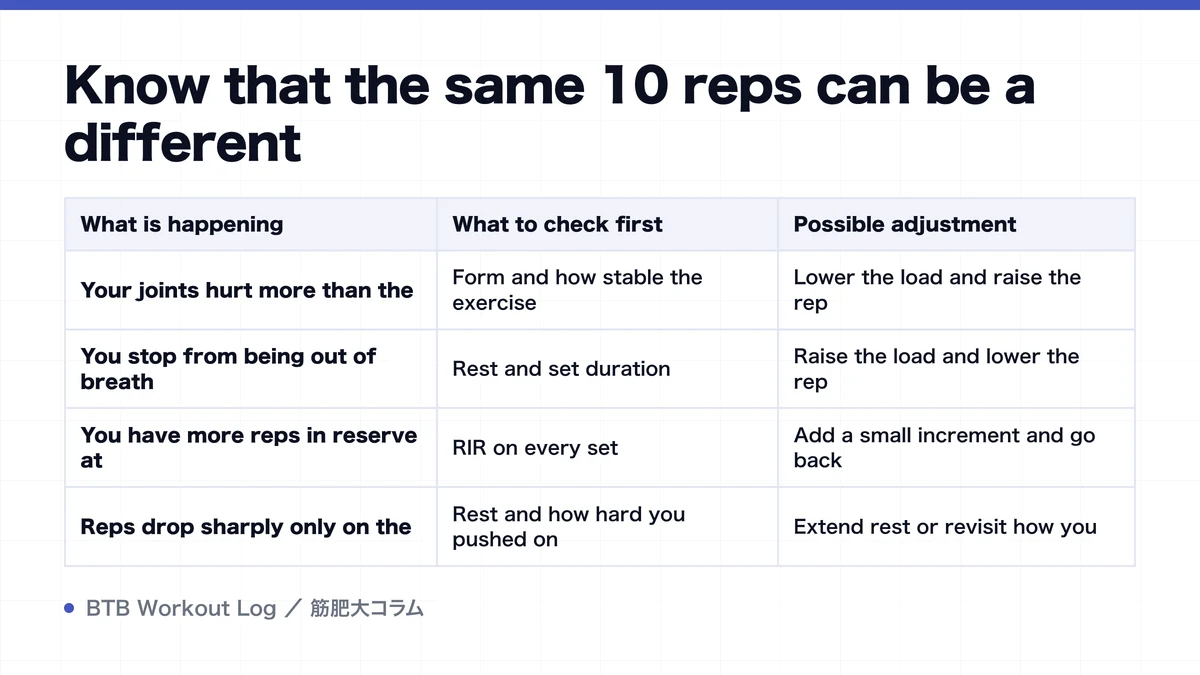
| What is happening | What to check first | Possible adjustment |
|---|---|---|
| Your joints hurt more than the target muscle | Form and how stable the exercise is | Lower the load and raise the rep range |
| You stop from being out of breath first | Rest and set duration | Raise the load and lower the rep range |
| You have more reps in reserve at the top of the range | RIR on every set | Add a small increment and go back to the bottom of the range |
| Reps drop sharply only on the later sets | Rest and how hard you pushed on the early sets | Extend rest or revisit how you distribute RIR |
Run a rep range rather than a fixed rep count
If you set a range like 8-12 reps instead of always 10, changes in your capacity can show up split across weight and reps. Start near the bottom of the range and add reps with the same form, range of motion, rest, and target RIR. Once every set reaches the top, raise the weight by the smallest increment and drop back near the bottom - that is double progression.
If after adding weight you cannot reach the bottom of the range, everything turns into RIR 0, or your movement breaks down, the jump in weight was too big. Conversely, if you reach the top of the range but RIR is still above 3 and you have room several sessions in a row, you can consider adding weight. You will not necessarily gain a rep every time, so judge from the trend across several sessions rather than a single day's ups and downs.
If you swap exercises often, the series of weights and reps breaks up. While you are checking whether a rep range suits you, keep equipment settings and exercise order as fixed as possible, and limit yourself to changing one condition at a time.
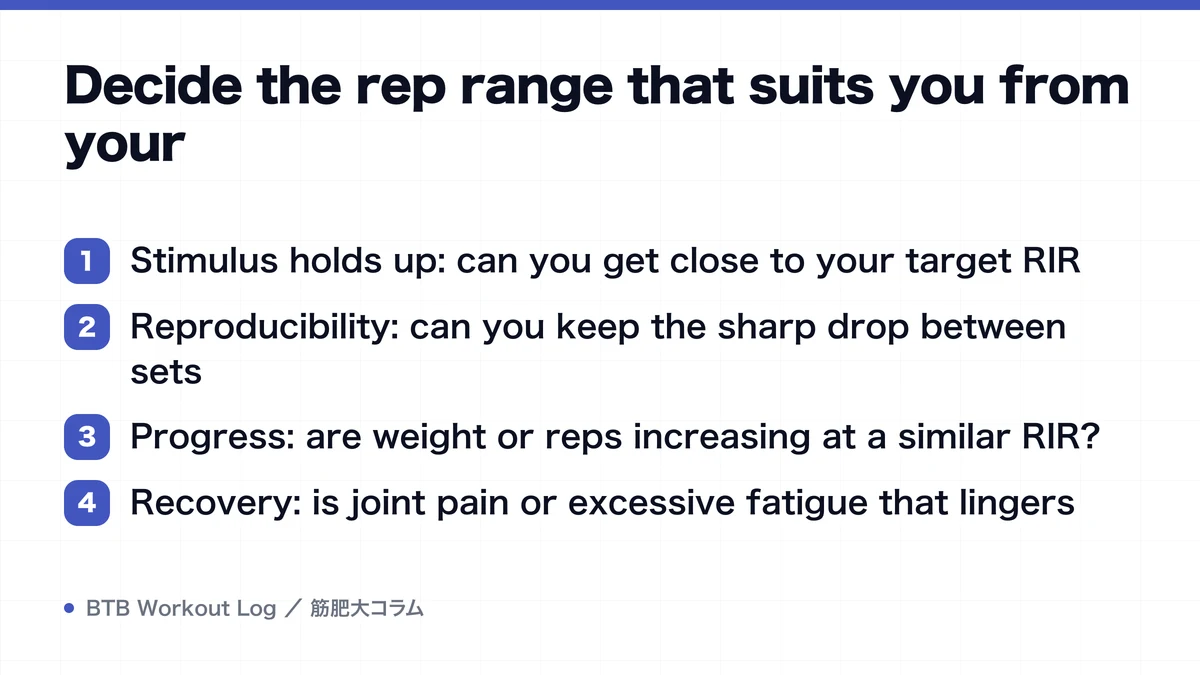
Decide the rep range that suits you from your log
Once you choose a rep range, keep conditions consistent and track it for at least a few weeks. Look beyond your highest rep count.
- Effective stimulus: Can you approach your target RIR with the target muscle being what makes you stop?
- Repeatability: Can you maintain the same range of motion and technique without a sharp drop in performance between sets?
- Progress: Are you adding weight or reps at a similar RIR?
- Recovery: Are you experiencing persistent joint pain or excessive fatigue that carries over into your next session?
To compare two rep ranges, use the same exercise and change only one variable at a time. If progress stalls while sleep, diet, weekly sets, and exercise order also change, you cannot pin it on the rep range. Record RIR alongside weight and reps, then track the same exercise over time. This makes it easier to tell whether 1 extra rep reflects improved performance or a difference in how close you were pushing to failure. BTB Workout Log lets you review weight and rep trends for each exercise. Add a note such as "RIR2" to that day's exercise notes to make comparisons easier.
Changing your rep range should not be your first response to a plateau. It is an option when progress has stopped despite consistent conditions, and problems with what makes you stop a set or with joint stress persist. First check your rest periods, target RIR, and load increments. If the range still does not suit you, shift it higher or lower.
Two principles to line up before rep count
Before fine-tuning rep counts, line up the effort of each set and the weekly volume per body part. Keep most working sets centered on RIR 1-3 in practice, and do not leave too many reps in reserve. Next, secure your weekly hard sets within what you can recover from, and track progress within the same exercise.
Debating the difference between 6 reps and 10 reps while those two are unstable tells you nothing about the effect of the rep range. Use 5-10 reps for main lifts, 8-15 for accessories, and 12-20 for isolation as your starting points, and move up or down based on the reason sets stop, RIR, progress, and recovery. That way you can use 8-12 as a convenient standard without freezing it into a myth.
FAQ
- Can I mix low reps (5) and high reps (20) in the same program?
- Mixing them is fine. Putting stable main lifts in the low-to-moderate rep range and isolation or machine work in the moderate-to-high range lets you keep strength practice while spreading joint stress and fatigue. On each exercise, hold the rep range fixed for a while and track the comparison with last time.
- Is pushing close to failure more important than hitting a specific rep count?
- You need to look at proximity to failure and not only reps, but you do not need to fail on every set. Do most sets in the RIR 1-3 range, and judge alongside that whether you can hold your range of motion and form and whether you can recover for the next set and the next session.
- Should I do the same number of reps on every set?
- It is natural for reps to fall slightly on later sets as fatigue builds. Do not force every set to the same count - match rest and RIR, and record them. If a sharp drop continues, revisit one of these: how hard you pushed on the early sets, your rest, or your load setting.
- How long do I need to try a rep range before I can judge it?
- Do not decide from a single good or bad session; track it for a few weeks with the same exercise, order, rest, and target RIR. Compare the trend in weight or reps, whether the target muscle is the reason sets stop, the state of your joints, and your recovery before the next session together.
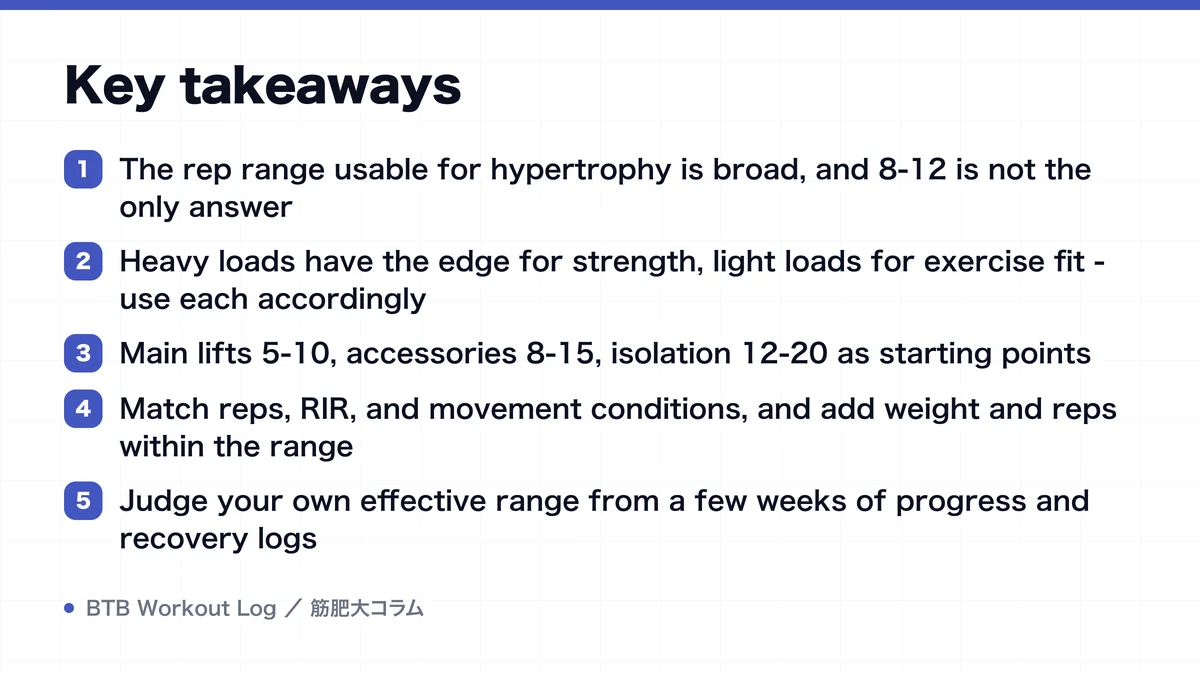
Key takeaways
- The rep range usable for hypertrophy is broad, and 8-12 is not the only answer
- Heavy loads have the edge for strength, light loads for exercise fit - use each accordingly
- Main lifts 5-10, accessories 8-15, isolation 12-20 as starting points
- Match reps, RIR, and movement conditions, and add weight and reps within the range
- Judge your own effective range from a few weeks of progress and recovery logs