
Hypertrophy Takes More Than Weight × Reps × Sets | The Numbers Trap
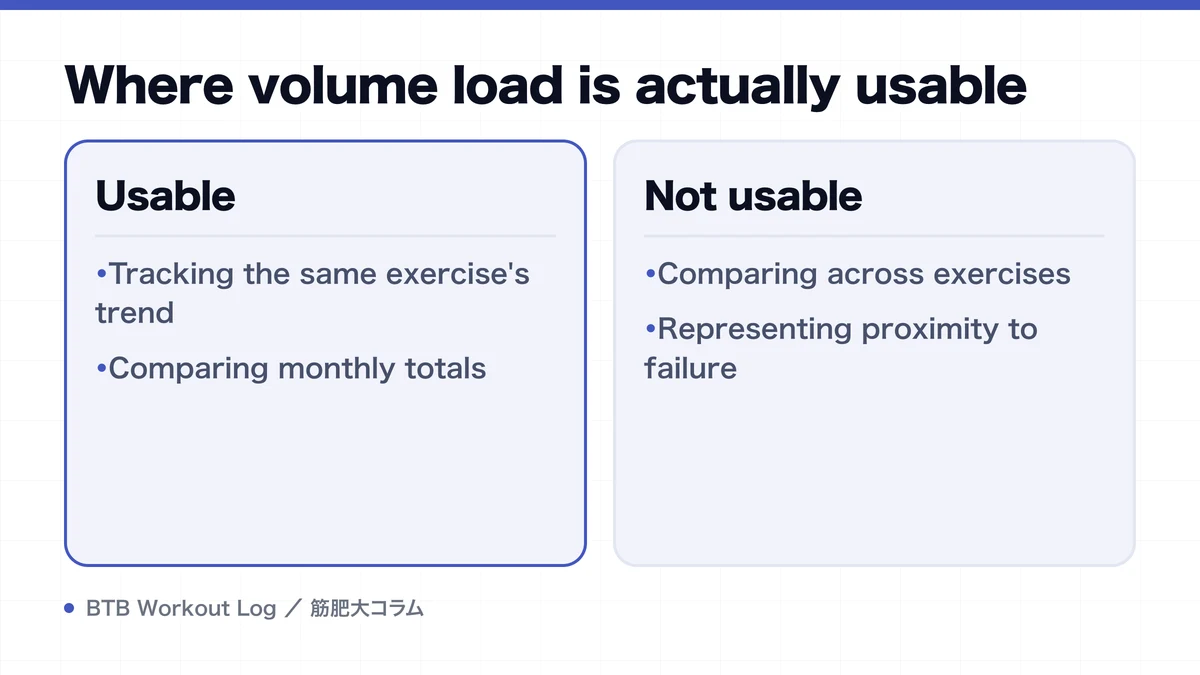
Volume load — weight times reps times sets — is convenient for tracking the same exercise under similar conditions, but it isn't an all-purpose score for hypertrophy stimulus itself.
Ignore what the number doesn't capture — load range, proximity to failure, range of motion, load on the target muscle — and you end up with the mistaken comparison that "more tonnage always works better".
What weight times reps times sets actually counts
What this formula counts is how many times you moved the external load shown on the bar or machine. 80kg for 8 reps across 3 sets comes to 1,920kg. If next time you do 9 reps for 3 sets at 80kg on the same exercise, same setup, same range of motion, it becomes 2,160kg. Because it's easy to calculate and rolls progress into a single number, it spread as a stand-in figure for "volume".
Up to here it's practical. Under nearly matched comparison conditions, a rise in volume load shows that load, reps or sets went up. As a supporting metric for reviewing workload within an exercise, it's useful — this is also why managing training volume deals with volume load at all.
But this number doesn't directly measure the stimulus the muscle received. The moment you treat "recorded external load" and "valid stimulus to the target muscle" as the same thing, you've stepped outside what the formula covers.
The same volume load doesn't mean the same set content
Even with matched volume load, the hypertrophy context changes if these conditions differ.
- Load range: a set handling 100kg for fewer reps and a set repeating a light weight many times can reach the same volume load with different rep counts and different fatigue characteristics.
- RIR: RIR describes reserve — how many reps were left. Even at the same 50kg × 10 reps, someone at true failure and someone with 5 reps left carried different relative effort.
- Range of motion and form: even with matched weight and reps, if range of motion, momentum, or how much load leaked to assisting muscles differs, load on the target won't match either.
- Exercise and equipment: adding 1,000kg from squats to 1,000kg from leg curls doesn't tell you how that was distributed across muscle groups. The displayed weight doesn't necessarily mean the same thing across different machines either.
In an extreme case, you could inflate volume load simply by adding a lot of light warm-up work. Counting that as increased hypertrophy stimulus doesn't hold up. Conversely, if volume load temporarily drops because you tightened range of motion or form, that alone doesn't establish that stimulus fell. The conditions around handling light loads should be considered separately, alongside why light loads can build muscle.
Even in research, "volume" isn't a single metric
Studies comparing load show that when low-load and high-load sets are both taken to failure, strength gains tend to favor high load while hypertrophy can be comparable across a wide load range. Mitchell et al.'s study likewise found no clear between-group difference in muscle gain across different load and set combinations. No single study settles this given limited populations and durations, but it's an example of why external weight or calculated volume load alone can't rank hypertrophy outcomes. Choosing a load range, as in comparing heavy and light load, is more sensibly decided by including strength, time and fatigue too.
Meanwhile, meta-analyses examining the dose-response relationship between volume and hypertrophy mainly use weekly set count as their primary metric. In other words, even in research, "volume" doesn't always mean weight times reps times sets. Weekly sets per muscle group are easier to use for grasping prescribed dose; volume load is easier to use for grasping results within an exercise. They're metrics that answer different questions.
Nor is there support for the simple claim that taking sets to failure is always superior. There's uncertainty in the relationship between proximity to failure and hypertrophy, and matching volume load doesn't necessarily erase differences in effort. Research averages are useful information, but they're not grounds for turning one formula into a universal conversion.
The easier a number is to calculate, the more it looks like the cause
This misconception arises not because volume load is a bad metric, but because it's easy to calculate and partly overlaps with genuine progress. On the same bench press, if load or reps climb while form holds, volume load usually rises too, and tends to run in parallel with hypertrophy progressing.
But a number moving in parallel isn't necessarily the whole cause. If you keep adding sets just to push volume load up, and it wrecks back-half output or next-session recovery, the number alone climbs while the program's quality can fall. If volume load drops in a week you changed exercises, you can't directly compare before and after as better or worse.
Rolling everything into one total makes it easier to manage, but it hides which muscle group, at what reserve, and with what movement the work was actually done. Confusing "it can be totaled" with "it explains the outcome" is what keeps this treated as all-purpose.
For hypertrophy purposes, read volume load in three layers
You don't need to discard volume load — limit the scope you compare it within, and combine it with other metrics.
- Check prescribed dose per muscle group: start by checking weekly hard sets. The standard for counting a set is that it placed sufficient load on the target muscle without leaving extreme reserve. Don't treat every set as equal value — also look at why the same 10 weekly sets can differ.
- Check results on the same exercise: hold exercise, equipment setup, form, range of motion and rest as fixed as possible, and track the trend in load and reps. Within this scope, volume load becomes a helpful reference line — but judge it by a multi-week trend, not a single session's rise or fall.
- Layer in set quality and recovery: check each set's RIR, load on the target muscle, recovery by next time, and any performance decline. If volume load rose but RIR grew larger, form shortened, or next-session reps fell, that's not necessarily pure progress.
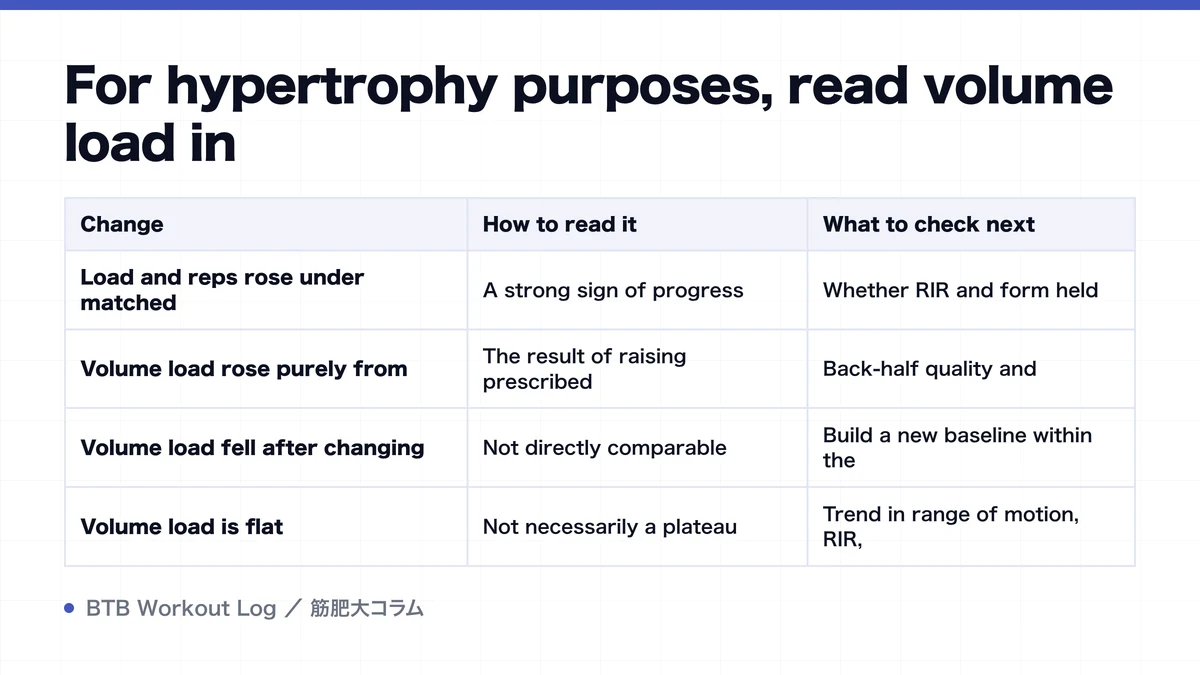
| Change | How to read it | What to check next |
|---|---|---|
| Load and reps rose under matched conditions | A strong sign of progress | Whether RIR and form held |
| Volume load rose purely from added sets | The result of raising prescribed dose | Back-half quality and next-session recovery |
| Volume load fell after changing exercise | Not directly comparable | Build a new baseline within the new exercise |
| Volume load is flat | Not necessarily a plateau | Trend in range of motion, RIR, weekly sets |
Match comparison conditions before raising the number
Consider adding sets not because volume load is low, but when you're stably completing and recovering from your current hard sets while load or reps under matched conditions haven't moved in several weeks. Conversely, if volume load keeps rising while form breaks down, RIR worsens, or fatigue carries over to next time, there's room to slow the pace of increase.
A cross-exercise figure like "20 tonnes total this week" is less useful for your next decision than a broken-down record — how many sets chest got, how the bench press progressed under matched conditions, and how much reserve was left. Volume load only carries meaning within the same exercise. BTB Workout Log lets you track per-exercise trends and per-muscle-group weekly sets separately.
Volume load is a number that summarizes what you did under matched conditions. It isn't a number that explains, on its own, how much muscle will grow. Respecting that boundary lets you keep the convenient formula without letting the number push you around.
FAQ
- Is there no point logging volume load?
- It's worth logging. It works as a supporting metric that summarizes progress in load or reps under similar conditions — same exercise, equipment setup, form, range of motion and rest. Just don't compare totals across different exercises, or sets with very different load ranges, as a hypertrophy effectiveness score.
- Which should I prioritize — volume load or weekly hard sets?
- It's practical to use weekly hard sets when adjusting prescribed dose per muscle group, and load/reps plus volume load when tracking progress on an individual exercise. Layer RIR, range of motion, form and recovery status onto both, rather than deciding changes from a single number alone.
- Is a week where volume load dropped bad for hypertrophy?
- You can't judge from one week's drop alone. It can fall from changing exercises, a deload, tightened range of motion, fatigue, or adjusted set counts. Only once results on matched-condition exercises decline for several weeks, along with worsening RIR or recovery, is it time to review fatigue or program design.
Key takeaways
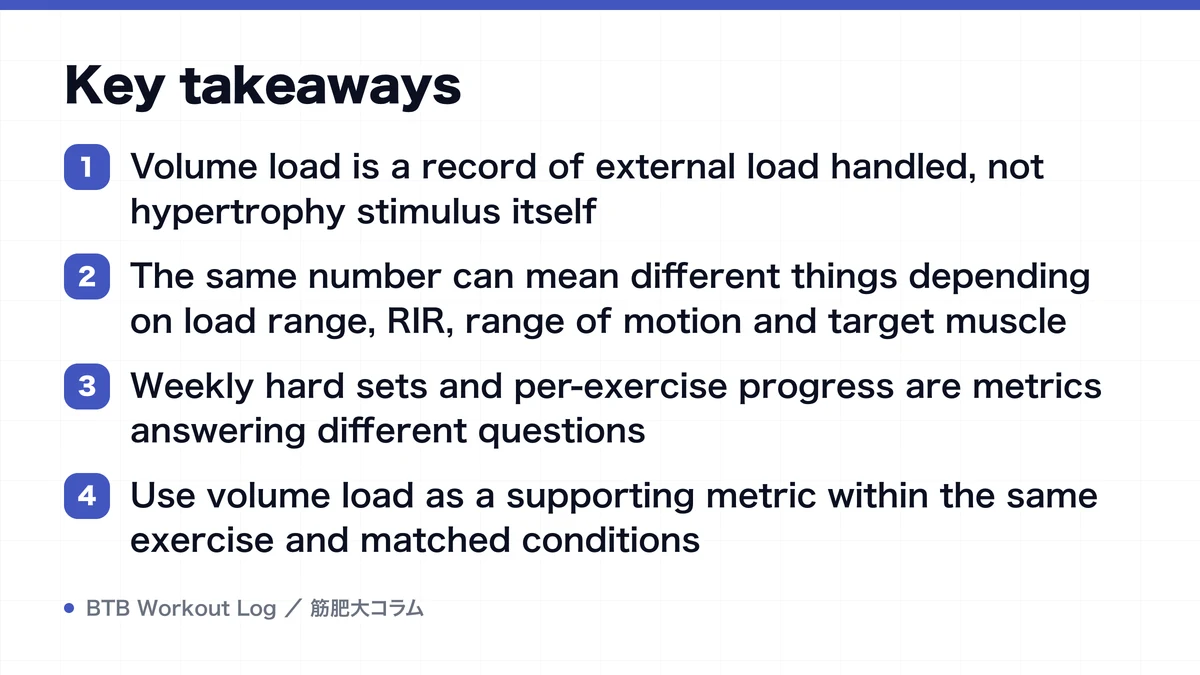
- Volume load is a record of external load handled, not hypertrophy stimulus itself
- The same number can mean different things depending on load range, RIR, range of motion and target muscle
- Weekly hard sets and per-exercise progress are metrics answering different questions
- Use volume load as a supporting metric within the same exercise and matched conditions
References
- Resistance Exercise Load Does Not Determine Training-mediated Hypertrophic Gains in Young Men
- Low- vs High-load Resistance Training for Strength and Hypertrophy: Meta-analysis
- Dose-response Relationship Between Weekly Resistance Training Volume and Muscle Mass
- Resistance Training Volume Enhances Muscle Hypertrophy in Trained Men
- Proximity-to-Failure and Muscle Hypertrophy: Systematic Review with Meta-analysis