Exercise Selection: Feeling a Muscle Work More Doesn't Make an Exercise Better | Why Feel Alone Can Mislead
Feeling the target muscle working is a useful cue for adjusting form, but it isn't a scorecard for ranking exercises by hypertrophy effectiveness.
Some exercises give strong contraction and burn but are hard to progressively load; others give a modest sensation while still letting you stack high-quality sets consistently. The point isn't to discard the sensation — it's to give it a limited, specific role.
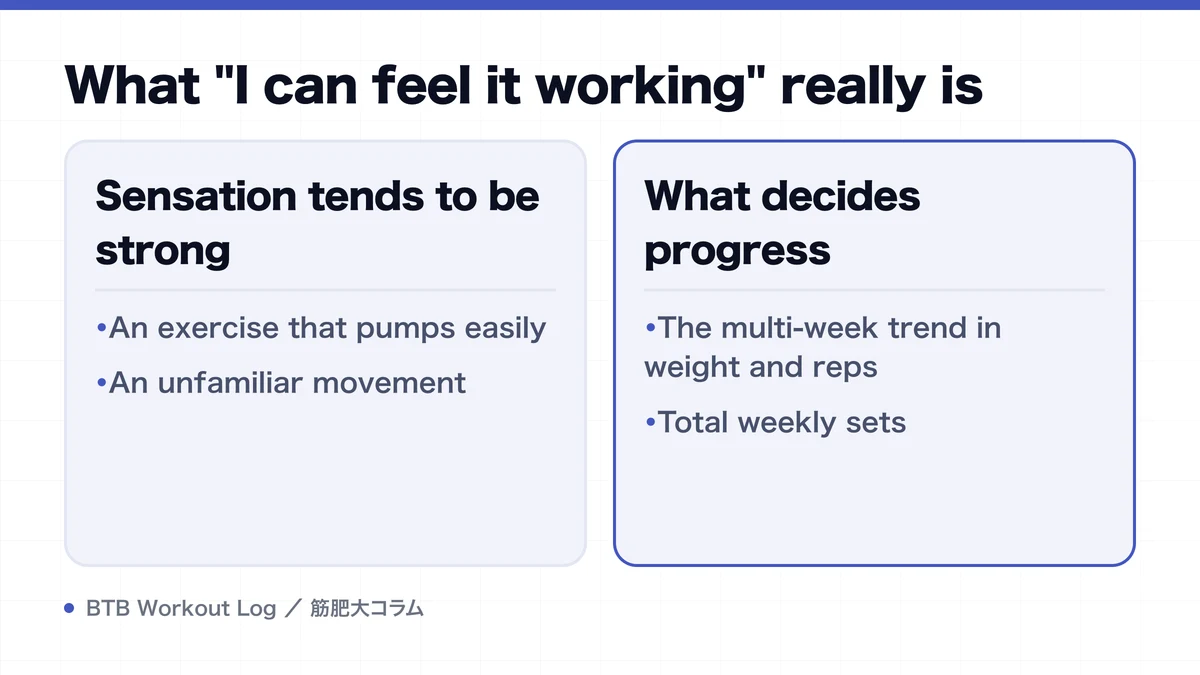
How far you can trust "I can feel it working"
Feeling the target muscle contract, stretch, or tighten during a set has real value. If your traps fatigue instead of your delts on lateral raises, or your calves hit their limit before your hamstrings on leg curls, that discomfort is a cue to review posture, path, load or machine setup. While learning a new exercise, it works as feedback that maps the intended movement onto internal sensation.
It's also useful for catching anomalies — a big left-right difference in sensation, confusing joint pain with muscle fatigue, or the target shifting set to set. What the sensation answers here is "how did this specific rep feel" — not "how much muscle will this exercise add months from now".
The same goes for the pump. It can serve as supporting information for whether the target muscle was likely involved, but it doesn't by itself confirm valid load, sufficient effort, or a recoverable amount of work. Using sensation as an entry point and drawing conclusions from sensation alone need to stay separate.
Why sensation strength and exercise quality diverge
The word "feel it working" blends several distinct phenomena — being aware of the contraction, feeling stretched, heat, pump, next-day soreness. Moving slowly at light load with short rest tends to amplify burn, but that doesn't mean it's the most favorable method for long-term hypertrophy. An unfamiliar exercise can feel fresher and more intense, while a well-practiced main lift can start to feel subdued even as it keeps working.
In multi-joint exercises, several muscles share the work. If your chest doesn't burn intensely on the bench press, that doesn't mean chest load was zero; if lat contraction feels weak on rows, you may still be resisting the external load along an appropriate path. The back in particular is hard to see and involves many muscles, which is part of why sensation there is hard to interpret — see why it's hard to feel your back working.
Conversely, even an exercise where the target muscle burns intensely loses value as a main lift if posture is unstable and the path changes every time, if joint discomfort stops you before the muscular limit, or if you can't progressively increase load or reps over time. A strong sensation is one response — it isn't a composite score covering stimulus quality, sustainable volume, and fatigue cost.
Research doesn't point to "maximize the feeling" as the one answer
Hypertrophy isn't a phenomenon that only occurs when you reproduce a specific sensation. Generally, given sufficient effort, hypertrophy can occur across a wide range of loads. The tension of a heavy set and the burn of a light set feel quite different, but that difference in sensation alone doesn't invalidate either one (see choosing between heavy and high-rep work).
Likewise, taking every set to complete failure isn't established as a necessary condition for hypertrophy either. Pushing to the limit tends to strengthen the impression of "that worked", but non-failure sets can produce comparable hypertrophy under matched conditions. In other words, going to failure every time to manufacture an intense sensation isn't the same thing as delivering the stimulus growth needs (see the effects and costs of training to failure).
That said, there's no basis for swinging the other way and declaring "awareness is entirely meaningless" either. Cueing or form adjustments that help load land on the target muscle are useful for many people and exercises. But short-term muscle activity, subjective contraction feel, and long-term hypertrophy aren't the same measurement. When applying research to practice, read it by separating out load condition, proximity to failure, range of motion and duration — not by the single fact that the sensation was strong.
Why "stronger feel means better exercise" is easy to believe
Hypertrophy is a change evaluated over weeks to months, but sensation arrives right after the set. Information that returns immediately tends to feel convincing even without confirmed causation to the outcome. When a new exercise produces intense soreness or a strong pump, it's tempting to declare it a "winner" on the spot.
Form that produces a strong sensation is also easy to communicate through video or coaching, while comparing matched-condition records across several weeks is unglamorous work. A cue like "angle your elbow this way to feel it in your chest" can be tried immediately, but that angle isn't necessarily optimal for everyone. The idea that there's no single "correct" appearance of form connects to the myth that there's only one correct form.
The misconception persists partly because feel and a genuinely good set do sometimes coincide. When appropriate load lands on the target muscle and you push close to the limit, contraction and fatigue sensations often follow. But there being cases of correlation is different from being able to rank exercises purely by sensation strength. What matters is not promoting short-term feedback into a long-term outcome metric.
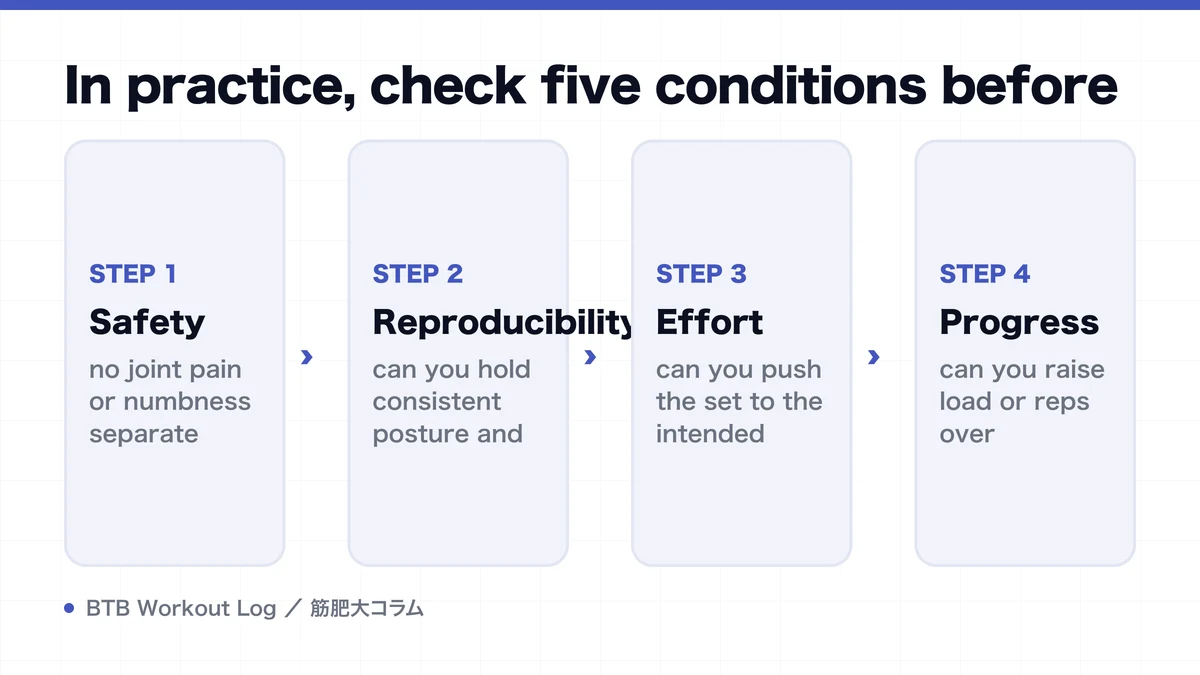
In practice, check five conditions before sensation
Deciding whether to keep or swap an exercise gets easier by checking these five items in order.
- Safety: no joint pain or numbness separate from muscle fatigue, and can you repeat the intended range of motion?
- Reproducibility: can you hold consistent posture and path set to set, with the target muscle stably involved?
- Effort: can you push the set to the intended range without leaving too much RIR — reps in reserve? See managing RIR for how to estimate it.
- Progress: can you raise load or reps over several weeks under comparable form, range of motion and RIR? This is the work of confirming progressive overload.
- Recoverability: does it avoid leaving fatigue or pain severe enough to disrupt the next exercise or session, letting you sustain your needed weekly sets?
If you're torn between two candidates, match weekly sets and exercise order as closely as possible, and trial each for 4–6 weeks. Compare load, reps, RIR, range of motion, pain, and recovery by next time, keeping sensation as a supporting column. Avoid comparisons that are too short — alternating for just a few days makes it easy to mistake the effect of familiarity or exercise order for a real outcome.
If every condition is roughly equal, it's fine to pick whichever exercise targets the muscle well and keeps you motivated to train. Feel can serve as a final tiebreaker — it just isn't the first filter.
FAQ
- Is it OK to keep an exercise even if I feel nothing in the target muscle?
- You don't need to drop it right away. First check that there's no pain, that you can reproduce the intended movement, that you can push to an appropriate RIR, and that load or reps are progressing. If assisting muscles keep hitting their limit first for several weeks even after adjustments, it becomes a candidate for change.
- Focusing on the contraction lowers the weight I can handle — which should I prioritize?
- If that focus stabilizes your path and makes the target muscle easier to use, a modest drop in weight isn't a problem. But if you're deliberately slowing down to the point load drops sharply and progress stalls, it's worth reconsidering. Compare using records with matched form, range of motion and RIR.
- Is it worth keeping an exercise that gives a strong feel as an isolation move?
- Yes. It's a strong candidate if it's joint-friendly, lets you train the target muscle with extra volume, and doesn't hurt overall recovery. Just don't adopt it purely for the strong sensation — judge it by whether it fills a gap your main lifts leave and whether you can sustain your weekly volume.
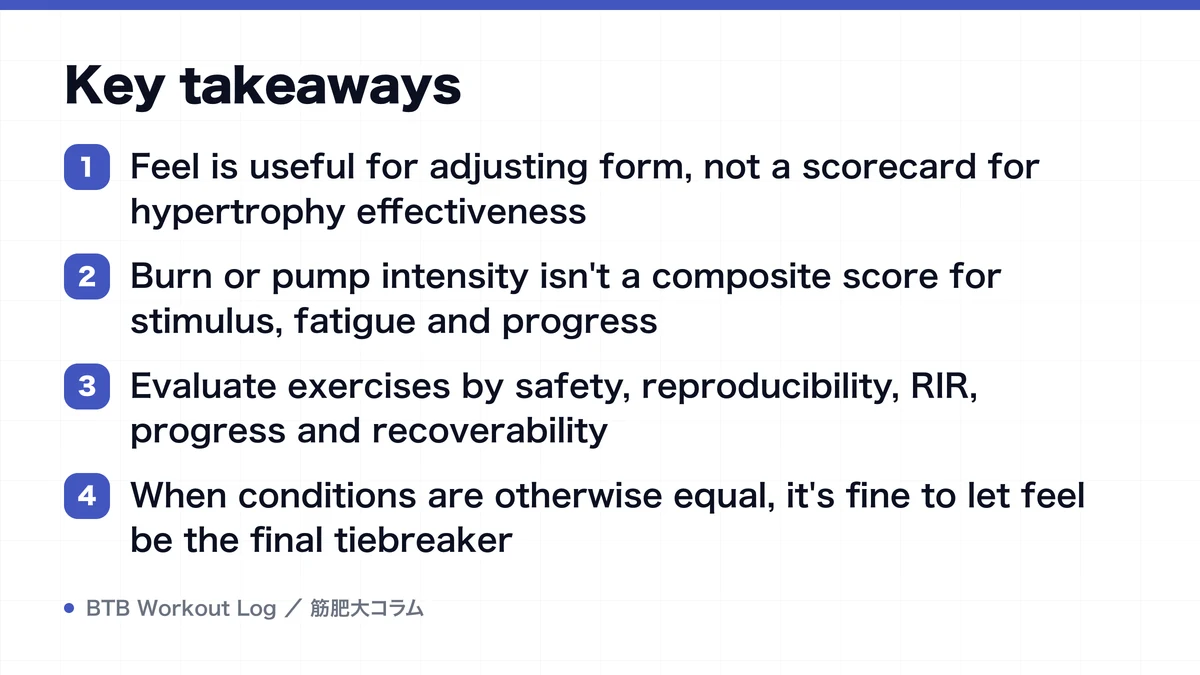
Key takeaways
- Feel is useful for adjusting form, not a scorecard for hypertrophy effectiveness
- Burn or pump intensity isn't a composite score for stimulus, fatigue and progress
- Evaluate exercises by safety, reproducibility, RIR, progress and recoverability
- When conditions are otherwise equal, it's fine to let feel be the final tiebreaker
References
- Low- vs High-load Resistance Training for Strength and Hypertrophy: Meta-analysis
- Resistance Exercise Load Does Not Determine Training-mediated Hypertrophic Gains in Young Men
- Training to Repetition Failure or Non-failure: Systematic Review and Meta-analysis
- ACSM Position Stand: Progression Models in Resistance Training for Healthy Adults