Hypertrophy: Why Believing There's Only One Correct Form Holds You Back
The danger isn't caring about form. It's treating one appearance as correct for every person and every goal, and applying it regardless of build, pain, target muscle or equipment.
Good form does have non-negotiables. But more than one movement can satisfy them, and there's room to adapt to the individual while keeping the conditions repeatable.
What's actually risky about "textbook or wrong"
Coaching often presents one template: stance width, grip width, joint angles, bar path. A reference point helps you learn the movement and spot obvious breakdowns, which makes it useful as a starting model. The problem arrives when that model gets promoted to a finished product everyone should reproduce identically.
Limb lengths, the directions your joints move well, your current mobility and the equipment in front of you all differ. And even within bench press, competing to lift the most weight and loading the pecs consistently for hypertrophy don't prioritise the same things. Forcing everyone toward one appearance can impose a position someone can't control, or discard adjustments that actually served their goal.
Swinging to "individual differences mean anything goes" is equally wrong. Uncontrolled momentum, a bar path that changes because the load is winning, and range of motion that shrinks purely to add reps are not deliberate adjustments. Why full range of motion is the default isn't about moving everyone's joints to the same maximum angle — it's about working the target muscle across a wide range and keeping conditions comparable.
The instinct to stabilise form is right
"Lock your form down" carries a real point. To evaluate progress in load or reps, this session's conditions have to resemble last session's. If grip width, stance, seat position, range of motion and momentum shift every time, a rising number could be strength — or just a movement you've made easier.
What you want fixed isn't a photograph. It's the execution conditions you chose. Decide the target muscle and the exercise's role, then hold start and end positions, the main path and your tempo policy within a range you can control pain-free. That repeatability is what lets you read progressive overload off load and rep trends.
| Category | What to check | How to treat it |
|---|---|---|
| Non-negotiable | You control the movement, no sharp pain, intended range of motion held | Don't let it break mid-set |
| Hold constant | Grip, stance, seat, range of motion, degree of momentum | What makes comparison possible |
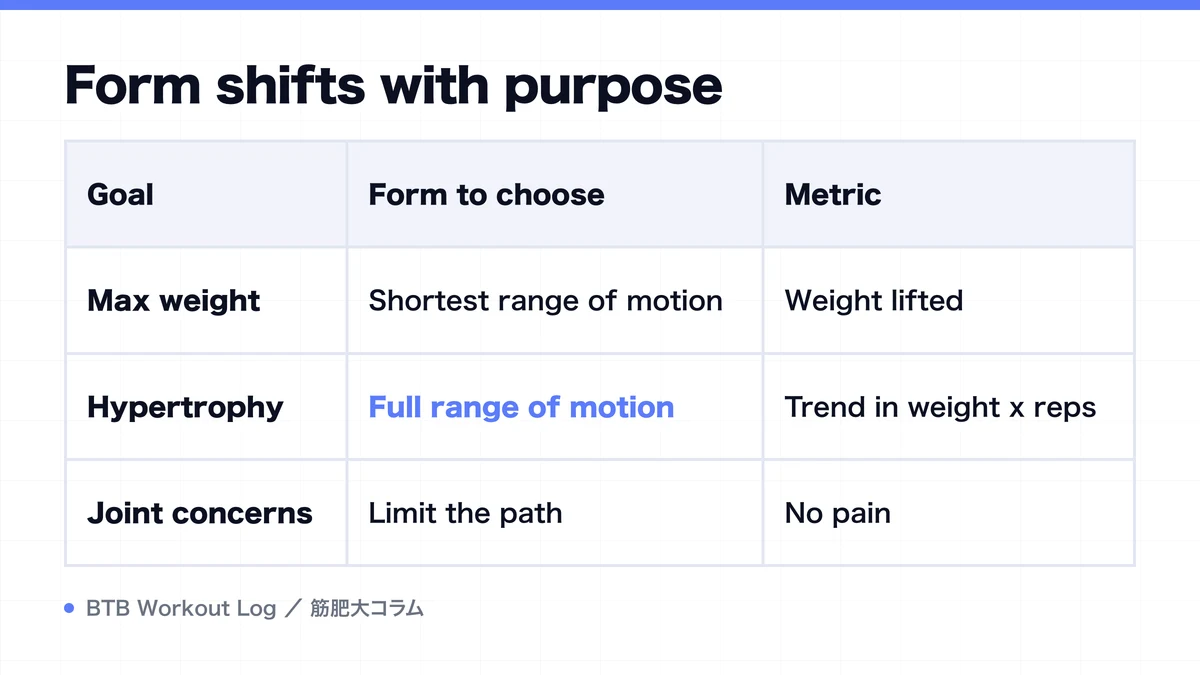
| Adjustable | Joint angles, bar path, stance, equipment, exercise variation | Fit to goal and individual |
Where individual difference ends and breakdown begins
An acceptable individual variation and a collapse under load can look identical. The test is whether the change was intended, repeatable and aligned with the goal. Widening your squat stance so you can reach your target depth under control is an adjustment. Stance and balance changing only in the back half of a set is fatigue.
Range of motion is the same. Full range is a strong default, but it isn't a synonym for "go to the joint's end range". The reference is the range where you keep load on the target and control the position. Pain or equipment constraints are legitimate reasons to adjust range — but log those separately from range shortened purely to handle more weight. That same distinction matters in full range versus partials.
Change part of your form and the load distribution and sticking points change too, even under the same exercise name. Treating a set with a new grip as a personal best on the old series isn't right. Simply separating "I lifted more than before" from "I got more capable at the same movement" lets you adjust form and still evaluate progress.
Research shows changing it changes the result
Bench press research reports that bench angle and execution change how uniformly regions of the pectoralis major are excited, and change performance. For back and delts too, exercise selection and execution shift the distribution of muscle activity. That's evidence against treating one appearance as optimal for every purpose.
What it doesn't establish is that the form with the highest short-term activation is the best form for long-term hypertrophy. Activation measurements, lifting performance and hypertrophy months later are separate outcomes. Participant experience, exercises, loads and measurement sites all move what gets observed.
Resistance-training reviews likewise treat the hypertrophic stimulus as a set of variables — frequency, intensity, volume and mode — not load alone. Form sits inside mode and how load is applied. Rather than extracting one universal bar path from the literature, it's more practical to set a goal, hold conditions steady and track the response.
Why a single form is so easy to believe in
Short cues communicate better on the gym floor, so you get simple rules: "don't let the knees travel", "keep the elbows at this angle". Useful when you're learning a complex movement, but originally a cue for a specific person fixing a specific problem. Once the context is stripped away, adjustable elements become prohibitions.
Copying advanced lifters is another driver. A technique optimised for that athlete's build, sport rules, years of practice and loads doesn't necessarily transplant into someone else's hypertrophy training. A video also shows one rep from one angle — not pain, stability, local fatigue in the target, or whether it's repeatable between sets.
Deciding on "what feels like it's working" alone is worth avoiding too. Sensation is a useful clue for adjusting form, but a strong pump or burn doesn't settle long-term superiority. Keep feel and exercise evaluation apart, and include load, reps, RIR and recovery under the same conditions.
In practice: goal, constraints, then the log
Rather than hunting for the correct video, narrow the conditions in this order.
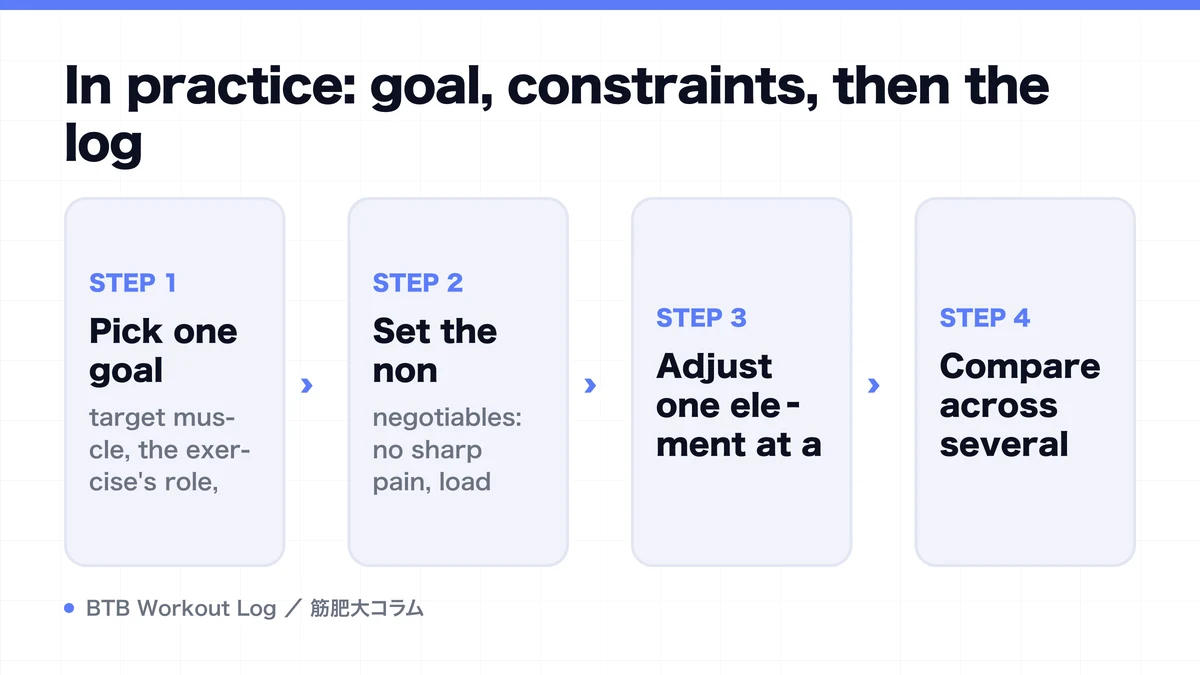
- Pick one goal: target muscle, the exercise's role, rep range.
- Set the non-negotiables: no sharp pain, load under control, intended range of motion reproducible.
- Adjust one element at a time: don't change grip, stance, seat and path together.
- Compare across several sessions: at similar RIR, look at reps, stability, fatigue in muscles you weren't targeting, and recovery.
- Lock in what you adopted: once it's clearly better, hold it steady for a while and progress load or reps from there.
If pain is sharp, worsens set to set, or you can't control the load even after dropping it, don't try to fix it with form tweaks — stop the exercise and consider seeing a professional. On the other hand, if your technique merely looks a little different from the textbook while you repeat it reliably and progress matches your intent, ask whether there's a reason to change it at all.
Just as adding weight every session isn't the definition of progress, numbers after a form change aren't a simple continuation of the old series.
FAQ
- For the same exercise, should my form match everyone else's?
- Even in the same exercise, limb lengths, comfortable joint angles, equipment and goal can change which stance and path suit you. Use the model as a starting point, and prioritise being pain-free and in control while reproducing your intended range and conditions.
- If I change my form, do my old records become meaningless?
- Not meaningless — just a separate series. Log the day you changed grip or range of motion, establish a baseline over a few sessions under the new conditions, and compare load and rep progress from there.
- If nothing hurts, is any form fine?
- Being pain-free matters, but it isn't sufficient. Check that you control the load, hold the target muscle and range of motion, and don't break down badly in the back half of a set. Stop for sharp pain or discomfort that's worsening, and get professional advice if needed.
Key takeaways
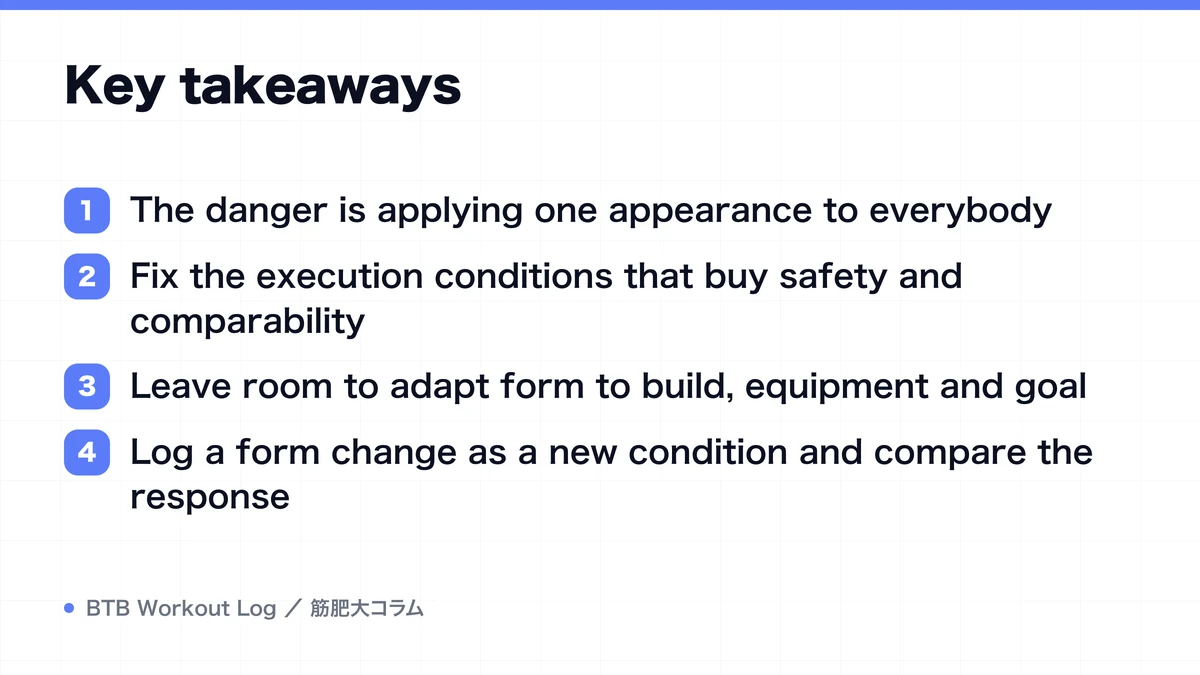
- The danger is applying one appearance to everybody
- Fix the execution conditions that buy safety and comparability
- Leave room to adapt form to build, equipment and goal
- Log a form change as a new condition and compare the response
References
- Non-uniform Excitation of the Pectoralis Major During Flat and Inclined Bench Press
- The Effects of Bench Press Variations in Competitive Athletes on Muscle Activity and Performance
- Variations in Muscle Activation During Traditional Latissimus Dorsi Exercises
- Different Shoulder Exercises Affect the Activation of Deltoid Portions
- The Influence of Frequency, Intensity, Volume and Mode of Strength Training on Whole Muscle Cross-sectional Area in Humans