More Exercises, More Muscle? This Myth Could Slow Your Gains
Adding an exercise is worth it when it covers a movement or region your current programme misses. Adding a near-duplicate is more likely to add fatigue and overlap than growth.
The criterion isn't how many exercises you run. It's whether you're doing enough quality hard sets with genuinely different roles, and whether you can keep progressing on them.
How far "hit it with lots of exercises" actually holds
Within a single muscle, changing joint angle or direction of force changes which regions and ranges take the most load. Flat and 45° incline bench press, for instance, don't excite the pectoralis major uniformly. For legs, a movement dominated by knee flexion and extension does a different job from one driven at the hip — both are still "leg training".
So there's real logic in using accessories to cover what your main lifts miss. Securing overall load with compounds and topping up gaps with single-joint work is one version of that. When you weigh up whether compounds alone are enough, the first question is likewise what's still missing, not how many exercises you have.
But observing different muscle activation is not the same as showing that more exercises produce more long-term hypertrophy. Variation can matter; that isn't a licence to add without limit.
Exercise count isn't the dose
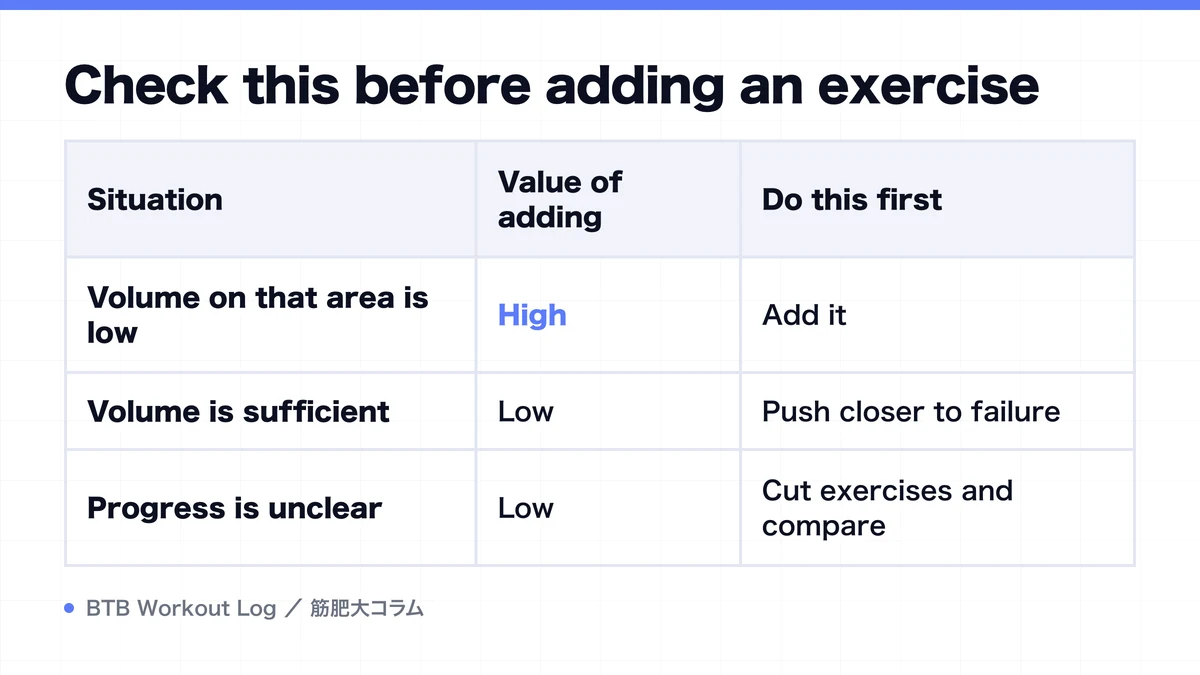
The myth begins the moment you start counting exercises as if they were stimulus. When hypertrophy research handles volume, the unit is normally weekly sets per muscle group. Five exercises for one set each is five sets; two exercises for three sets each is six. Exercise count alone tells you nothing about how much you actually trained.
Separate "divided" from "added"
Split a planned 12 chest sets from two exercises across four and weekly volume is still 12. The distribution changed; the dose didn't double. Add two exercises while keeping the existing set counts and weekly volume genuinely rises — in which case the candidate explanation isn't exercise count, it's the added sets.
Weekly sets and hypertrophy show a dose-response trend, but not every added set carries the same value. You have to distinguish hard sets — where the target muscle takes meaningful load and you finish roughly one to three reps shy of failure — from everything else.
Stack similar exercises and late-set quality drops
Bench press, then chest press, then dumbbell press, then a machine press on a similar path: the exercise list grows. But every one is a press, and by the back half your triceps or general fatigue may be the limiter rather than your chest. Hitting the planned reps on sets that can't put high tension through the target muscle isn't stimulus worth the extra time.
The other cost is thinning out practice on any one movement. Rotate eight exercises weekly and you repeat each under the same conditions far less often, so form stability and load selection take longer to settle. That isn't an argument that novelty is useless — but moving to the next exercise before you've driven load and reps up makes progressive overload hard to accumulate.
Added sets also cost more than local fatigue: joint load, session time, and recovery before the next session. A strong pump right after the addition means little if load and reps on your main lift keep falling afterwards — across the week you may well be behind.
What research points to is a workable combination of variables
Hypertrophy can't be organised around one number called exercise count. Frequency, intensity, volume and training mode all act at once, and the same three exercises become a completely different programme at different set counts, RIR, ranges of motion and frequencies.
Raising weekly volume does tend to increase average muscle gain. That is not a rule saying growth scales with the length of your exercise list. Whether you concentrate effective sets into few exercises or spread the same total across many, the things worth comparing are stimulus to the target muscle, set quality, recovery and continued progress.
Generally, activation distribution can shift with angle — but that alone doesn't establish a long-term hypertrophy effect. In practice, don't think "add as many as possible"; think "top up the roles my main lifts cover weakly, by as much as needed". Keep this separate from the belief that you must manufacture change every week (the myth about repeating a programme).
Why more exercises feels more effective
A new exercise is unfamiliar, so it tends to produce a stronger pump and more soreness — which reads as extra growth. And if you add sets at the same time as exercises, there's no way to separate variety from a simple volume increase. Novelty and added workload arrive together, which is exactly why the exercise-count explanation survives.
Give every new exercise one clear job
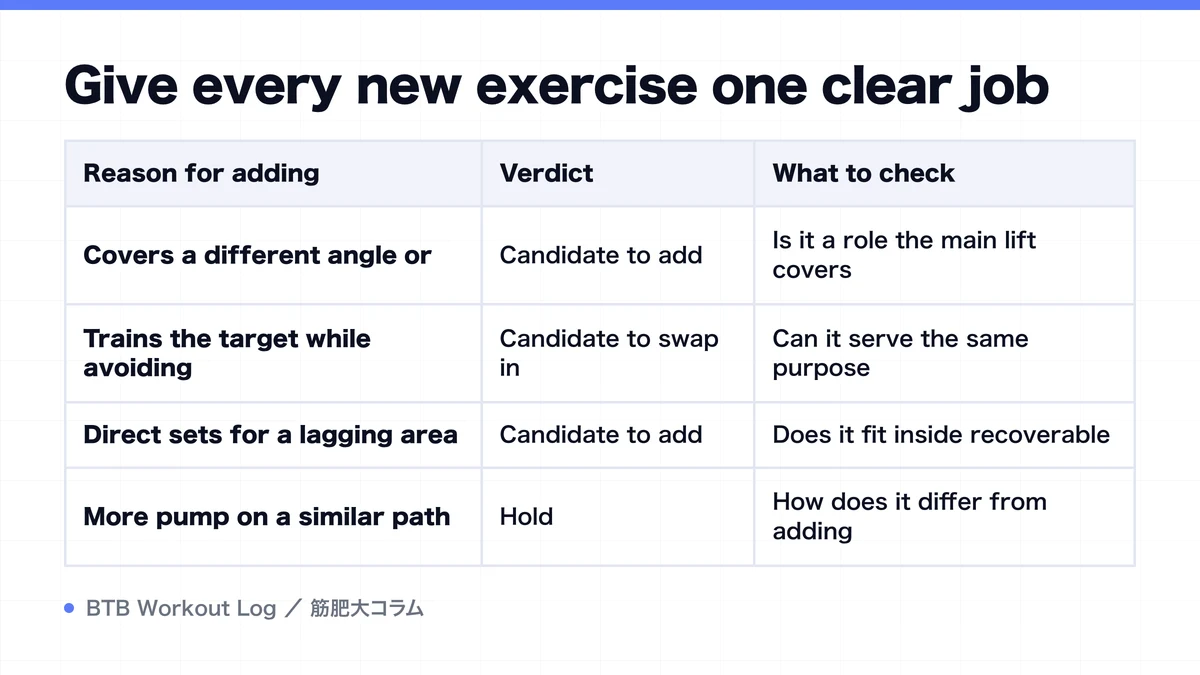
Before adding anything, answer in one sentence what it covers. If the answer is only "I want a different stimulus" or "I was bored", that's a weak case. Comparing roles against existing lifts makes the call easier.
| Reason for adding | Verdict | What to check |
|---|---|---|
| Covers a different angle or movement | Candidate to add | Is it a role the main lift covers poorly? |
| Trains the target while avoiding pain | Candidate to swap in | Can it serve the same purpose more reliably? |
| Direct sets for a lagging area | Candidate to add | Does it fit inside recoverable weekly volume? |
| More pump on a similar path | Hold | How does it differ from adding sets to an existing lift? |
Fix the main lifts and change one thing at a time
Keep an anchor exercise for each muscle group so load, reps and RIR stay comparable. Then add one gap-filling exercise and watch for several weeks without moving much else. Why too many exercises makes this hard is covered in how progress becomes unreadable.
The right exercise count is settled by what happens after
Judge the addition over three to six weeks, not by how the session felt. If the new exercise loads the target reliably, load and reps hold or improve on your main lifts too, and you're recovering by the next session, it's earned its place. Big drops in late-session reps, more joint discomfort, main lifts stalling, or nothing changing except session length are all cues to cut.
Work through it in this order: (1) is there a genuine role gap, (2) are weekly hard sets short, (3) can you hold set quality after adding, (4) is there load or rep progress over several weeks, (5) are you recovering. That order shifts the default from "add something" to "add only the work that's missing".
Using your log as evidence lets you compare before and after an addition on the same terms.
FAQ
- How many exercises should I use per muscle group?
- There's no fixed answer. Secure the weekly hard sets you need on your main lifts first, and add only when you genuinely need a different angle, movement or direct work for a lagging area. Prioritise set quality and multi-week load and rep progress over the number of exercises.
- Won't my muscles get used to the same exercise?
- Not while load, reps, RIR and range of motion are still progressing — the stimulus isn't static. Pain, a long plateau or a genuine role gap are reasons to change, but you don't need frequent swaps purely to manufacture variation.
- What are the signs I should cut exercises?
- Load or reps falling sharply on later exercises, main lifts stalling for a while, growing joint discomfort, not recovering by the next session, or session length being the only thing that changed. Drop one of the overlapping roles and compare the trend over several weeks.
Key takeaways
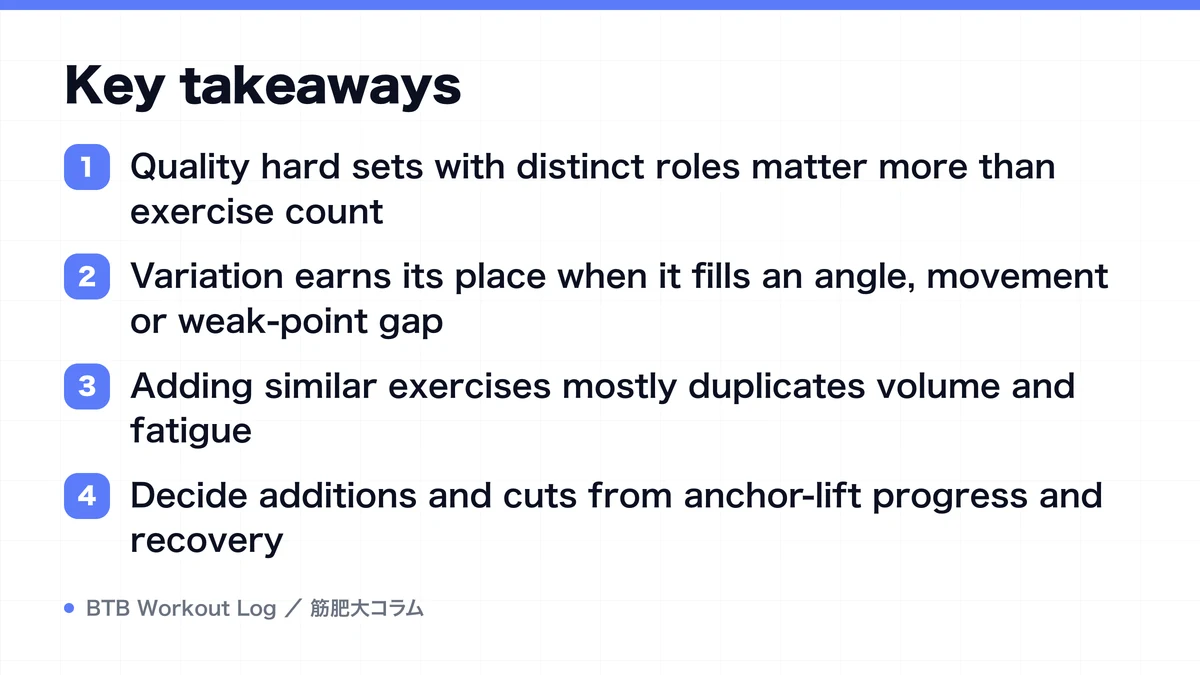
- Quality hard sets with distinct roles matter more than exercise count
- Variation earns its place when it fills an angle, movement or weak-point gap
- Adding similar exercises mostly duplicates volume and fatigue
- Decide additions and cuts from anchor-lift progress and recovery