Training to Failure Every Set: Hypertrophy Benefits and Hidden Costs
Bottom line: training to complete failure on every set is not required. Leaving 1-3 reps in the tank (RIR 1-3) produces nearly equivalent muscle growth while cutting fatigue and injury risk significantly.
Failure training is a useful tool, but using it indiscriminately can stall your progress by wrecking recovery.
What training to failure actually does
Sets taken to failure - all-out sets - recruit more muscle fibers and reliably deliver a strong stimulus. For lifters who tend to leave reps in reserve in particular, they are valuable as a way to feel whether you are really getting close to failure. There is no doubt that hypertrophy requires sufficient pushing to failure. The question is whether you need to do that pushing to failure on every set.
What research says: RIR 1-3 is enough
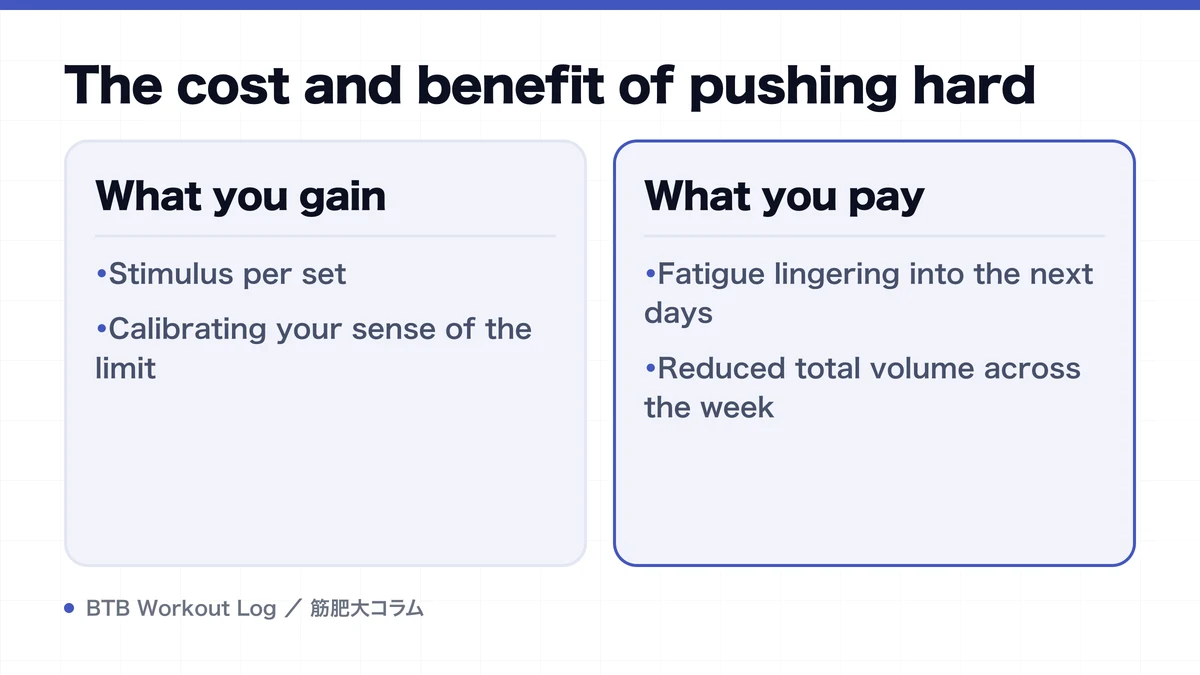
Studies comparing sets taken to complete failure with sets stopped 1-3 reps short (RIR 1-3) find no meaningful difference in muscle growth. Meanwhile, training to failure every set accumulates significantly more neural and muscular fatigue, which hurts recovery between sets and between sessions. In other words, stopping one step before failure gives you almost the same stimulus at a fraction of the cost - the smart play (managing RIR).
The cost of going to failure every set
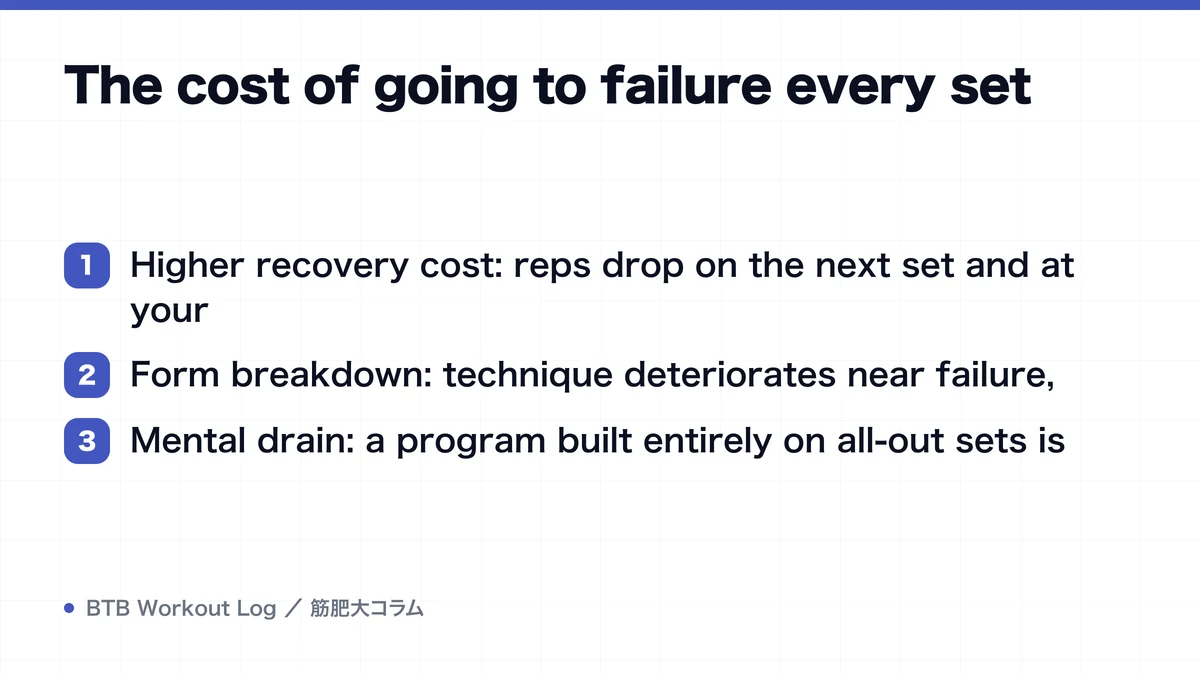
- Higher recovery cost: reps drop on the next set and at your next session, cutting total weekly volume.
- Form breakdown: technique deteriorates near failure, raising injury risk.
- Mental drain: a program built entirely on all-out sets is hard to sustain long-term.
Even if one brutally hard set delivers a bigger stimulus, if it costs you volume and consistency, the net result can be negative.
When failure training makes sense
The practical approach: keep your main compound lifts at RIR 1-3, and push to failure only on the last set of safe, low-risk isolation exercises and machines. One or two all-out sets on something like a leg extension or a machine press at the end of a session adds stimulus without the same injury risk or recovery hit that compound failure brings. Logging which sets you took to failure also helps you spot the telltale sign of overreaching: your working weights start going down.
FAQ
- I've heard you have to "destroy" your muscles to make them grow. Is that true?
- You need sufficient stimulus, but that doesn't mean true failure every set. RIR 1-3 delivers nearly the same muscle growth with far less fatigue and injury risk. Enough stimulus doesn't require maximum pain.
- How do I gauge RIR 1-3?
- At the end of a set, ask yourself how many more reps you could have done with good form. When your rep speed slows noticeably and the next rep would clearly be a battle, you're around RIR 1-2. Accuracy improves with experience and logging.
- Should advanced lifters train to failure more often?
- Advanced lifters may need harder pushes to drive growth, but all-out sets on every exercise is still wasteful. The same rule applies: save failure for the last set of low-risk isolation work, and keep compounds at RIR 1-3.
Key takeaways
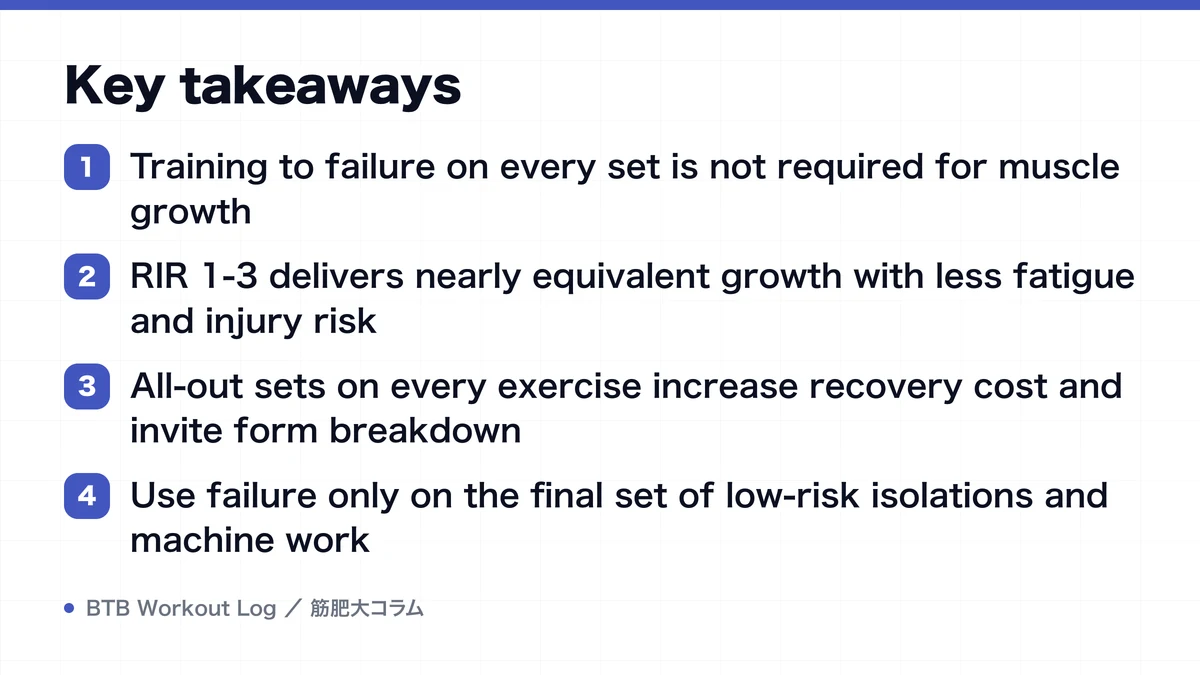
- Training to failure on every set is not required for muscle growth
- RIR 1-3 delivers nearly equivalent growth with less fatigue and injury risk
- All-out sets on every exercise increase recovery cost and invite form breakdown
- Use failure only on the final set of low-risk isolations and machine work