Hypertrophy Training | How to Choose Frequency, Exercises, and Reps
"Which of A and B is better for hypertrophy" often has no answer as asked. Average differences in the research are small, and the real answer depends on which of goal, recovery capacity and available time you're prioritising.
This page organises the choices people get stuck on by the criteria that should settle them. Individual comparisons live in their own articles; this one covers what to decide by.
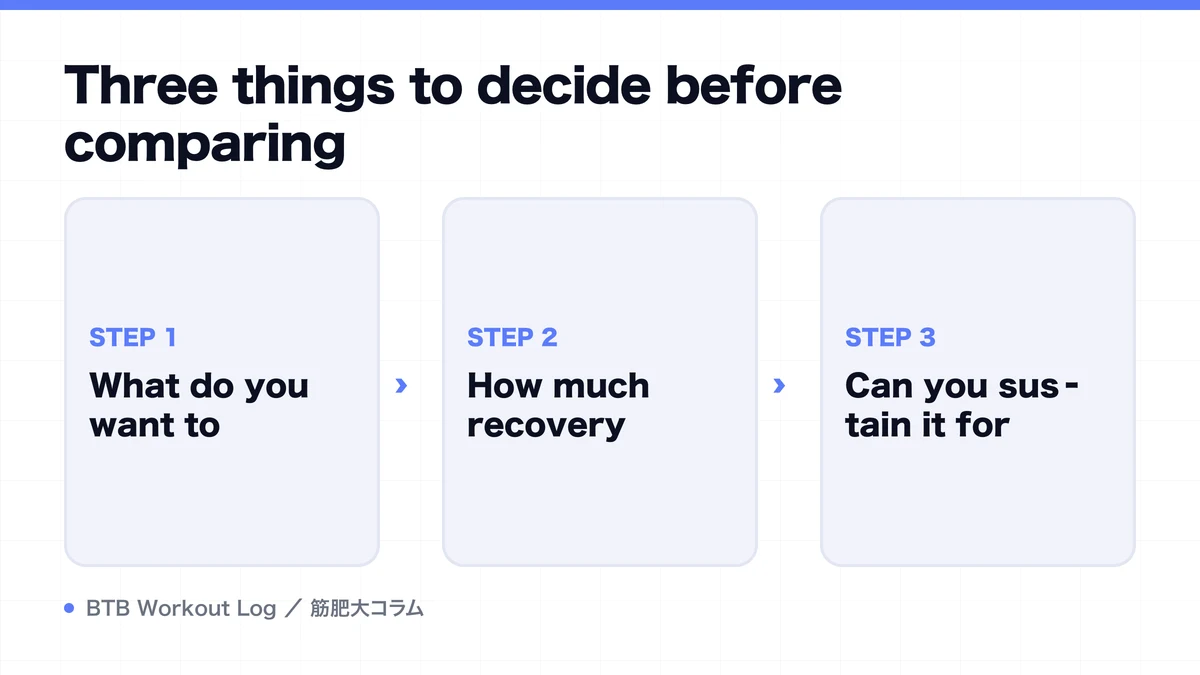
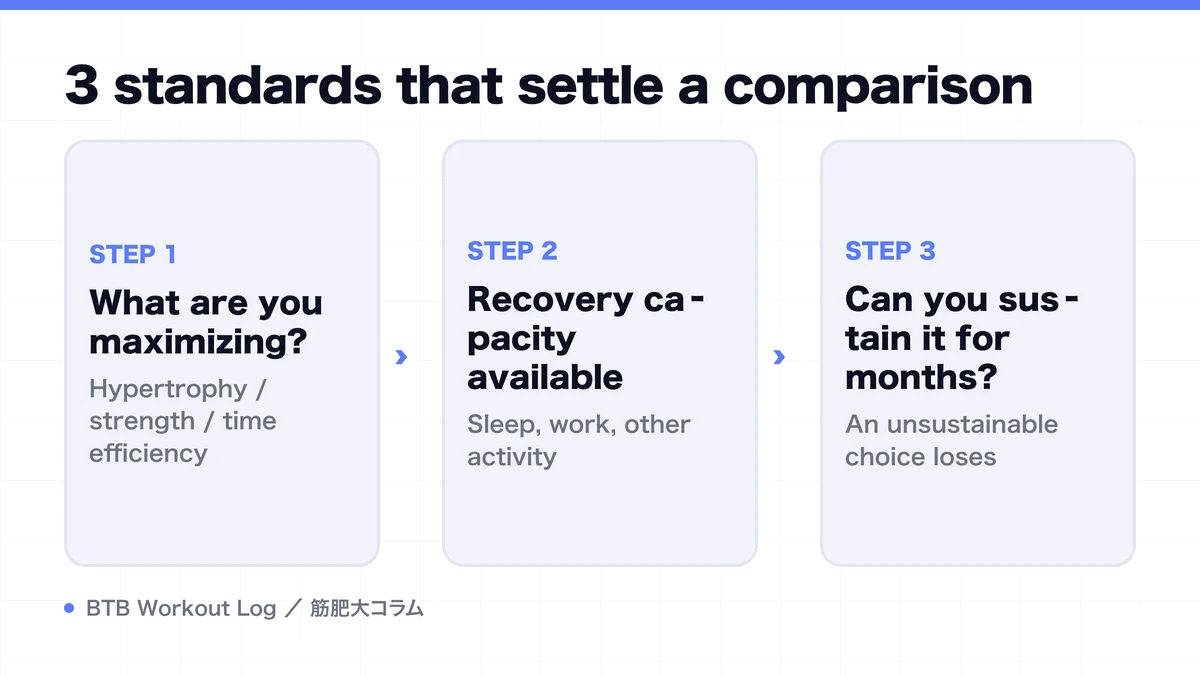
Three things to decide before comparing anything
Reading comparison articles won't settle anything until you know what you're optimising for. In practice, three questions are enough.
- What do you want to maximise? Hypertrophy above all, strength as well, or results within limited time?
- How much recovery capacity do you have? Sleep, work stress, other activity. The thinner this is, the worse a high-fatigue-cost option looks.
- Can you sustain it for months? An option that's better on average still loses if you don't keep doing it.
Settle those three and most comparisons resolve themselves. If time is your hardest constraint, for instance, whether to progress load or reps first can simply be decided by whichever is easier to log.
Choosing load, reps and how close to failure to go
With effort matched, comparisons across load ranges report small hypertrophy differences. So this cluster of choices isn't "which is superior" — it's "which fits your exercise and your joints".
| Where people get stuck | What actually decides it |
|---|---|
| Low reps vs high reps | How safe the exercise is, and what limits out first mid-set |
| Heavy vs light | Whether maximal strength is also a goal |
| Failure vs leaving RIR | How much fatigue you can accept into later sessions |
| 2-minute vs 5-minute rest | Total session time versus protecting reps on the next set |
All of these assume proximity to failure is matched. Compare load or reps alone without that and the comparison means nothing. A set of 8 with 3 in reserve and a set of 15 with 0 in reserve differ in stimulus intensity before the rep count even enters it.
A practical split: lean toward higher reps on exercises where a joint is unreliable or heavy loading is risky, and toward heavier loads on main lifts with stable form where you want to track progress. You don't need every exercise in the same rep range.
Work backward from recovery capacity for volume, frequency and splits
With weekly volume equated, frequency's independent effect is reported to be small. So it's easier to treat frequency and splits not as "ways to boost effect" but as ways to arrange the volume you need without breaking down.
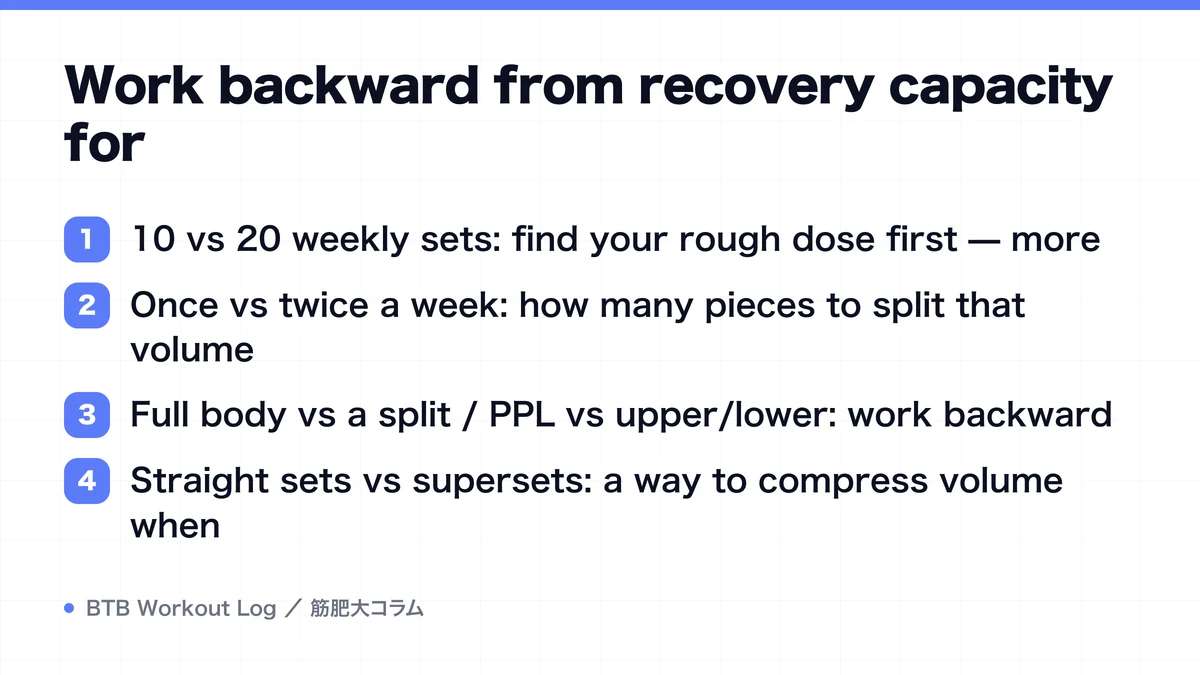
- 10 vs 20 weekly sets: find your rough dose first — more isn't automatically better.
- Once vs twice a week: how many pieces to split that volume into.
- Full body vs a split / PPL vs upper/lower: work backward from the days you can actually train.
- Straight sets vs supersets: a way to compress volume when time is short.
The order is volume, then distribution, then exercises. Decide it backwards and volume tends to break down as exercises accumulate. Line up the exercises you feel like doing first, and you won't notice weekly sets skewing by region.
And adopting a generic number for your starting dose doesn't tell you it fits you. The useful set range moves with training history, intensity, exercise selection and recovery capacity, so starting from a rough figure and adjusting on a few weeks of trend is the realistic approach.
Choose exercises by role
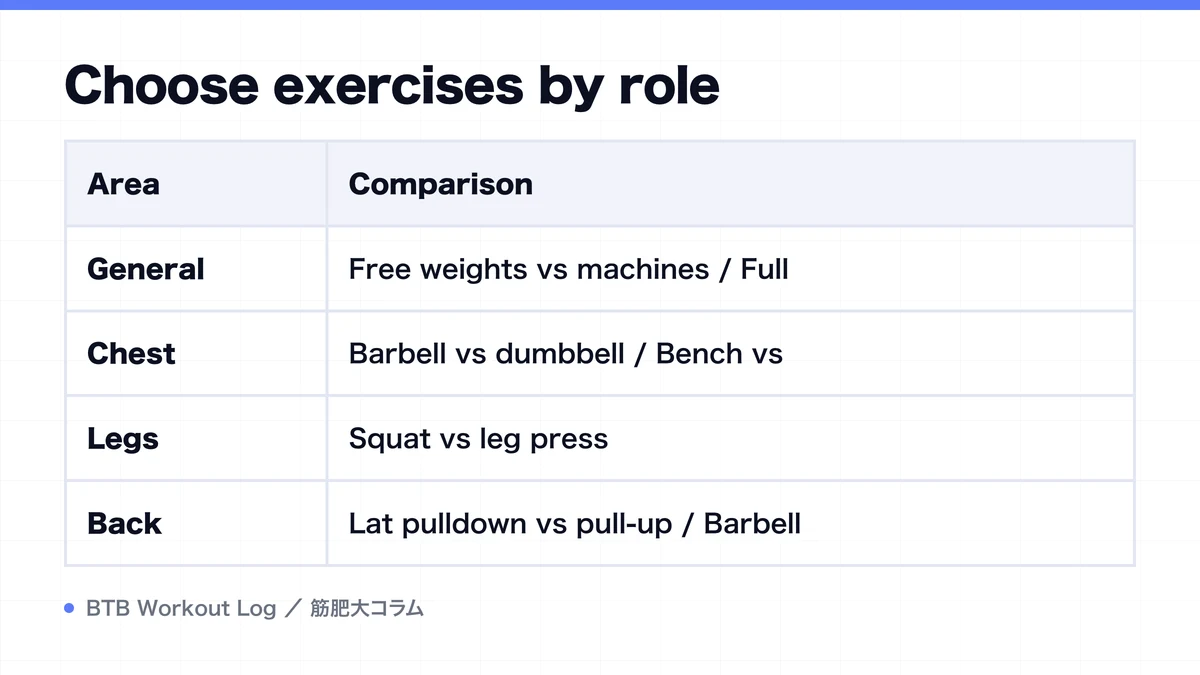
Exercise comparisons tempt you to crown a winner, but mostly they're just different roles within a programme. Place them by role: an exercise you track progress on with heavy load, an exercise that loads the target at a long muscle length, an exercise with low fatigue cost that lets you add volume.
| Area | Comparison |
|---|---|
| General | Free weights vs machines / Full range vs partials |
| Chest | Barbell vs dumbbell / Bench vs chest press |
| Legs | Squat vs leg press |
| Back | Lat pulldown vs pull-up / Barbell row vs seated row |
| Arms and shoulders | Dumbbell vs preacher curl / Lateral raise load selection |
Thinking by role also explains why you'd run two similar exercises for one region. Pairing barbell and dumbbell for chest, for instance, uses one as your progress marker and the other for stretch-side stimulus. Two exercises with the same role side by side is really just extra sets, not extra coverage.
What to do when the comparison still doesn't settle it
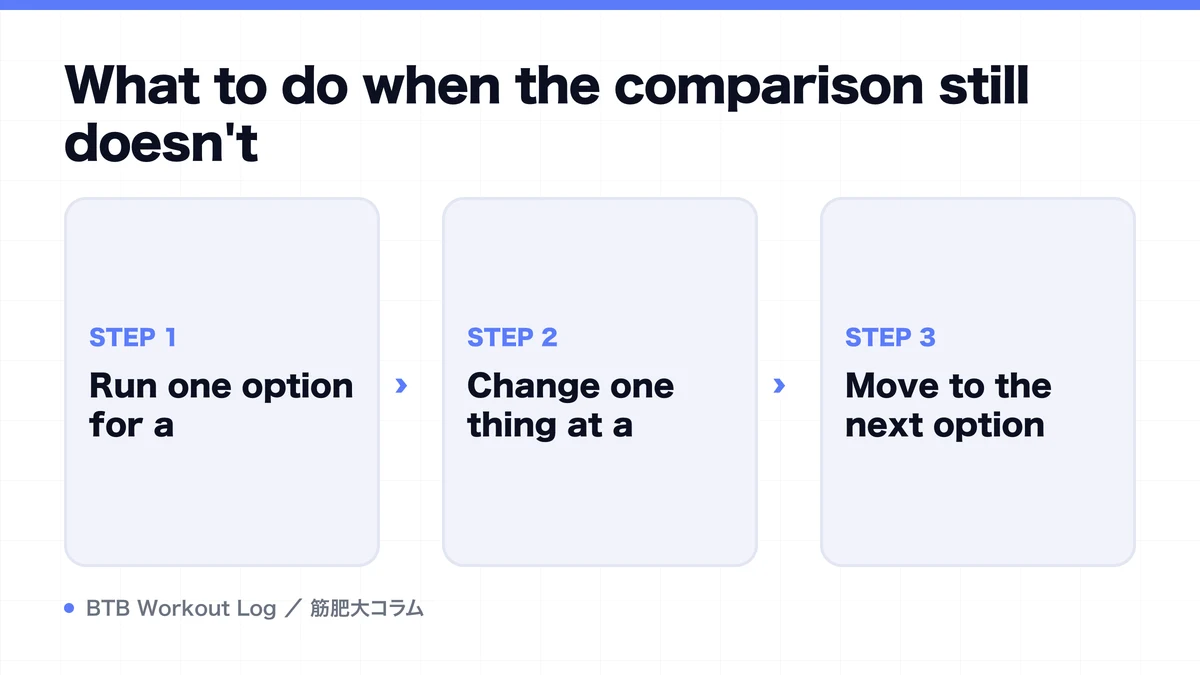
If reading a comparison article still doesn't settle it, the honest answer is usually "the difference is small enough that it doesn't much matter". In that case:
- Run one option for a few months and log it. Even fixed versus rotating can't be judged without records.
- Change one thing at a time. Change several at once and you'll never know what helped.
- Move to the next option once the numbers stall. If they aren't stalled, there's no reason to change.
In the end, the answer to any comparison lives in your own log. Keep weekly sets and per-exercise load and rep trends, and you can verify afterward which choice actually worked for you (a training log).
FAQ
- If I always pick whichever option a comparison article favours, will I progress faster?
- Research reports averages across groups, and in most comparisons the gap itself is small. An option that's better on average still costs you if you can't sustain it or can't recover from it. Meet volume and proximity-to-failure requirements first, then choose on top of that.
- Is more exercises better?
- Two to four exercises per region with distinct roles is usually enough. Add more and per-exercise frequency and visibility into progress both fall, and you lose track of what actually worked.
- How do I decide whether to change a choice?
- A useful guide is whether load and reps have genuinely not moved on the same exercise for three weeks or more. One or two weeks of flat numbers is normal variation — change on that timescale and you lose the ability to evaluate anything.
Key takeaways
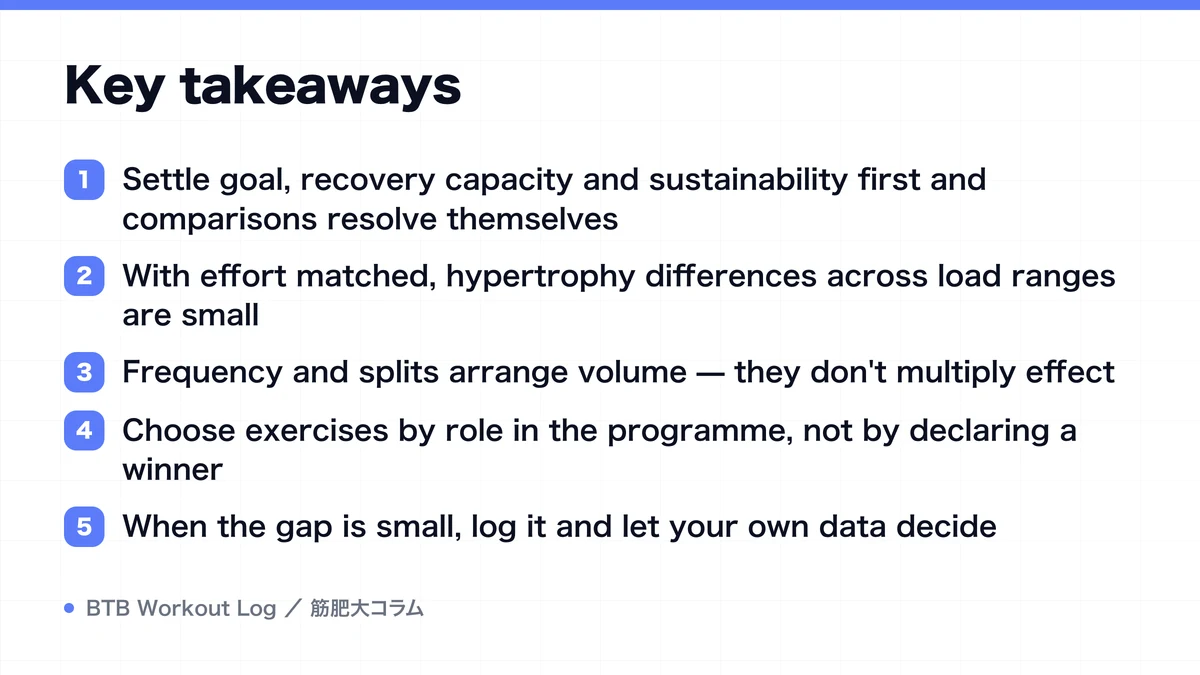
- Settle goal, recovery capacity and sustainability first and comparisons resolve themselves
- With effort matched, hypertrophy differences across load ranges are small
- Frequency and splits arrange volume — they don't multiply effect
- Choose exercises by role in the programme, not by declaring a winner
- When the gap is small, log it and let your own data decide