Free Weights vs. Machines: Which Is Better for Hypertrophy?
If hypertrophy is the only goal, neither free weights nor machines is categorically better. Whichever lets you work the target muscle hard, accumulate recoverable sets and progress within that exercise is the better choice in that slot.
They aren't interchangeable, though. Compare local stimulus alongside stability, systemic fatigue, setup time and how finely you can adjust load, and it becomes clear where each belongs in a programme.
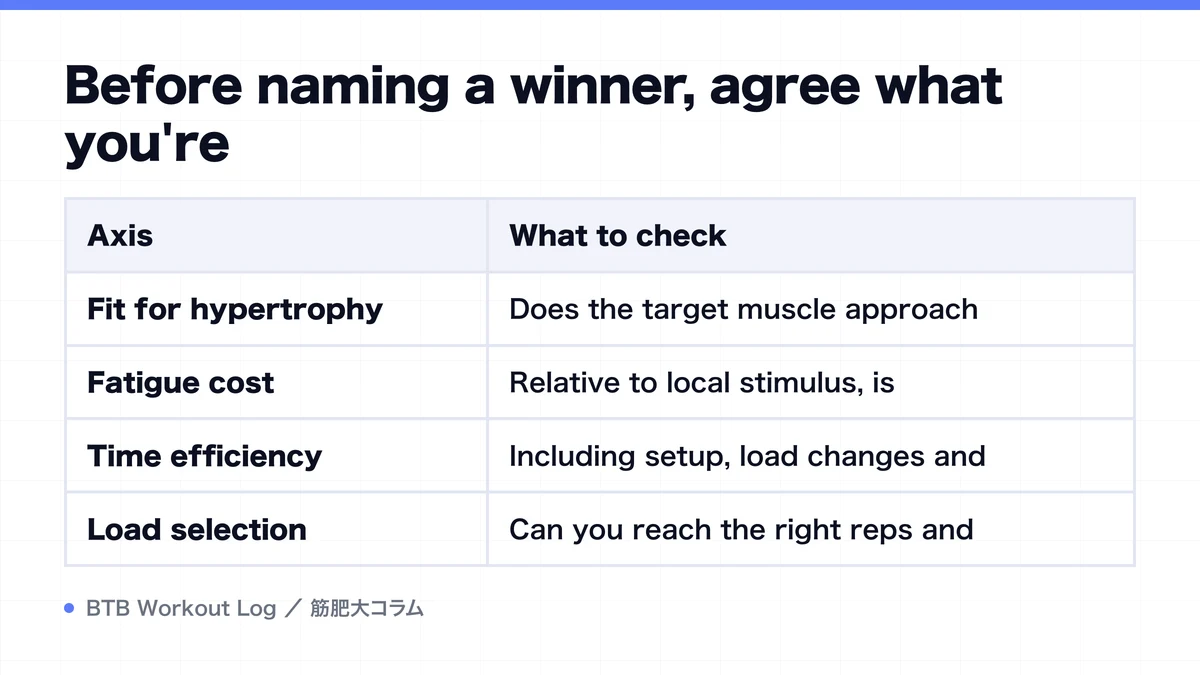
Before naming a winner, agree what you're comparing
You can't rank equipment on load lifted or movement difficulty. A machine's displayed weight means something different depending on pulleys and lever ratios, and doesn't compare directly with a barbell. The difficulty of controlling position with free weights doesn't by itself mean more stimulus to the target. Leaving the free-weight-superiority myth aside, look at these five under matched conditions.
| Axis | What to check |
|---|---|
| Fit for hypertrophy | Does the target muscle approach its limit first, and can you reproduce the range of motion? |
| Fatigue cost | Relative to local stimulus, is trunk, grip, breathing or next-exercise fatigue excessive? |
| Time efficiency | Including setup, load changes and waiting, can you get quality sets done? |
| Load selection | Can you reach the right reps and effort, and progress in fine steps? |
| Individual fit | Does it suit your build, joints, skill, equipment and whether you have a spotter? |
These let you ask "which fills this slot for this muscle group" instead of "free or machine". If skill transfer to a strength sport is part of the goal, that adds a separate axis — don't blend it into a hypertrophy-only comparison.
Compare on whether the target reaches sufficient effort, not the label
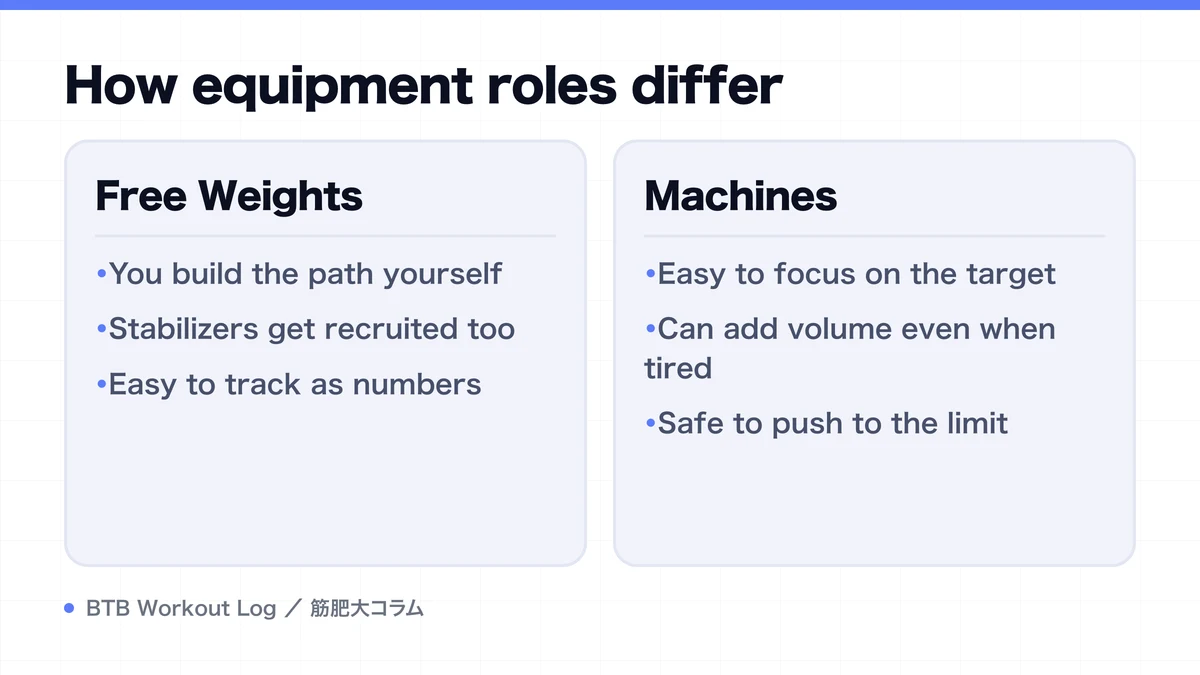
Free weights let you shape the path to your body, so some exercises fit better. Many also use several joints and muscle groups at once, which is handy for spreading stimulus across a small exercise list. But for people whose balance, trunk or grip limits out first, the set can end with the target still holding reserve.
Machines supply external stability, reducing the postural demand. When the path suits your body, that makes it easier to concentrate on repping the target and to hold movement conditions into the back half of a set. When a fixed path doesn't suit your joints or build, though, stability isn't automatically an advantage. Resistance profiles and adjustment ranges differ between models, so "machines" as one word doesn't describe the effect well.
Research showing hypertrophy across low and high loads is exactly why absolute load can't crown a winner. As in heavy versus light, what matters is doing enough reps at whatever load you chose. On each set, check RIR — reps left in reserve — plus range of motion and what actually ended the set. A squat where breathing gives out before your legs and a leg press where quads reach their limit are not the same "leg set", even at matched volume.
Judge fatigue and time across the week, not one set
Multi-joint free-weight work loads several muscle groups at once, which is efficient when you want the whole body from few exercises. But sets demanding high stability and concentration accumulate fatigue outside the target too. Good local stimulus on one exercise is expensive if reps collapse on the next one, or you haven't recovered by the following session.
Machines often need less plate loading and rack setup, and some let you end a set safely alone. When you're adding weekly hard sets for a muscle late in a session, cutting the postural burden is exactly the advantage you want. Conversely, waiting for a popular machine, fiddling with seat settings or coarse weight increments all cost time. Free weights are quick too when dumbbells are available and changing load is easy.
So time efficiency isn't just "how many muscle groups per exercise" — it's total cost from setup through recovery. Someone squeezing full-body work into three short sessions leans toward multi-joint free weights; someone topping up a lagging muscle after their main lifts leans toward machines.
Don't race displayed loads — track progress inside each exercise
Free weights let you add small plates, though on some lifts the smallest jump is still large relative to your strength. Dumbbells depend on your gym's increments. Machine stacks can have a step that's too heavy, but pin changes are fast and some models make seat position and path easy to reproduce. Which progresses better comes down to actual increments and repeatability, not equipment category.
There's no need to compare loads across exercises. A 60 kg chest press is neither better nor worse than a 50 kg bench press. What you compare is the same exercise, same settings, similar range of motion and RIR: one more rep than last time, or slightly more load at the same reps. Progressive overload runs on both.
The key is not counting an equipment change as progress. Switching machines can raise the displayed number without any strength gain. Fix your main exercises for a stretch and log load, reps, sets, RIR, seat position and safety settings. If the increment is too big, run reps to the top of the range first, or vary load between sets — pick a progression that suits the equipment.
For individual fit, ask which path type suits you
Free-weight freedom helps when you need to adjust the path to your shoulder width and limb lengths. The flip side is that more freedom means more session-to-session variation and a longer learning curve. A machine's fixed path aids repeatability, but on a model that doesn't fit you even after adjusting seat and grip, there's little room to escape discomfort.
Safety isn't settled either. Machines you can bail out of tend to be easier to manage when pushing close to failure alone. That doesn't make a badly set-up machine or reps performed through pain safe. Free weights are manageable too with safeties, a spotter and appropriate loads. If sharp pain or joint discomfort persists, defending an equipment camp is beside the point — stop the exercise and consult a professional.
Range of motion doesn't split neatly either: free isn't automatically wider, fixed isn't automatically narrower. Check per exercise and per machine where you can keep load on the target and how your body responds. Handle range-of-motion priorities in full range versus partials and keep them separate from equipment category.
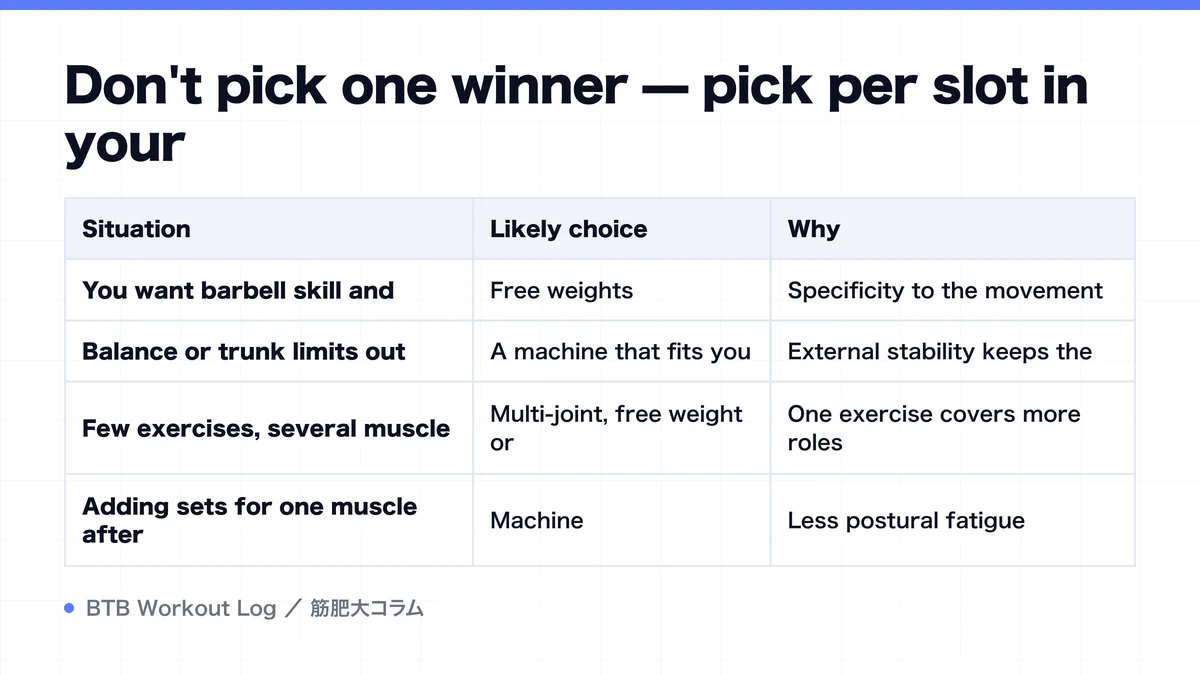
Don't pick one winner — pick per slot in your programme
| Situation | Likely choice | Why |
|---|---|---|
| You want barbell skill and strength too | Free weights | Specificity to the movement you're practising |
| Balance or trunk limits out before the target | A machine that fits you | External stability keeps the target repping |
| Few exercises, several muscle groups | Multi-joint, free weight or machine | One exercise covers more roles |
| Adding sets for one muscle after the main lifts | Machine | Less postural fatigue |
| A fixed path doesn't suit you | Free weights, cables, another model | Easier to find a tolerable path |
| Equipment and waiting times vary | Whatever you can reliably access | Keeps adherence and logging conditions stable |
In most hypertrophy programmes, dividing roles beats staging a contest. For chest, practise free-weight skill and high output on bench press early, then add chest sets on a chest press later. Or, if bench press fatigues shoulders and triceps before chest and sport skill isn't a goal, make a chest press that fits you the main lift from the start.
Once you've chosen, judge on results rather than reputation. Fix the exercise for four to eight weeks and check weekly sets for the target, RIR per set, load and reps, joint response and recovery. When you use a training log, don't line free-weight and machine loads up side by side: track each exercise's settings and trend separately.
Free weights win where a free path and movement skill serve the goal and you can still progress after paying the cost. Machines win where external stability lets you add quality sets for the target within your recovery. For hypertrophy, producing that conditional answer for each slot is more useful than crowning a single winner.
FAQ
- Machines don't use stabilisers — aren't they insufficient for hypertrophy?
- A lower postural demand isn't the same as less stimulus to the target. If you want to train stability, treat that as a separate slot, and grade your hypertrophy exercises on target engagement, range of motion, RIR, progress and recovery.
- Should I always include both free weights and machines?
- It isn't required. Adding exercises with overlapping roles can simply consume sets you could have recovered from. Use both when it covers stimulus your current equipment misses, or removes whatever is limiting you first.
- For the same muscle, which should come first?
- Put the exercise where you want to protect skill and high output first. If barbell skill is a goal, that's usually the free-weight lift; if you only want local stimulus and the machine is your main lift, lead with the machine.
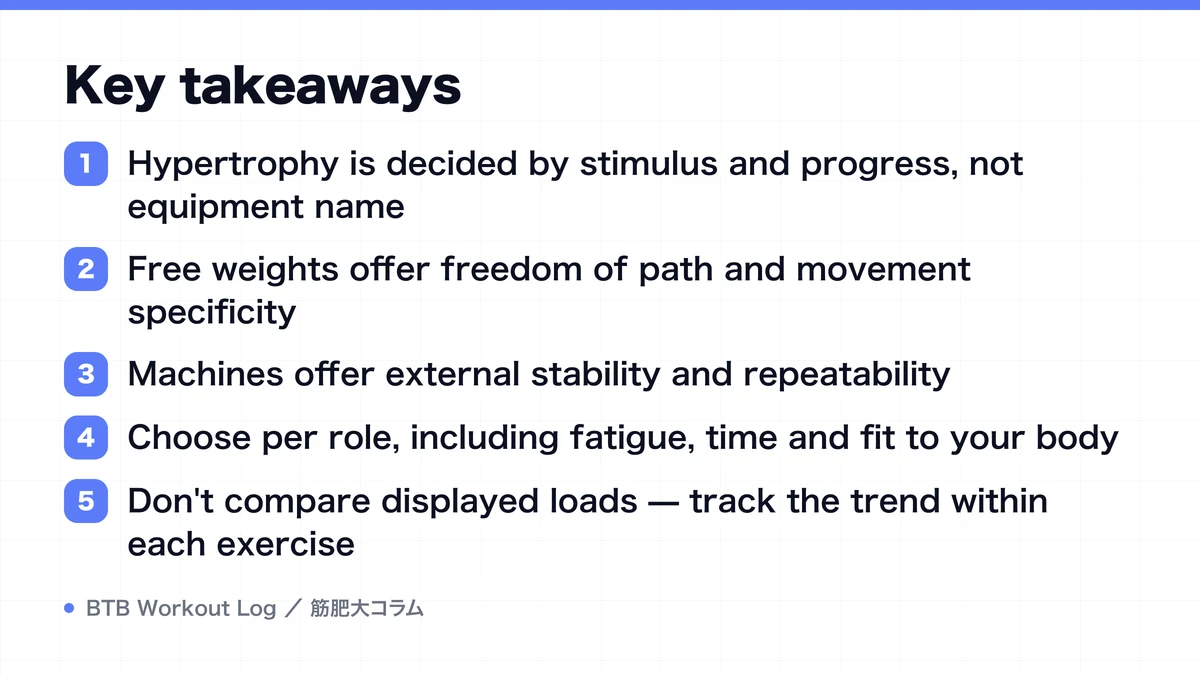
Key takeaways
- Hypertrophy is decided by stimulus and progress, not equipment name
- Free weights offer freedom of path and movement specificity
- Machines offer external stability and repeatability
- Choose per role, including fatigue, time and fit to your body
- Don't compare displayed loads — track the trend within each exercise