Lat Pulldown vs. Pull-Up: Which Builds a Wider Back? | Comparing Their Effect on the Lats
For lat hypertrophy alone, there's no winner shared by everyone between lat pulldown and pull-up. Whichever lets you hold intended range of motion, bank sufficiently effortful sets, and gradually raise load is the stronger option for that person.
Don't decide purely by whether you can do a pull-up — compare reproducibility of stimulus, fatigue, time, load adjustment, and joint fit under matched conditions.
What to compare isn't exercise prestige — it's whether you can bank valid sets
Both are vertical pulls bringing overhead hands toward the torso. Beyond the lats, the teres major, elbow flexors like the biceps, and scapula-moving muscles all work too. Just because a pull-up - lifting your own body - looks harder doesn't establish stronger lat hypertrophy stimulus on its own.
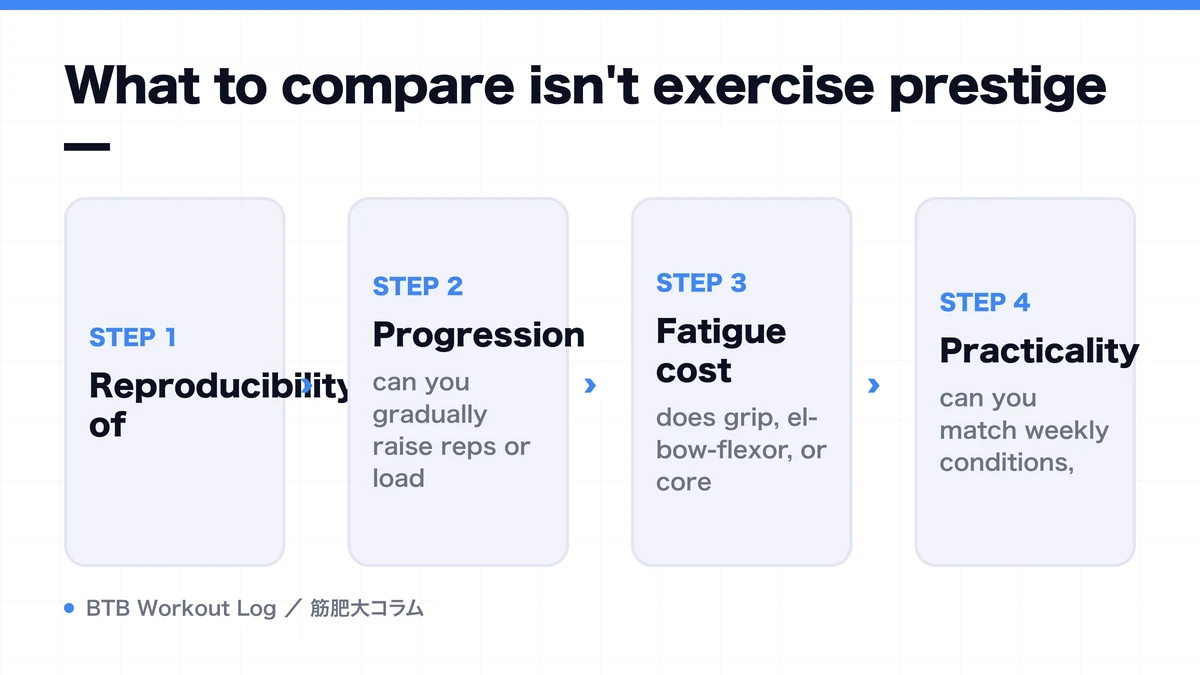
Compare on these four axes.
- Reproducibility of stimulus: can you repeat hard sets with intended range of motion and form, pain-free?
- Progression: can you gradually raise reps or load at comparable RIR?
- Fatigue cost: does grip, elbow-flexor, or core fatigue end the set before the lats do?
- Practicality: can you match weekly conditions, including equipment, setup time, and body-weight fluctuation?
RIR is an estimate of how many more reps were possible. RIR 2, for instance, means roughly 2 more reps possible while holding form. Prioritize whichever lets you sustain high-quality sets at matched range of motion and RIR over exercise name.
Pull-up rep count is also affected by body weight. A rep increase during a cut doesn't necessarily mean lat output alone improved, and a rep decrease during a bulk doesn't necessarily mean regression either. Since displayed pulldown weight isn't directly comparable across different machines, fix exercise-specific conditions during your evaluation period.
Think of hypertrophy effect through range of motion and effort, not a direct winner
Findings directly comparing long-term lat hypertrophy between lat pulldown and pull-up are limited. Rather than declaring one always grows more, it's safer to judge from the shared fact that both can load the lats. An EMG study of 12 healthy men with weight-training experience found some differences in lat and other muscle activity between wide/reverse-grip pulldown and two seated-row conditions. But muscle activity is an in-the-moment electrical measurement — it isn't long-term hypertrophy itself.
In practice, match the range from arms overhead down to elbows pulled toward the torso every time. Excessively shrugging the shoulders at the top, or arching the chest and drifting toward a horizontal pull at the bottom, make comparison against last time ambiguous. Use, as your standard, whatever range of motion you can control from the long-lat-length position to the short one without shoulder discomfort. This connects to comparing full range and partials too.
Absolute load also has no single answer. A meta-analysis pooling studies comparing low and high load taken to failure each set found no significant average hypertrophy difference. Pull-up being low-rep and pulldown being high-rep doesn't by itself decide superiority. The premise is that you can match RIR within your intended rep range and deliver sufficient reps to the lats before form breaks down.
Fatigue, time efficiency and load setup each have different strengths
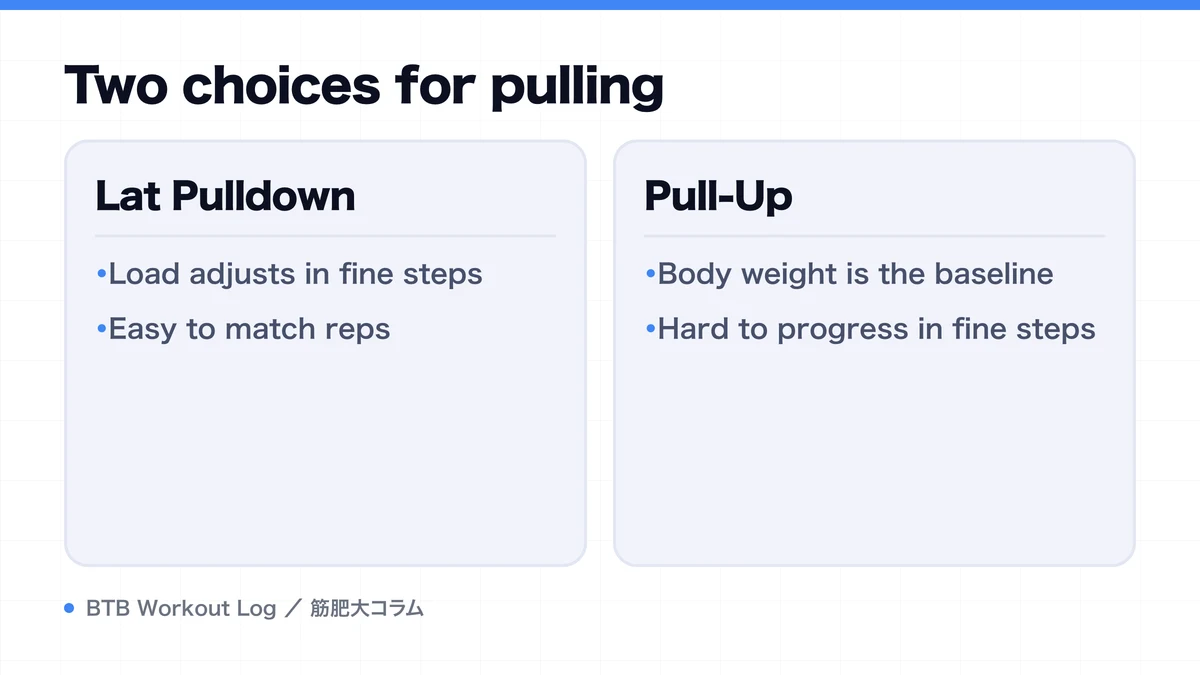
| Comparison | Lat pulldown | Pull-up |
|---|---|---|
| Load setup | Easy to fine-tune via the weight stack | Bodyweight-based — needs tracking assistance or added weight |
| Form stability | Easy to fix posture with seat and thigh pad | You control core and leg sway yourself |
| How fatigue shows up | Easy to lower load to match the lats | Grip, arms and core can become the limiter for some people |
| Time efficiency | Swapping pins is fast, but needs a machine | Little setup for bodyweight; added weight needs more equipment |
| Tracking progress | Easy to compare weight/reps on the same machine | Compare including body weight and added weight or assistance amount |
Fatigue isn't a story of "pull-up always costs more." For someone skilled at pull-ups who can hold their core stably without strain, it becomes an efficient main lift. Conversely, for someone whose arms or grip give out first, lowering load on pulldown makes it easier to bank consistent lat sets.
You don't need to take every set to failure either. There's no clear evidence that failure training beats non-failure for hypertrophy, and keeping your main sets around RIR 1–3 makes it easier to preserve later-set output. See comparing failure sets and leaving RIR for adjusting how hard to push.
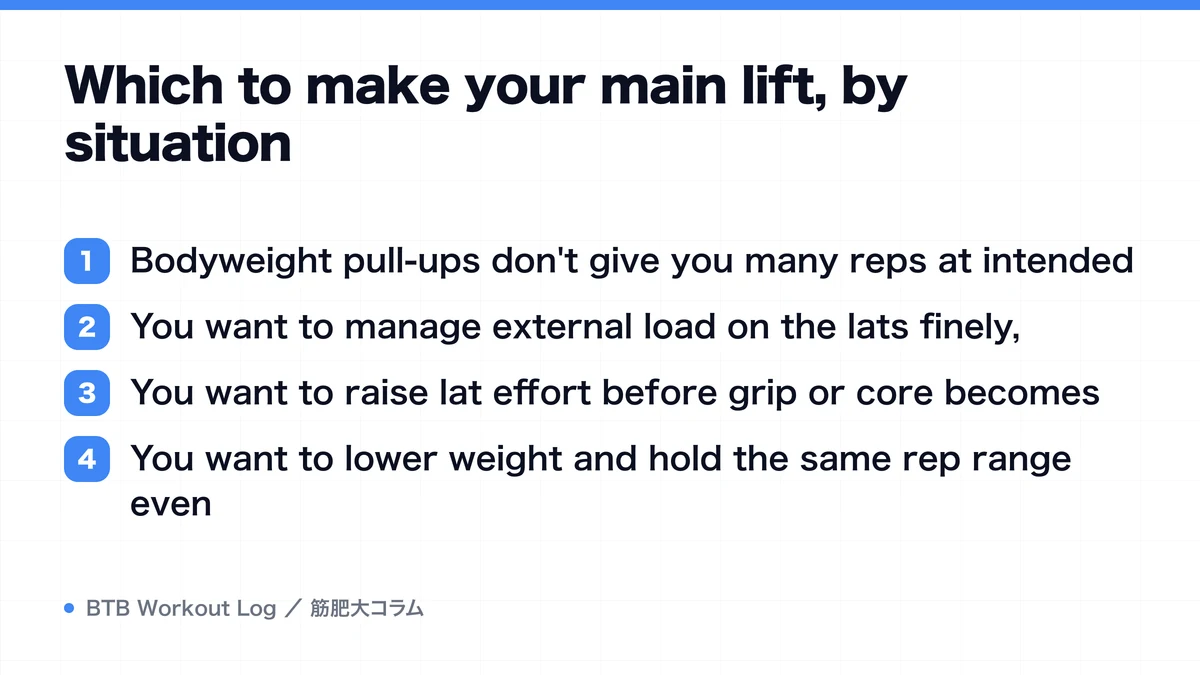
Which to make your main lift, by situation
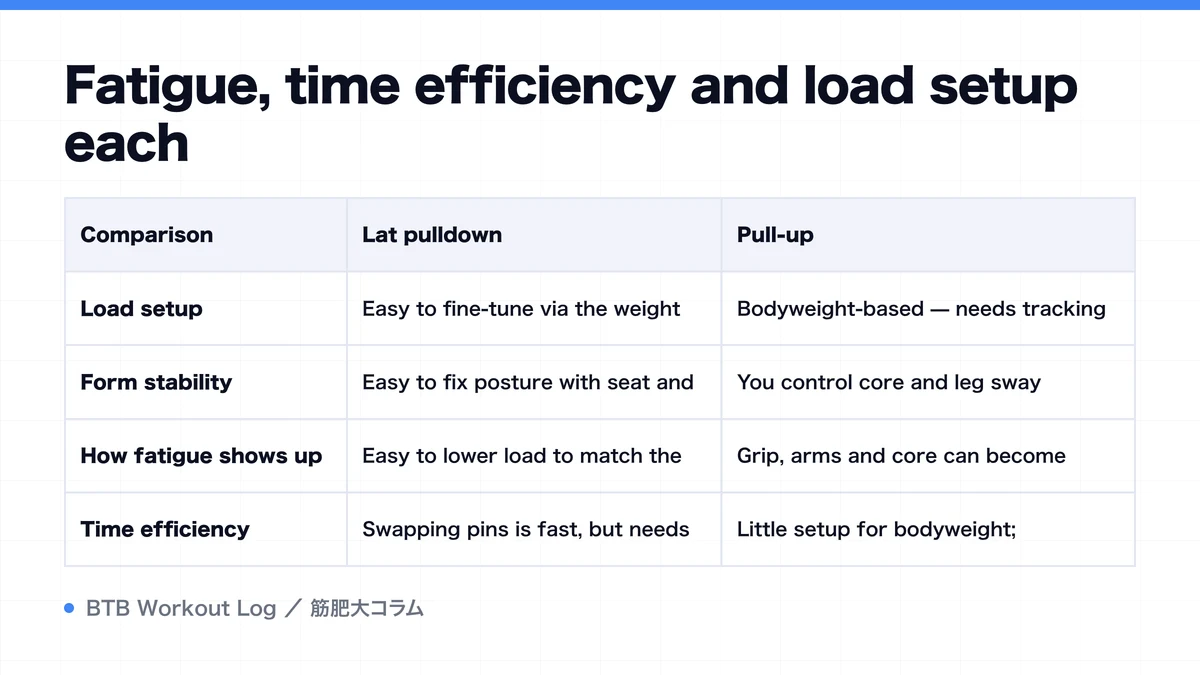
Situations that favor lat pulldown as your main lift
- Bodyweight pull-ups don't give you many reps at intended range of motion.
- You want to manage external load on the lats finely, independent of body-weight fluctuation.
- You want to raise lat effort before grip or core becomes the limiter.
- You want to lower weight and hold the same rep range even late in a session.
Situations that favor pull-up as your main lift
- You can do sufficient reps without momentum and estimate each set's RIR.
- You can add weight in small increments — via a dip belt, for instance.
- Alongside lat hypertrophy, you also want to build relative strength moving your own body.
- You have a stable bar available and aren't constrained by machine crowding.
If using both, decide why you're stacking the same role. For example, weighted pull-ups as your low-to-moderate-rep main lift, and pulldown added at slightly higher reps. But adding only vertical pulls can skew set distribution across the whole back. Consider the division of labor with horizontal pulls too, as in comparing barbell row and seated row, and check the full picture in a back hypertrophy routine.
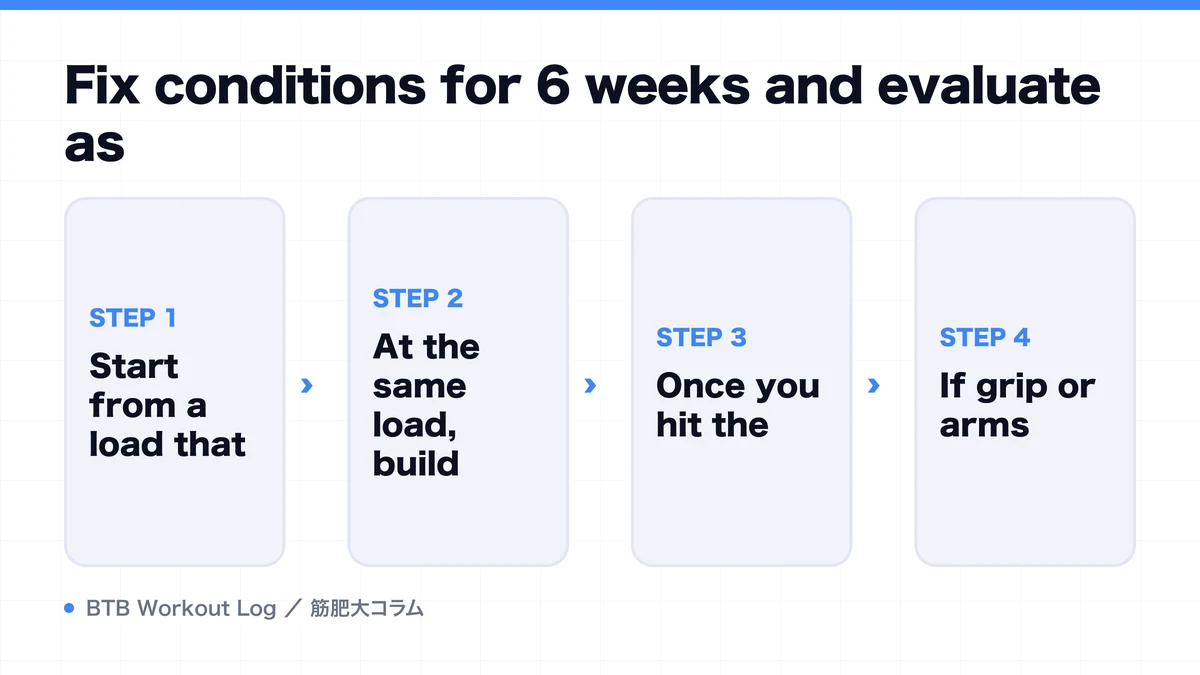
Fix conditions for 6 weeks and evaluate as your main lift
If unsure, make one your main lift and hold conditions fixed for roughly 6 weeks. Match grip, range of motion, set count and target RIR, and log each session's weight and reps. For pull-ups, log body weight and added weight; for assisted pull-ups, log the assistance amount too. Since displayed pulldown weight means something different on a different machine, compare on the same machine as your baseline.
- Start from a load that lands at RIR 1–3 within your intended rep range.
- At the same load, build reps without changing form until you reach the top of the range.
- Once you hit the ceiling, raise load by a small increment and rebuild from the bottom of the range.
- If grip or arms consistently stop you before the lats, joint discomfort rises, or output doesn't return by next time, review load or exercise.
This weight-and-rep progression method lets you evaluate both exercises against the same progression standard. What to watch isn't one pump — it's whether reps at the same RIR and range of motion are rising over several weeks, and whether you can bank your planned hard sets within what's recoverable.
Training is what produces hypertrophy, but your log is material for checking whether that choice is actually working.
FAQ
- If I can't do a single pull-up, does that hurt lat growth?
- Not necessarily. Lat pulldown or assisted pull-ups let you adjust load while holding range of motion and bank sufficient hard sets. Build reps and load there first, and practice bodyweight pull-ups gradually as a separate strength goal.
- Should I do both lat pulldown and pull-ups on the same day?
- Possible, but not required. If your main lift already secures needed vertical-pull sets, the rest can go to rowing exercises. If combining both, split their roles — rep range, grip — to avoid overlapping stimulus.
- Is a wider grip more effective for the lats?
- Widening grip doesn't automatically raise hypertrophy effect — too wide can lower range of motion or load for some people. Choose a hand width that lets you pull your elbows toward your torso with no shoulder discomfort, moving the same range every time, and judge from tracked progress.
Key takeaways
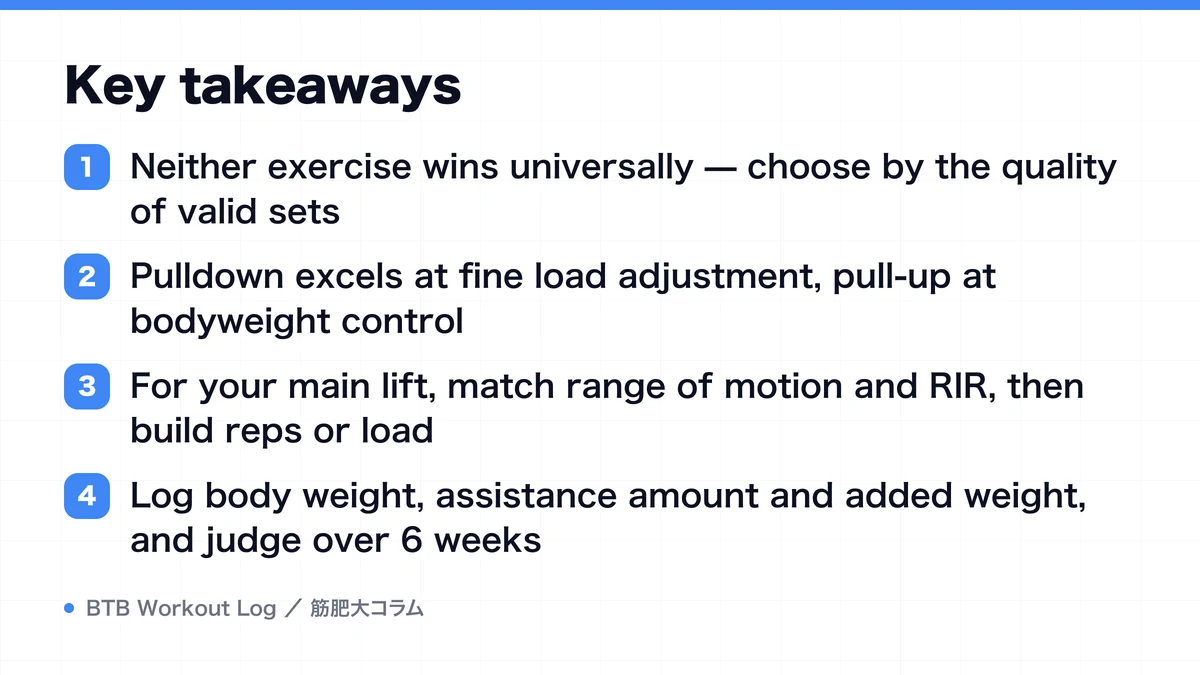
- Neither exercise wins universally — choose by the quality of valid sets
- Pulldown excels at fine load adjustment, pull-up at bodyweight control
- For your main lift, match range of motion and RIR, then build reps or load
- Log body weight, assistance amount and added weight, and judge over 6 weeks