Bench Press vs. Chest Press Machine: How Should You Use Each for Hypertrophy? | The Machine Isn't a Compromise
For hypertrophy alone, bench press isn't always superior, nor is the chest press machine a full substitute. It's easier to split roles by making whichever gives the chest sufficient range of motion and effort, with stable progress, your main lift, and the other a role that fills a gap.
Bench press's strength is the skill of controlling a free path plus whole-body stability; the chest press's strength is focusing on the chest via a fixed path and being easier to push close to the limit. But how well a machine's path fits your body varies model to model.
The first standard to decide isn't "how many kilos moved"
80kg on a barbell and 80kg on a chest press machine are not the same load - pulley, lever ratio, friction and path all differ. You cannot decide a winner from comparing displayed weight across machines. What to watch for hypertrophy purposes is whether you can bank high-quality hard sets on the pecs you are targeting and keep progressing within that exercise.
A hard set here means one taken to roughly 1-3 reps of reserve - RIR 1-3 - while holding form and range of motion. Compare on five axes: ① does the chest fatigue sufficiently first, ② can you reproduce pain-free range of motion, ③ can you progress weight or reps, ④ how much fatigue is left for the next set or next time, and ⑤ time including setup. Without matching these conditions, comparing "bench feels heavier" or "the machine feels like it works better" cannot settle hypertrophy usefulness.
Comparing hypertrophy, fatigue, time efficiency, load setup, and fit
| Comparison | Bench press | Chest press machine |
|---|---|---|
| Movement stability | You stabilize bar path, shoulder girdle, legs and core yourself | The machine stabilizes part of the path and posture |
| Focus on the chest | Tends to also be influenced by triceps, front delts and stabilizers | Lower stability demand makes it easier to focus on chest work |
| Fatigue cost | Tends to be high, including setup and whole-body tension | Easier to push locally and keep set-to-set reproducibility |
| Progressing load | Easy to add small plate increments, easy to standardize | Machines with a large jump per pin need reps to progress instead |
| Body fit | Grip width and bar path are adjustable, but control takes skill | Stable if the path fits, but the pivot or handle position may not suit everyone |
| Operating near the limit | Hard to manage a failed rep without safeties or a spotter | Machines that return to a stopper make it easier to push close to the limit solo |
The chest press machine isn't one thing either — converging vs. parallel path, backrest angle, grip, and starting position all change stimulus and comfort. Bench press similarly shifts handled weight and how muscle groups share the load with grip width and angle. This is a step more concrete than the general free-weight-vs-machine comparison — it should be evaluated on the actual bench and machine you use.
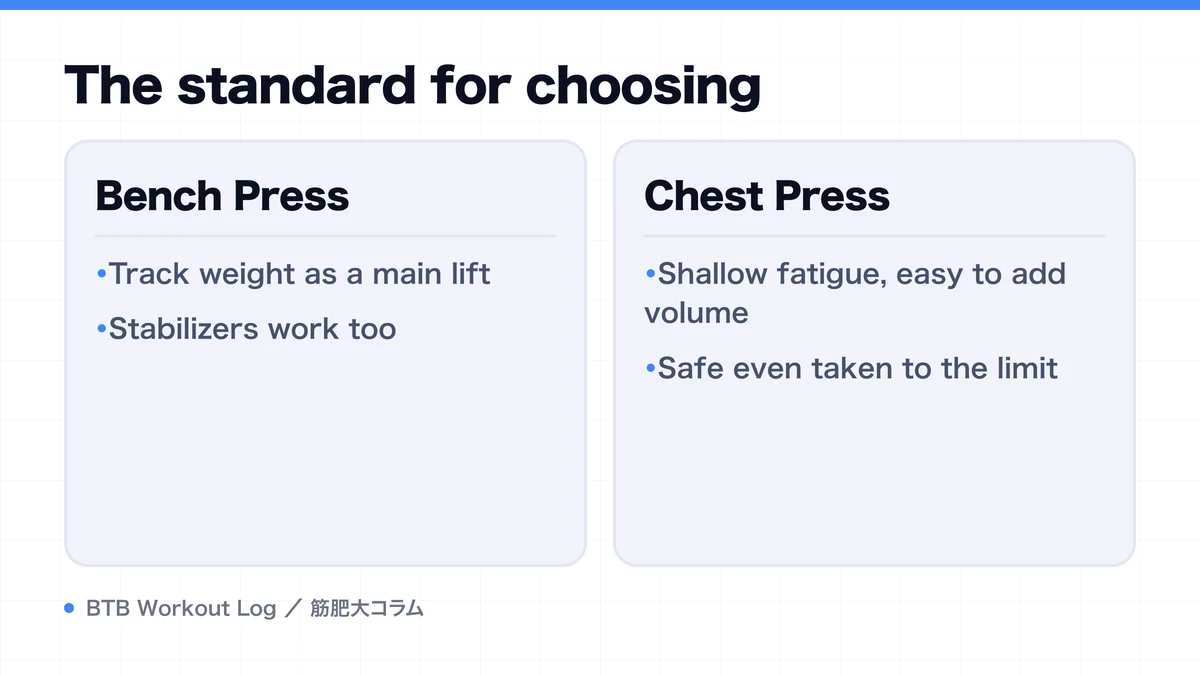
Why it's hard to name a single winner for hypertrophy effect
Given sufficient frequency, intensity and volume, hypertrophy occurs across several movement styles, including both free weights and machines. Hypertrophy can be targeted across a wide load range, but high load tends to favor maximal strength gains — so growing your chest and raising your bench press record overlap, but aren't the same goal.
For someone whose chest works sufficiently on bench press and who can progress reps or weight with stable form, the free path isn't a downside — bench technique and strength grow alongside it. Conversely, for someone limited by balance or triceps before the chest, ending the set with reserve still in the pecs, the chest press machine's stability makes it easier to build chest-focused hard sets.
But "more stable" doesn't automatically mean "chest press wins" either. A machine where the handles at full pull cause shoulder discomfort, where the pivot doesn't match shoulder height, or where you can't get sufficient range of motion, lowers both stimulus and sustainability. Don't decide long-term hypertrophy from EMG numbers or a single pump — judge from progress within each exercise combined with body fit.
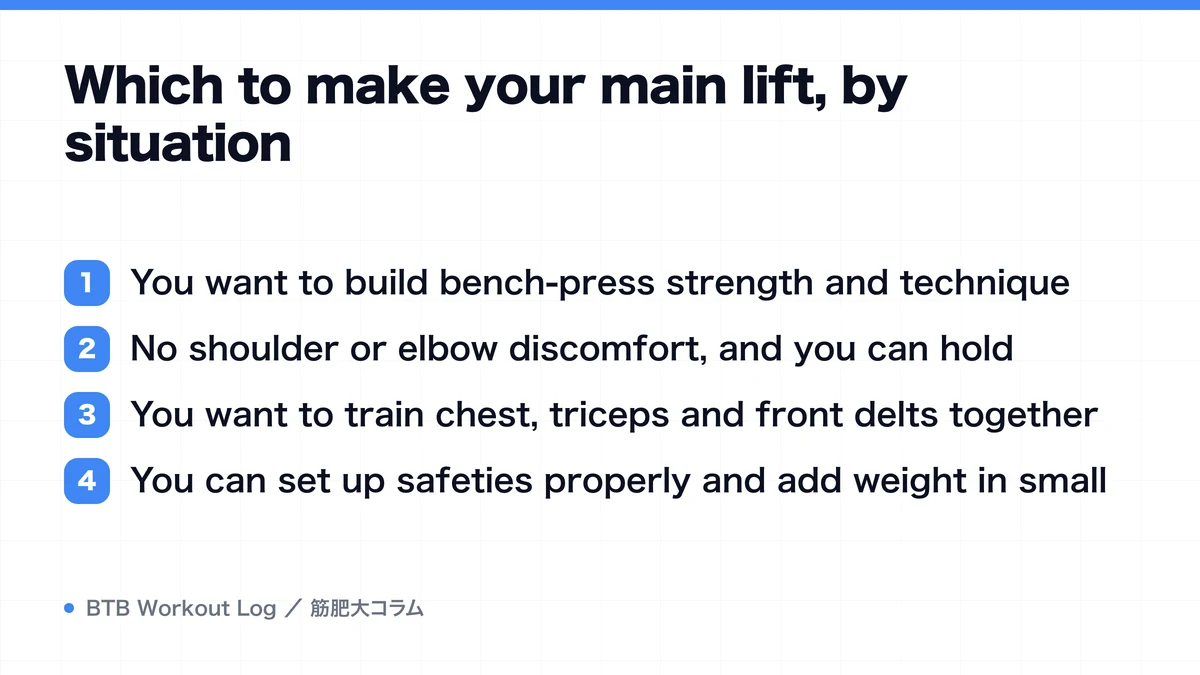
Which to make your main lift, by situation
Situations that favor bench press as your main lift
- You want to build bench-press strength and technique alongside chest hypertrophy.
- No shoulder or elbow discomfort, and you can hold reproducible chest-focused form.
- You want to train chest, triceps and front delts together with few exercises.
- You can set up safeties properly and add weight in small increments.
Situations that favor the chest press machine as your main lift
- On bench, stability or technique becomes the limiter before you can push the chest close to the limit.
- Whole-body fatigue is high from other compound lifts and you want to add a local chest set.
- You're in an environment where you can secure safety solo, and want to reproduce high-rep sets.
- That machine's path and grip fit your body, letting you use a deep position pain-free.
If using both, reflect your priority order in sequence. On a day you also want bench strength, doing bench first and treating the chest press as added chest volume is a natural structure. During a period prioritizing local chest stimulus above all, it's also an option to place a well-fitting chest press machine first and do bench with reserve to protect technique. Don't unconditionally raise weekly chest sets just because you added a second exercise — redistribute your existing sets instead.
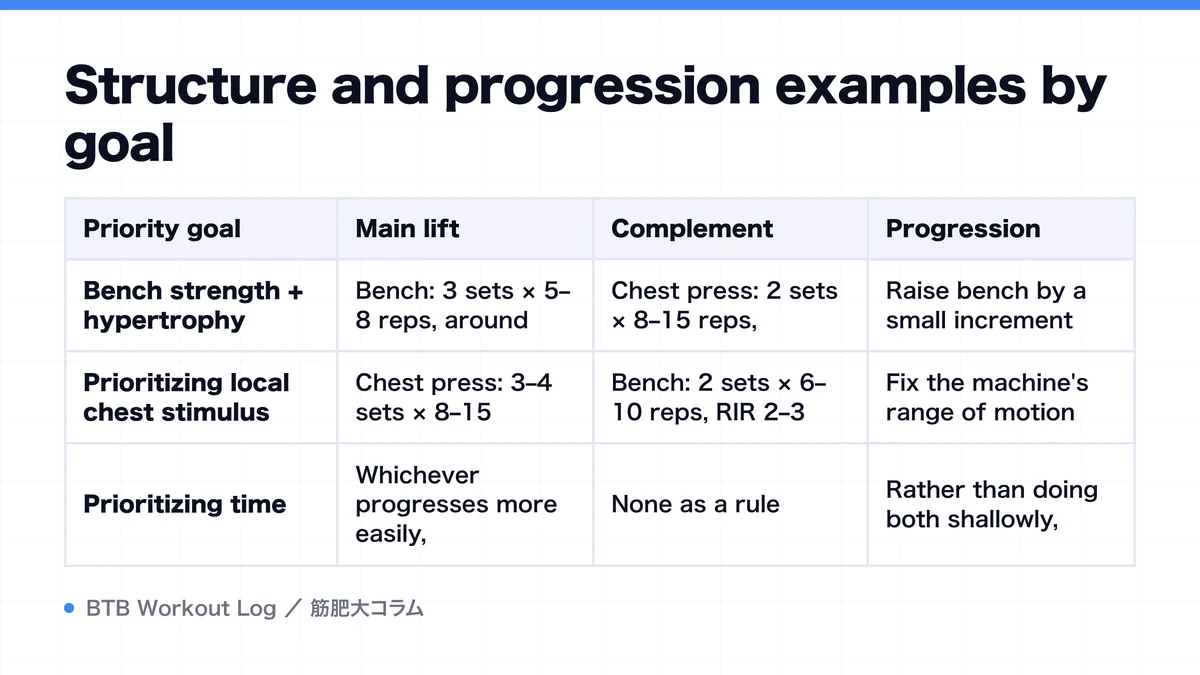
Structure and progression examples by goal
The following are examples for starting a comparison, not a fixed prescription. Adjust set count to fit your training history, frequency, other chest exercises, and recovery.
| Priority goal | Main lift | Complement | Progression |
|---|---|---|---|
| Bench strength + hypertrophy | Bench: 3 sets × 5–8 reps, around RIR 2 | Chest press: 2 sets × 8–15 reps, RIR 1–2 | Raise bench by a small increment after hitting the rep ceiling. Build reps first on the machine |
| Prioritizing local chest stimulus | Chest press: 3–4 sets × 8–15 reps, RIR 1–2 | Bench: 2 sets × 6–10 reps, RIR 2–3 | Fix the machine's range of motion and raise weight one step after every set hits the ceiling |
| Prioritizing time | Whichever progresses more easily, 3–4 sets | None as a rule | Rather than doing both shallowly, secure quality and rest on one exercise |
Right after switching from bench to chest press, a higher displayed weight doesn't mean progressive overload has advanced. Track weight and reps as a separate series per exercise, and per machine model if using a machine. If the jump per pin is large, an easy way to manage progress is to raise weight only after every set hits the ceiling of, say, an 8–12 rep range, then rebuild from near the floor next time. If you want to compare options within bench itself, the barbell-vs-dumbbell difference is a separate decision axis.
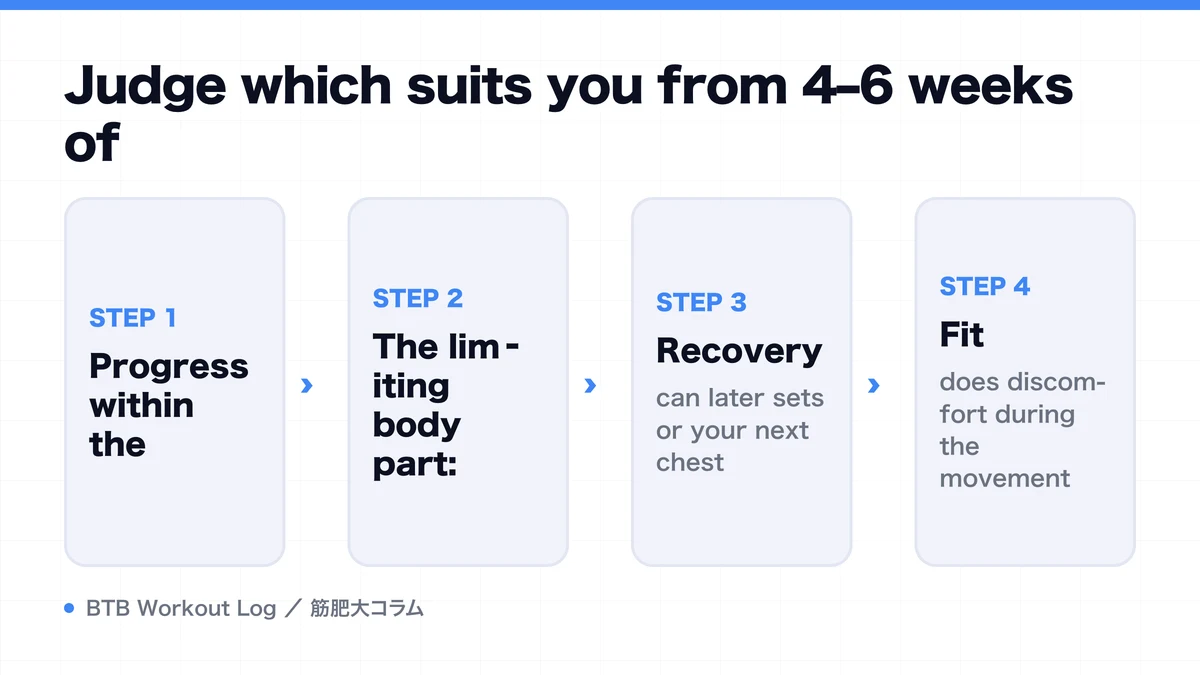
Judge which suits you from 4–6 weeks of records
Given exercise familiarity and day-to-day variance, judging from a single session's feel is premature. Hold your candidate fixed for 4–6 weeks, keep weekly chest sets, RIR and rest roughly matched, and log the following.
- Progress within the exercise: is weight or reps rising at the same range of motion and RIR?
- The limiting body part: are you stopped by triceps, shoulders, or stability before the chest sufficiently fatigues?
- Recovery: can later sets or your next chest session hold intended performance?
- Fit: does discomfort during the movement stay flat, and can you reproduce the same form and range of motion every time?
- Time: including setup, plate changes and waiting, can you complete your needed sets?
Whichever progresses stably once you factor in chest limitation, recovery, and time is the exercise better suited to be your main lift in your current environment. If equipment or goals change months later, you can re-decide using the same standard.
FAQ
- Can the chest press machine alone still build a bigger chest?
- Yes. If you get sufficient range of motion on a path that fits your body, bank sets at RIR 1–3, and can raise weight or reps long-term, it works as a hypertrophy exercise. But you won't build bench-specific technique or free-weight strength, since you're not practicing them.
- If I do both, which should come first?
- Put whichever capability you prioritize first. If you also want to raise your bench record, bench first; if local chest stimulus is the top priority for a period, the chest press machine can go first. Weight drops on whatever comes later due to fatigue, so don't compare it directly against a session where it was done on a separate day — track progress within that sequence instead.
- If I'm worried about my shoulder, is the chest press machine safer?
- Not universally. A fixed path helps stability for some people, but for others the pivot or handle position doesn't fit and causes discomfort. Check pain-free range of motion and form on both, and if pain persists, lower load and consult a medical or exercise professional.
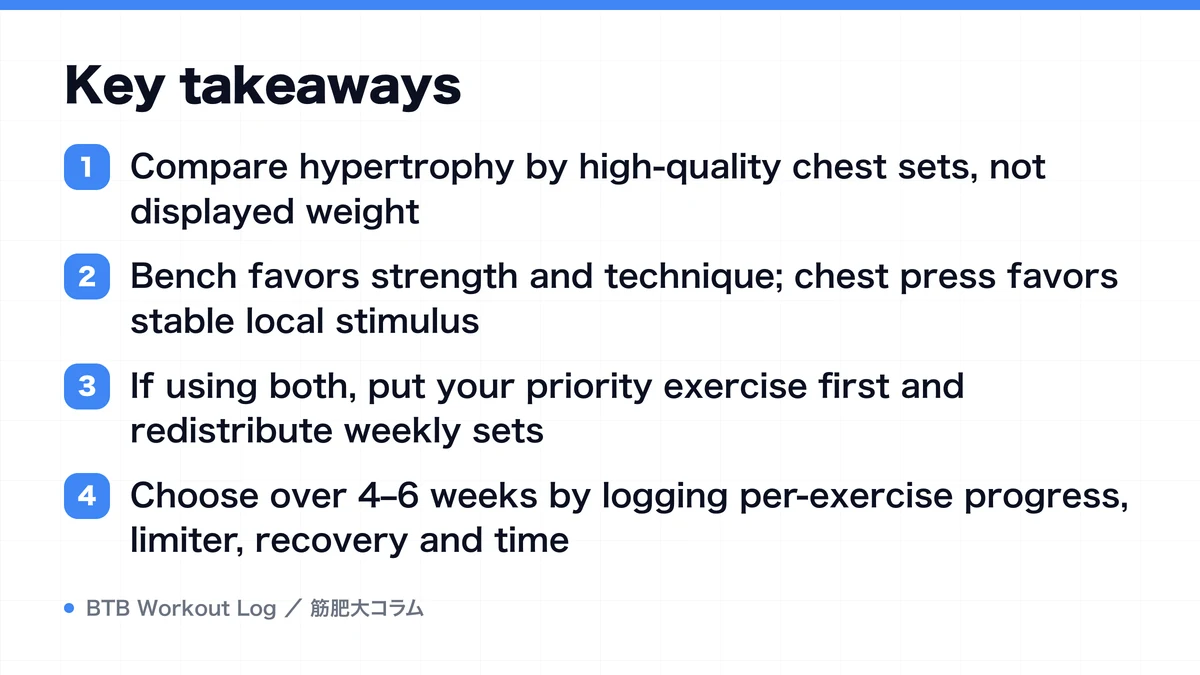
Key takeaways
- Compare hypertrophy by high-quality chest sets, not displayed weight
- Bench favors strength and technique; chest press favors stable local stimulus
- If using both, put your priority exercise first and redistribute weekly sets
- Choose over 4–6 weeks by logging per-exercise progress, limiter, recovery and time
References
- The Influence of Frequency, Intensity, Volume and Mode of Strength Training on Whole Muscle Cross-sectional Area in Humans
- Low- vs High-load Resistance Training for Strength and Hypertrophy: Meta-analysis
- The Effects of Bench Press Variations in Competitive Athletes on Muscle Activity and Performance