Lateral Raises: Heavy vs. Light for Rounder Shoulders
Lateral raises are easiest to manage centered on low-to-moderate load, but heavy load can work too if you can hold the intended range of motion and posture. Looking purely at middle deltoid hypertrophy, heavier doesn't automatically win.
What to compare isn't the number on the dumbbell — it's whether you can end the set at the middle delt, reproduce the movement, and carry progress into next time.
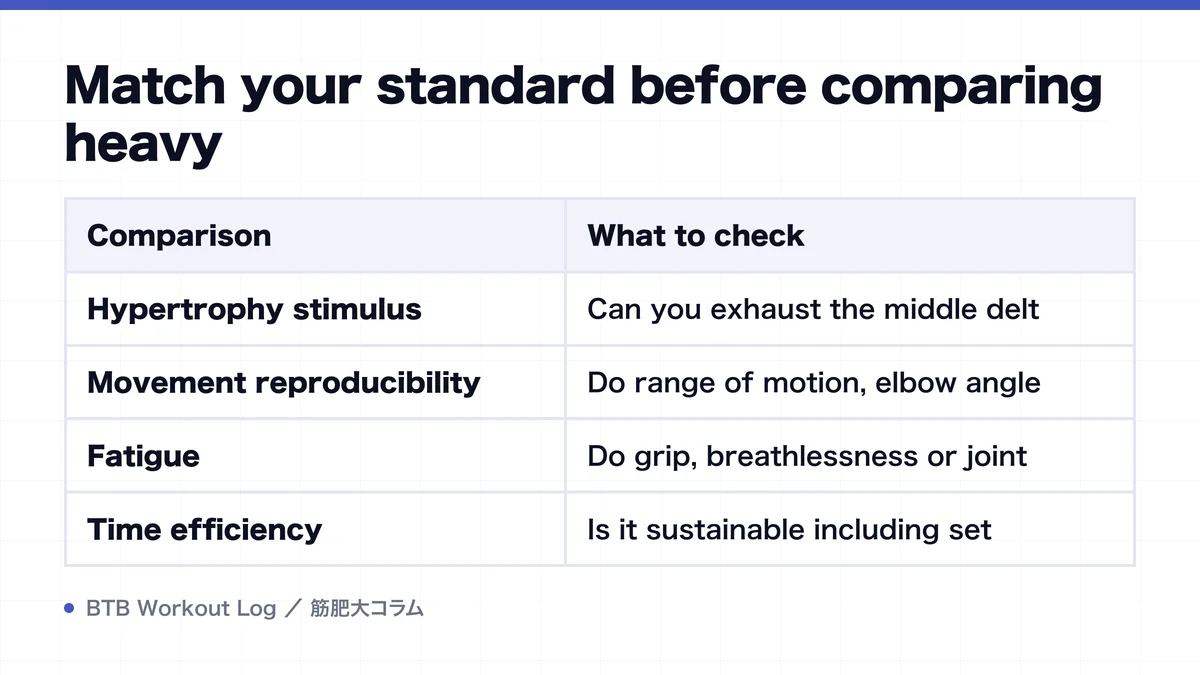
Match your standard before comparing heavy and light
Here, heavy means load that reaches roughly RIR 1–3 at 8–12 reps, and light means load that reaches roughly RIR 1–3 at 15–30 reps. RIR is an estimate of reserve — how many reps were left. The boundary isn't absolute — treat it as a relative comparison for the same person doing the same lateral raise.
Even if you think you only changed the weight, if the heavier side brings in more upper-body momentum, more elbow bend, or a lower arm-raise height, you're actually comparing a different movement. Dumbbells, cables and machines also load differently, so fix the equipment and posture first. Comparing the following five points then makes the choice clearer.
| Comparison | What to check |
|---|---|
| Hypertrophy stimulus | Can you exhaust the middle delt with sufficient effort? |
| Movement reproducibility | Do range of motion, elbow angle and torso movement match every time? |
| Fatigue | Do grip, breathlessness or joint discomfort limit you before local fatigue does? |
| Time efficiency | Is it sustainable including set time and needed rest? |
| Progressive potential | Can you raise load or reps without changing form? |
The general picture for load comparison is also covered in choosing between heavy and high-rep work, but on lateral raises, the small range of motion and coarse weight increments make the choice harder.
Hypertrophy effect isn't decided by weight alone
Research on resistance training generally shows hypertrophy can occur across a wide range of loads, given sufficient set effort. Heavy load tends to favor maximal strength gains, but doesn't always come out ahead on hypertrophy amount too. This isn't a finding from a direct lateral-raise comparison, so it doesn't go so far as "any weight works the same". Still, there's weak grounds for assuming the simple relationship that a heavier dumbbell always means a bigger middle delt.
The condition that makes light load work is not stopping once you've merely completed the reps — it's genuinely approaching the target muscle's limit. If you stop at 20 reps but could do 10 more, you haven't turned lightness into a hard set. On the heavy side too, if you can no longer lift without momentum before the middle delt itself fatigues, it's worth reviewing why that set actually ended. Either way, the starting point is a load that lets you approach roughly 1–3 reps left, in your intended form. See the practical RIR guide for handling RIR.
So for hypertrophy effect alone, there's no clear winner to declare. Where the real difference shows up isn't the research average — it's the practical question of whether you personally can direct that effort at the middle delt.
Light load tends to have the edge for targeting the middle delt
The lateral raise is a single-joint movement that abducts the shoulder — it isn't an exercise like the shoulder press that moves large weight across several big muscle groups. Since different shoulder exercises activate different parts of the deltoid, the point of choosing the lateral raise isn't "lifting something heavy" — it's repeating a movement that targets the middle head. See training the deltoid heads separately for the overall shoulder exercise picture.
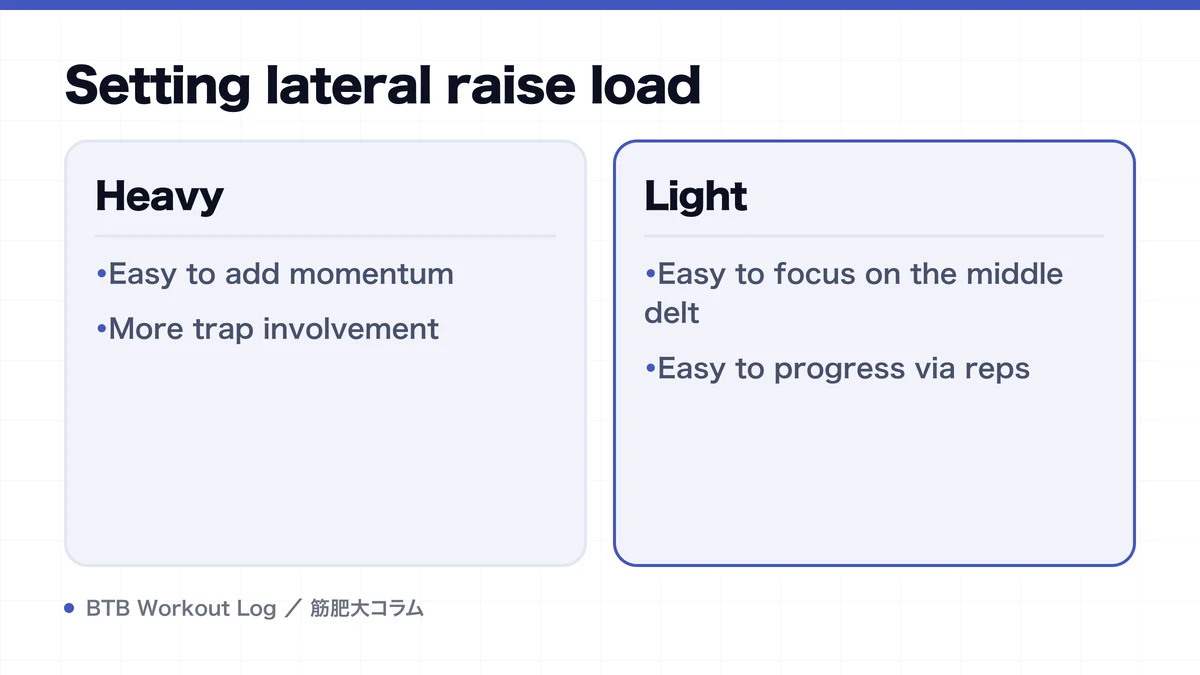
Light load makes it easier to standardize arm-raise height, elbow bend, torso lean and the lowering position. If you can hold that standard through the back half of the set too, it's an advantage that rising reps can be read as genuine progress. But go too light and it becomes easy to stop from burn or lost focus before the middle delt itself, and sets well past 30 reps also take time.
Heavy load can produce strong force in a short set, but the moment you raise weight, swinging your torso, shrugging your shoulders, or shortening range of motion breaks the comparison against last time. There's no need to categorically reject a lateral raise that uses momentum. But if you do use it, it's more accurate to track it as a separate variation rather than mixing it into the same log series as "strict-form lateral raise". The pass condition on the heavy side is that your defined movement standard doesn't change much even as the last few reps slow down.
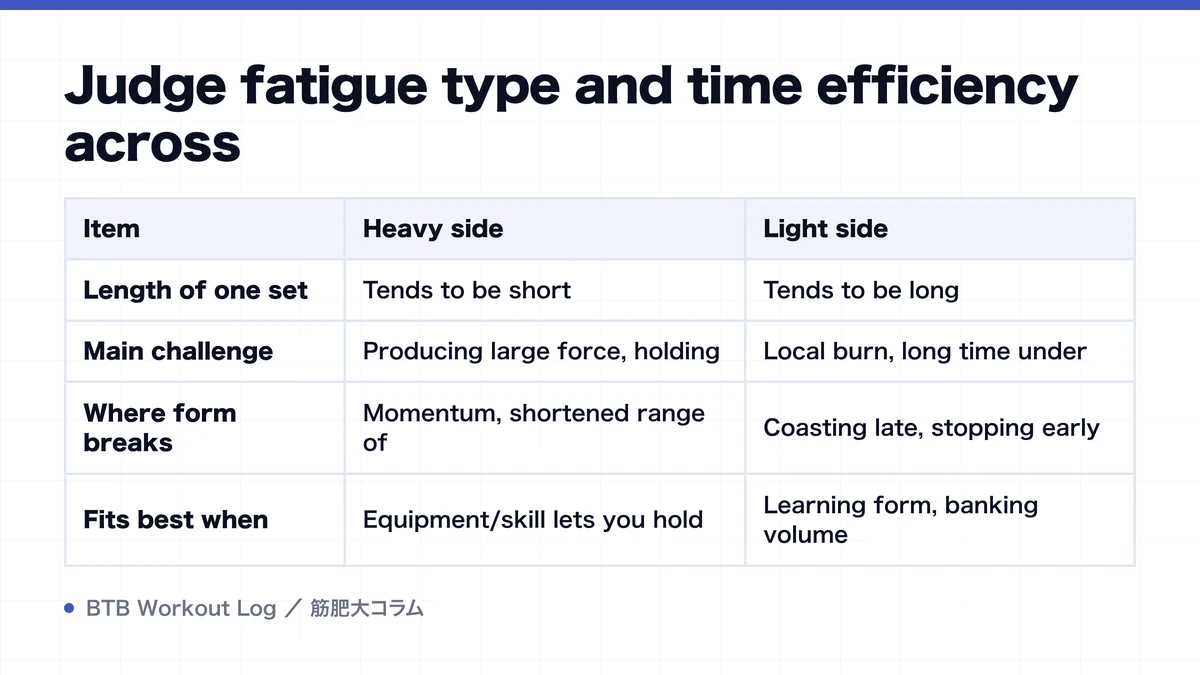
Judge fatigue type and time efficiency across the whole session
| Item | Heavy side | Light side |
|---|---|---|
| Length of one set | Tends to be short | Tends to be long |
| Main challenge | Producing large force, holding posture | Local burn, long time under tension |
| Where form breaks | Momentum, shortened range of motion | Coasting late, stopping early |
| Fits best when | Equipment/skill lets you hold targeting even at low reps | Learning form, banking volume while feeling out the joint |
Heavy load has fewer reps, so a single set can be shorter in time. But if rest to reset posture grows longer, or invalid sets pile up while you check form, overall session efficiency doesn't improve. Light load, too, if you push to the limit at 30 reps every time, costs significant time and discomfort, and can eat into focus for later exercises.
Neither side is universally less fatiguing. The joint and postural strain of heavy load, and the local fatigue of light load, are different in kind. Judge including recovery by next time, effect on later pressing exercises, and weekly hard set count. Before adding more lateral raises, check your weekly volume and separate whether you merely changed load range or actually raised total volume.
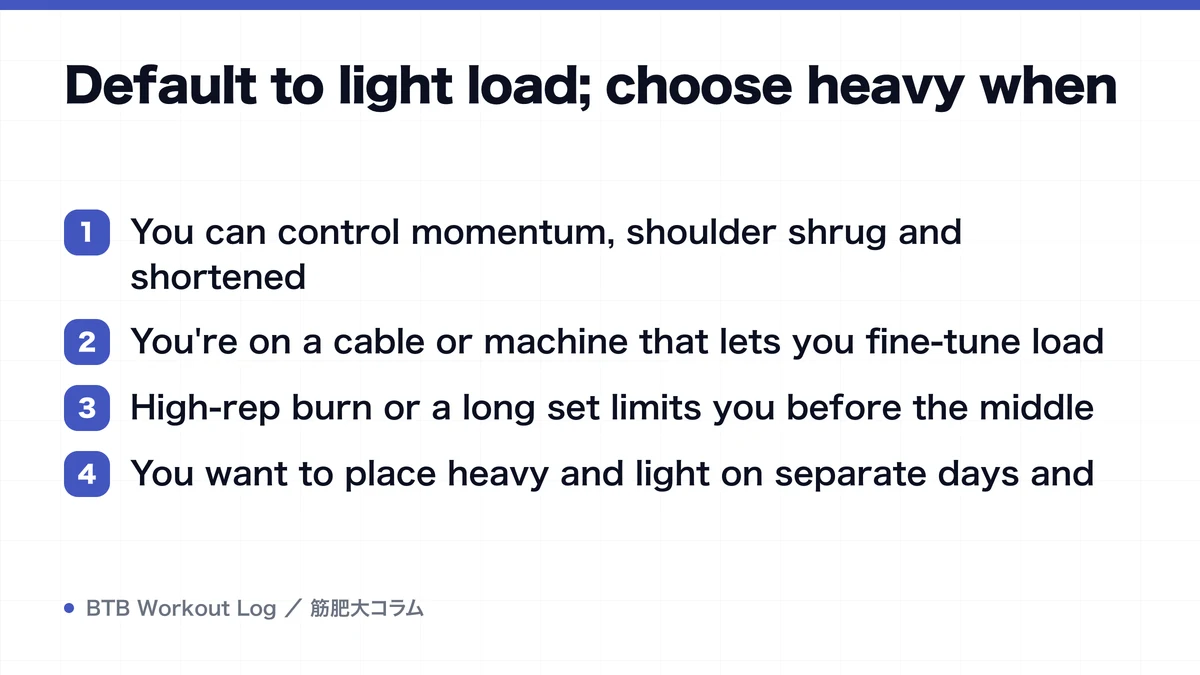
Default to light load; choose heavy when conditions are met
As a starting setup for the dumbbell lateral raise, a load you can hold form on around 12–20 reps is an easy-to-use range — not because light is the only correct answer, but because it's a starting point that lets you balance form and effort. Once you can hold RIR and range of motion stable near 20 reps, raise weight and build back up from the bottom of the range. See deciding rep range for detailed operation.
Situations that favor heavy load
- You can control momentum, shoulder shrug and shortened range of motion even at 8–12 reps
- You're on a cable or machine that lets you fine-tune load while holding posture stable
- High-rep burn or a long set limits you before the middle delt itself
- You want to place heavy and light on separate days and track progress across two rep ranges
Situations that favor light load
- Raising weight shifts the movement toward torso swing or trap dominance
- The next dumbbell increment is too large to hold your intended rep count
- You want to bank set volume on a consistent path while avoiding shoulder discomfort
- You're building form and learning to feel the set end at the middle delt
Even in a stretch where you can't add weight, rising reps at the same load and form still counts as progressive overload. Log not just weight and reps but RIR, your range-of-motion standard, and whether momentum was used, briefly each time.
FAQ
- What weight counts as "heavy" for lateral raises?
- It's not a fixed number, since it shifts with build and equipment. This article treats a load that reaches roughly RIR 1–3 at 8–12 reps, with your defined form held, as the heavy side. Once momentum or shortened range of motion increase, that weight has stepped outside the comparison.
- Can 30+ reps at light load still build muscle?
- It can, if you genuinely approach the limit. But the more reps you do, the more likely burn or time becomes the limiter first. If it takes well past 30 reps to reach RIR 1–3, going slightly heavier may be easier to manage.
- Is a heavy lateral raise that uses momentum pointless?
- Not necessarily pointless, but it should be treated as a separate variation from strict form. Keep the amount of momentum and range of motion consistent each time, check whether posture is breaking down before the middle delt itself ends the set, and log it apart from your strict sets.
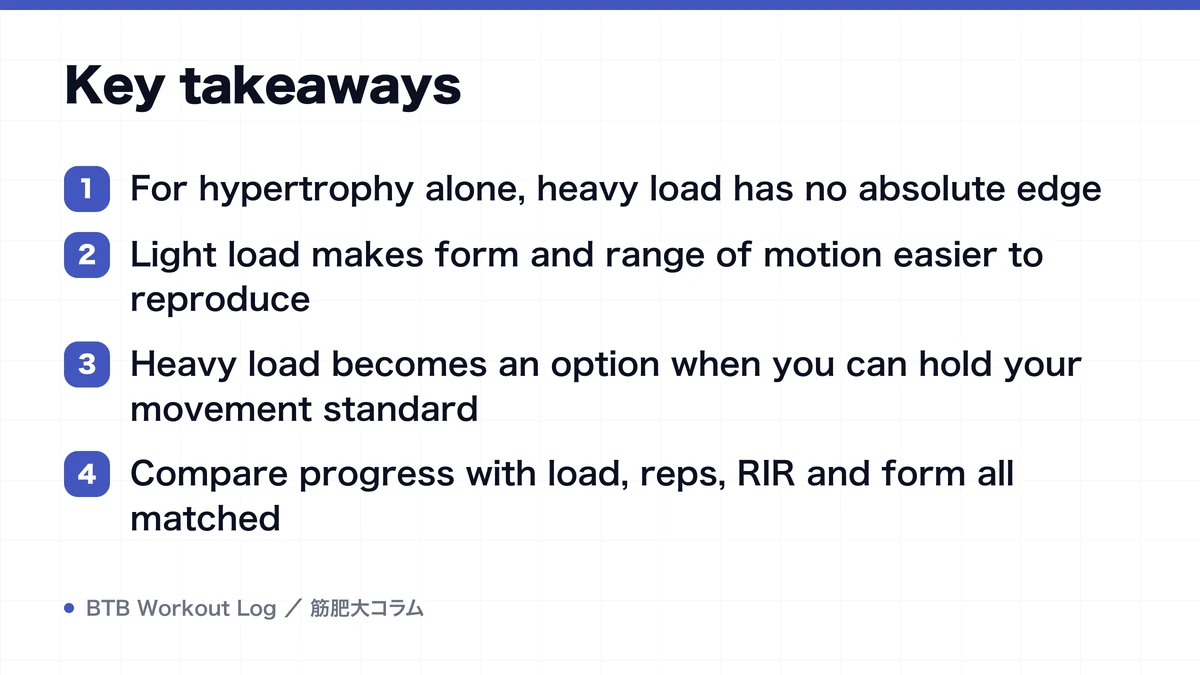
Key takeaways
- For hypertrophy alone, heavy load has no absolute edge
- Light load makes form and range of motion easier to reproduce
- Heavy load becomes an option when you can hold your movement standard
- Compare progress with load, reps, RIR and form all matched
References
- Low- vs High-load Resistance Training for Strength and Hypertrophy: Meta-analysis
- Different Shoulder Exercises Affect the Activation of Deltoid Portions
- Training to Repetition Failure or Non-failure: Systematic Review and Meta-analysis
- Proximity-to-Failure and Muscle Hypertrophy: Systematic Review with Meta-analysis