Add Weight or Reps First? How to Progress Without a Plateau
For hypertrophy purposes, the default is to build reps within your set rep range first, then raise weight once you can reproduce the top of that range under the same movement conditions. That said, on exercises with small weight increments, or when you're also chasing maximal strength, prioritizing weight is more sensible.
The question to compare isn't "which matters more, kilograms or reps" — it's which one lets you add the next bit of stimulus on your current exercise in small, reproducible steps.
Compare weight and reps at the same RIR and form
Before comparing raising weight against raising reps, fix the conditions you'll judge progress by. You need to match at least exercise, range of motion, form, rest time, set count, and RIR — the estimate of how many reps were left. If these differ, a bigger number doesn't necessarily mean greater capability.
Say a set at 60kg was 10 reps at RIR 2. Next time, the same 60kg gets you 11 reps at RIR 0. Reps rose, but since using up all your reserve is mixed into that result, you can't call it a clean one-rep improvement. Conversely, raising to 62.5kg while range of motion shallows or momentum increases means you can't fairly compare load on the target muscle either.
Progressive overload isn't a race to move a number — it's raising, over the long term, the capability you can produce under a fixed standard. Treat weight and reps as two tools for producing that change.
For hypertrophy alone, neither one wins outright
Raising weight increases external load per rep; raising reps at the same weight increases the repeated-effort capacity you can produce at that load. Both, accumulated under matched conditions, are material for advancing your load setup. What matters for hypertrophy isn't building only weight or only reps — it's repeating sets of sufficient effort within what you can recover from, and raising capability over time.
A meta-analysis comparing low and high load reported comparable hypertrophy when all sets were taken to momentary failure, while 1RM strength gains favored the high-load side. This isn't a study directly comparing rep progression against weight progression, but it does show there's no basis for always rushing toward heavier weight for hypertrophy purposes. See rep range for choosing a load band in more detail.
So for hypertrophy alone, the practical difference centers on this: building reps first makes fine-grained progress easier, while raising weight makes it easier to hold a target load band. If maximal strength is also a clear goal, priority shifts toward getting reps in at heavy load.
Compare by increment size, fatigue, time efficiency, strength, and exercise fit
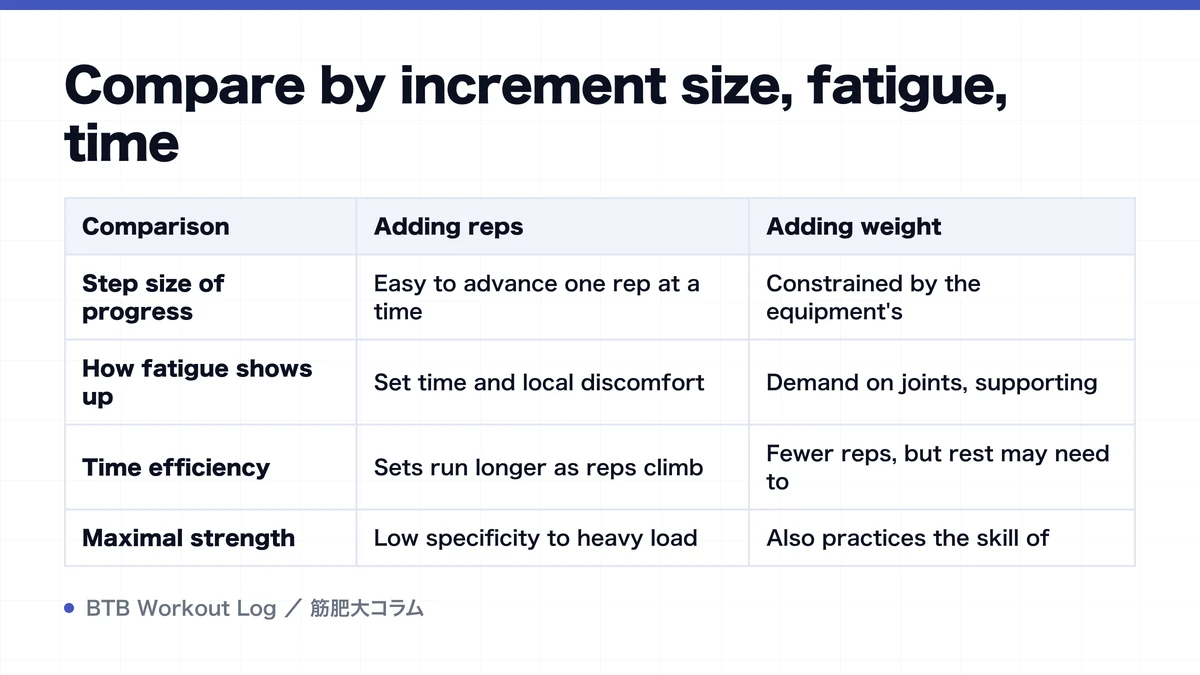
| Comparison | Adding reps | Adding weight |
|---|---|---|
| Step size of progress | Easy to advance one rep at a time | Constrained by the equipment's smallest plate |
| How fatigue shows up | Set time and local discomfort tend to rise | Demand on joints, supporting muscles and technique tends to rise |
| Time efficiency | Sets run longer as reps climb | Fewer reps, but rest may need to grow |
| Maximal strength | Low specificity to heavy load | Also practices the skill of handling heavy weight |
| Fits best for | Exercises with coarse weight increments, single-joint work | Exercises with fine increments, compound lifts, strength focus |
You can't say either side is simply always less fatiguing. Raising reps makes it easier for breathlessness or burn to end the set before the target muscle does; raising weight raises the demand on maintaining form and on the joints. Even at the same RIR, the type of fatigue and its effect on the next set shift by exercise.
The answer also differs between an environment where you can add small increments on a barbell and one where dumbbells only come in large jumps. If the smallest weight increase would drop your reps below the floor of your rep range, that increment is too coarse for your current capability — adding reps instead gives a smoother progression.
Four situations that favor building reps first
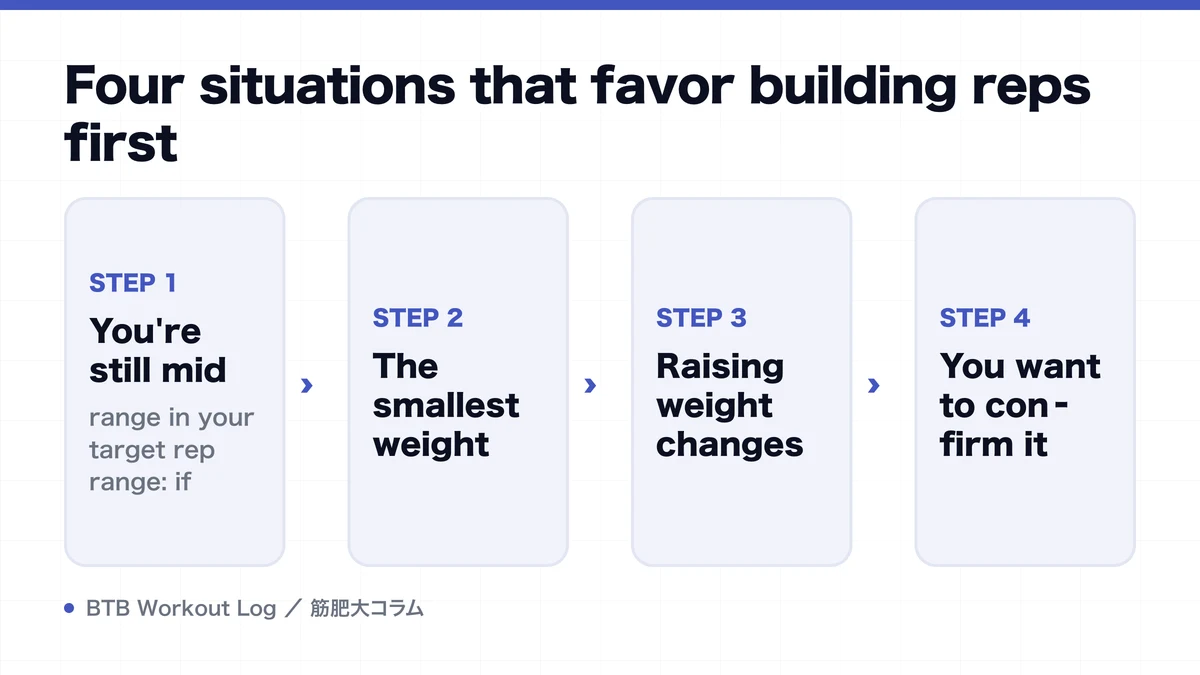
- You're still mid-range in your target rep range: if your range is 8–12 and you're at 9, first aim for 10 reps at the same weight. Adding weight while there's still room to the top risks dropping below the floor and stepping outside your planned stimulus.
- The smallest weight increment is large: on dumbbells or some machines, even one step up is a proportionally large jump. Adding one rep at a time works as a fine adjustment that fills that gap.
- Raising weight changes the movement: if range of motion narrows, momentum increases, or assisting muscles fatigue before the target does, it's not yet time to rush a weight increase.
- You want to confirm it wasn't a one-off good day: reps also swing with sleep, food, or exercise order. If you can reproduce the top of your range across several sessions under matched conditions, the case for moving up in weight gets stronger.
That said, turning "one more rep than last time" into a goal in itself tends to invite shortening range of motion only on the last rep, or cutting into your planned RIR. Only count a rep increase as progress if it was done at the same quality. You don't need to add a rep to every single set either — a small rise in the combined total across 3 sets counts too. Decide your judging rule before you start.
Don't just extend reps endlessly either — setting a ceiling matters. Keeping this comparison's standard distinct from testing "one more rep than last time" in detail makes it clearer here.
When to switch to raising weight
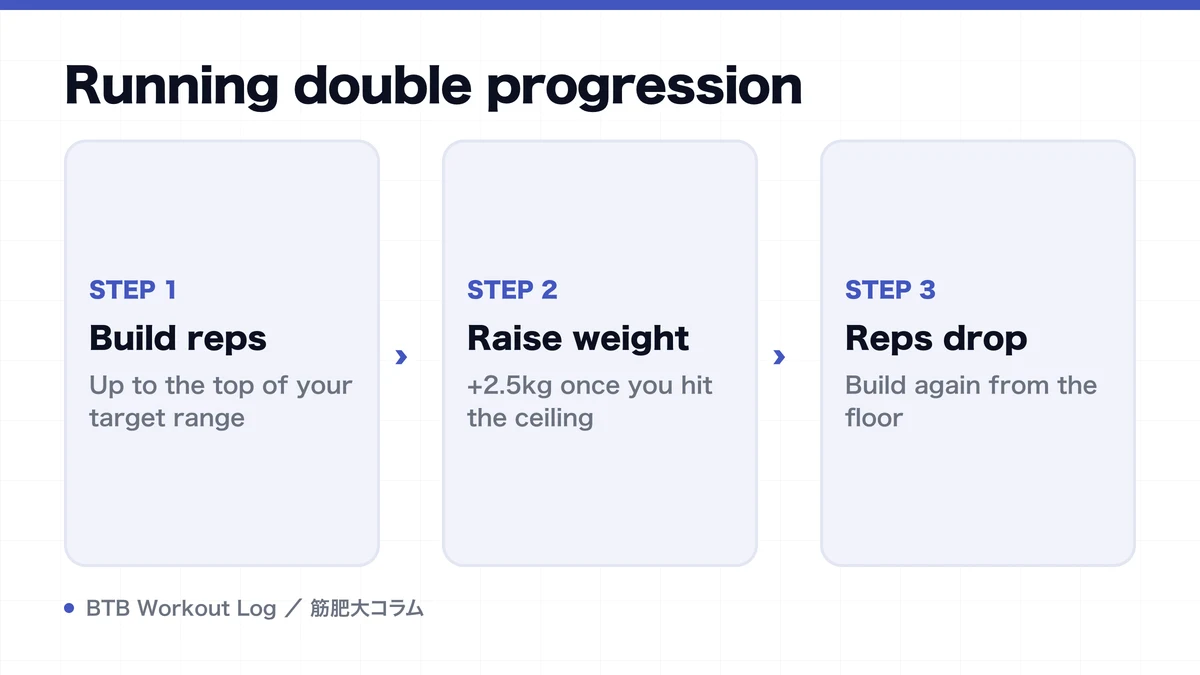
The clearest signal to raise weight is when you can reproduce the top of your rep range — across all your planned working sets, or a predetermined total — under the same form, range of motion and RIR. At that point, add the smallest available increment and accept that reps will drop back toward the bottom of the range. This back-and-forth is double progression.
Dropping from 12 reps back to 8 after a weight increase isn't itself a step backward. As long as you hold your planned floor and RIR at the new weight, you can start building reps again. But if you drop well below the floor, RIR suddenly hits 0, or range of motion narrows, the jump was too large, or the switch condition wasn't actually met yet — stay at the old weight, or find a smaller plate increment.
The case for raising weight strengthens on compound lifts where you're also chasing maximal strength, exercises where rising reps have made sets too long, and exercises where you can add very small increments. But if reps have stalled from insufficient recovery, raising weight to "change the stimulus" doesn't fix the actual problem. Don't make raising weight every session mandatory, and separate out a weight plateau from fatigue or program design when needed.
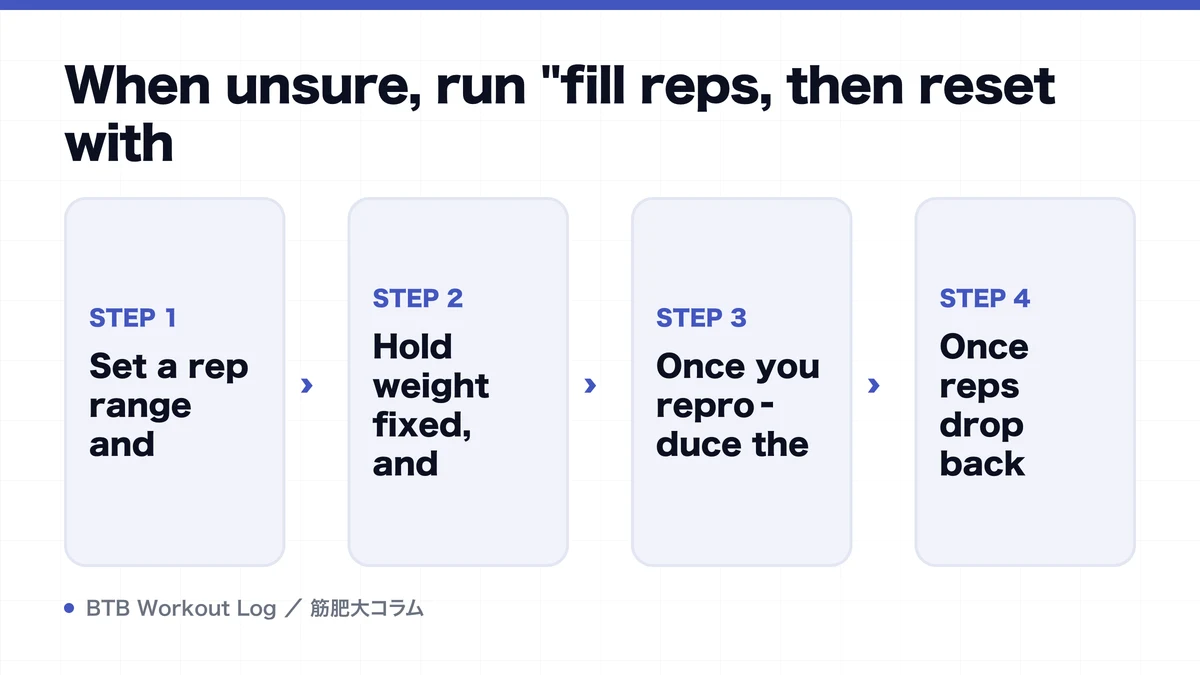
When unsure, run "fill reps, then reset with weight"
The basic procedure for hypertrophy purposes is:
- Set a rep range and target RIR for each exercise ahead of time.
- Hold weight fixed, and build reps — or the combined total across all sets — while maintaining form and range of motion.
- Once you reproduce the top-of-range condition across several sessions, raise weight by the smallest available increment.
- Once reps drop back toward the bottom of the range, start building them up again under the same conditions.
- If neither has moved in several weeks, don't force a weight increase — review volume, recovery and exercise order instead.
This rule can vary by exercise. Raising weight in small steps on the bench press while extending reps longer on lateral raises is a combination that fits the equipment and movement characteristics better. What matters is not swapping your standard based on that day's mood, and keeping the record in a form you can compare against next time.
Line up load, reps and RIR trends per set, and use whether you could add weight after hitting the top of the range, and whether you held the floor afterward, as material for your next decision. Double progression can't run without seeing where you currently sit within the range. BTB Workout Log can show your last session's reps as a starting point.
FAQ
- Should I avoid raising weight until every set hits the top rep count?
- It's not mandatory. You can raise weight once every set hits the top, or once your combined total reaches a set standard — both work. What matters is matching form, range of motion and RIR, and not conveniently switching your judging rule partway through.
- If weight stays the same but reps rise, does that count as hypertrophy progress?
- If reps rise at the same exercise, form, range of motion, rest and RIR, and that trend reproduces across several sessions, it can be evaluated as progress in repeated-effort capacity. But don't declare hypertrophy itself from a single one-rep gain — carry it forward from a several-week trend into your next weight increase.
- Reps dropped a lot after I raised weight. Should I revert?
- If you're still holding your rep range's floor, target RIR and range of motion at the new weight, keep building reps as planned. If you've dropped well below the floor, form has broken down, or RIR suddenly hit 0, the increment was too large — revert to the old weight or use a smaller increment.
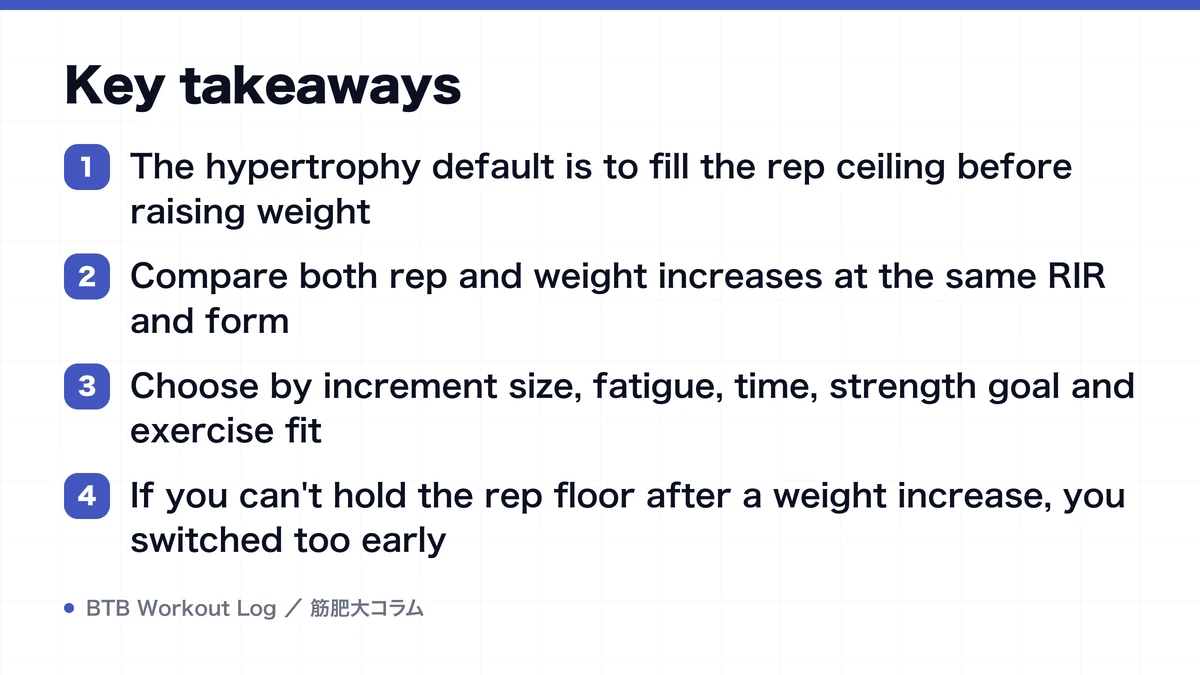
Key takeaways
- The hypertrophy default is to fill the rep ceiling before raising weight
- Compare both rep and weight increases at the same RIR and form
- Choose by increment size, fatigue, time, strength goal and exercise fit
- If you can't hold the rep floor after a weight increase, you switched too early