2 vs 5 Minutes of Rest for Hypertrophy: Is Longer Really Worse?
If you can hold load, reps and form at 2 minutes, you don't need to wait a full 5 minutes every time for hypertrophy's sake. Conversely, if next-set quality clearly drops at 2 minutes on a heavy compound lift, extending to 5 minutes is worth it.
What to compare isn't rest time alone — it's the quality reps you banked afterward and the total time the session cost. Rather than standardizing on one length across every exercise, vary rest by how long it actually takes your output to recover.
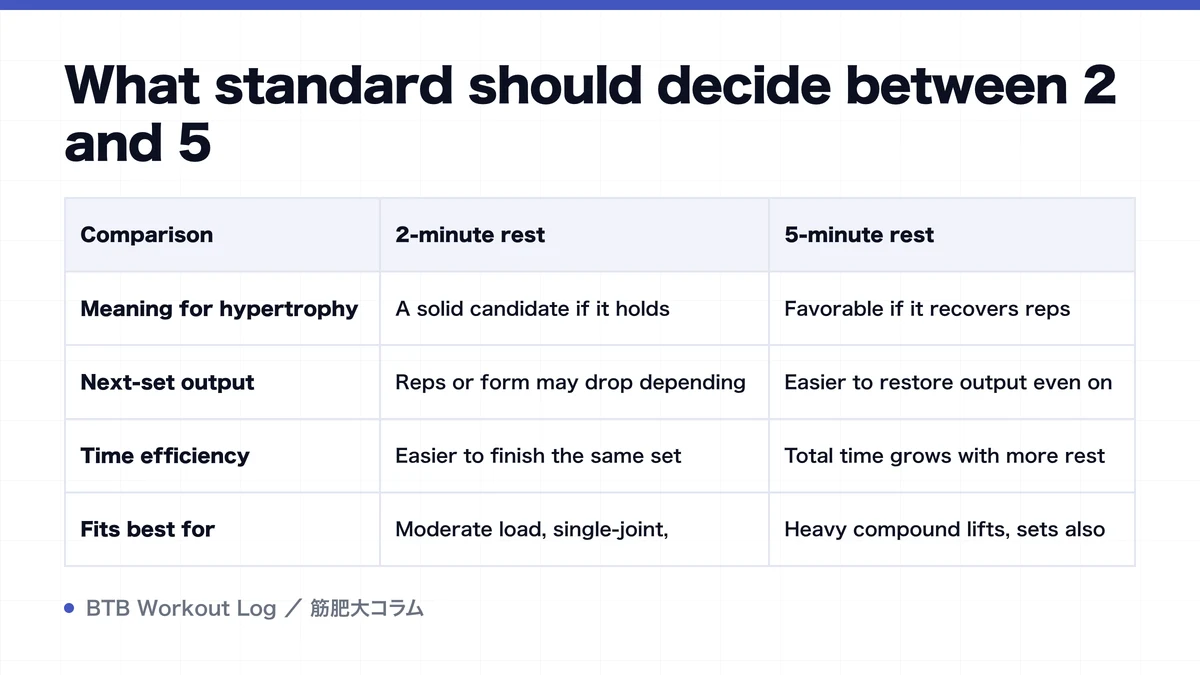
What standard should decide between 2 and 5 minutes?
Comparing rest for hypertrophy purposes can't be settled by "longer means more recovery" or "shorter is harder" alone. The standard that matters is whether you can bank high-quality hard sets on the target muscle, sustained week after week. A hard set here holds the intended range of motion, with RIR — how many more reps you had left — roughly in the 1–3 range. See the RIR guide for how to handle RIR in detail.
| Comparison | 2-minute rest | 5-minute rest |
|---|---|---|
| Meaning for hypertrophy | A solid candidate if it holds needed set quality | Favorable if it recovers reps otherwise lost to insufficient rest |
| Next-set output | Reps or form may drop depending on the exercise | Easier to restore output even on heavy lifts |
| Time efficiency | Easier to finish the same set count faster | Total time grows with more rest periods |
| Fits best for | Moderate load, single-joint, machine, accessory work | Heavy compound lifts, sets also targeting strength |
So the question to compare isn't "does 5 minutes give full recovery", but does the extra 3 minutes add valid reps that day or long-term progress. If it doesn't, 2 minutes wins on time efficiency; if it does, the wait at 5 minutes isn't wasted.
Research doesn't show that 5 minutes grows more than 2
The study most often cited on rest time — Schoenfeld et al. — compared trained lifters resting 1 or 3 minutes over 8 weeks of training. The 3-minute group favored strength and some muscle thickness measures. This shows that resting sufficiently can be more favorable than cutting rest short enough to lose next-set workload.
But this study can't be taken directly as evidence that "5 minutes grows more than 2". What was compared was 1 versus 3 minutes, not 2 versus 5. Nor was the thickness difference uniform across every measurement site. It's an average result from one study of trained lifters, and needed rest per exercise, plus individual variation, still remain.
ACSM's guidelines don't treat rest as one-size-fits-all either — they suggest 1–2 minutes for typical hypertrophy-oriented load, while suggesting 3–5 minutes for strength training emphasizing high load. That's an organization where rest shifts with goal and load. Starting from the existing rest-interval guidelines, this 2-vs-5 comparison ultimately needs to be decided by actual set output.
Can 5 minutes recover what 2 minutes loses?
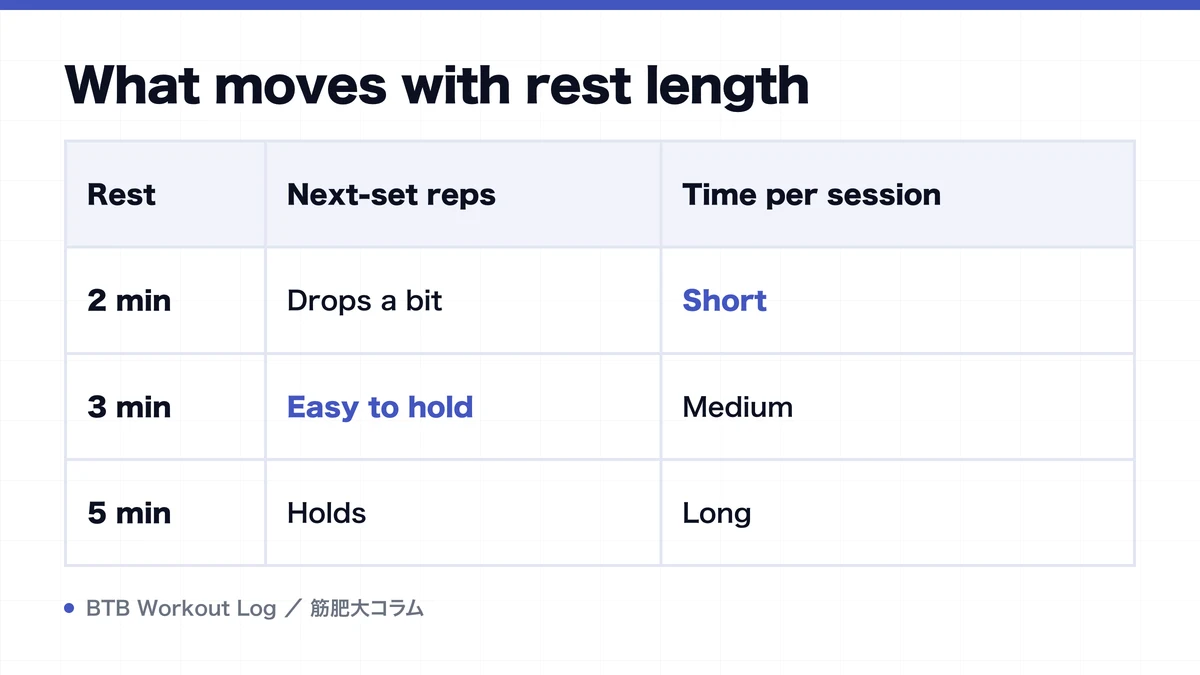
Extending from 2 to 5 minutes matters when the recovery genuinely improves next-set work. If the same weight lets you do 10 reps on set one, drops to 6 after 2 minutes, but comes back to around 9 after 5, the extra rest is helping preserve valid reps. Conversely, if 2 minutes already lets you finish the next set with the same form and intended RIR, waiting 5 doesn't automatically add more hypertrophy stimulus.
Check what limited you, not just the rep count
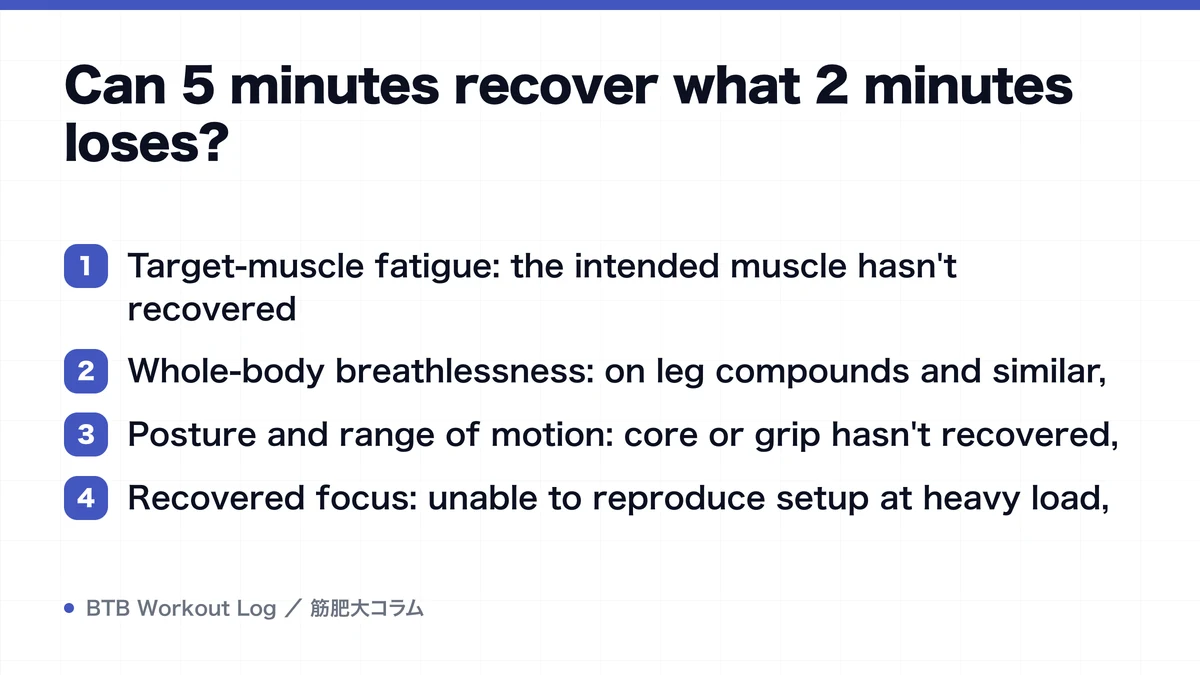
- Target-muscle fatigue: the intended muscle hasn't recovered and can't sustain the same movement.
- Whole-body breathlessness: on leg compounds and similar, breathing limits before the muscle does.
- Posture and range of motion: core or grip hasn't recovered, narrowing range of motion rep after rep.
- Recovered focus: unable to reproduce setup at heavy load, increasing technical variance.
8 reps done with form cut short from insufficient rest isn't the same as 8 reps done with full range of motion after sufficient rest. On the other hand, extending rest sometimes doesn't change output at all if local fatigue in the target muscle remains regardless. What matters is comparing training volume including its content, not just the set count on paper.
The cost of 5-minute rest shows up in total time, not just 3 extra minutes once
The weakness of 5-minute rest isn't hypertrophy effectiveness — it's that it can squeeze the session. A 3-set exercise has 2 rest periods between sets. Do 4 exercises at 3 sets each, and that's 8 rest periods — switching from 2 to 5 minutes adds a straightforward 24 minutes. Including setup and moving between exercises, that can force other costs too — cutting planned accessory work, rushing the back half, or reducing how often you can make it to the gym.
But if shortening to 2 minutes causes reps to drop enough that you need to add sets back, that's not necessarily faster either. Compare total time by how long it takes to complete your intended-quality sets, not by "one rest period". On a time-constrained day, resting longer only on your main lift and keeping 2 minutes for accessory work is more sensible than treating every exercise the same.
If you want to shorten things further, alternating exercises that don't rest the same muscle is one option. But supersets have their own fatigue and equipment-availability conditions — see the comparison against straight sets and check you aren't quietly cutting rest through this route instead.
Default to 2 minutes, and extend only the sets that need 5
In practice, you don't need to standardize your whole routine on either 2 or 5 minutes. Defaulting to 2 minutes and extending to 3–5 only for the sets whose output doesn't recover makes it easier to manage both time and quality.
Situations that favor 5 minutes
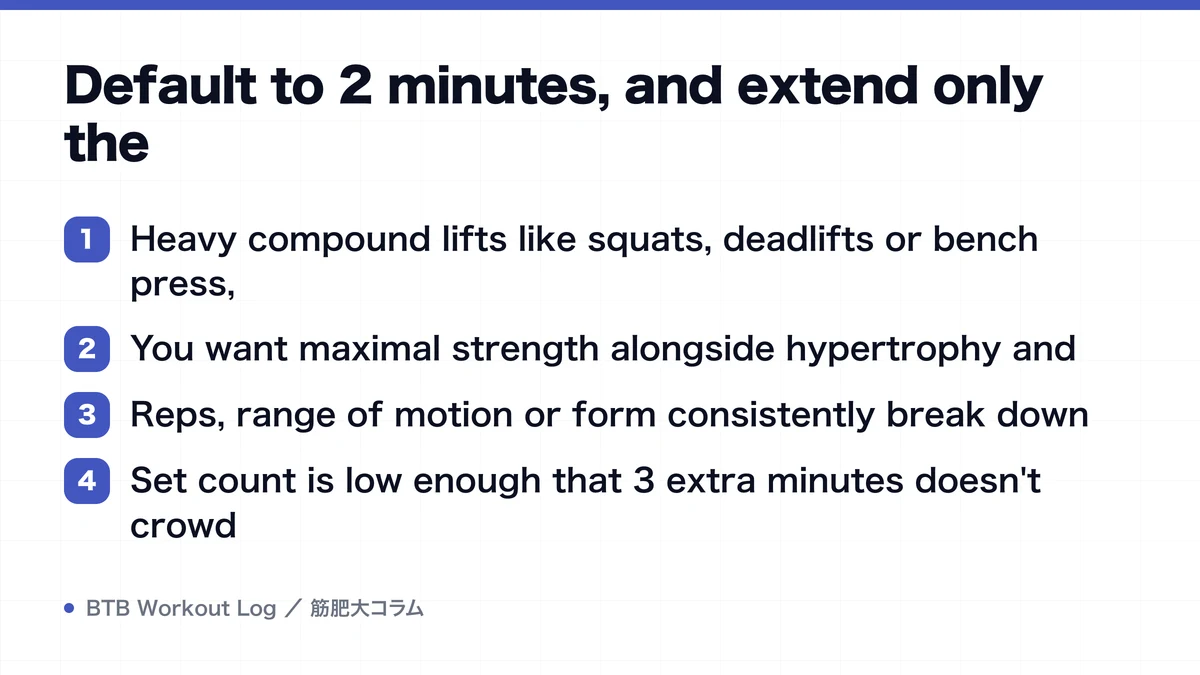
- Heavy compound lifts like squats, deadlifts or bench press, done at low-to-moderate reps.
- You want maximal strength alongside hypertrophy and prioritize reproducing load and technique each set.
- Reps, range of motion or form consistently break down significantly at 2 minutes.
- Set count is low enough that 3 extra minutes doesn't crowd the whole session.
Situations that favor 2 minutes
- Machines or single-joint exercises, where local output reproduces fine even at 2 minutes.
- Performed at moderate-to-high reps, with breathing or setup not limiting the next set.
- Extending to 5 minutes changes neither reps nor form — only adds wait time.
- Securing your needed weekly sets within limited time is the priority.
The same person can reasonably rest 5 minutes on squats and 2 on leg curls. Recovery speed can also shift with a poor sleep night, a cutting phase, a hot environment, or later in a session. A fixed timer improves reproducibility, but there's no need to protect that number at the cost of set quality.
Check which rest length favors you across 4 sessions
Deciding by feel alone just compares the impressions "5 minutes felt easy" against "2 minutes felt brutal". Match conditions and log output plus time to decide instead.
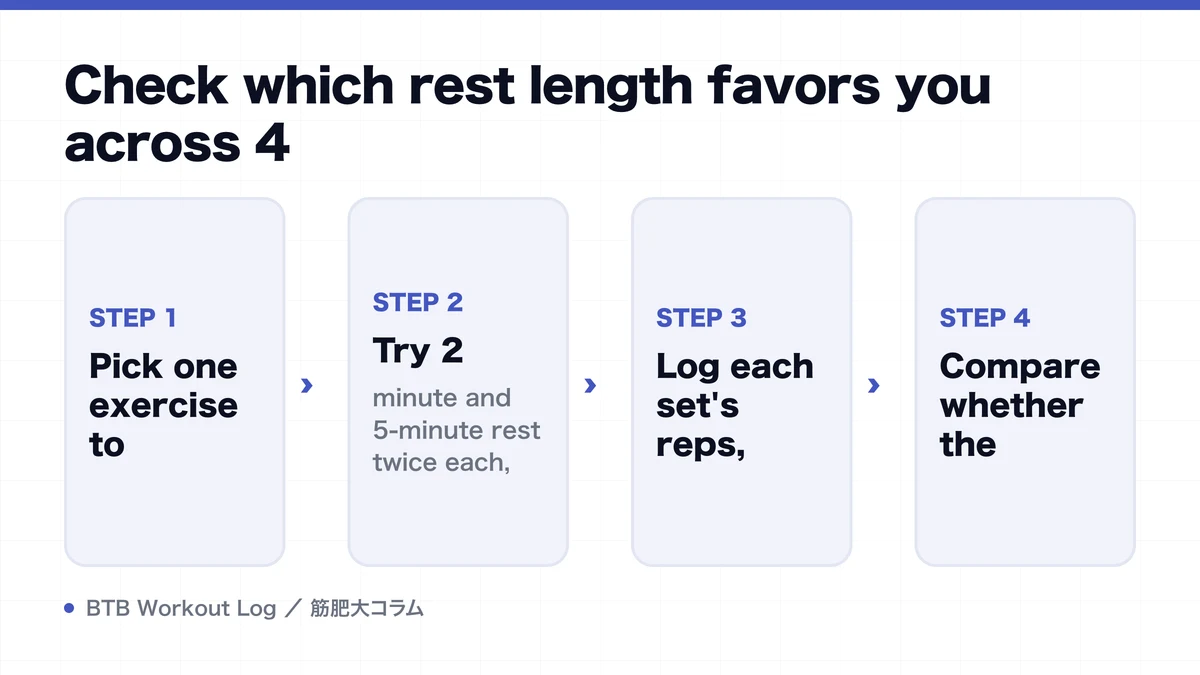
- Pick one exercise to compare, and fix load, sets, rep range, target RIR and exercise order.
- Try 2-minute and 5-minute rest twice each, on similar days of the week or under similar condition.
- Log each set's reps, the last set's form, and total time taken.
- Compare whether the extra 3 minutes' improvement in reps or technique reproduces, including its effect on later exercises.
If 2 minutes still lets you proceed as planned and sustain progressive overload, adopt 2 minutes. If only 5 minutes prevents output decline, extend rest for that exercise specifically. If the difference is unclear, 3 minutes as a middle ground is an option too — you don't need to lock yourself into a binary choice from the start.
What produces hypertrophy isn't the rest timer — it's the training that follows. Treat rest as an adjustable variable for reproducing high-quality sets.
FAQ
- Does resting 5 minutes weaken the stimulus to the muscle?
- It's unlikely that resting longer alone weakens hypertrophy stimulus. If 5 minutes lets you hold load, reps and range of motion, it can benefit set quality. But on exercises where 2 minutes already lets you do the same work, the extra 3 minutes shows up as a time cost rather than an effectiveness gain.
- Can I standardize every exercise to 2-minute rest?
- That's fine for exercises where 2 minutes lets you hold next-set reps and form. If heavy squats or deadlifts leave lingering breathlessness or technical decline, extend to 3–5 minutes. Prioritize reproducing output per exercise over the convenience of one uniform number.
- What should I log to find out whether 2 or 5 minutes suits me?
- Log reps per set, whether range of motion and form held, and session time, at the same load, set count and target RIR. Extend rest only for the exercises where 5 minutes repeatedly shows improvement, and default to 2 minutes elsewhere — that balances hypertrophy and time efficiency.
Key takeaways
- No need to extend to 5 minutes if 2 already holds set quality
- The core research compares 1 vs. 3 minutes, not a direct 2-vs-5 test
- 5 minutes for heavy compound lifts, 2 minutes for accessory work, as a starting split
- Compare the output the extra 3 minutes buys against total session time
- Log load, reps and form reproducibility to decide by exercise