PPL vs Upper/Lower Split: Which Is Right for Your Hypertrophy Goals?
Four days a week points to upper/lower; six shorter sessions point to PPL. With weekly volume and per-set effort matched, the name of the split doesn't decide hypertrophy.
What separates them is whether you can complete the required sets at high output, and whether you can run it week after week around your life. Match the terms and the right side for you becomes visible.
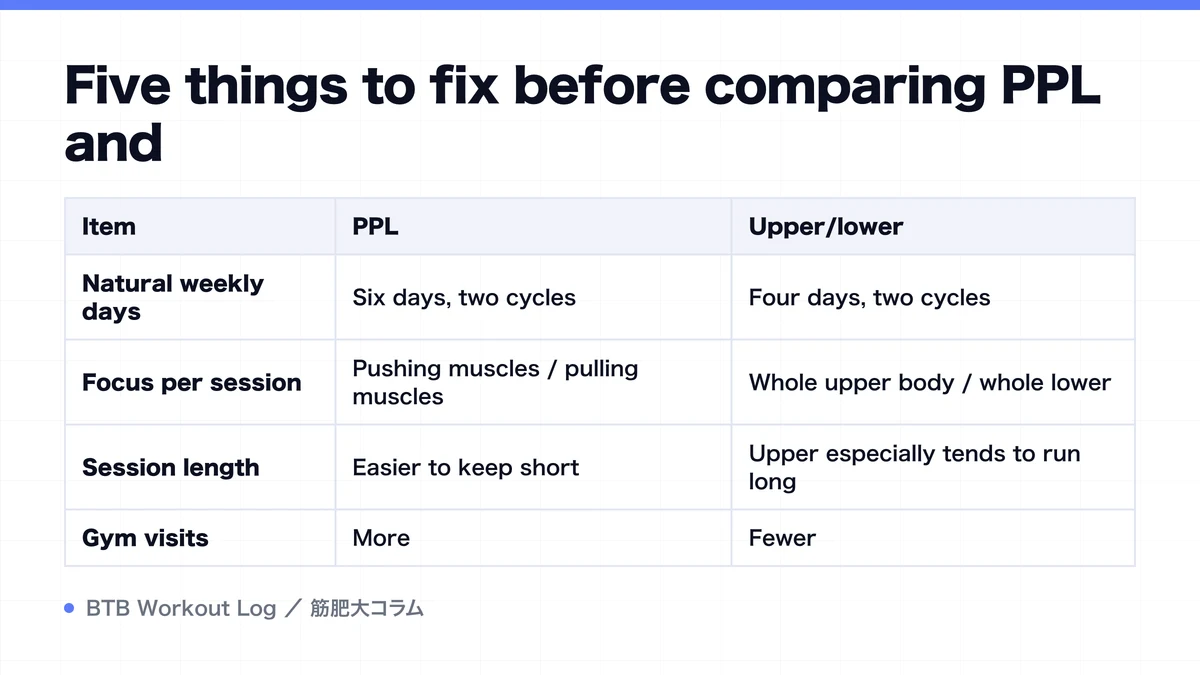
Five things to fix before comparing PPL and upper/lower
PPL is a three-way split: Push (chest, shoulders, triceps), Pull (back, biceps) and Legs. Upper/lower alternates two sessions. They feel different, but both are just containers for distributing weekly volume across days.
To compare fairly, fix at least these five.
- Weekly hard sets per muscle group: the weekly total of sets where the target does the work and you reach your intended RIR
- Effort: keep target RIR (reps left in reserve) similar on both
- Exercises and range of motion: don't give one side more exercises or a wider range
- Progression: advance load, reps or sets over a block on both
- Adherence: the share of planned sessions you actually completed
Ignore those and comparing "six-day PPL" with "four-day upper/lower" measures frequency and volume, not the split. Start by confirming both designs deliver comparable effective work to the same muscles.
| Item | PPL | Upper/lower |
|---|---|---|
| Natural weekly days | Six days, two cycles | Four days, two cycles |
| Focus per session | Pushing muscles / pulling muscles / legs | Whole upper body / whole lower body |
| Session length | Easier to keep short | Upper especially tends to run long |
| Gym visits | More | Fewer |
| Effect of missing one | On fixed days, a whole pattern can drop out | Easy to roll forward |
Hypertrophy follows weekly volume, not the split's name
No study pitting PPL directly against upper/lower shows one consistently ahead. What the adjacent research does support is that with weekly volume equated, changing how often a muscle is trained produces little average difference in hypertrophy. Recent meta-regressions suggest a small independent effect of frequency, while weekly sets show a dose-response relationship with growth.
So twelve chest sets across Monday and Thursday on six-day PPL, versus twelve across Tuesday and Friday on four-day upper/lower, is unlikely to differ much if exercises, RIR, range of motion and progression are similar. Treat frequency not as an independent magic variable but as the one that divides required volume into units where quality holds. The research is unpacked in training frequency, and set counting in weekly sets.
But "same volume" has to be true in practice, not just on paper. If reps for shoulders and arms collapse late in every Upper session, those sets aren't equivalent to the same sets placed on a separate PPL day. Conversely, missing six-day PPL a few times a month means your executed volume falls below upper/lower even if the plan said otherwise. What suits hypertrophy isn't the side that can theoretically hold more — it's the side where you accumulate effective sets at a high completion rate.
PPL spreads fatigue; upper/lower saves trips
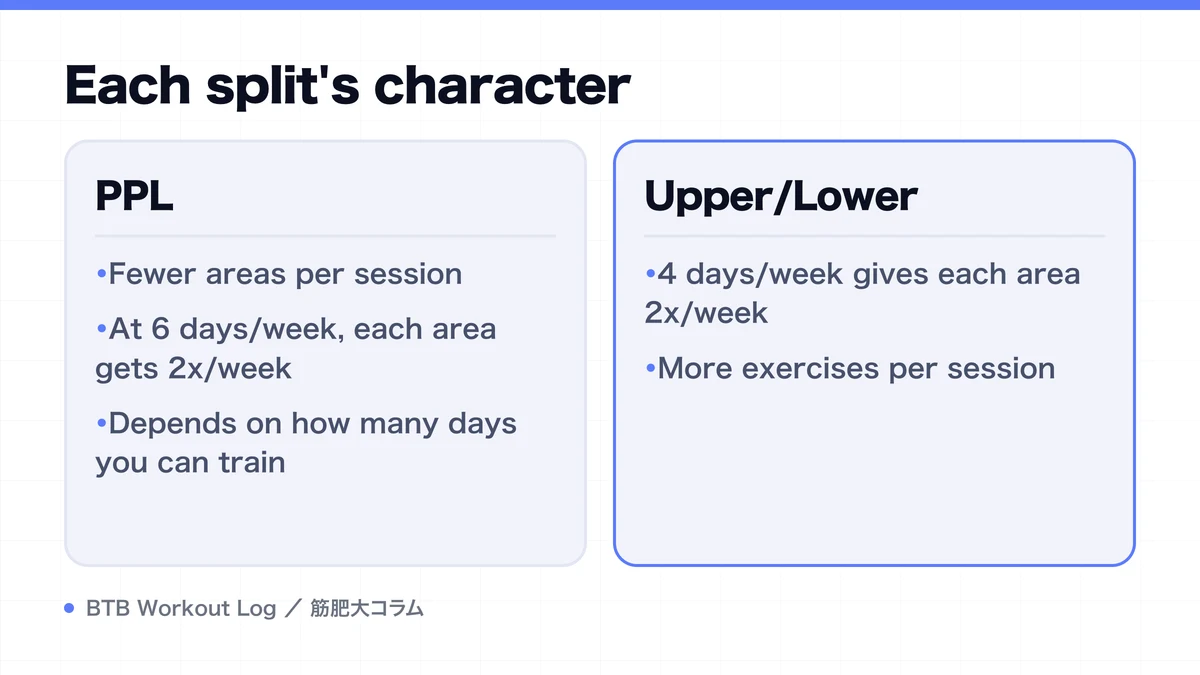
PPL's advantage is splitting upper-body work into Push and Pull. Chest pressing, shoulders and triceps go one day, back and biceps another, which keeps the exercise count per session down. If doing presses, rows and arms in one Upper session leaves your later exercises buried in local fatigue, PPL will hold output better.
PPL has its own overlaps, though. Shoulder press and triceps work after bench press use the same pushing muscles, so the back half isn't automatically high quality. Cram quads, hamstrings, glutes and calves into Legs and that day runs as long as an upper/lower Lower session. The name doesn't improve recovery — exercise order and per-session set count are what manage local fatigue.
Split time efficiency in two. For time inside the gym per session, PPL tends to be shorter, which suits people who can reliably find 45–60 minutes often. For total weekly commitment including travel, changing and warm-ups, four sessions usually wins. Recommending short PPL sessions to someone who can find 75–100 minutes but not six days won't raise their adherence.
Missed sessions matter too. Skip Pull on a fixed-day PPL and back can go a long time before its next stimulus. Rolling forward from the missed day reduces the imbalance but decouples the plan from weekdays. Upper/lower needs fewer days and rolls forward trivially. The more your schedule moves, the more weight resilience and easy recovery from a miss deserve.
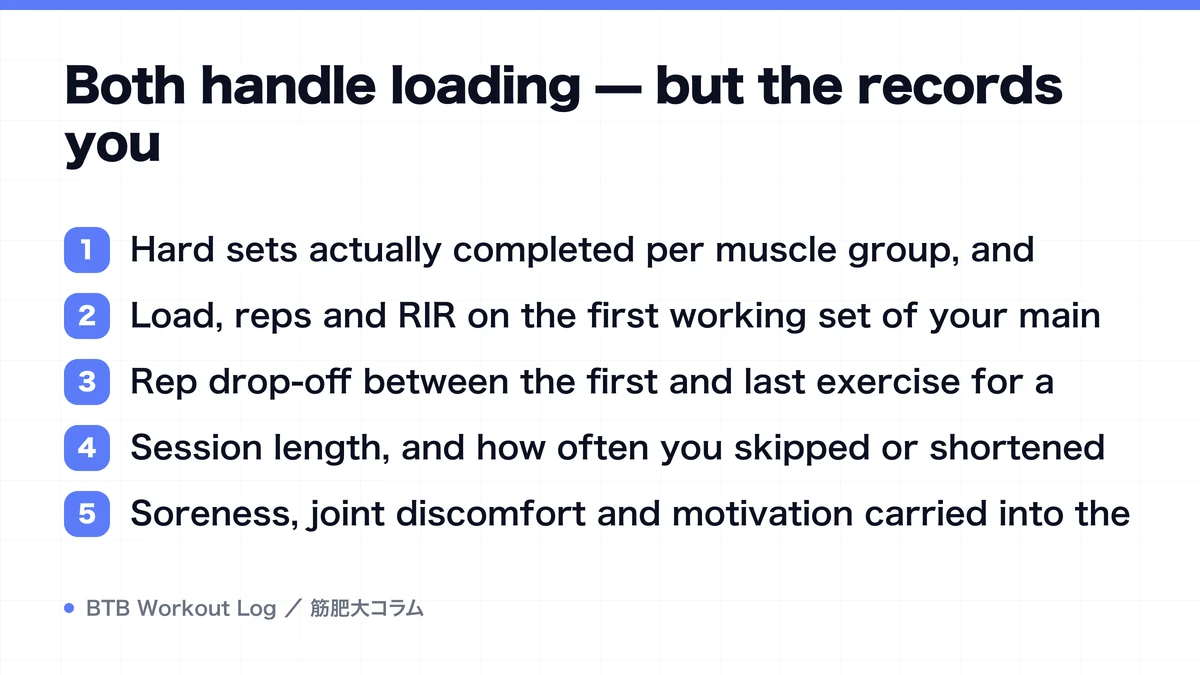
Both handle loading — but the records you watch differ
Neither has an inherent edge in how freely you can set loads and rep ranges. PPL lets you press heavy in the first cycle and use moderate-to-high reps in the second. Upper/lower lets you make Upper A heavier and Upper B volume-focused, and swap squat and hinge priority between Lower A and B. Both let you practise the same lift twice a week while spreading stimulus and joint load.
The difference shows in operational data. Track these per split for at least four to six weeks.
- Hard sets actually completed per muscle group, and plan-completion rate
- Load, reps and RIR on the first working set of your main lifts
- Rep drop-off between the first and last exercise for a muscle group
- Session length, and how often you skipped or shortened sessions
- Soreness, joint discomfort and motivation carried into the next session
If only lateral raises and curls at the end of Upper have stalled while your main press and row climb, reorder before switching the whole programme to PPL. If output for the target keeps falling even after reordering, that's a real case for splitting into Push and Pull. And if PPL isn't producing, check your six-day attendance rate and per-muscle totals before counting the extra days as an achievement in themselves.
No app picks your split. Use one to compare output and adherence before and after the change.
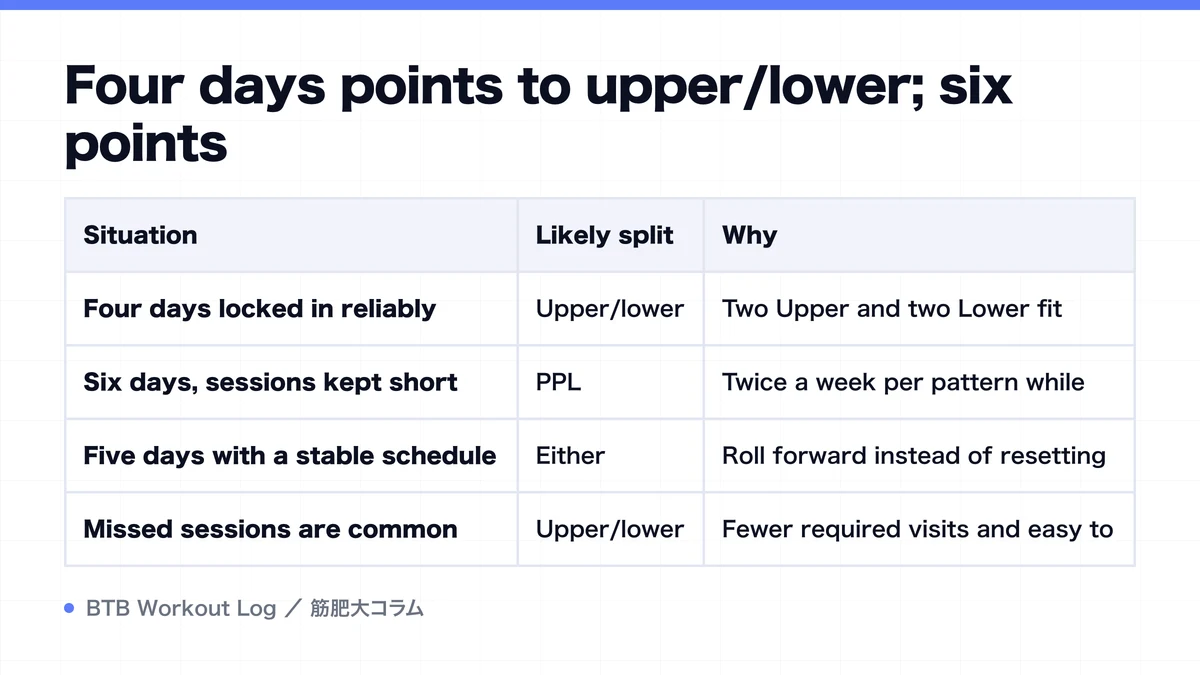
Four days points to upper/lower; six points to PPL
| Situation | Likely split | Why |
|---|---|---|
| Four days locked in reliably | Upper/lower | Two Upper and two Lower fit comfortably |
| Six days, sessions kept short | PPL | Twice a week per pattern while spreading upper-body work |
| Five days with a stable schedule | Either | Roll forward instead of resetting weekly, or mix PPL with Upper/Lower |
| Missed sessions are common | Upper/lower | Fewer required visits and easy to rebalance by rolling forward |
| Upper runs long and fades late | PPL | Splitting Push and Pull cuts upper-body exercises per session |
Neither is natural at three days. Fixed three-day PPL means once a week per pattern. Upper/lower rolled as Upper–Lower–Upper then Lower–Upper–Lower averages 1.5 sessions per side, though weekly imbalance remains. If three days is your constraint, bring full body versus a split at three days into the comparison.
At four days, start from upper/lower and check whether Upper runs too long. At six, start from PPL and check that missed sessions and joint fatigue don't creep up. At five, you don't have to reset every Monday — rolling PPL or Upper/Lower forward works fine. Nothing requires the same sequence to fit inside seven days.
Once you've chosen, run it four to six weeks without moving weekly set counts much. Main lifts climbing, late-set drop-off within tolerance and most sessions completed means the split is working. Overrunning, missing sessions or persistent output decline in one muscle group means it's time to switch. Deciding PPL versus upper/lower on the effective work you actually banked is more reproducible than deciding it in the abstract.
FAQ
- Is there a hypertrophy difference between PPL and upper/lower?
- Match weekly hard sets per muscle group, RIR, exercises, range of motion and progression and a large difference from the split name alone is unlikely. In practice six-day PPL and four-day upper/lower differ in adherence and late-session output, so choose the side where you sustain quality volume.
- At five days a week, PPL or upper/lower?
- Both work. Roll PPL forward instead of resetting on weekdays, or combine three PPL days with an Upper and a Lower day. Count the gap and weekly sets for each muscle group and avoid placing high-fatigue days for the same area back to back.
- If my Upper session is too long, should I switch to PPL?
- Not immediately. First try moving priority exercises earlier, shifting direct arm work to another day, and cutting overlapping exercises. If late-session rep loss and overruns persist, splitting the upper body into Push and Pull is the reasonable next step.
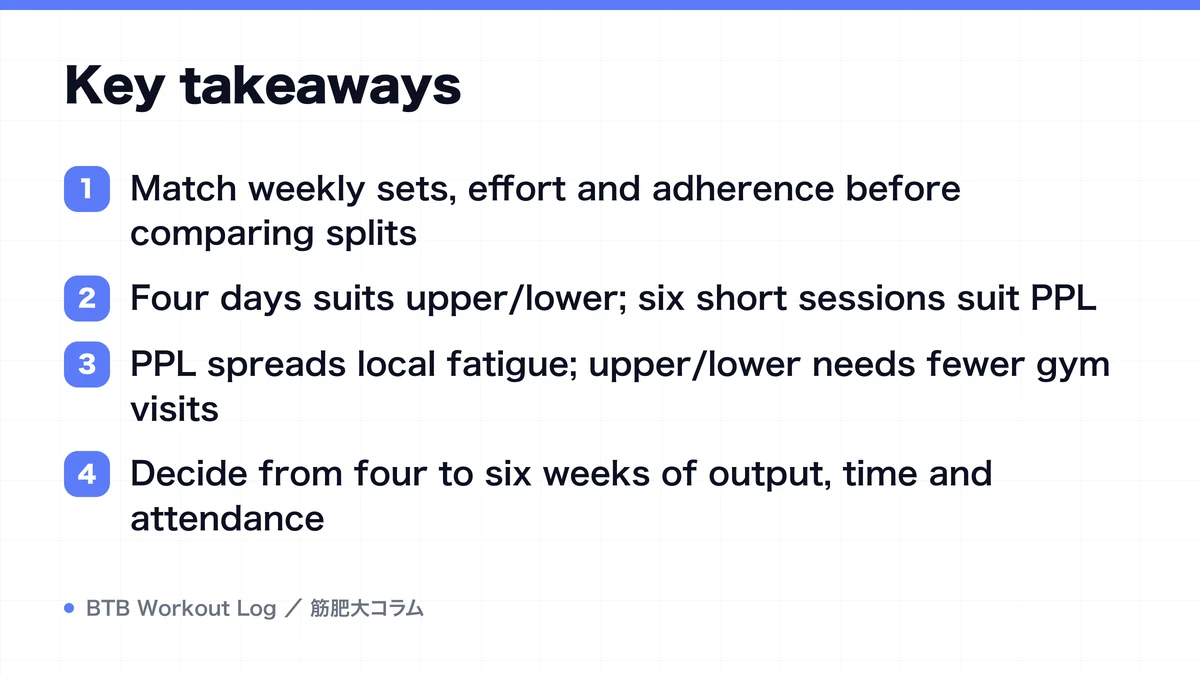
Key takeaways
- Match weekly sets, effort and adherence before comparing splits
- Four days suits upper/lower; six short sessions suit PPL
- PPL spreads local fatigue; upper/lower needs fewer gym visits
- Decide from four to six weeks of output, time and attendance
References
- Resistance Training Frequency and Muscle Hypertrophy: Systematic Review and Meta-analysis
- The Resistance Training Dose Response: Meta-Regressions Exploring the Effects of Weekly Volume and Frequency on Muscle Hypertrophy and Strength Gains
- Dose-response Relationship Between Weekly Resistance Training Volume and Muscle Mass