Barbell Row vs. Seated Cable Row: Which Builds More Back Hypertrophy?
For back hypertrophy alone, there's no universal winner between barbell row and seated row. Choose on these four: banking sufficient back stimulus, lower-back fatigue, form reproducibility, and ease of progressing load.
Barbell row is a strong option if you also want to build whole-body-stabilized pulling strength; seated row is strong if you want to concentrate fatigue on the back movement itself. Seated row here means a cable version where feet rest on a footplate without large torso swing.
Decide the standard first: back stimulus divided by fatigue
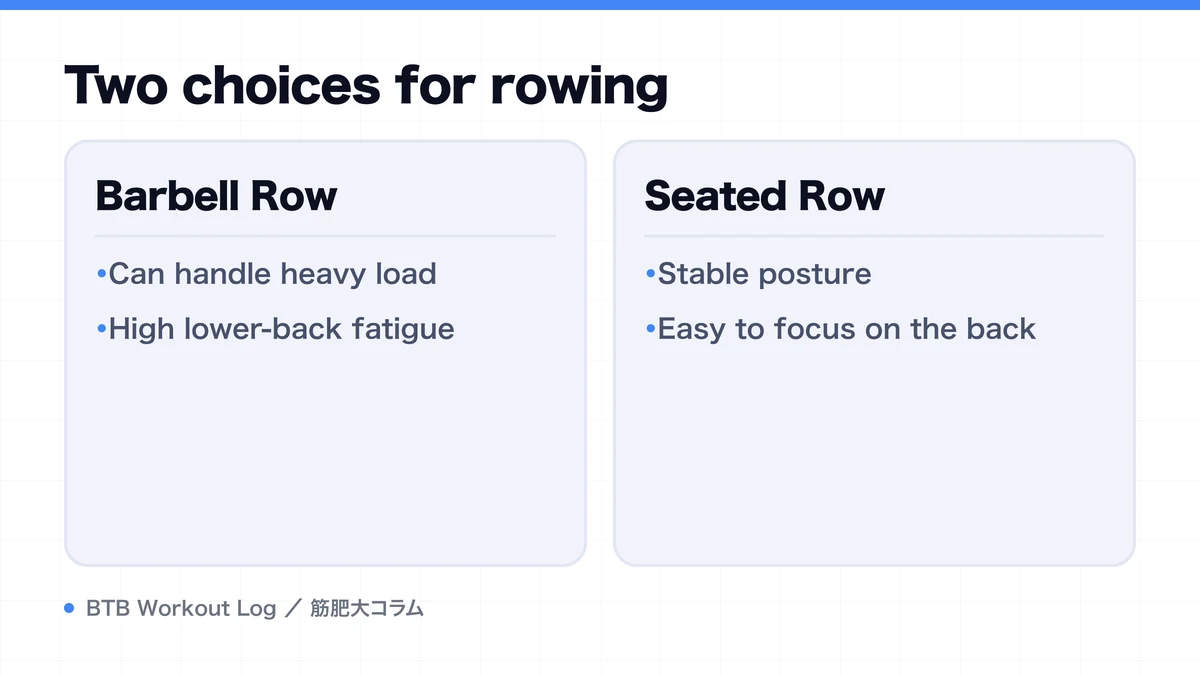
Even as the same horizontal pull, the two exercises demand different work. Barbell row holds a hip-hinge position, pulling the bar while spinal erectors, glutes and hamstrings support the torso. Seated row lets you fix your feet while seated, lowering demand on the lower body and lower back, making it easier to focus on shoulder-joint and shoulder-blade movement.
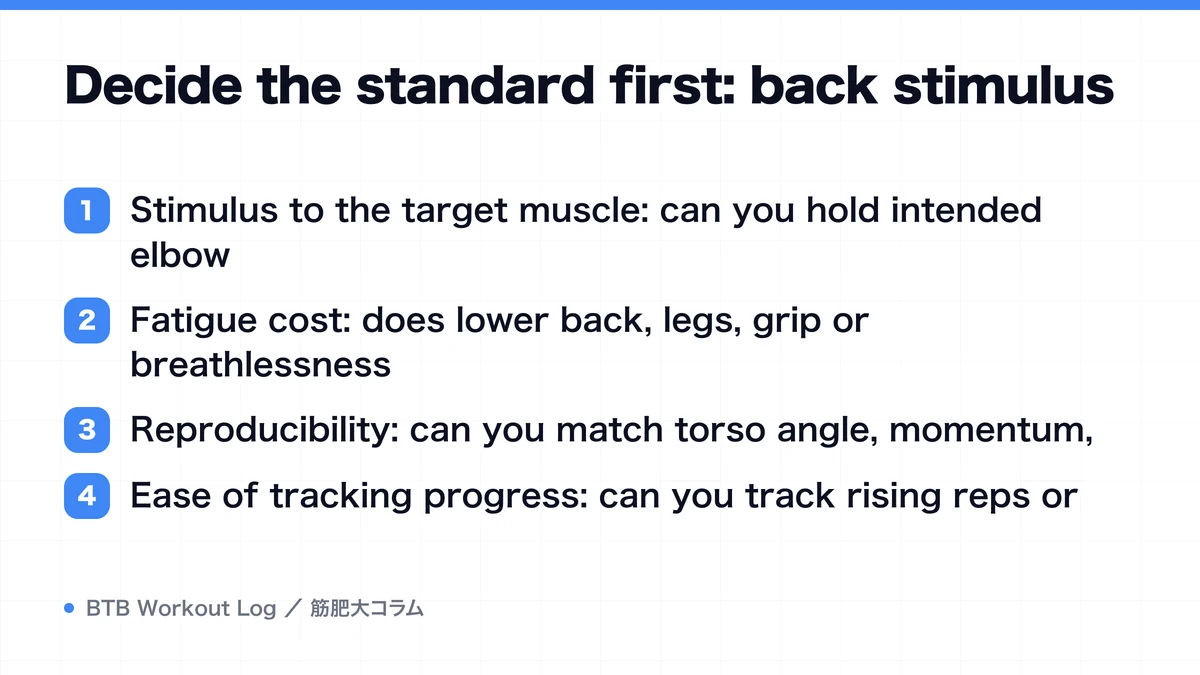
When comparing, watch these four rather than how much weight was handled.
- Stimulus to the target muscle: can you hold intended elbow path and range of motion all the way to the end?
- Fatigue cost: does lower back, legs, grip or breathlessness limit before local back fatigue does?
- Reproducibility: can you match torso angle, momentum, handle, and range of motion every time?
- Ease of tracking progress: can you track rising reps or load under matched conditions?
This is a narrower question than the general free-weight-vs-machine comparison. For rows, the choice comes down to how many valid back reps you can bank, and how much whole-body fatigue you pay for it.
Hypertrophy effect is decided by elbow path and set quality, not exercise name
There isn't sufficient evidence directly comparing long-term hypertrophy between barbell row and seated row under matched conditions. Across resistance training generally, given appropriate frequency, intensity and volume, hypertrophy occurs across several resistance modalities, and no single modality is consistently superior. So a judgment based purely on equipment name — "barbell for thickness," "cable for contraction" — is too coarse.
Where load lands on the back can be organized more by where you pull your elbow toward than by grip. Keeping the elbow close to the torso and pulling toward the hip increases shoulder extension, making it easier to target the lats. Flaring the elbow slightly out and pulling toward the lower chest increases scapular retraction, distributing more to the mid-traps, rhomboids and rear delts. Since the path is adjustable on either piece of equipment, exercise name alone doesn't fix the target muscle.
Studies examining back muscle activity also show differences by exercise variation. But activity is measured during a single bout — it doesn't by itself rank hypertrophy months later. In practice, evaluate whichever holds intended path while matching RIR (how many more reps were possible), and lets the back become the limiting factor. Don't disqualify an exercise purely for weak contraction feel — combine with criteria for evaluating the back beyond sensation too.
Seated row tends to be more stable on fatigue cost and time efficiency
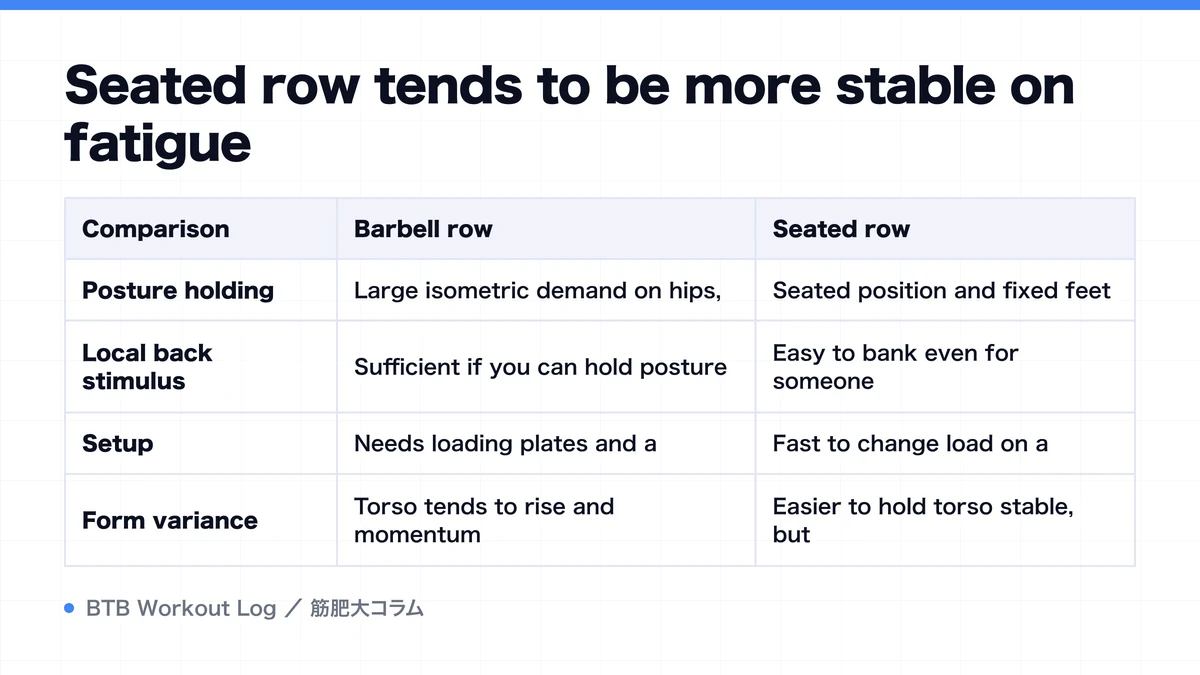
| Comparison | Barbell row | Seated row |
|---|---|---|
| Posture holding | Large isometric demand on hips, lower back, legs | Seated position and fixed feet lower the demand |
| Local back stimulus | Sufficient if you can hold posture | Easy to bank even for someone whose lower back tires first |
| Setup | Needs loading plates and a gradual warm-up | Fast to change load on a pin-loaded machine |
| Form variance | Torso tends to rise and momentum increases with fatigue | Easier to hold torso stable, but varies if you lean back |
| Whole-body role | Trains the horizontal pull and posture-holding together | Easier to narrow the role to the horizontal pull alone |
Seated row's advantage isn't "it's easier, so it doesn't work" — it's that it reduces limiters other than the target muscle. In a week when your lower back is already fatigued from deadlifts, Romanian deadlifts or squats, adding barbell row can cause posture holding to break down before the back does. In that case, seated row makes it easier to complete your planned weekly hard sets without a quality drop.
Barbell row's whole-body nature isn't purely a downside, though. If holding a hinge position and controlling free weight with your whole body is also a goal, one exercise fills several roles. Judge time efficiency including not just "is one set fast" but the value of skipping setup time and other exercises too.
Don't compare displayed weight — track progress within each exercise
Comparing "barbell is 80kg, cable is 60kg, so barbell wins" is meaningless. Cable machines differ in pulley ratio, friction and stack increment by equipment, so displayed weight means something different from barbell. What to compare is the progress each one sustains under matched conditions over time.
On barbell row, fix torso angle, bar height off the floor, momentum, and where the bar touches, alongside weight and reps. If only weight rises while your torso stands more upright and range of motion shortens, it's hard to call that progressive overload for the back. On seated row, match machine, seat, handle, grip width, starting scapula position, and how much you lean back. If the stack increment is large, building reps first at the same weight works.
Splitting rep range — low-to-moderate for barbell, moderate-to-high for seated — makes roles easier to define, but it isn't a fixed rule. Sufficiently effortful training works for hypertrophy regardless of load. Adopt whichever lets you hold form, makes the target back muscle the limiter late in the set, and lets reps or load rise over several weeks.
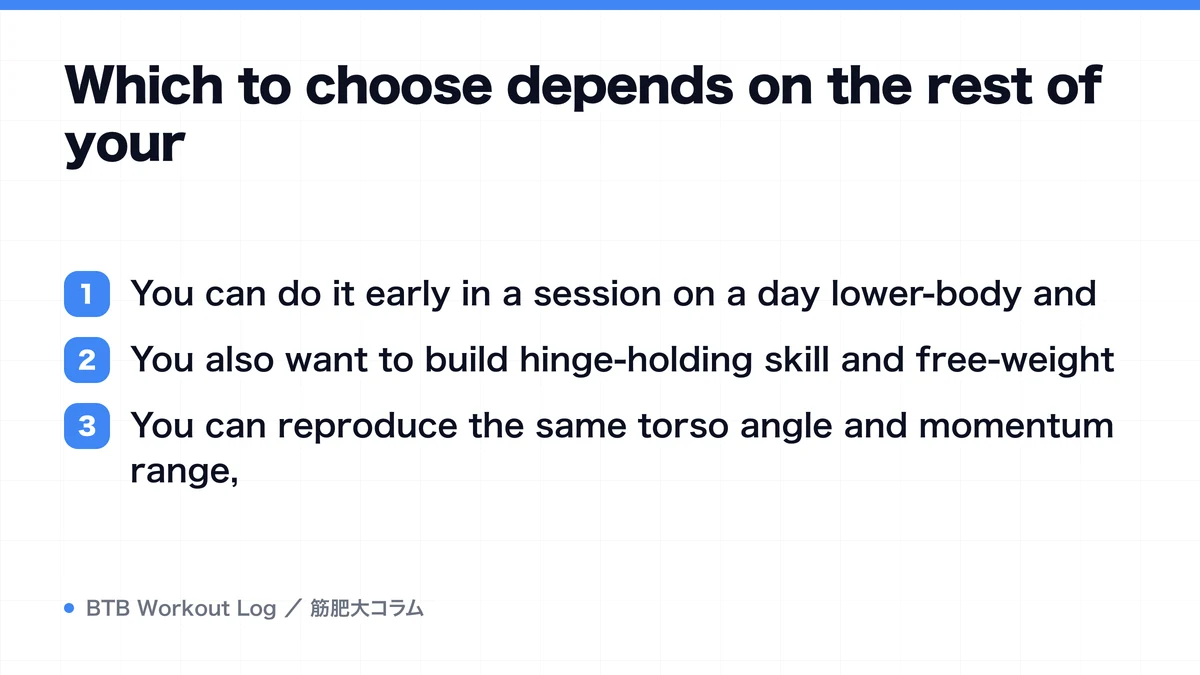
Which to choose depends on the rest of your routine, beyond the back
Situations that favor barbell row as your main lift
- You can do it early in a session on a day lower-body and lower-back fatigue is low.
- You also want to build hinge-holding skill and free-weight handling.
- You can reproduce the same torso angle and momentum range, progressing with small plates.
Situations that favor seated row as your main lift
- You don't want to add lower-back fatigue after hinge exercises or squats.
- Posture-holding or breathlessness ends the set before the back tires.
- You want to vary handle and elbow path to match load to a specific target area.
- You want to change load with minimal setup and bank consistent back sets.
Torso length, hip mobility, lower-back tolerance, and available equipment also shift the answer. If unsure, trial each for 4–6 weeks, matching weekly set count, RIR, rep range, and other back exercises. Then compare whether the target muscle tires first, whether form holds, whether reps or weight rose, and whether you recovered by your next session. This is a test decided by reproducibility across several weeks, not a single pump.
If using both, don't stack the same role — split them across the week
Both being good exercises doesn't mean you need to run them every time with the same path and rep range. Rather than raising sets that overlap in role, make one your main lift and the other a complement. For example, training back twice a week: day 1, barbell row at 6–10 reps for 3 sets; day 2, seated row at 10–15 reps for 3 sets, separated by day to spread fatigue and rep range. Consider the overall design including vertical pulls too, in a back hypertrophy routine.
Conversely, someone with lots of hinge work on leg day can limit horizontal pulls to seated row alone. Dropping barbell row isn't giving up on back stimulus. If seated-row progress stalls and your lower back has room to spare, that's when swapping in barbell row becomes an option.
What to keep as material for judgment: exercise name, equipment or handle used, weight, reps per set, RIR, and any form change.
FAQ
- Does barbell row favor hypertrophy more since I can handle more weight?
- You can't decide from displayed weight alone. It's strong if torso angle and range of motion hold and you can bank reps where the back is the limiter. If momentum or lower-back fatigue ends the set, a lighter but more reproducible seated row may leave more valid load on the back.
- If my lower back tires on barbell row, should I switch to seated row?
- First review weight, torso angle, momentum, and placement relative to hinge exercises. If your lower back still limits before your back does, switching to seated row is reasonable. If there's pain, don't push through it — stop and consult a professional as needed.
- Do I need both barbell row and seated row for a bigger back?
- Not required. Since their role as a horizontal pull overlaps, it's sufficient if one of them banks high-quality sets on your intended back area and keeps progressing. Use both when you want to split fatigue and rep range across twice a week, or to cover a different elbow path.
Key takeaways
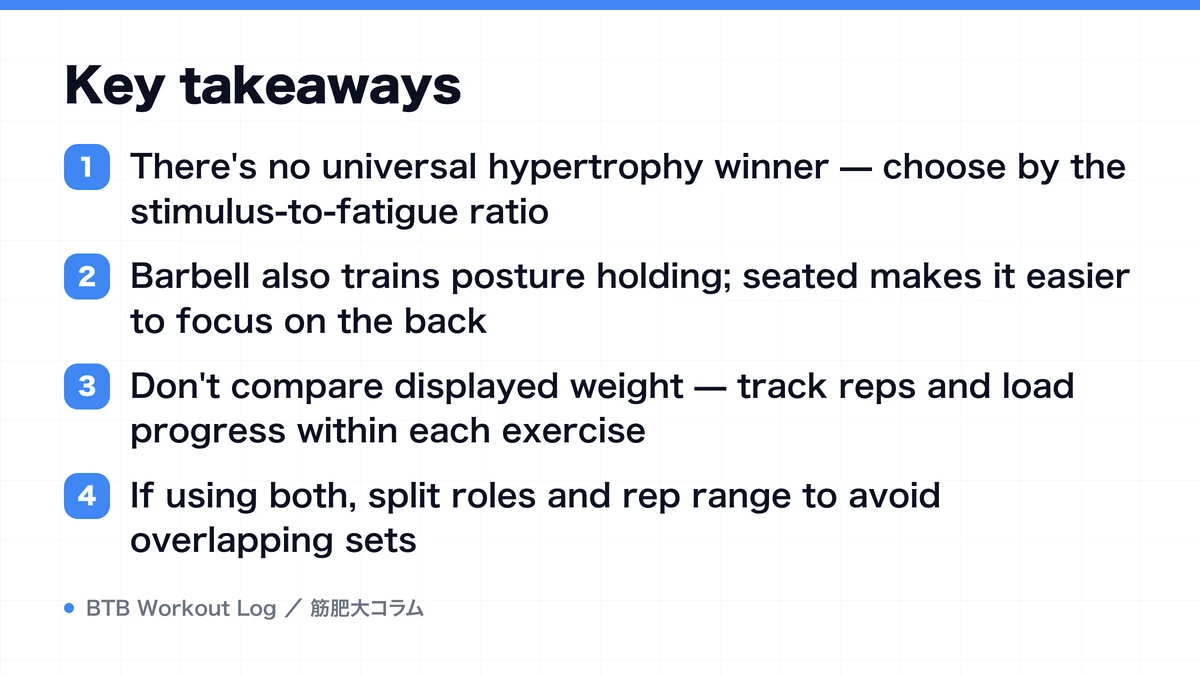
- There's no universal hypertrophy winner — choose by the stimulus-to-fatigue ratio
- Barbell also trains posture holding; seated makes it easier to focus on the back
- Don't compare displayed weight — track reps and load progress within each exercise
- If using both, split roles and rep range to avoid overlapping sets