
Hypertrophy Training Frequency: How Often to Train Each Muscle for Growth and Recovery
For hypertrophy, training each muscle twice a week is a practical starting point for most people. But rather than a fixed number that directly determines growth, it is a design variable for delivering the weekly sets you need at high quality.
Once a week still produces growth when the conditions line up, and some muscles suit three times a week. You choose it not by how many sessions you do, but by weekly total volume, your output on each set, recovery before the next session, and progress over several weeks.
Weekly total volume, not frequency, determines hypertrophy
Frequency here does not mean the number of days you go to the gym, it means how many times you train the same muscle group in a week. Doing 12 chest sets on Monday alone is once a week and 6 sets each on Monday and Thursday is twice a week, but both are 12 weekly sets. When you compare frequencies, you first have to match those weekly sets.
Taken together, the research shows that when total weekly sets and effort are matched, the average difference in hypertrophy from frequency alone is small. So comparing once a week with twice a week is not a question you settle on numbers alone. Once a week works for someone who can complete a smaller number of sets at high quality and keep progressing, while splitting into twice a week suits someone whose load, reps and range of motion drop late in the session when the required volume is crammed into one day.
The benefit of frequency is that it breaks the same total volume into recoverable chunks and makes it easier to hold the quality of each session. Simply adding sessions does not increase the amount of useful work, and if it adds enough scheduling and travel burden it can even reduce adherence. Why higher frequency does not necessarily speed growth up becomes clearer once you separate this "independent effect" from the "distribution effect".
How to read the twice-a-week guide from the research
A 2016 meta-analysis suggested that training each muscle group twice a week may be more favourable than once a week. The number of studies was limited, though, and it included comparisons where weekly volume was not fully matched. Later analyses have settled on the view that once weekly total volume is matched, the independent effect of frequency is small. You can check the background and the limits in our read of the frequency meta-analysis.
One common explanation is that muscle protein synthesis rises after a resistance session and moves back towards baseline somewhere in the 24-72 hour range. Reasoning from that response to twice a week is easy to follow, but the moment synthesis returns to baseline does not by itself determine long-term hypertrophy or the optimal day for the next session. The response changes with training history, the number of sets you did last time, the exercises and nutritional status.
So we do not treat it as "building two synthesis peaks a week is always better" or "a day back at baseline is wasted". Twice a week is a starting setting that combines the average of the research with practical set distribution. From there you use your own log to check whether you can perform the same weekly sets with better output and whether recovery keeps up.
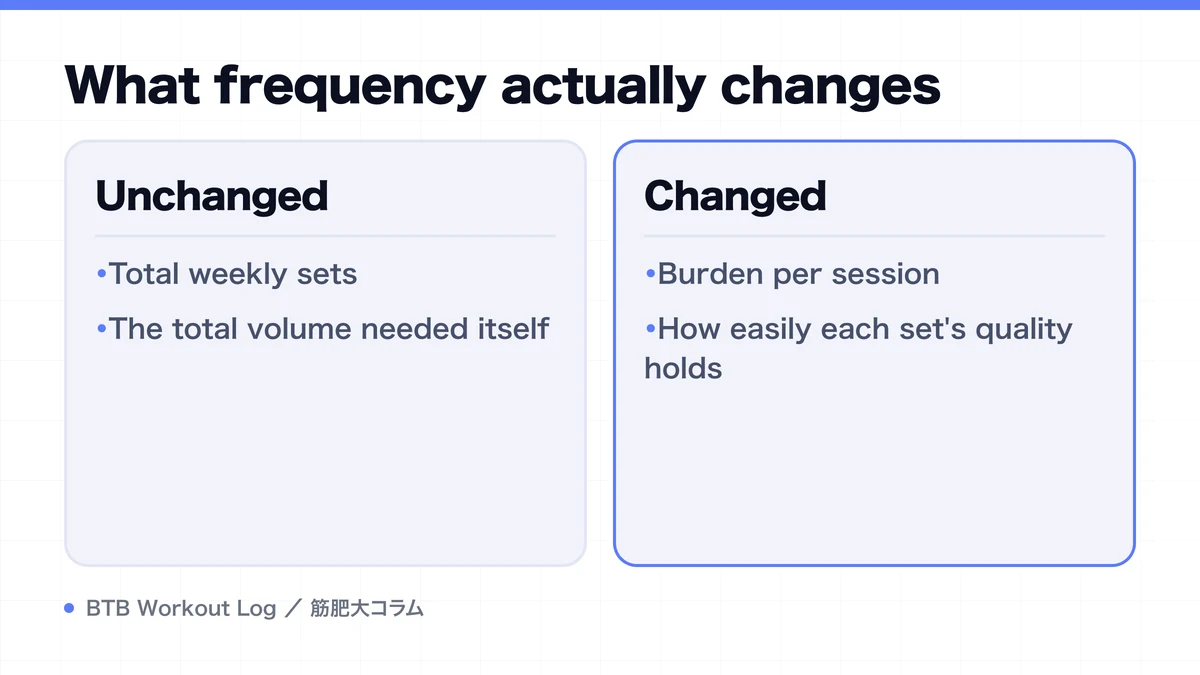
How weekly sets move when you change frequency
There are two ways to raise frequency: holding weekly total volume fixed and redistributing it, and keeping the per-session volume so that weekly total volume rises too. If you mix the two, you cannot pin a change in results on either frequency or volume.
| Change | Chest sets per session | Frequency | Weekly total | What mainly changes |
|---|---|---|---|---|
| Before | 12 | 1x/week | 12 | Baseline |
| Redistribute | 6 | 2x/week | 12 | Per-session fatigue and set quality |
| Add volume too | 12 | 2x/week | 24 | Frequency, total volume and recovery cost |
If this is your first time changing frequency, hold weekly total volume fixed and compare over 2-4 weeks. Spreading the work is worth it if reps fall sharply on the later sets of a session, if you struggle to focus on the target muscle, or if the session runs too long. Conversely, if splitting mostly adds warm-ups and travel and leftover fatigue drags your output down, going back to the previous frequency is an option.
Use weekly sets per muscle as the starting point for your set target, but a range like 10-20 sets is not a fixed prescription. How much you can recover from moves with training history, exercise selection, RIR, indirect loading and sleep. The formula and worked examples are laid out in the relationship between frequency and weekly sets.
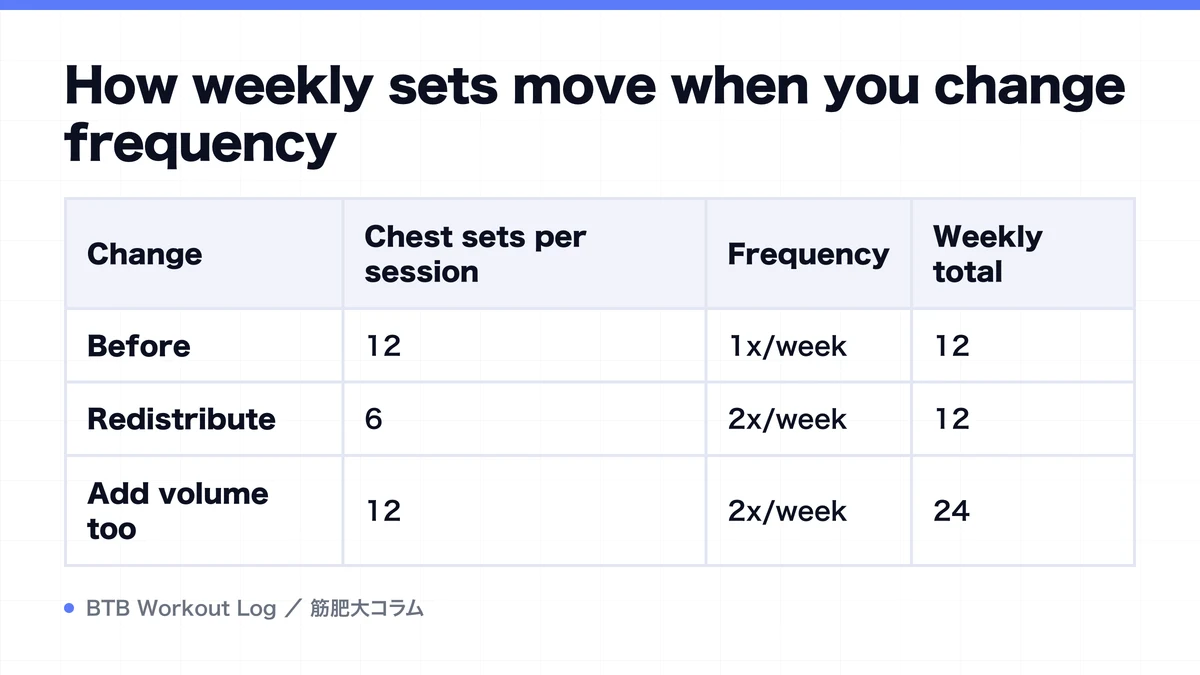
A rough guide to frequency and recovery by muscle group
| Muscle group | Starting frequency | Rough interval | Overlap to check |
|---|---|---|---|
| Chest, back, legs (large muscles) | 2x/week | 48-72 hours | Fatigue from presses, rows and squat patterns |
| Shoulders, arms (small muscles) | 2-3x/week | Start by trying 24-48 hours | Indirect sets from chest and back exercises |
| Abs, calves | 2-3x/week | Adjust based on output | Check symptoms and progress even at high frequency |
This is not a timetable that guarantees full recovery, it is the first layout for building a programme. Chest presses also load the triceps and front delts, and rows and pulldowns also load the biceps. If you only count dedicated shoulder and arm sets, you can underestimate the actual stimulus and the recovery cost.
Even within "legs", the exercises and the fatigue differ between quads, hamstrings, glutes and calves. On top of that, heavy squats and leg extensions do not produce the same systemic fatigue either. Rather than fixing the interval from the muscle group name alone, look at whether you can reproduce your load and reps over the same range of motion as last time.
Small muscles are easy to add to a short session, but raising frequency does not automatically make them recover faster. If elbow or shoulder discomfort or a drop in reps continues, cut the dedicated sets or widen the interval.
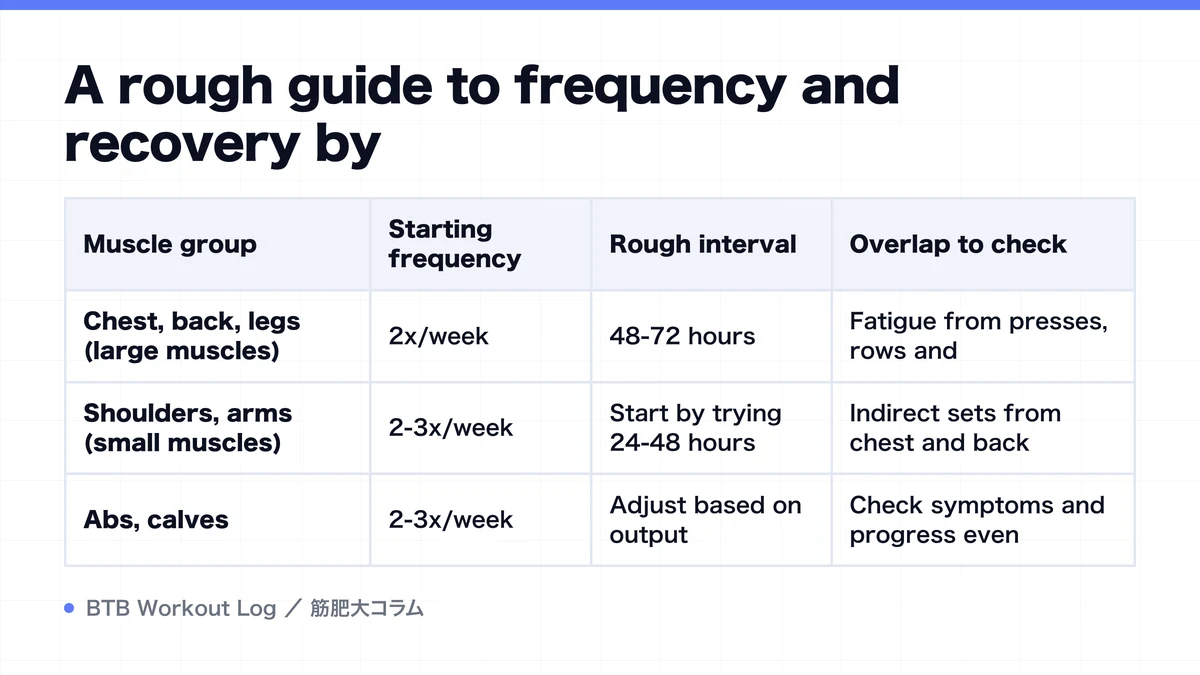
Choosing a split from the days you can train
Once the days you can train are set, work backwards to decide where each muscle group's weekly sets go. The name of a split has no hypertrophy effect of its own, what matters is delivering the required work to the target muscles and being able to keep progressing over several weeks.
- 2 days a week: run full body twice and spread every muscle across both days. If a session runs long, cut the number of exercises.
- 3 days a week: three full body sessions, or full body as the base with a different priority muscle each day, is an easy setting to manage. Check whether you can meet the conditions under which three full body sessions a week are enough.
- 4 days a week: running an upper/lower split twice each makes it easy to get every muscle twice a week.
- 5-6 days a week: PPL and similar setups keep the per-session volume down, but muscle overlap between adjacent days and the risk of missing sessions both rise.
At three sessions a week full body is easy to use as the default setting, but a split routine can suit people whose output drops on the muscles trained late in a session, or who want to give one muscle a lot of sets. Choose between full body and a split at three sessions a week on which one lets you get through the same weekly total volume at higher quality. For templates by number of days, see how to choose a split routine.
Judge recovery by your next session's output, not by 48 hours
Leaving 1-2 days between sessions for the same muscle, 48-72 hours, is a convenient starting point, but you cannot call recovery complete just because 48 hours have passed. The interval you need changes with the number of sets you did last time, proximity to failure, exercises that load the muscle at long muscle lengths, sleep, nutrition and fatigue from work. The limits of the 48-hour rule require you to treat muscle protein synthesis and performance recovery as separate things.
Soreness is not a standalone criterion either. Your output can still be down with no soreness at all, and with mild tightness you may still reproduce your normal movement and load after warming up. On days with strong pain, joint discomfort or a change in form, drop the load or move the session.
Prioritise whether you can hold load, reps, RIR (the reps you could still have done before failure) and range of motion under the same conditions as last time. If reps fall for several sessions in a row, RIR comes in lower than planned, and sleep and food are not the problem, adjust the interval or the weekly sets. The role of rest days is covered in how to think about recovery for hypertrophy.
Who should raise frequency and who should leave it alone
Candidates for raising frequency are people who cram around 8-10 sets for the same muscle into one session and see load, reps and range of motion clearly drop late on. That number is not a hard ceiling, it is a rough guide for when to consider spreading the work. Split it over two days while keeping weekly total volume the same, and see whether the quality of the later sets and recovery into the next week improve.
Candidates for leaving it alone are people who hold the quality of every set at their current frequency, recover on schedule, and are adding load or reps. There is no need to assume that "once a week does not build muscle", it works as long as the stimulus and the progression are there. The weakness of once a week is not that it is ineffective, it is that a missed week easily drops the stimulus to zero, and that the more volume you add the more the later sets tend to lose quality. This is covered in detail in the myth that once a week does not grow muscle.
Candidates for lowering frequency are people who work the same muscle or its synergists on consecutive days and whose output stays down from the warm-up onwards. Do not add sets and change frequency at the same time, change only the distribution first. Compare your main lifts under the same conditions over 2-4 weeks: if things improve, keep going, if nothing changes, take whichever fits your life, and if things get worse, go back to the previous setting.
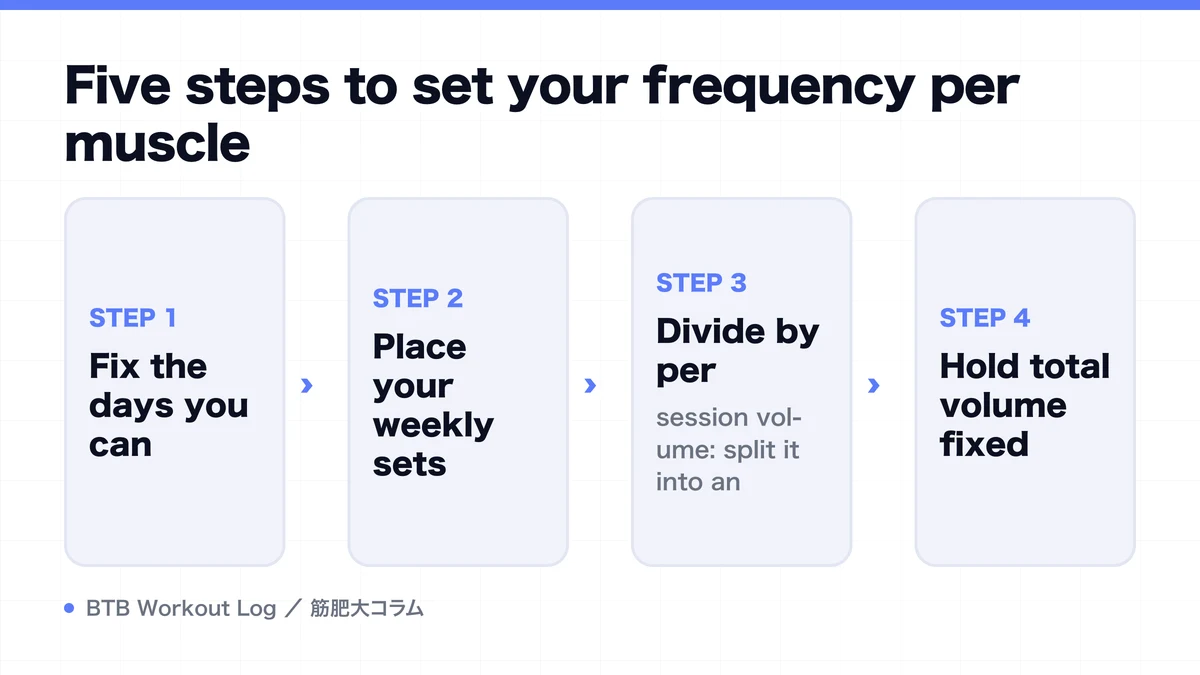
Five steps to set your frequency per muscle
- Fix the days you can train: decide on a slot of 2-5 days a week that you are unlikely to miss, not your ideal number of days.
- Place your weekly sets per muscle: check both the direct sets and the exercises that load the muscle indirectly.
- Divide by per-session volume: split it into an amount that lets you hold output to the end, and most muscles land at around twice a week.
- Hold total volume fixed for 4 weeks: change nothing major other than frequency, and log load, reps, RIR and symptoms on your main lifts.
- Re-tune muscle by muscle: rather than moving everything to three times a week, change frequency or sets only for the muscles where recovery and progress do not line up.
A log like BTB Workout Log, where you can check weekly hard sets per muscle and the trend for each exercise, gives you the material to compare before and after a frequency change under the same conditions. Judge on whether you reproduced high-quality sets across the whole week and made progress, not on the fact that you added sessions.
FAQ
- Can I train the same muscle every day?
- Training every day is not necessarily off the table for everyone, but stacking normal hard sets daily makes it hard to hold recovery and output. Start from twice a week and look for the interval at which your load, reps and RIR come back under the same conditions.
- Will I still build muscle training each muscle once a week?
- Hypertrophy can happen at once a week if you have enough weekly sets, effort close to failure, and ongoing progress in load and reps. If quality drops late in the session or your risk of missing a week is high, split it into twice a week.
- Does more frequency mean more muscle?
- Not necessarily. At the same weekly total volume, the main effect of frequency is redistributing sets. Raising frequency and sets at the same time also raises the recovery cost, so hold total volume fixed first and compare the change in output.
- Do I always have to leave 48 hours between sessions for the same muscle?
- 48 hours is an easy starting point to try, not a rule that guarantees full recovery. It changes with the previous load, the exercises and sleep, so judge it together with your next session's load, reps, RIR, movement and symptoms.
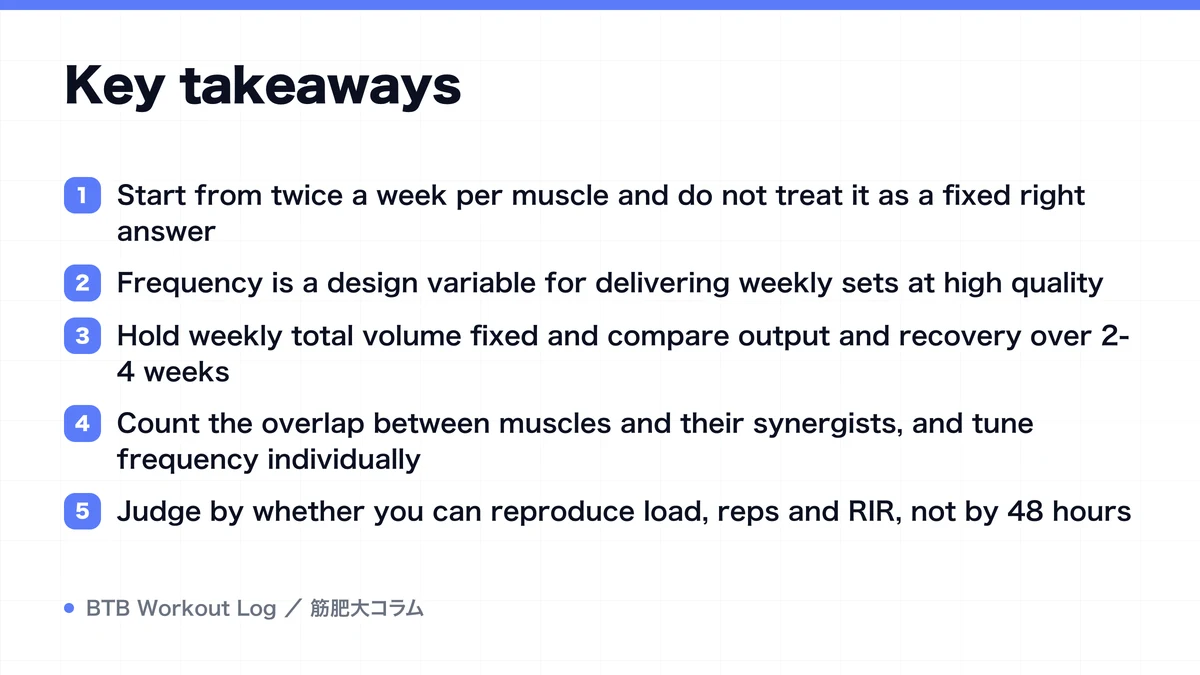
Key takeaways
- Start from twice a week per muscle and do not treat it as a fixed right answer
- Frequency is a design variable for delivering weekly sets at high quality
- Hold weekly total volume fixed and compare output and recovery over 2-4 weeks
- Count the overlap between muscles and their synergists, and tune frequency individually
- Judge by whether you can reproduce load, reps and RIR, not by 48 hours
References
- Resistance Training Frequency and Muscle Hypertrophy: Systematic Review and Meta-analysis
- Dose-response Relationship Between Weekly Resistance Training Volume and Muscle Mass
- Mixed Muscle Protein Synthesis and Breakdown After Resistance Exercise in Humans
- Muscle Protein Synthetic Response to Resistance Exercise: Systematic Review and Meta-analysis
- ACSM Position Stand: Resistance Training Prescription for Muscle Function, Hypertrophy, and Physical Performance in Healthy Adults: An Overview of Reviews