Straight Sets vs. Supersets: Save Time Without Sacrificing Hypertrophy?
Given matched weekly sets and effort, set method alone doesn't decide a hypertrophy winner. Straight sets favor prioritizing high output; supersets favor compressing time on accessory work without sacrificing set quality.
What matters isn't feeling exhausted in a short time — it's whether you hold reps, range of motion and RIR on the target muscle and can still progress next time. Supersets in particular vary a lot depending on how you pair exercises.
Split hypertrophy efficiency into "effectiveness" and "time"
A straight set means performing one exercise, taking the set rest interval, and finishing that exercise's sets in order. A superset means running two exercises back to back with a short transition, then resting once you've completed both. It isn't simply a matter of whether rest is long or short.
"Hypertrophy efficiency" carries at least two meanings. One is how much muscle you can add over weeks to months. The other is how many high-quality sets you can fit into a limited session. On the first alone, straight sets are the solid choice since they preserve output more easily; factor in the second and supersets gain value.
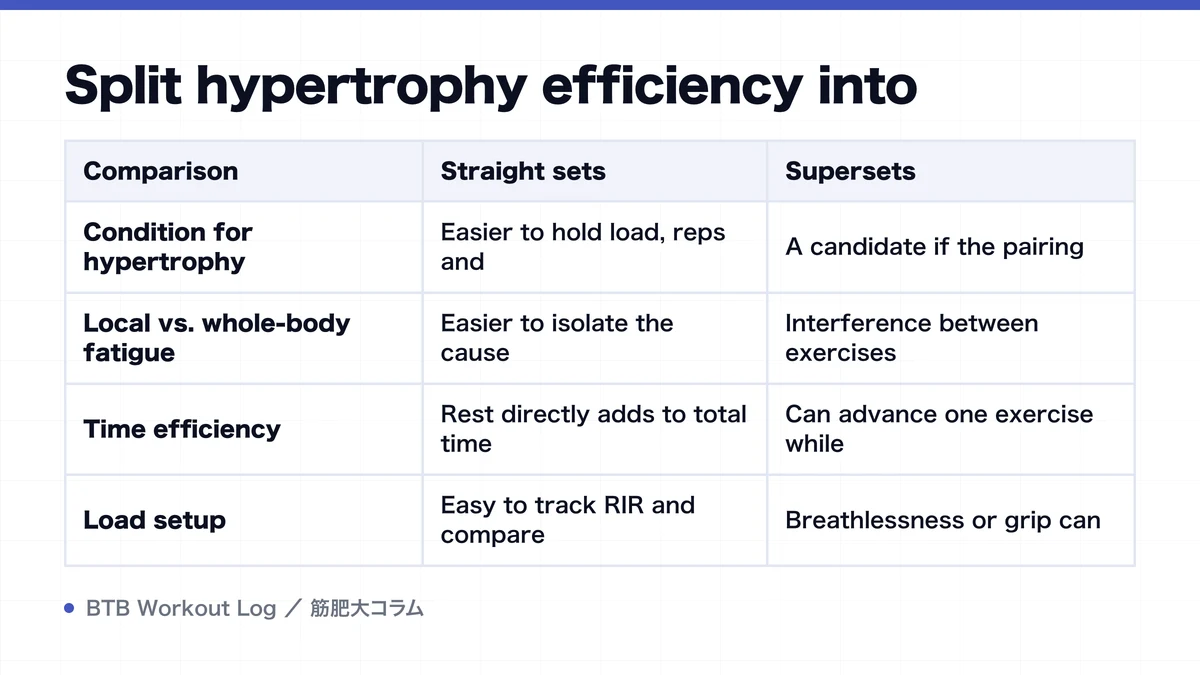
| Comparison | Straight sets | Supersets |
|---|---|---|
| Condition for hypertrophy | Easier to hold load, reps and range of motion | A candidate if the pairing preserves the same conditions |
| Local vs. whole-body fatigue | Easier to isolate the cause | Interference between exercises can occur |
| Time efficiency | Rest directly adds to total time | Can advance one exercise while the other recovers |
| Load setup | Easy to track RIR and compare against last time | Breathlessness or grip can distort RIR judgment |
| Fits best for | Priority exercises, heavy load, technique-focused work | Accessory work, different muscle groups, time constraints |
RIR is a gauge of how many reps are left before the limit — see the RIR guide for how to use it. When comparing, don't just match set count — bring each set's RIR, range of motion and rep quality as close together as possible too.
Research doesn't settle a winner from set method alone
Rest-interval research is useful background for thinking through hypertrophy-relevant conditions. An 8-week study of 21 young trained men performing 7 whole-body exercises 3 times a week found the 3-minute-rest group favored bench press and squat 1RM plus anterior thigh muscle thickness over the 1-minute group. This suggests that if short rest costs you next-set work, added discomfort doesn't necessarily translate to a hypertrophy advantage.
Meanwhile, a meta-regression of 15 studies and 34 treatment arms — with only 2 studies in trained lifters — shows a dose-response relationship between weekly set count and muscle gain. And a meta-analysis of 15 studies comparing training to failure against stopping before failure in healthy adults found no evidence that training to momentary muscular failure is superior for hypertrophy. In other words, what to watch isn't intensifying fatigue in a short time by itself — it's whether you can bank your needed weekly sets with sufficient effort, in a recoverable way.
None of this, though, directly compares straight sets against supersets. Nor does a superset necessarily mean shorter rest for the same muscle. If you alternate exercise A and B and still get the recovery time A needs before its next set, you've simply filled the clock-time gap with exercise B instead of leaving it empty. What these studies establish is the importance of matching comparison conditions — not a verdict on set method alone.
A "superset" becomes a different thing depending on what you pair
The word "superset" alone doesn't tell you the fatigue cost. Whether you continue the same muscle, pair opposing muscle groups, or pair body parts that barely compete, changes the output on the second exercise substantially.
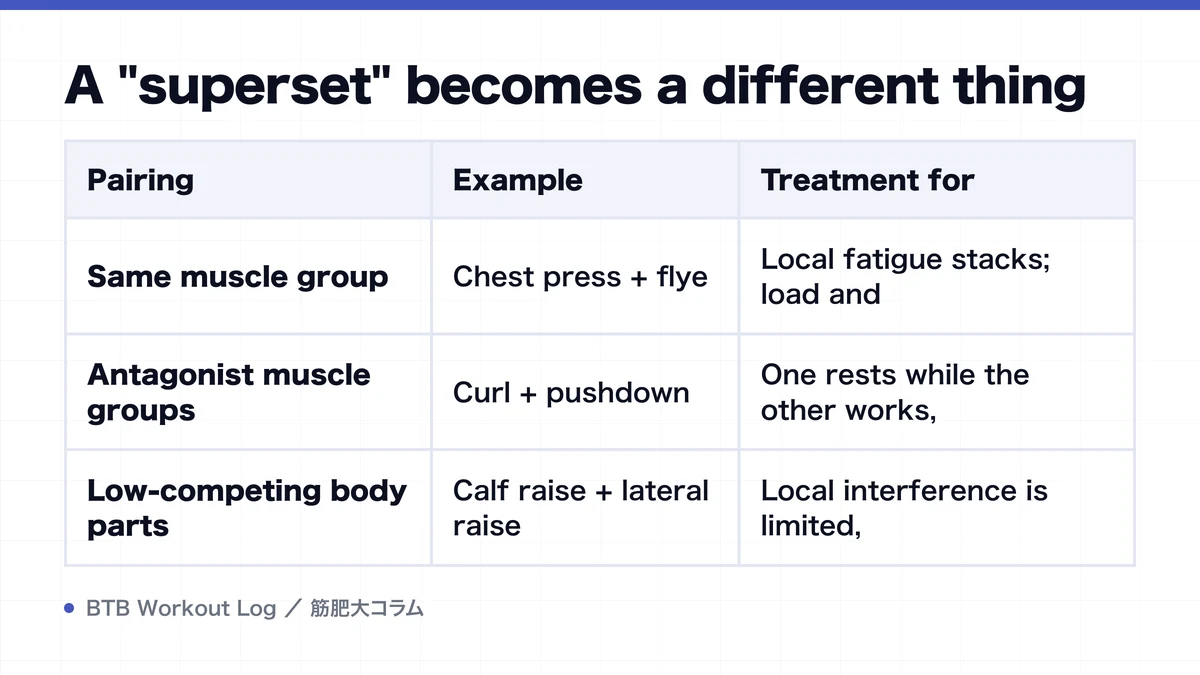
| Pairing | Example | Treatment for hypertrophy purposes |
|---|---|---|
| Same muscle group | Chest press + flye | Local fatigue stacks; load and reps on the later exercise tend to drop |
| Antagonist muscle groups | Curl + pushdown | One rests while the other works, making it usable for accessory pairs |
| Low-competing body parts | Calf raise + lateral raise | Local interference is limited, but factor in transitions and equipment availability |
Same-muscle-group pairing fatigues the target muscle intensely in a short time. But load on the second exercise drops, so "both exercises felt brutal" and "both exercises were high-quality sets" need to stay separate claims. It can be a valid choice for chasing metabolic stress or a pump, but that isn't grounds to make it the default for main lifts you're tracking progress on.
Even with antagonist or low-competing pairings, interference doesn't hit zero. Grip, core, breathing, and equipment setup are all shared. Multi-joint pairs like bench press and rows carry substantial whole-body fatigue even with different target muscles, and don't save time as simply as a curl-and-pushdown pair does. Choose the pairing not by muscle name alone, but by what hasn't recovered after the set.
Cutting time doesn't raise efficiency if it cuts output too
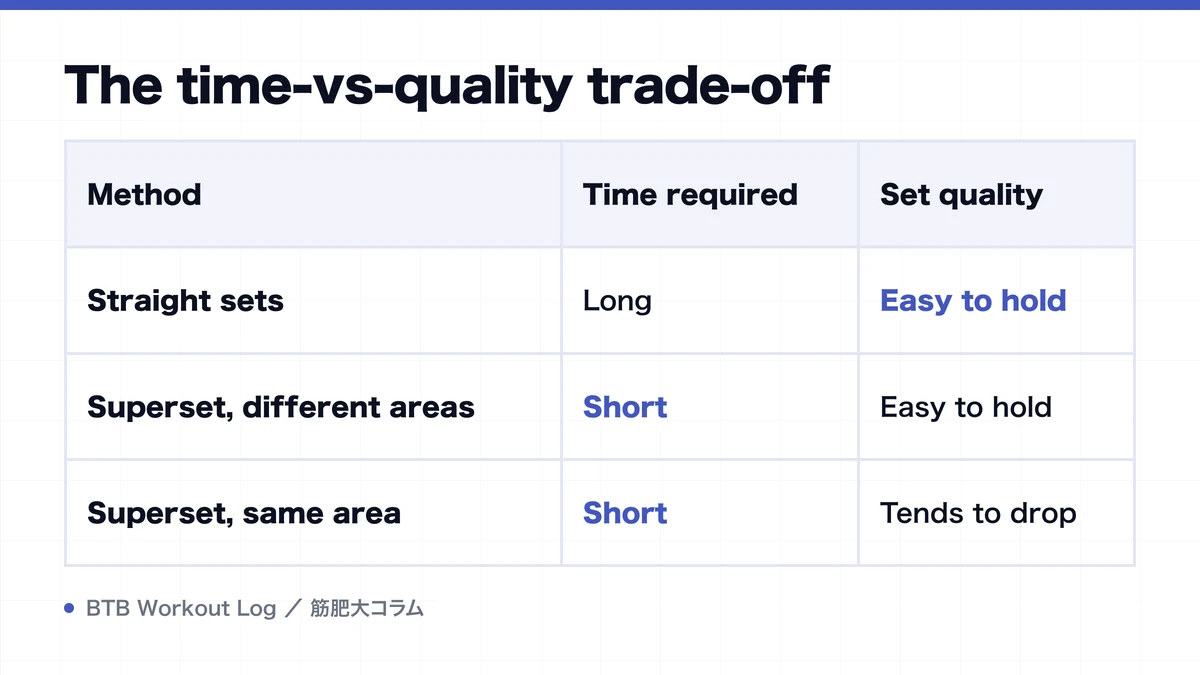
The advantage of a superset is overlapping the rest of two exercises. But once you include transitioning between exercises, waiting for equipment, and adjusting weight, it can end up shorter than planned by less than expected. Judge time efficiency not by "seconds of rest" but by total time from after warm-up to the final working set.
Output decline needs watching too. If you're still out of breath entering the second exercise and cardiovascular discomfort arrives before the target muscle's own fatigue, RIR means something different even at the same number. Grip or core can fatigue first too, narrowing range of motion just to match the rep count. Maintaining the same set count under these conditions keeps the volume figure the same while the content no longer matches.
What to log for both methods
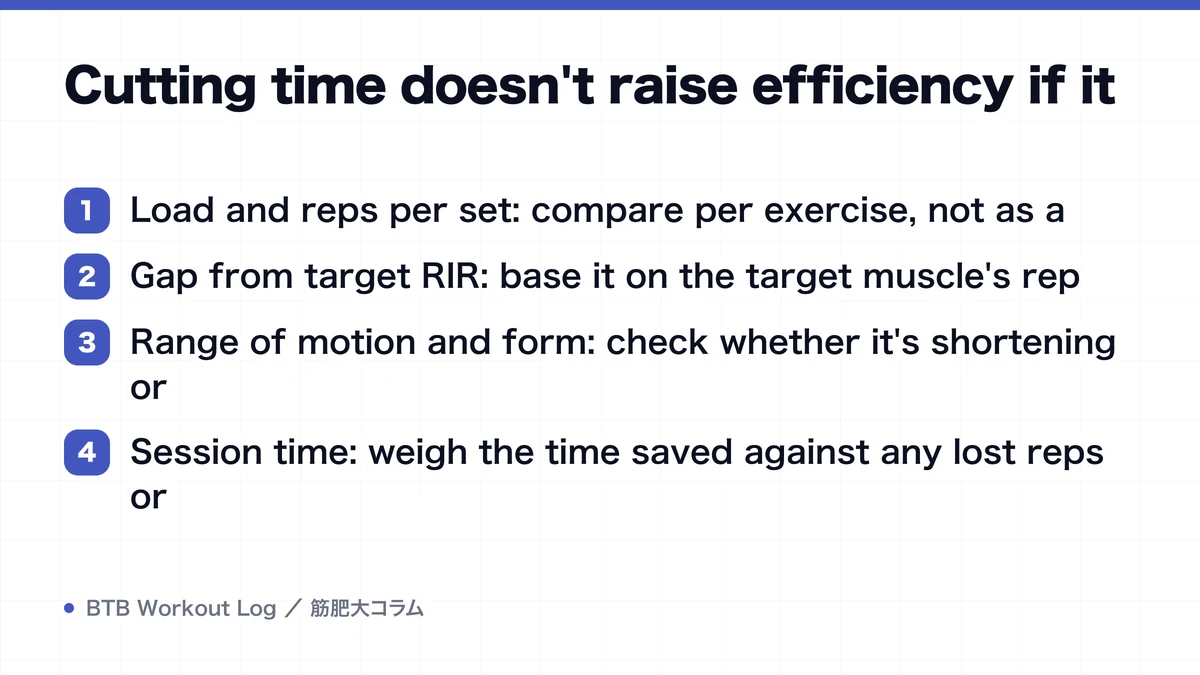
- Load and reps per set: compare per exercise, not as a paired total.
- Gap from target RIR: base it on the target muscle's rep limit, not breathlessness.
- Range of motion and form: check whether it's shortening or picking up momentum even at the same reps.
- Session time: weigh the time saved against any lost reps or effect on later exercises.
If you're someone who keeps skipping accessory work due to weekly time constraints, even a small output drop can be outweighed by the benefit of actually completing your needed weekly sets via supersets. Conversely, if you have time to spare and want to maximize progress on your main lifts, there's no need to give up straight sets' stability.
Straight sets for priority exercises, chosen pairings for accessory work
In practice, splitting your routine by priority is more manageable than standardizing on either method across the board. Protecting output and technique on the first exercise or two with straight sets, then supersetting only the back-half accessory work, lets you aim for both hypertrophy and time savings.
Situations that favor straight sets
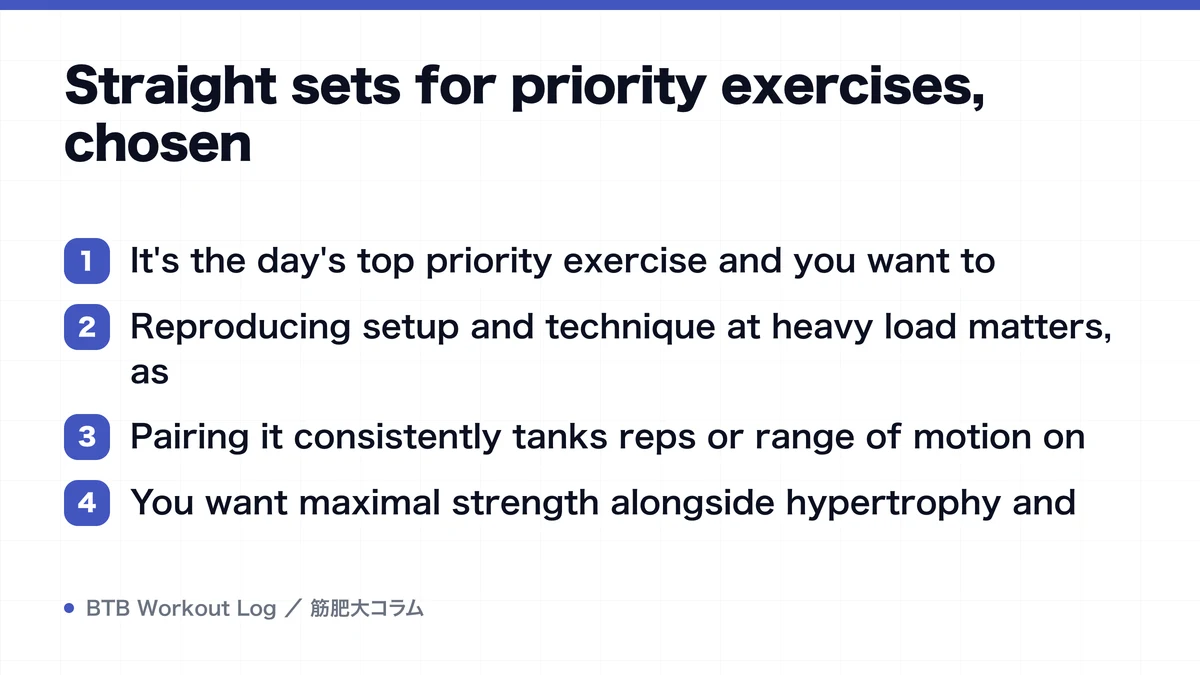
- It's the day's top priority exercise and you want to clearly track load/rep progressive overload.
- Reproducing setup and technique at heavy load matters, as on squats or presses.
- Pairing it consistently tanks reps or range of motion on the exercise that follows.
- You want maximal strength alongside hypertrophy and prioritize output on every set.
Situations that favor supersets
- You can pair relatively non-competing accessory exercises, like curls and pushdowns.
- You're on stable machines or single-joint exercises where breathlessness or core fatigue has little effect.
- Session time is limited, and saving time means not having to skip planned sets.
- You can genuinely secure the recovery time needed from one A-exercise set to the next.
Reserve pairing the same muscle group back to back for a limited role, after your priority exercise is done. If you're unsure how long to rest on straight sets, pairing this with the 2-minute vs. 5-minute rest comparison makes it easier to separate wait time you can cut for the sake of time from recovery time you need to protect.
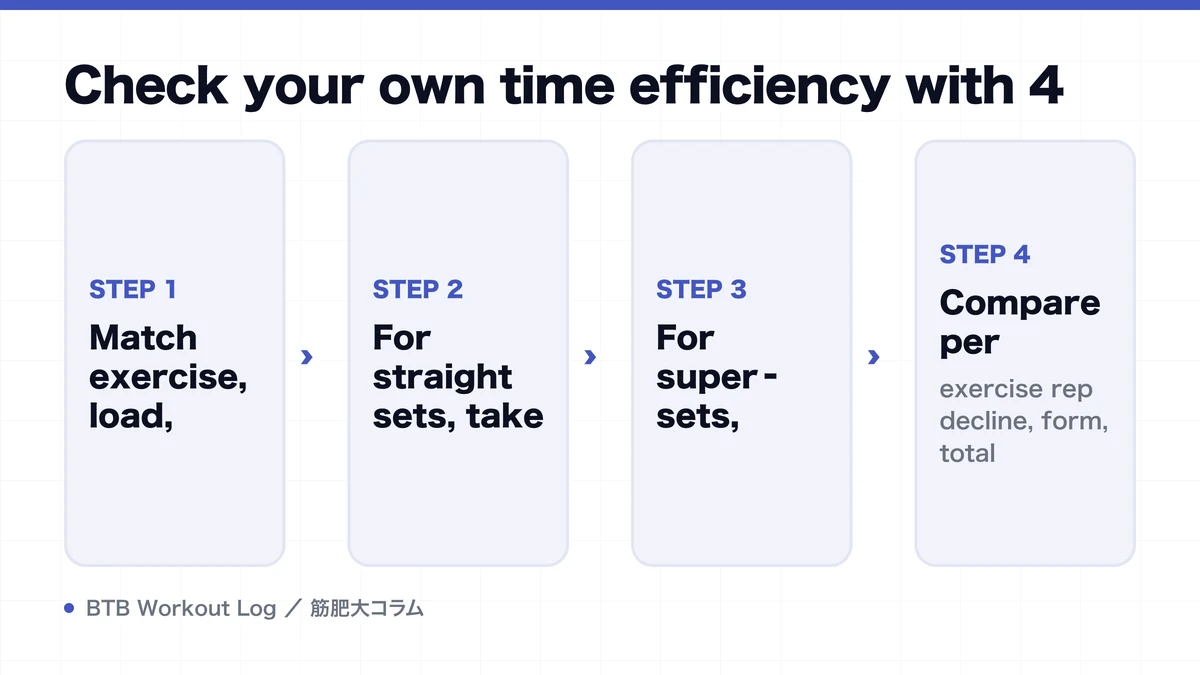
Check your own time efficiency with 4 matched-condition tests
How well a set method fits you also shifts with how crowded the gym is, equipment layout, exercise order and cardiovascular fitness. Pick two candidate exercises and trial straight sets and supersets twice each, so a single good or bad day doesn't decide it.
- Match exercise, load, set count, target RIR, range of motion and execution order.
- For straight sets, take your usual rest and finish each exercise's sets in order.
- For supersets, alternate A and B, and also log the time from one A set to the next.
- Compare per-exercise rep decline, form, total time, and progress next time.
If total time shortens while reps, RIR, range of motion on both exercises and next-time progress all hold, you can conclude supersets are the more efficient choice for that pairing. If only one exercise's output drops, swap the order; if both drop, extend rest or revert to straight sets. Don't make pushing to the limit itself the standard — distribute fatigue with the help of choosing between failure sets and RIR too.
The deciding material isn't just "today finished faster" — it's both the time you saved and the set quality you kept.
FAQ
- Do I need to eliminate all rest between paired exercises in a superset?
- No. Keep the transition from exercise A to B short, but still rest after B, and secure the recovery time A actually needs before its next set. If reps or range of motion drop, extend the transition or post-pairing rest — prioritize set quality over the clock.
- Is supersetting the same muscle good for hypertrophy?
- It fatigues the target muscle intensely in a short time, but load and reps on the later exercise also tend to drop. Don't make it the default for tracking progress on your main lifts — use it as a supplementary choice after priority sets are done, weighing recovery and weekly volume.
- Can I superset everything on a day I'm short on time?
- Pairing even your priority exercises can drop output and technique from breathlessness or core fatigue. It's easier to save time while still tracking progress against last time if you do your first heavy exercise as straight sets, and only pair the less-competing accessory work in the back half.
Key takeaways
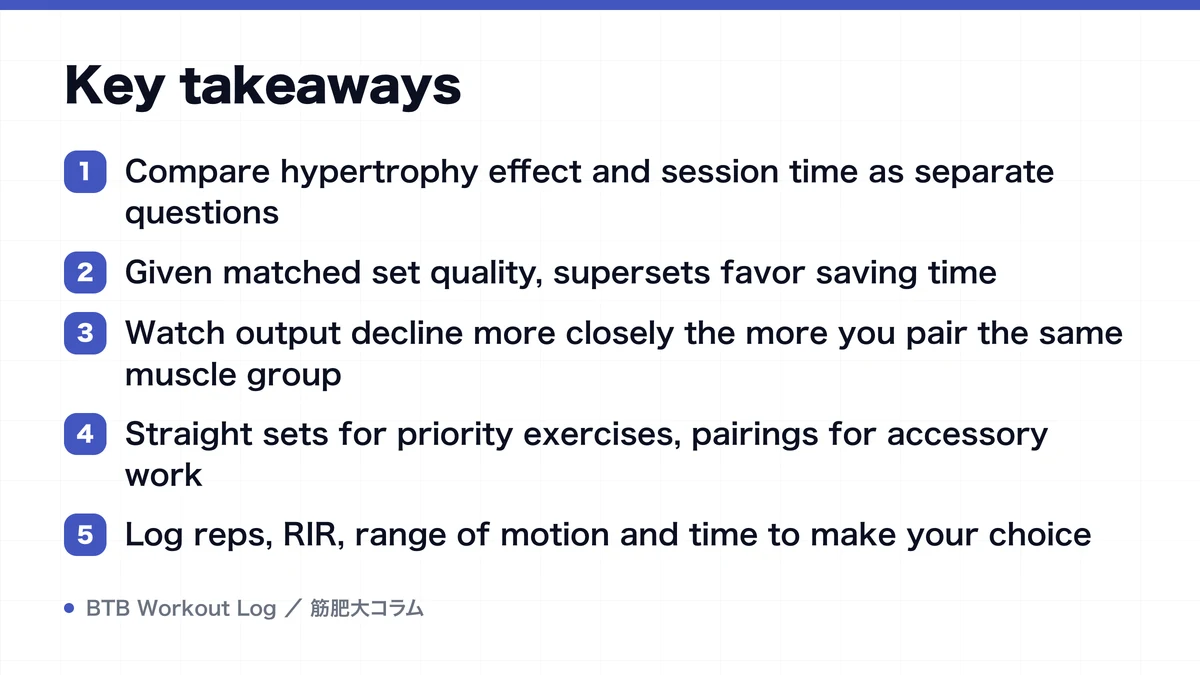
- Compare hypertrophy effect and session time as separate questions
- Given matched set quality, supersets favor saving time
- Watch output decline more closely the more you pair the same muscle group
- Straight sets for priority exercises, pairings for accessory work
- Log reps, RIR, range of motion and time to make your choice