How to Build a Workout Plan in 5 Steps | Stop Copying, Start Making Progress
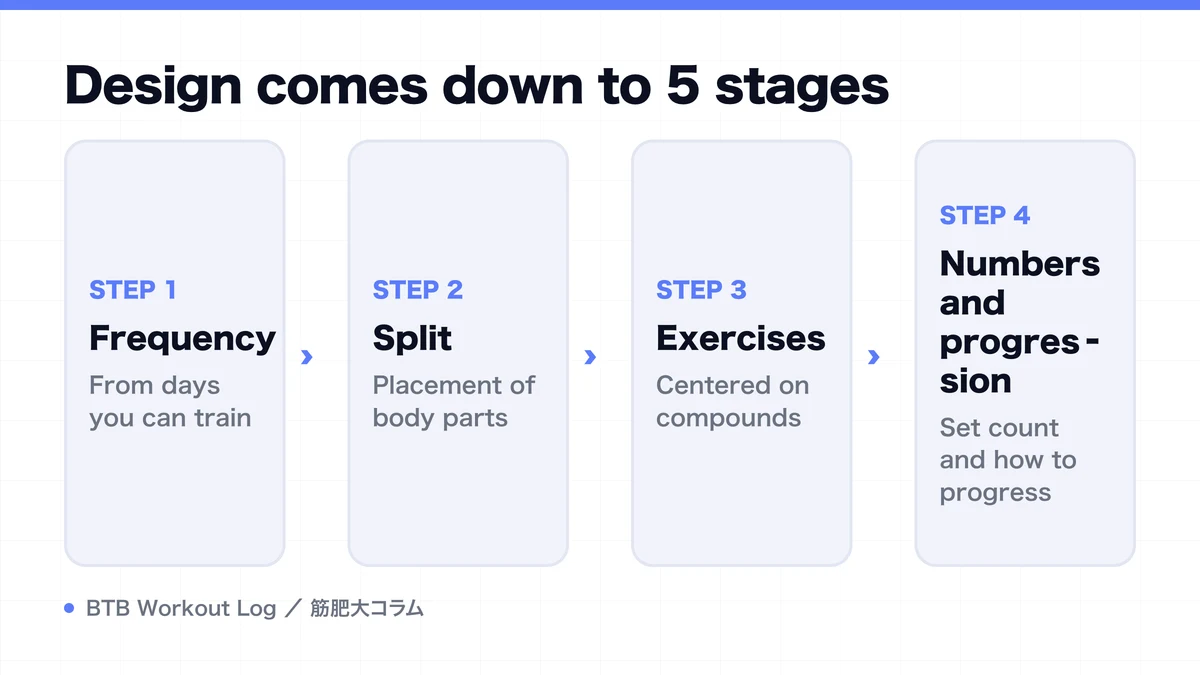
Program design is just a series of decisions made in order: 1. frequency, 2. split, 3. exercises, 4. sets, reps, and intensity, 5. progression.
Follow these 5 steps and instead of copying someone else's routine, you'll build a program tailored to your own life and goals.
Why you should be able to build your own program
Off-the-shelf programs are optimized for someone else's schedule, experience level, and equipment. If your available days or gear differ, a copied plan never quite fits. Understand the design principles and you can fine-tune things yourself whenever progress stalls; it's a skill you keep for life. And it isn't complicated: you just fill in the decisions from the top down.
Step 1: Decide your weekly frequency
First, pick a number of days you can realistically sustain. The trick to consistency is choosing the floor you can always hit despite work and life, not the ideal number. Frequency then determines which splits are on the table.
- 2-3 days a week: full body
- 4 days a week: upper/lower split
- 5-6 days a week: PPL or a body-part split
Step 2: Choose your split
The rule: pick a split that trains every muscle twice a week. The best option for each frequency is covered in the split comparison guide, but when in doubt, full body or upper/lower won't steer you wrong. The shorter you want each session, the more days you train and the fewer muscle groups you hit per session.
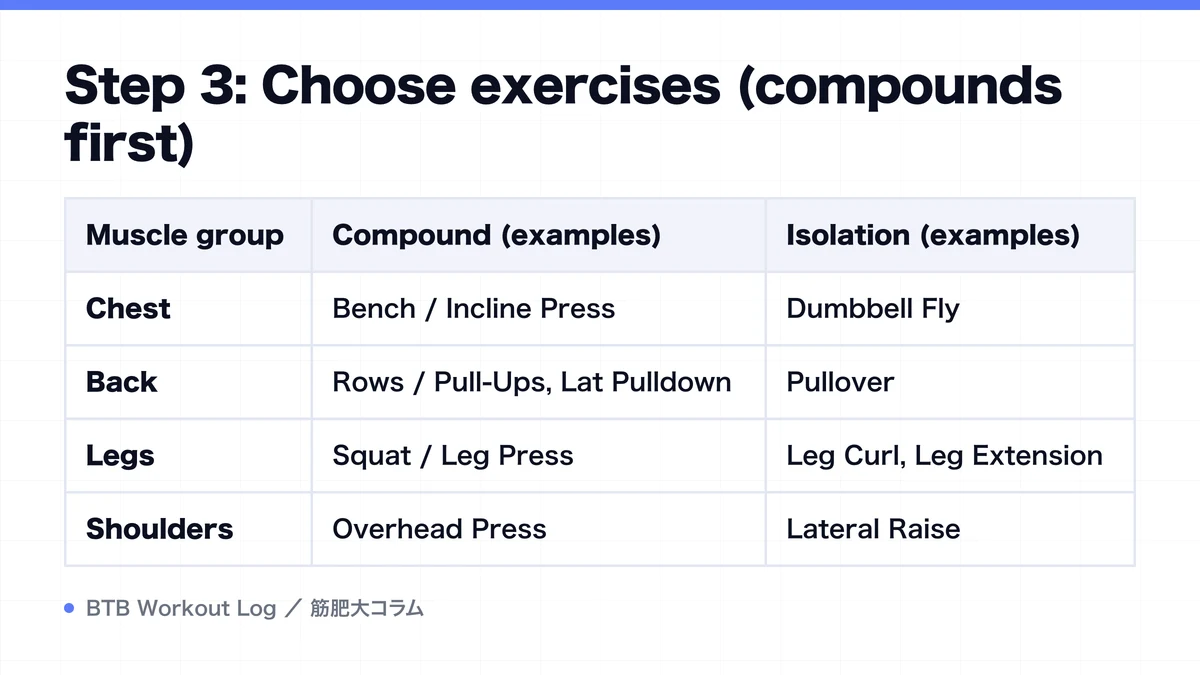
Step 3: Choose exercises (compounds first)
The template per muscle group: 1-2 multi-joint compound lifts plus one single-joint isolation exercise. Compounds deliver the heavy loading and the bulk of your volume; isolation work finishes off the target muscle.
| Muscle group | Compound (examples) | Isolation (examples) |
|---|---|---|
| Chest | Bench / Incline Press | Dumbbell Fly |
| Back | Rows / Pull-Ups, Lat Pulldown | Pullover |
| Legs | Squat / Leg Press | Leg Curl, Leg Extension |
| Shoulders | Overhead Press | Lateral Raise |
| Arms | - | Curls / Pushdowns |
Step 4: Set your sets, reps, and intensity
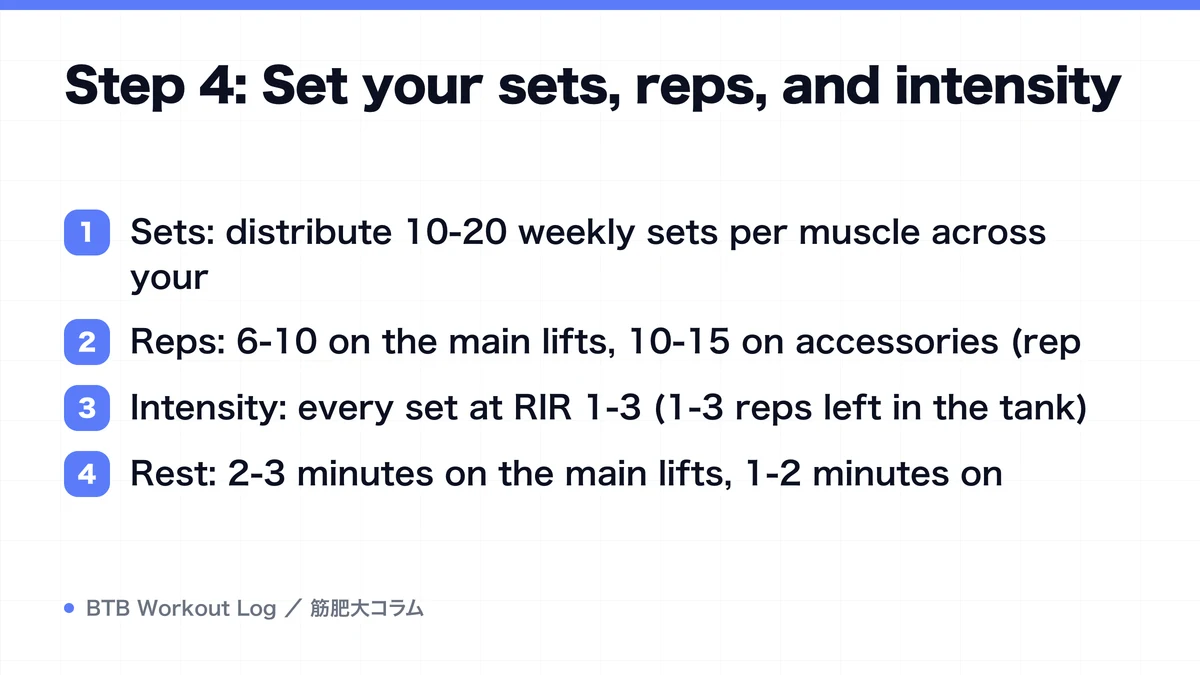
Now plug in the muscle-growth numbers. The targets:
- Sets: distribute 10-20 weekly sets per muscle across your training days
- Reps: 6-10 on the main lifts, 10-15 on accessories (rep ranges)
- Intensity: every set at RIR 1-3 (1-3 reps left in the tank)
- Rest: 2-3 minutes on the main lifts, 1-2 minutes on accessories (rest intervals)
Step 5: Decide how you'll progress, and log it
Finally, decide how you'll move forward. The recommendation is double progression: once every set reaches the top of your rep range, add weight and start over at the bottom. Running it requires knowing last session's numbers, so record every set's weight and reps, in a notebook or an app. When you can see what you did last time, every set today has a clear target (progressive overload).
FAQ
- Should beginners design their own program from day one?
- The safe route is to start from a full-body template and use this article's 5 steps to fine-tune it as you gain experience. Almost any sensible program produces growth in your first few months, so prioritize consistency over perfect design.
- How many exercises per workout?
- Around 4-7 per session. More than that and your focus and effort per exercise drop, dragging down the quality of your total volume. Lock in the compound lifts for the major muscle groups first, then add accessories.
- How often should I change my program?
- Keep your exercises as long as they keep progressing. Check your progress every 4-8 weeks as a rule of thumb, and swap rep ranges or exercises only on the lifts that have stalled.
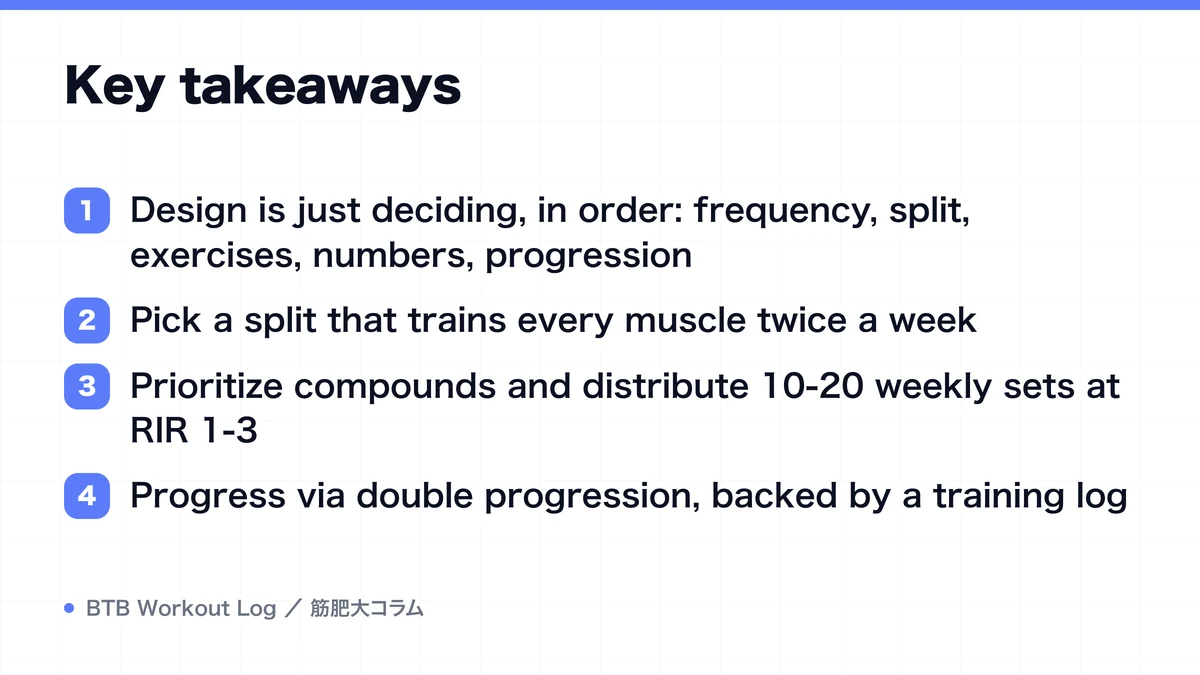
Key takeaways
- Design is just deciding, in order: frequency, split, exercises, numbers, progression
- Pick a split that trains every muscle twice a week
- Prioritize compounds and distribute 10-20 weekly sets at RIR 1-3
- Progress via double progression, backed by a training log
References
- ACSM Position Stand: Resistance Training Prescription for Muscle Function, Hypertrophy, and Physical Performance in Healthy Adults: An Overview of Reviews
- Dose-response Relationship Between Weekly Resistance Training Volume and Muscle Mass
- Low- vs High-load Resistance Training for Strength and Hypertrophy: Meta-analysis
- Proximity-to-Failure and Muscle Hypertrophy: Systematic Review with Meta-analysis