Full ROM vs. Partial Reps for Hypertrophy: What the Research Says
Full range of motion is an easy default standard for hypertrophy, while partials limited to the long muscle-length end are a strong option when the exercise and goal fit. But partials restricted to the short muscle-length end can't be lumped in and called "equivalent".
What to compare isn't how far the bar travels — it's at what muscle length you can load the target muscle with tension, whether you can bank valid reps against fatigue, and whether you can track progress under matched conditions.
Define your range before comparing full range and partials
Full range of motion doesn't mean moving to the joint's physical limit. It means using the controllable span, from a starting point to an ending point, where you can hold load on the target muscle without pain or major compensation. The endpoints shift with individual anatomy and equipment, but you should hold them fixed while evaluating the same exercise. See why full range of motion is the standard for detailed criteria.
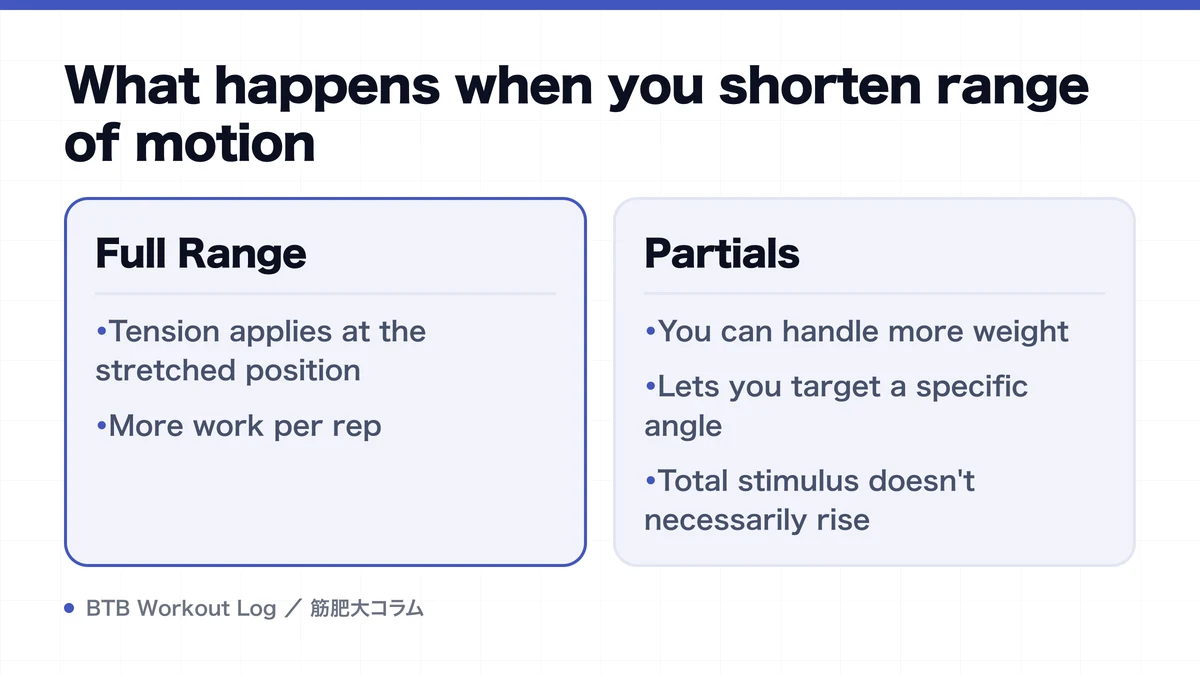
Partial range, on the other hand, means repeating only part of the full range. But a long-muscle-length partial using the stretched position, a short-muscle-length partial using the contracted position, and a partial confined to around the sticking point all carry different stimulus and purpose. Lumping them all under one word — "partials" — breaks the comparison itself.
You also need care comparing at the same weight and reps. Shortening range of motion generally makes it easier to handle more weight, and at the same weight, easier to do more reps. But a rep with changed travel distance and muscle length isn't the same work. Evaluate hypertrophy effect, local fatigue, time, load setup and reproducibility as separate axes.
Full range is the solid average — but the long-muscle-length end can be an exception
Full range's strength is that it makes it easy to work the target muscle across a wide span of muscle lengths within one rep. Rather than biasing toward one narrow segment, it uses the exercise's resistance curve as a whole — which suits it as the default when there's no clear reason to pick a specific range. With form and endpoints fixed, it's also easier to track progress in load or reps.
That said, partials aren't always inferior. On exercises where the target muscle receives sufficient resistance at the stretched position, a long-muscle-length partial can produce hypertrophy close to full range, or even favor certain measurement sites. What matters isn't "you only moved halfway" — it's which segment, the one you kept or the one you cut, actually carried more tension for the target muscle. How range of motion changes stimulus is covered in more depth in how range of motion shifts stimulus.
It's premature to extend this trend to every muscle and every exercise. Results can shift with the muscle, the exercise, the equipment's resistance direction, training history, and which site hypertrophy is measured at. There's weaker basis for expecting the same benefit from short-muscle-length partials as from long-muscle-length ones — if the main purpose is contraction feel or practicing a specific segment, it's safer to keep that separate from your main hypertrophy strategy. A practical order: full range as the average starting point, long-muscle-length partials as a conditional alternative or addition.
A shorter range is faster, but not necessarily more efficient for stimulus
Because a partial rep travels a shorter distance, it's easier to shorten set time at the same rep count, and to add extra reps by avoiding the segment where full range stalls. On a stable machine or single-joint exercise, adding a small number of long-muscle-length reps after a full-range set can be a way to concentrate extra stimulus on the target muscle.
But you can't treat more reps as automatically improving time efficiency or hypertrophy effect. 20 reps in a short segment and 20 full-range reps are different content per rep. A heavy-load partial can also raise stress on supporting muscles or joints, or skew stimulus by avoiding whichever segment happens to be hardest. Conversely, some full-range exercises spend too much whole-body fatigue on maintaining posture or reversing direction, ending the set before the target muscle is sufficiently worked.
Judge time efficiency not by "how many seconds shorter one set is", but by how many sets are needed to reach the intended stimulus, including whether you recover by next time. Adopting partials and just kept adding more sets could inflate recovery cost beyond the time saved. Conversely, if full range keeps spending time every rep on an endpoint you can't control, it may be worth reviewing the range or the exercise choice.
Once you change range of motion, keep separate standards for load, reps and RIR
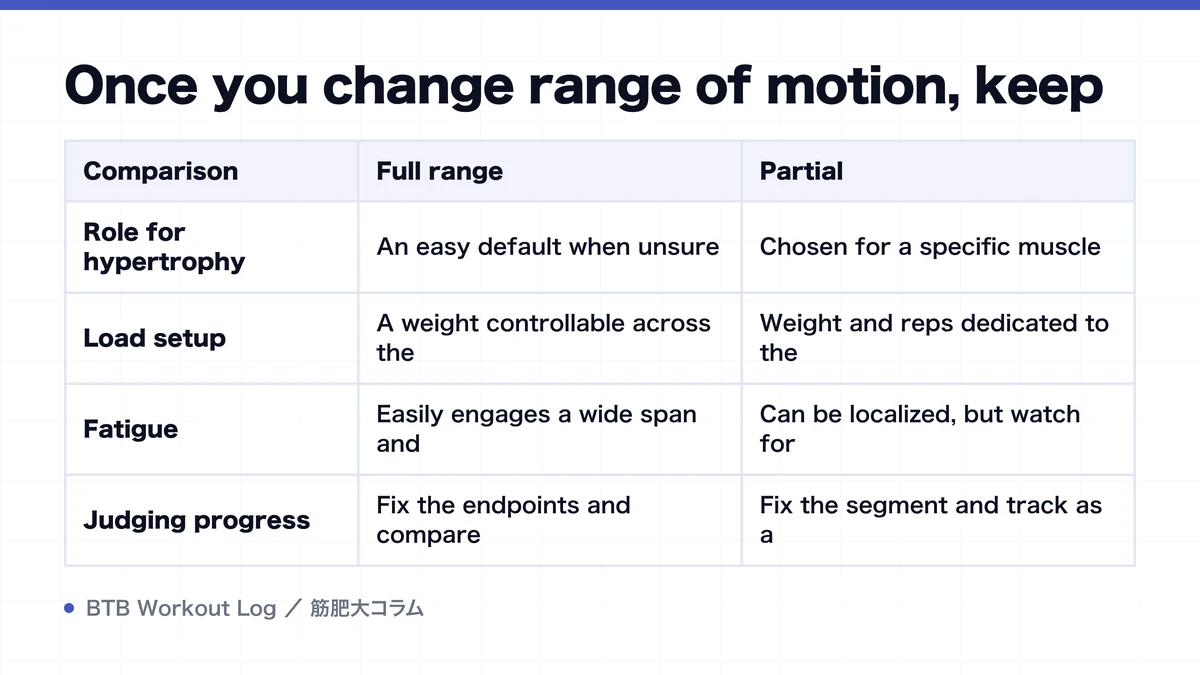
| Comparison | Full range | Partial |
|---|---|---|
| Role for hypertrophy | An easy default when unsure | Chosen for a specific muscle length and purpose |
| Load setup | A weight controllable across the whole span | Weight and reps dedicated to the limited segment |
| Fatigue | Easily engages a wide span and supporting muscles | Can be localized, but watch for overly heavy load |
| Judging progress | Fix the endpoints and compare against last time | Fix the segment and track as a separate exercise |
Changing range of motion changes difficulty even at the same weight, so you can't carry over your old RIR. RIR describes remaining reps — how many more you could do — but a weight that was RIR 2 at full range isn't necessarily RIR 2 at a partial too. Hold the segment fixed for the first few reps to gauge reserve, and set a dedicated RIR and rep range for that specific condition.
In your log, it's clearer not to mix full-range and partial entries into one continuous record under the same exercise name. Leave a short note that lets you reproduce the start and end points — "bottom half", "knee-angle marker", "stop at chest" — and track it as a separate variation. This is to avoid mistaking a shortened range with rising weight for genuine progressive overload.
Default to full range; use partials when you can state the purpose in one sentence
Situations that favor full range
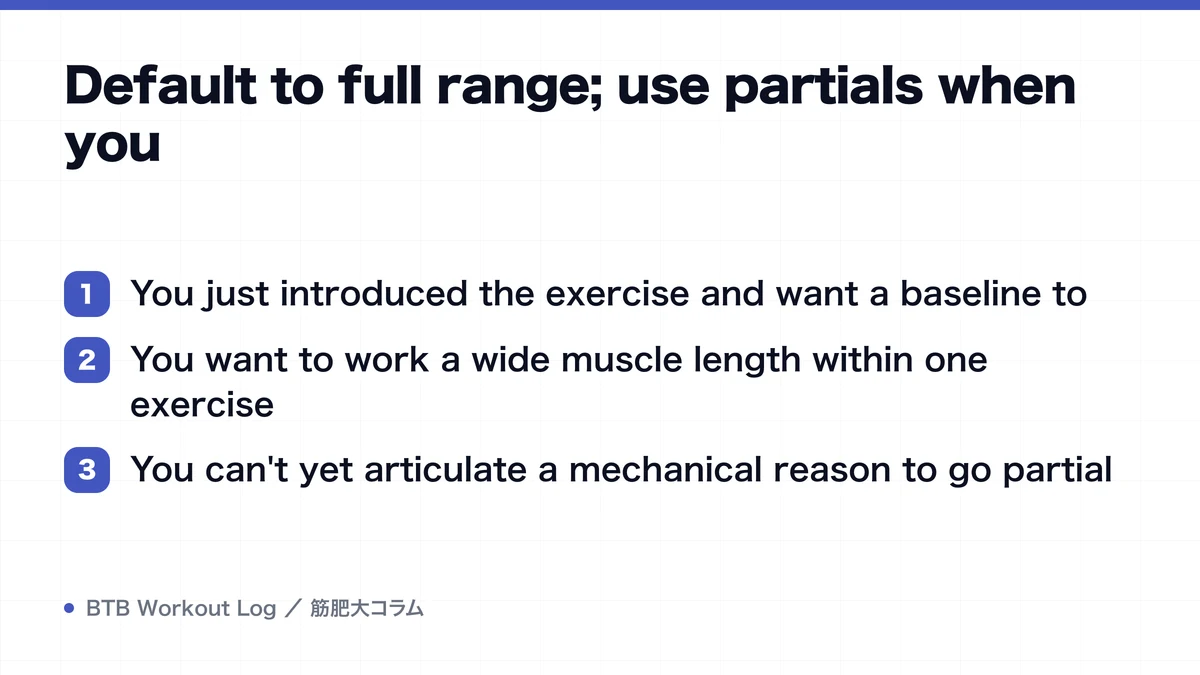
- You just introduced the exercise and want a baseline to measure progress against
- You want to work a wide muscle length within one exercise and reduce bias
- You can't yet articulate a mechanical reason to go partial
Situations worth considering a long-muscle-length partial
- Resistance doesn't drop off at the stretched position, and you can keep the movement stable
- You have a clear purpose for adding reps after the back half of a full-range set
- You can compare the response as a distinct condition from full range for a defined period
Short-muscle-length partials gain value when the purpose includes something other than hypertrophy — practicing a specific segment's technique, control at the contracted position, or specificity to a sport movement. If you're narrowing range of motion to avoid pain, continuing within a pain-free range is reasonable on its own, but that isn't grounds for adding heavy load while ignoring the cause. The idea of separating what to protect from what to adjust, rather than fixing form to one appearance, also appears in criteria for adjusting form.
To compare, hold weekly set count and roughly matched effort while keeping range of motion fixed for several weeks. During that window, watch target-muscle performance, discomfort, recovery by next time, and the trend in load and reps. The final call isn't about average superiority — it's choosing whichever condition you can reproduce while sustaining both progress and recovery. Mixing a range-changed day into the same personal-best trend breaks the comparison. BTB Workout Log lets you log variations separately.
FAQ
- Can I build my whole routine around long-muscle-length partials alone?
- It may work for specific muscles and exercises, but there's no need to replace every exercise with it. It's easier to judge stimulus bias and progress if you default to full range and only trial exercises that hold resistance at the stretched position as a separate variation.
- If I can handle more weight than at full range, does that mean the partial is higher intensity?
- External weight going up doesn't necessarily mean stimulus to the target muscle went up, since travel distance, muscle length, and which segment is hardest have all changed. Set dedicated load, reps and RIR for the partial and evaluate it separately from your full-range personal best.
- Is adding partials after reaching failure at full range effective?
- It can add stimulus if you can hold the long-muscle-length position stably on a stable exercise. But doing it every set raises fatigue and total volume. Start by limiting it to a subset of final sets, and adjust volume based on next-session rep decline or joint discomfort.
Key takeaways
- Full range is the standard that most easily secures a wide muscle length and reproducible progress
- Evaluate long-muscle-length and short-muscle-length partials separately
- Once you change range of motion, track load, reps and RIR as a separate condition
- Choose by situation based on purpose, recovery and sustained progress
References
- The Mechanisms of Muscle Hypertrophy and Their Application to Resistance Training
- Mechanisms of Muscle Hypertrophy: Current Understanding and Future Directions
- The Influence of Frequency, Intensity, Volume and Mode of Strength Training on Whole Muscle Cross-sectional Area in Humans
- Low- vs High-load Resistance Training for Strength and Hypertrophy: Meta-analysis
- Muscle Hypertrophy Is Independent of Load Across Upper and Lower Limbs When Effort Is Matched