Dumbbell Curl vs. Preacher Curl: Which Builds a Bigger Bicep Peak?
Both can serve as a main biceps-building exercise. Preacher curl is easier to choose if you want to fix the movement and standardize rep quality; dumbbell curl is easier if you want to adjust wrist and elbow path to fit yourself. There's no universal winner on hypertrophy effect alone.
What to compare isn't "feel" — it's whether you can bank hard sets at intended range of motion, whether reps or weight rise over several weeks, and whether it's easy on the elbow and wrist.
What to compare first: execution conditions, not exercise name
Dumbbell curl here means the common standing version, holding dumbbells with supinated palms facing up. Preacher curl means resting the upper arm on an angled pad and flexing the elbow with dumbbells, an EZ bar, or a machine. Since dumbbells can be used on the preacher pad too, this isn't a clean equipment-vs-posture comparison. Without fixing the preacher-side equipment too, load increments and how you handle left-right differences will vary.
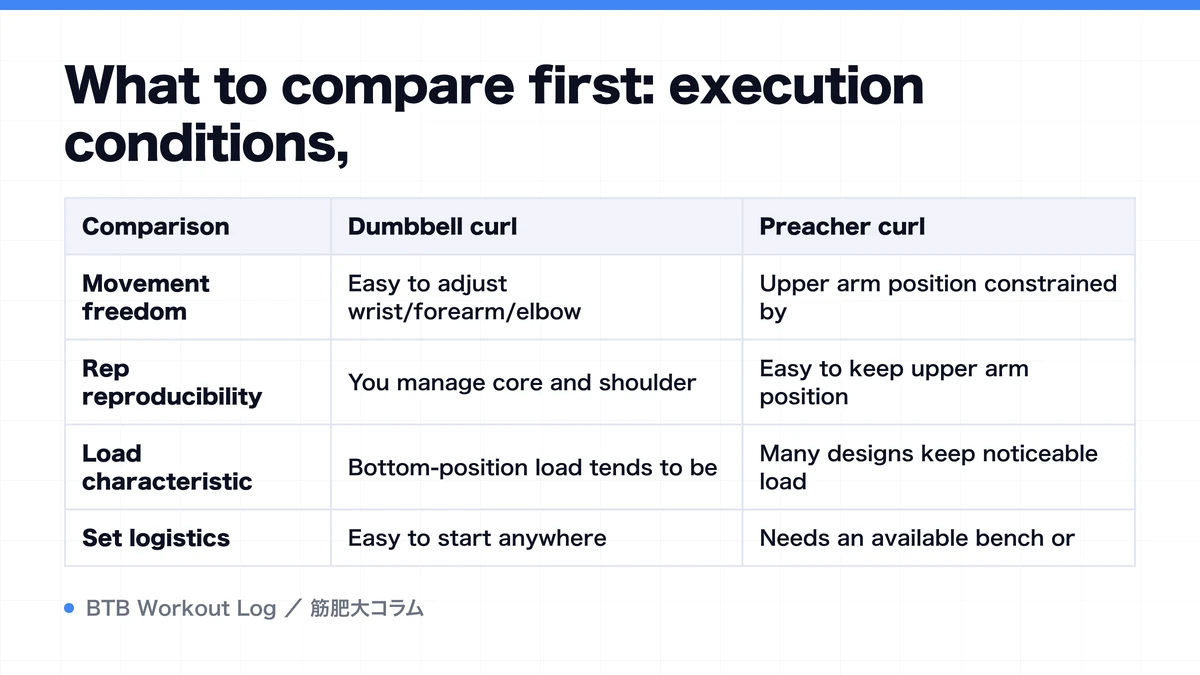
For hypertrophy purposes, evaluate on these five axes. Range of motion isn't a competition to push the joint to its extreme — use whatever range you can reproduce pain-free as your standard. If you want to consider range of motion itself, treat it separately, as in comparing full range and partials.
| Comparison | Dumbbell curl | Preacher curl |
|---|---|---|
| Movement freedom | Easy to adjust wrist/forearm/elbow path | Upper arm position constrained by the pad |
| Rep reproducibility | You manage core and shoulder movement yourself | Easy to keep upper arm position matched |
| Load characteristic | Bottom-position load tends to be small when standing | Many designs keep noticeable load from bottom to mid-range |
| Set logistics | Easy to start anywhere | Needs an available bench or machine |
| Individual fit | Easy to find a natural path | Pad angle and build fit vary by person |
Biceps stimulus shifts with stability and the load curve
Both center on elbow flexion, working the brachialis and brachioradialis alongside the biceps — it isn't that only one exercise uses the biceps just because the name differs. Across resistance-training research generally, there's a range of loads and reps that can target hypertrophy, and what matters more than exercise name is sustaining sufficient effort and progressive load setup.
Dumbbell lets you adjust the path
On dumbbell curl, you can adjust forearm supination, elbow position, and each side's independent path to fit your build. It's easy to find a position free of wrist or elbow discomfort, and handling left and right independently is a strength. But if you arch your torso or push your shoulders forward late in the rep, or move your elbow substantially, the biceps' conditions change even at the same weight and reps. Freedom is room for fit, but it also means you have to build reproducibility yourself.
Preacher makes it easier to fix upper-arm position
Since the pad supports the upper arm on preacher curl, it's harder to continue reps via torso momentum or shoulder movement, making local failure easier to identify. Where standing dumbbell curl tends to have a small external moment at the bottom with the elbow extended, preacher curl tends to keep noticeable load from the bottom into the mid-range, depending on pad angle and equipment. But the load curve differs across free weight, cable and machine — you can't generalize "preacher always means maximal load at long muscle length."
Higher stability doesn't automatically mean better hypertrophy either. As with free weights vs. machines, value shifts with whether you want to bank output on the target muscle in a stable environment, or preserve a free path.
Comparing fatigue, time, and joint stress
Both are single-joint exercises, so whole-body fatigue isn't large like on squats or rows. The differences show up in within-set stability, local fatigue, and gym logistics. Preacher requires less work holding posture, making it easier to bank hard biceps sets, but with fewer ways to compensate, local failure arrives more abruptly. Dumbbell lets you start quickly while standing, but requires more attention to holding form as you fatigue.
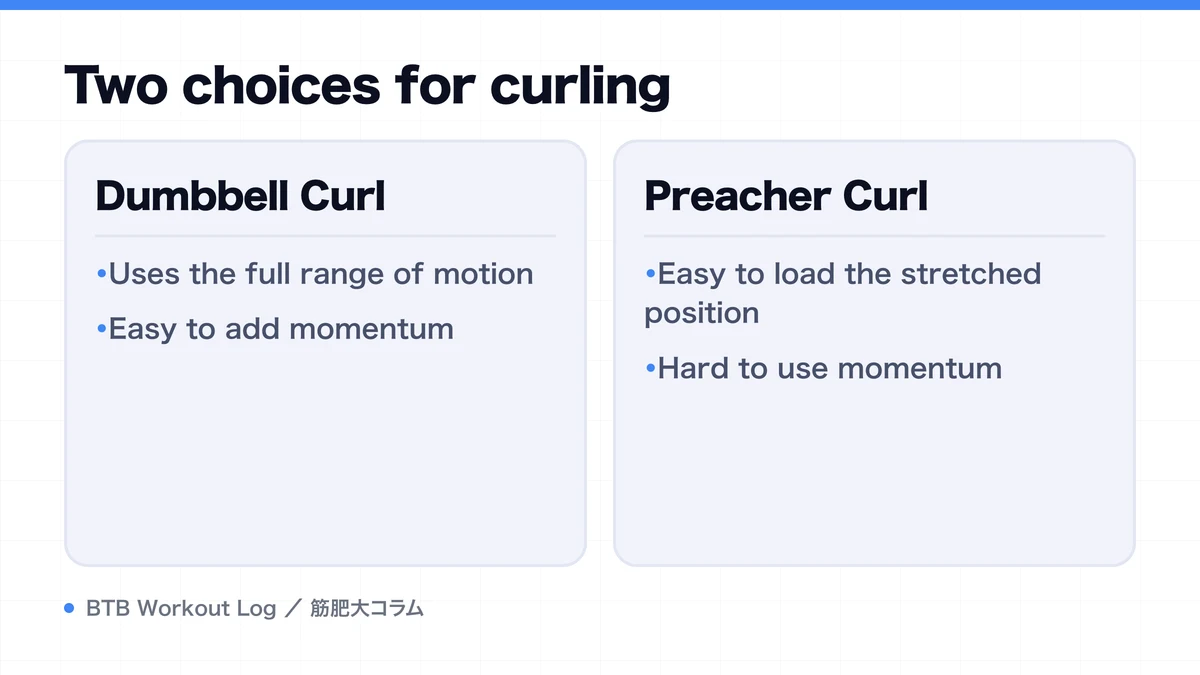
- Want to start quickly: standing curl, grabbing whatever dumbbells are free, wins. Alternating sides extends set time.
- Want consistent set quality: preacher, where you can match pad position every time, wins. If you have to wait for the bench when crowded, it's less efficient for the whole session.
- Want elbow/wrist freedom: dumbbell makes it easy to fine-tune forearm orientation and elbow width. Some people find a fixed EZ bar or machine grip fits well too.
- Worried about the bottom position: on preacher, don't snap the elbow to full extension — reduce range of motion and weight to something controllable. Don't count pain as hypertrophy stimulus.
Joint-friendliness isn't decided by exercise name alone — it shifts with pad height, grip, weight, rep speed, and prior elbow/wrist status. If discomfort persists, don't interpret it as "proof it's working" — change equipment or path, and drop the exercise if it doesn't resolve.
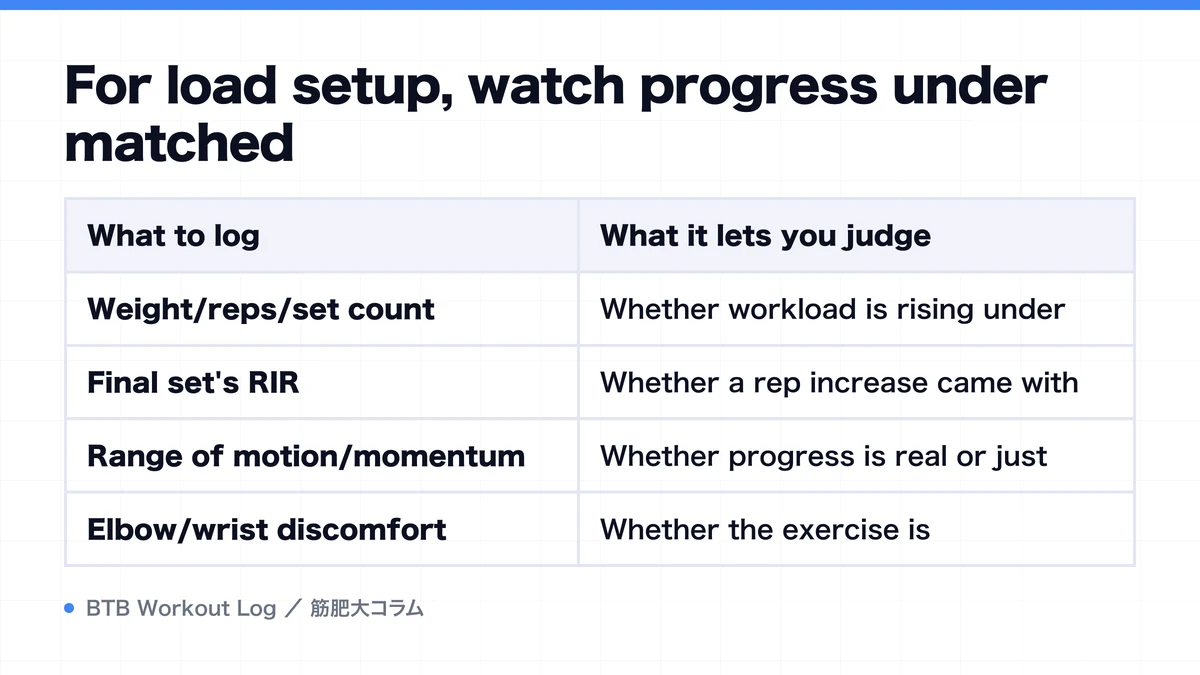
For load setup, watch progress under matched conditions, not weight itself
Being able to curl heavier weight and having raised valid load on the biceps aren't the same thing — adding momentum or shortening range of motion can raise the number alone. To compare, fix equipment, grip, pad height, range of motion and tempo, and watch whether weight or reps rose under matched conditions. Preacher makes settings easy to fix; dumbbell's freedom makes video or a brief form note useful.
Match intensity via RIR — how many more reps were possible. Running most sets at comparable effort, roughly RIR 1–3, makes it easier to compare the two exercises fairly. You don't need to fail every set, and especially on preacher, repeated failure reps that break form at the bottom aren't good comparison material.
If the weight increment is large, build reps within your set rep range before moving to the next weight. At 8–12 reps, for example, raise weight once every set can reproduce near the ceiling. Since a smaller muscle group means each weight addition is a larger percentage jump, using weight-first vs. rep-first progression appropriately makes it easier to preserve progressive overload.
| What to log | What it lets you judge |
|---|---|
| Weight/reps/set count | Whether workload is rising under matched conditions |
| Final set's RIR | Whether a rep increase came with more reserve |
| Range of motion/momentum | Whether progress is real or just a bigger number |
| Elbow/wrist discomfort | Whether the exercise is sustainable |
Which to choose, by situation
Preacher curl tends to suit as your main lift for someone whose standing curl picks up momentum easily, who wants a clear local biceps limit, and who can use the same pad or machine setting every time. It also has the advantage of banking a direct set even on a day core or grip is fatigued from back exercises.
Dumbbell curl tends to suit as your main lift for someone who gets elbow or wrist discomfort from a fixed grip, wants to vary path to match left-right differences, and wants to finish quickly with limited equipment. If standing produces momentum, adjustments — back against a wall, sitting down, or lowering weight — are options too, without needing to immediately switch to preacher.
If using both, don't add sets of overlapping role without a plan. Allocate weekly direct sets to one as your main lift first, and make the other accessory work at a different rep range or on a separate day. Since elbow flexors also work during back pulling exercises, adding curls without watching arm recovery and total weekly hard sets can become a low-quality addition.
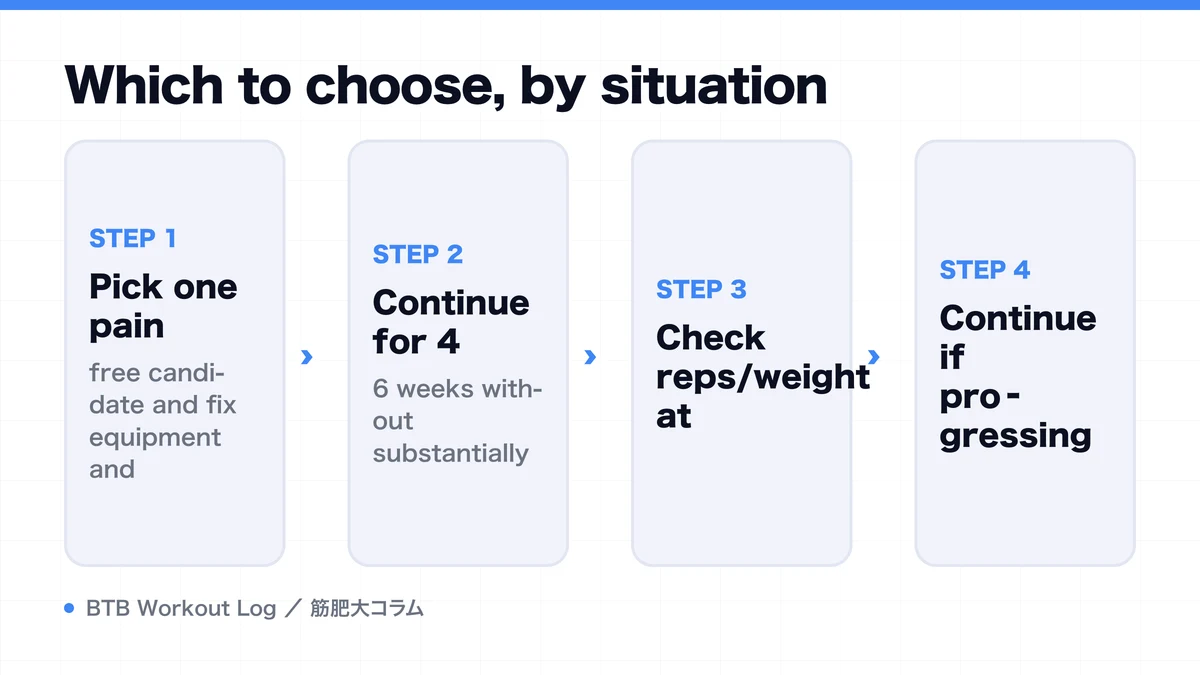
Judge your main lift over 4–6 weeks
- Pick one pain-free candidate and fix equipment and form conditions.
- Continue for 4–6 weeks without substantially changing weekly direct sets or RIR.
- Check reps/weight at the same range of motion, discomfort, and recovery by next time.
- Continue if progressing and joints are stable; if stalled, check recovery and total volume before considering a swap.
Don't decide superiority from one pump — judge from a multi-week trend under matched conditions.
FAQ
- Is it OK to do both dumbbell curl and preacher curl on the same day?
- That's fine. But since both center on elbow flexion, adding sets doesn't automatically diversify stimulus. Make one your main lift and the other accessory at a different rep range, and keep only the sets you actually need, watching total weekly volume including back exercises and recovery.
- Is preacher curl an exercise that easily hurts the elbow?
- The exercise itself isn't inherently dangerous. Dropping fast into the bottom, snapping the elbow to full extension at an uncontrollable weight, or using a mismatched pad height tends to cause discomfort. Adjust weight and range of motion, and stop if pain persists.
- Which should I choose to build a biceps peak?
- Muscle-belly shape is also influenced by individual anatomy, so you can't reliably shape it with one specific curl variation alone. If you want a visual change, it's more realistic to choose whichever you can sustain pain-free while progressing weight or reps at the same form.
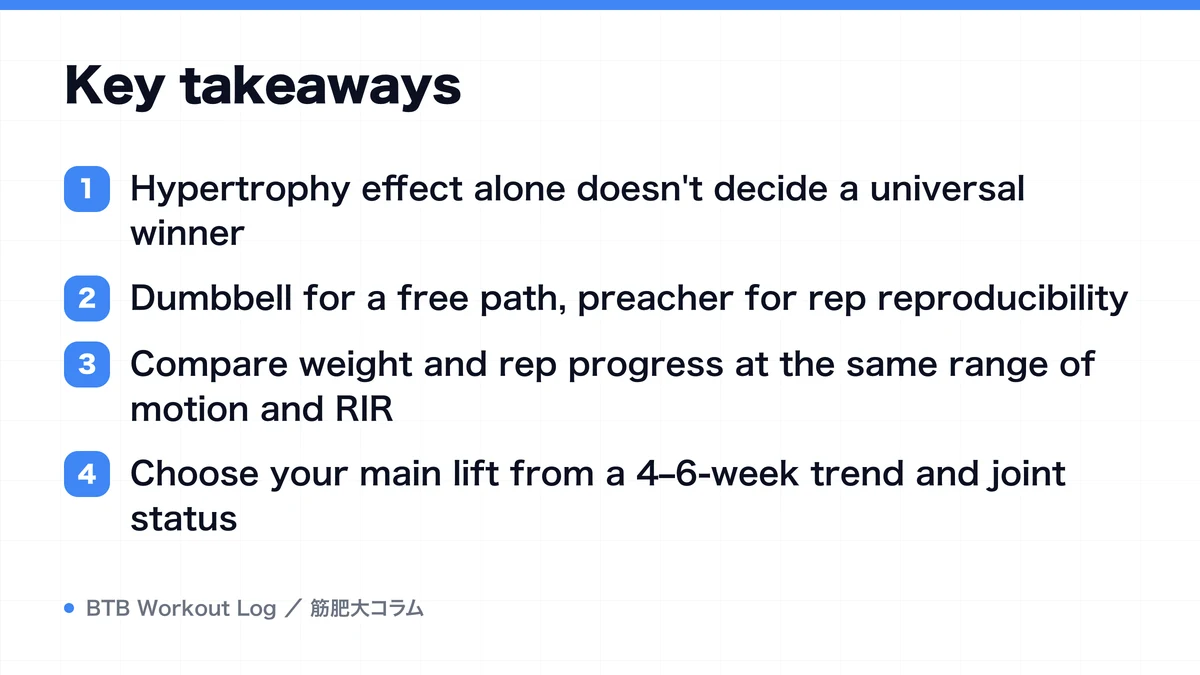
Key takeaways
- Hypertrophy effect alone doesn't decide a universal winner
- Dumbbell for a free path, preacher for rep reproducibility
- Compare weight and rep progress at the same range of motion and RIR
- Choose your main lift from a 4–6-week trend and joint status
References
- Comparison Between Shoulder Flexed and Extended Positions in Elbow Flexion Resistance Training on Regional Hypertrophy and Maximum Strength: Preacher versus Bayesian Cable Curls
- Low- vs High-load Resistance Training for Strength and Hypertrophy: Meta-analysis
- Muscle Hypertrophy Is Independent of Load Across Upper and Lower Limbs When Effort Is Matched
- Training to Repetition Failure or Non-failure: Systematic Review and Meta-analysis
- Repetitions in Reserve Is a Reliable Tool for Prescribing Resistance Training Load