Barbell Bench vs. Dumbbell Bench: Which Builds More Chest?
For chest hypertrophy alone, neither barbell nor dumbbell always wins. Barbell is easier to choose if you prioritize high output and ease of progressing load; dumbbell is easier to choose if you want to use independent arm paths and a wider range of motion.
What to compare isn't equipment reputation or lifted weight — it's whether the pecs reach sufficient effort, whether you can keep progressing under matched conditions, and whether you can recover from that stimulus within the week.
Match five standards first before comparing chest hypertrophy
Even if you handle 100kg on barbell versus 36kg per hand on dumbbell, you can't compare hypertrophy effect from the size of the numbers. A movement where both hands are connected by one bar, and a movement where left and right are controlled independently, differ in what weight means and in stability demand. For a hypertrophy-focused comparison, watch these five.
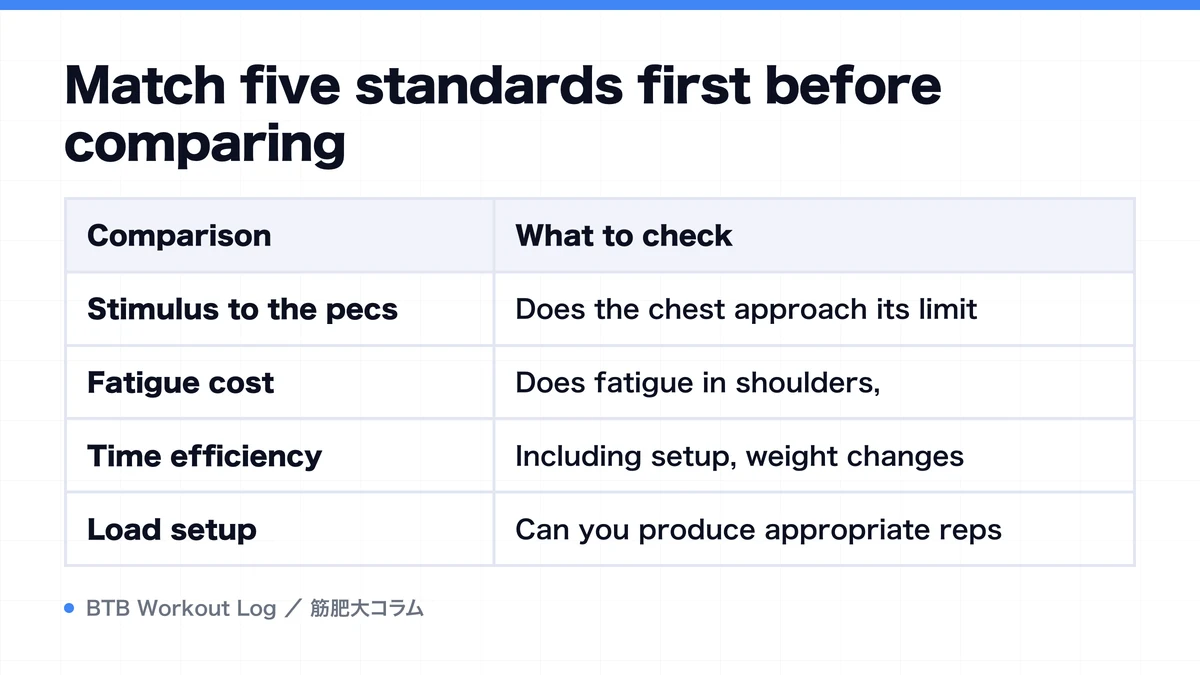
| Comparison | What to check |
|---|---|
| Stimulus to the pecs | Does the chest approach its limit first, and can you reproduce intended range of motion? |
| Fatigue cost | Does fatigue in shoulders, triceps or posture control interfere with chest sets or next time? |
| Time efficiency | Including setup, weight changes and safety, can you complete high-quality sets? |
| Load setup | Can you produce appropriate reps and RIR, and progress load or reps in fine steps? |
| Individual factors and goals | Does it fit your shoulder mobility, left-right asymmetry, equipment, and bench-strength goals? |
RIR is an estimate of reserve — how many more reps were possible at the end of a set. Even at the same rep count, a set at RIR 5 and a set at RIR 1 carry different effort. Rather than deciding a winner from equipment alone, match range of motion, RIR and weekly set count as closely as possible, then compare which one lets you personally bank high-quality reps.
Hypertrophy effect can be roughly equal, but how stimulus is produced isn't the same
Both are presses using shoulder horizontal adduction and elbow extension, working the anterior deltoid and triceps alongside the pecs. Given sufficient effort and weekly volume, and the ability to progress load within the same exercise, either barbell or dumbbell can develop the chest. Since no source directly compares their long-term pec hypertrophy head to head, there's no basis for declaring "X% better on average."
Barbell's strength is that both hands are connected by one bar, making the path easier to keep consistent even at heavy load. Because the bar touching the chest becomes the bottom point, you can't lower your elbows as deep relative to the torso as with dumbbells — but that doesn't necessarily mean insufficient stimulus. If you can hold chest tension and lower to a similar position every time, it works as a highly reproducible range of motion.
Dumbbells, since the bar doesn't hit the chest, let you lower deeper within what the shoulder tolerates, and move each arm through an independent path. Hand orientation is also easier to rotate, and a more neutral-leaning grip suits some people. But deeper isn't always better — if the shoulder slides forward, chest tension drops, or you bounce out of the bottom with momentum, the added range of motion isn't raising quality. As with chest exercise selection, decide range of motion within whatever span keeps load on the pecs.
A study of 12 competitive bench-press lifters, varying barbell grip width and bench angle, found differences in some muscle activity and 6RM weight. But that result doesn't determine a long-term hypertrophy winner between barbell and dumbbell. If triceps stop you before chest does, isolate why triceps fatigue first before switching equipment.
Compare fatigue and time efficiency including setup and finishing, not just the set itself
Barbell: you unrack it and both arms push one shared load. It's easy to add small increments and structure sets aiming for high output, but training heavy alone requires setting safety height and rack position in advance. Don't casually push to failure — assume a spotter or appropriate safeties, and manage reserve.
Dumbbells: since each side needs independent stabilizing, some people find forearm or shoulder control becomes the burden before chest does. The heavier the weight, the more the motion of getting them from your knees to starting position, and safely finishing the set afterward, also matters. On the other hand, in an environment where you don't need to occupy a rack and can start with minimal setup, or a gym where your target weight is readily available, dumbbells can let you proceed without breaking flow.
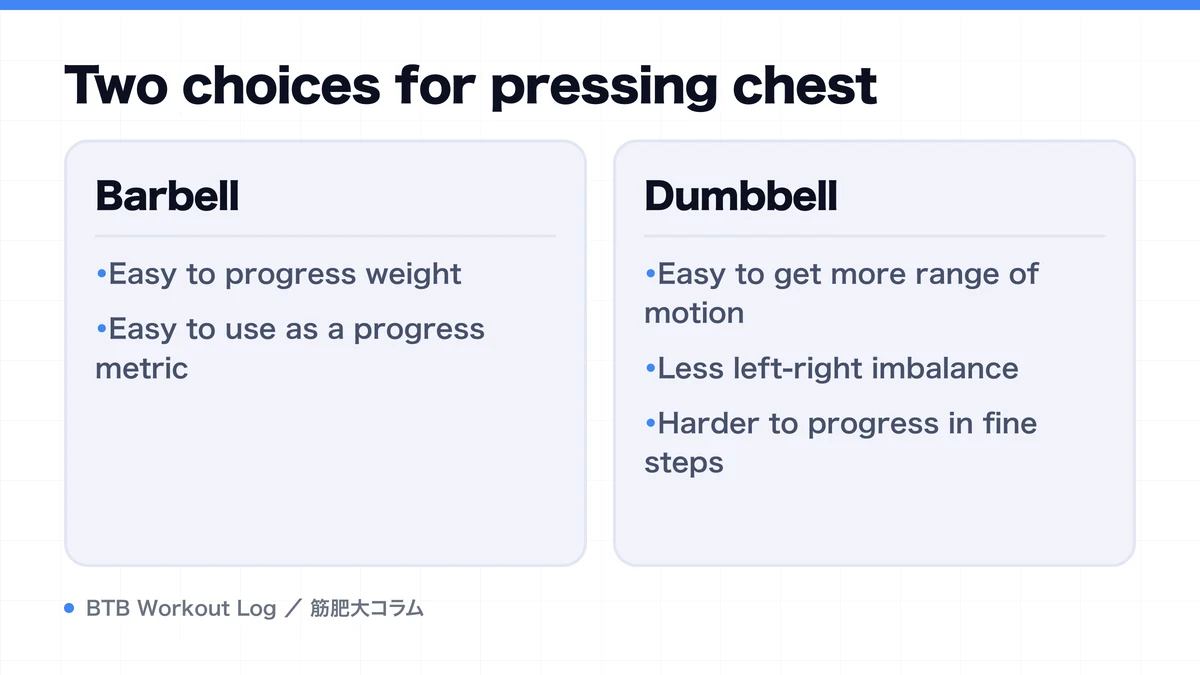
| Situation | Barbell | Dumbbell |
|---|---|---|
| Chasing high output | Easy to handle one shared load with both hands | The transition to starting position can be a constraint |
| Stability demand | Sides are connected, but bar path still needs control | Each side needs independent control |
| Safety | Easy to set up safeties or a spotter | Need a defined procedure for finishing a heavy set |
| Changing weight | Requires swapping plates | Easy to grab the next weight, but depends on increment size |
Judge fatigue not just from "it felt brutal" but from subsequent chest-exercise reps and next-time recovery. If you can handle heavy barbell weight but later sets crash hard, that may be high-cost relative to your chest's weekly volume. If dumbbells give a strong stretch feel but fatigue from stabilizing keeps the chest from reaching its limit, that's off-target too.
Barbell favors fine-grained progression, but dumbbell progress is achievable too
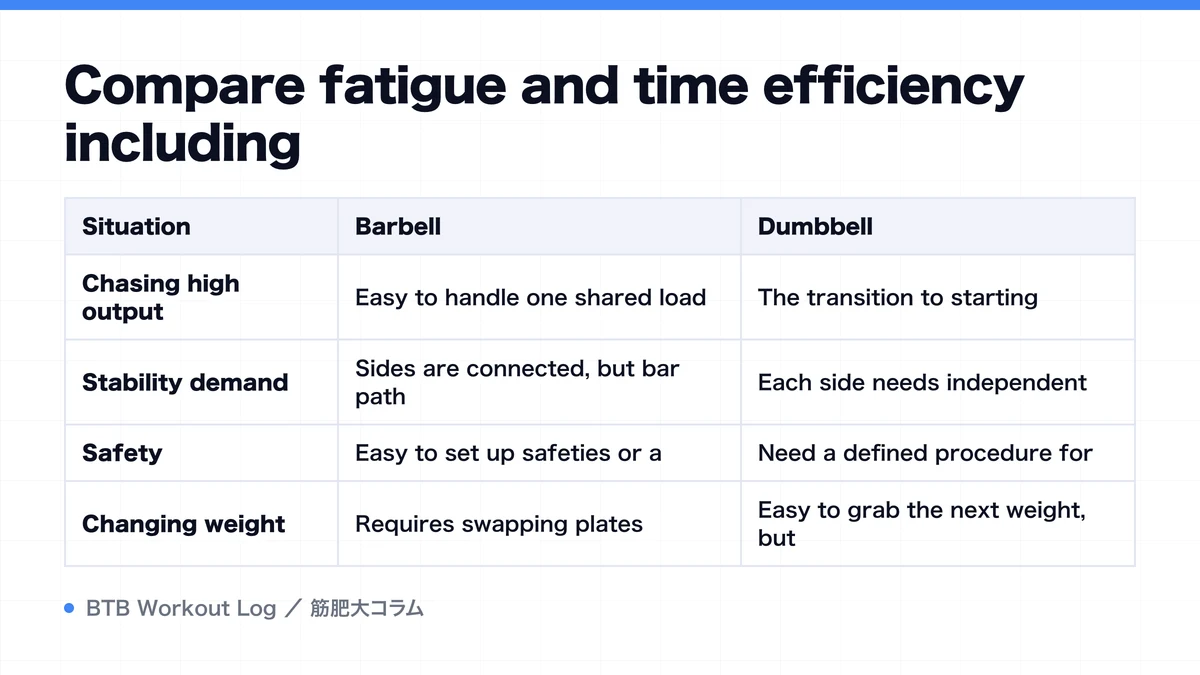
Barbell tends to favor fine-grained progress in most settings — you can raise total weight in small steps with small plates, and the same grip width and chest-touch position are easy to log too. If bench-press strength itself is also a goal, there's specificity from practicing the barbell lift directly. This is why someone who wants to raise lifted weight alongside hypertrophy would put barbell as the main lift.
With dumbbells at 2kg increments per hand, that's a 4kg jump combined. Depending on current weight, that single step can be large enough that raising weight instantly drops you below your target rep count. Here, double progression — building reps to the ceiling of, say, an 8–12 rep range before moving to the next weight — is an easy-to-use method. Reps returning toward the floor the week you raise weight isn't a stall.
A meta-analysis comparing high and low load found, given every set taken to momentary failure, hypertrophy comparable between ≤60% 1RM and >60% 1RM, while 1RM strength gained substantially more on the high-load side. This isn't a direct barbell-vs-dumbbell comparison, but it's grounds for rejecting "heavy barbell always means a bigger chest" or "light dumbbell is inferior." With either, match RIR and progress progressive overload within the same equipment.
You don't need to convert weight across exercises. Rather than ranking barbell 80kg against dumbbell 30kg per hand, watch whether you gained a rep from last time at the same range of motion and comparable RIR, or whether you could move to the next weight. If you also changed grip, bench angle, or range of motion, don't count the weight change alone as progress.
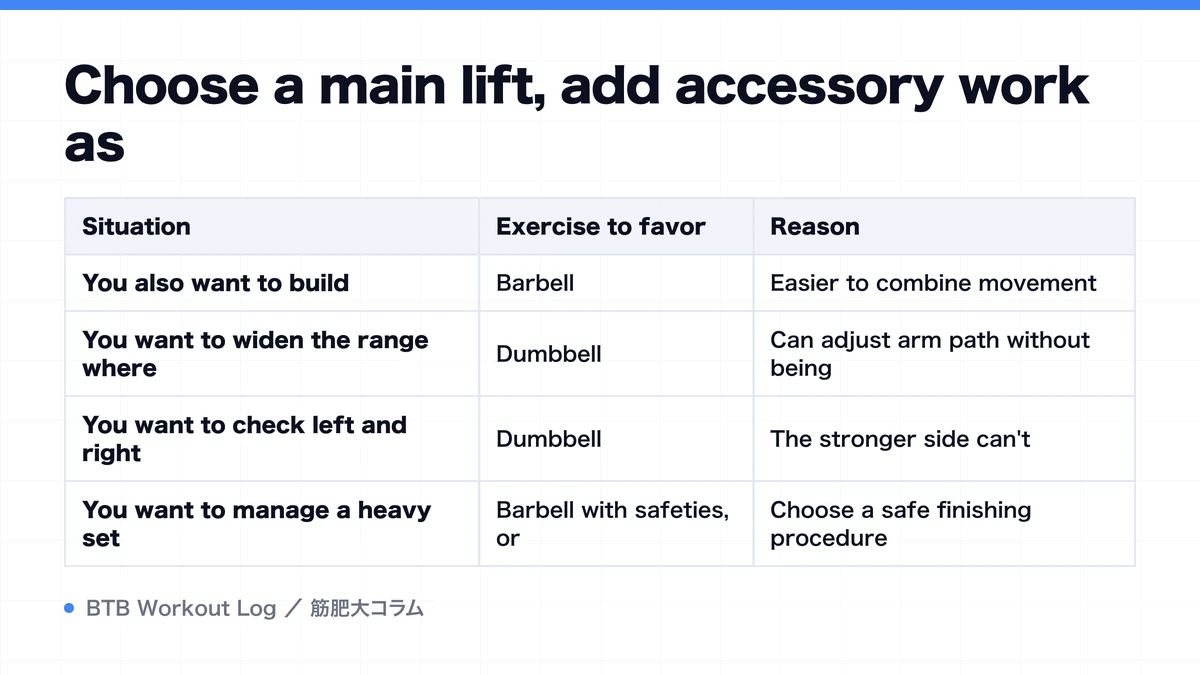
Choose a main lift, add accessory work as needed — a situational split
| Situation | Exercise to favor | Reason |
|---|---|---|
| You also want to build bench-press strength | Barbell | Easier to combine movement practice with fine load increases |
| You want to widen the range where you can hold chest stretch | Dumbbell | Can adjust arm path without being limited by the bar |
| You want to check left and right independently | Dumbbell | The stronger side can't compensate for the weaker one |
| You want to manage a heavy set solo | Barbell with safeties, or dumbbells you can start/finish without strain | Choose a safe finishing procedure that fits your equipment and weight |
| You want to bank chest sets in limited time | Whichever is more available at your gym | Reduces wait and setup, keeping your completion rate up |
If you use both on the same day, split their roles. An easy structure: barbell as your low-to-moderate-rep main lift chasing high output, dumbbell as moderate-rep accessory work adjusting arm path and range of motion. Conversely, if dumbbell lands on your chest more reliably, it's fine to put it first. If placing both becomes the goal in itself and only weekly set count rises with similar stimulus, one exercise is enough.
Judge which suits you as the main lift by fixing conditions for 4–8 weeks. Log weight, reps, RIR, what stopped you before the chest did, shoulder response, and next-time output, and watch whether chest sets are progressing. If progress stalls, check causes of a bench press plateau before deciding equipment is the winner or loser.
Barbell if you prioritize high output and fine progression; dumbbell if you want to use independent paths and a depth that suits you. If either can deliver sufficient chest stimulus, decide your main lift by goal, equipment, shoulder fit, and how easily you can sustain progress — and add the other only when it fills a gap.
FAQ
- Should beginners start with barbell or dumbbell?
- Choose whichever lets you safely practice starting position and finishing procedure at light weight. If you can set up safeties properly, barbell is easier to learn the path on; if you can handle light dumbbells stably, you can also check left-right movement. There's no need to compete on weight from the start.
- Is it fine to do both barbell and dumbbell on the same chest day?
- That's fine, as long as their roles don't overlap too much. Use the main lift for output and progress, and the accessory for range of motion or arm path. If back-half reps crash badly or you don't recover by next time, adjust without raising set count further while keeping both.
- Is dumbbell safer if I have shoulder discomfort?
- Some people find it easier since you can adjust hand orientation and path, but dumbbell isn't always safe either. Review weight, lowering depth, and elbow direction, and limit yourself to a pain-free range. Stop and consult a professional if there's sharp or persistent discomfort.
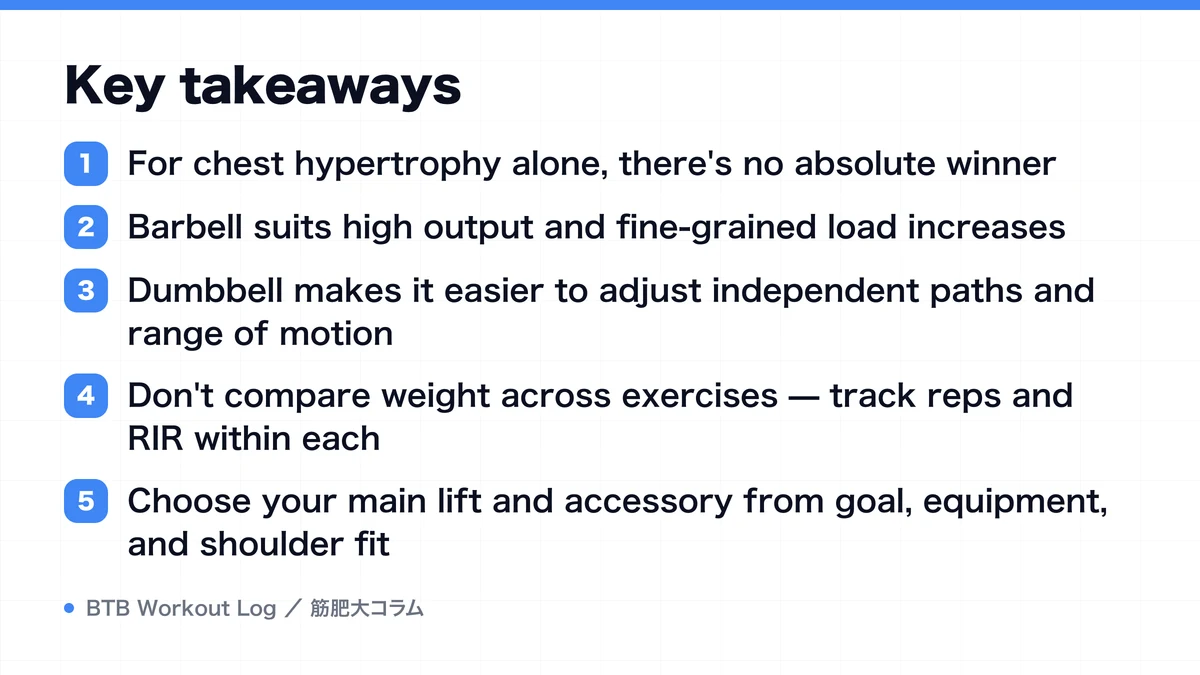
Key takeaways
- For chest hypertrophy alone, there's no absolute winner
- Barbell suits high output and fine-grained load increases
- Dumbbell makes it easier to adjust independent paths and range of motion
- Don't compare weight across exercises — track reps and RIR within each
- Choose your main lift and accessory from goal, equipment, and shoulder fit