Full Body vs. Split Routine: Maximize Hypertrophy 3 Days a Week
At three days a week, full body is the sensible default. But if output collapses on the later exercises when you cover everything, or you want to concentrate sets on specific areas, a split will get your weekly work done at higher quality.
What to compare isn't the name of the method — it's which one lets you complete the same weekly sets consistently while load and reps climb.
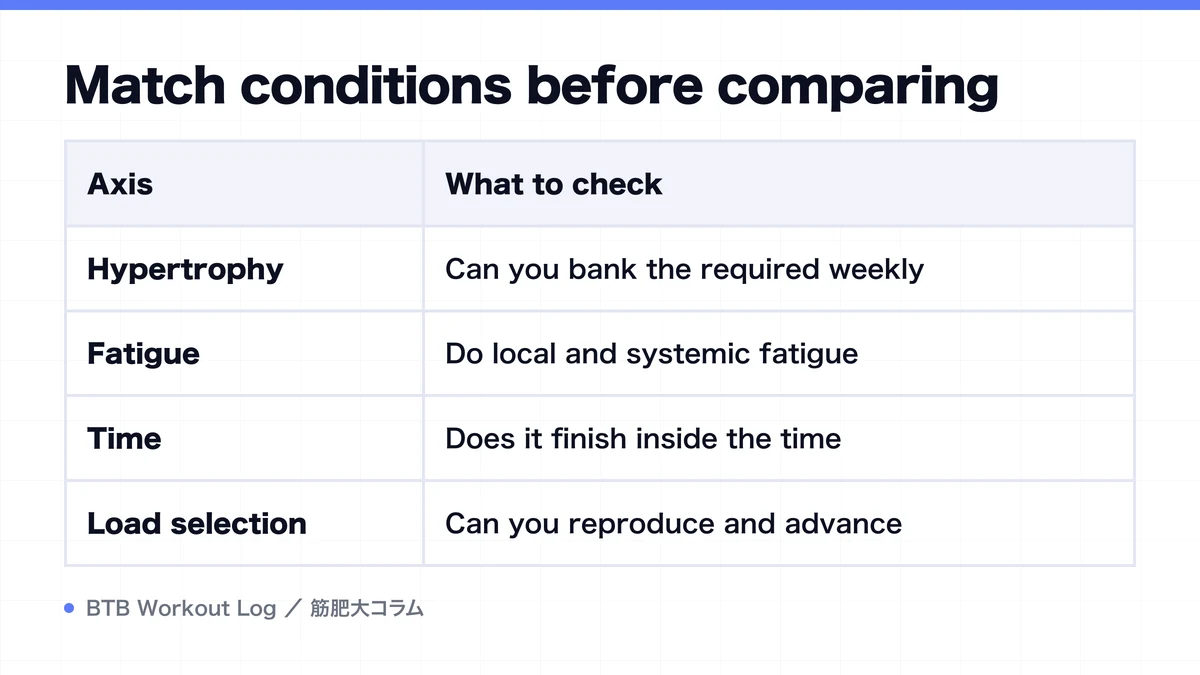
Match conditions before comparing
Full body trains the major muscle groups — legs, chest, back — broadly in each session. At three days a week that means touching each group two to three times while spreading sets out. A split narrows the focus per day: upper/lower, or Push/Pull/Legs (PPL). To compare split types generally, see comparing splits.
To compare fairly, roughly match weekly sets per muscle group, per-set effort and range of motion. Giving full body twelve weekly chest sets against six on the split and comparing results measures volume, not method. The five criteria here are:
| Axis | What to check |
|---|---|
| Hypertrophy | Can you bank the required weekly sets without quality dropping? |
| Fatigue | Do local and systemic fatigue clear before the next session? |
| Time | Does it finish inside the time you actually have, setup included? |
| Load selection | Can you reproduce and advance load, reps and RIR? |
| Fit with life | Does a missed or moved day leave you badly unbalanced? |
Framed this way you compare "which produces progress under my constraints" rather than "which method is stronger".
Growth follows weekly stimulus and set quality, not the label
Reading the frequency research as a whole, the fair interpretation is that with weekly volume equated, raising frequency alone adds little to hypertrophy. Frequency is less a magic independent variable than the one deciding how many pieces your weekly sets are cut into. The details are in training frequency.
Full body's advantage is splitting, say, chest sets across Monday, Wednesday and Friday so each set starts relatively fresh. The more your reps and range of motion fall when you concentrate a muscle into one day, the more you gain from spreading. Conversely, with modest weekly sets and output that holds to the end of a session, a split handles the same volume fine.
What to avoid is adding lots of light sets purely to raise exposures. RIR describes how many reps you had left, and a set that never approaches your target RIR isn't the same stimulus as one that does — even though both count as one set. Hold your current weekly sets per muscle group and change only the distribution, and the method difference becomes legible.
So while full body is the better average starting point, it isn't always superior on hypertrophy grounds. If your later exercises break down every session under full body, restoring quality by splitting beats nominal high frequency.
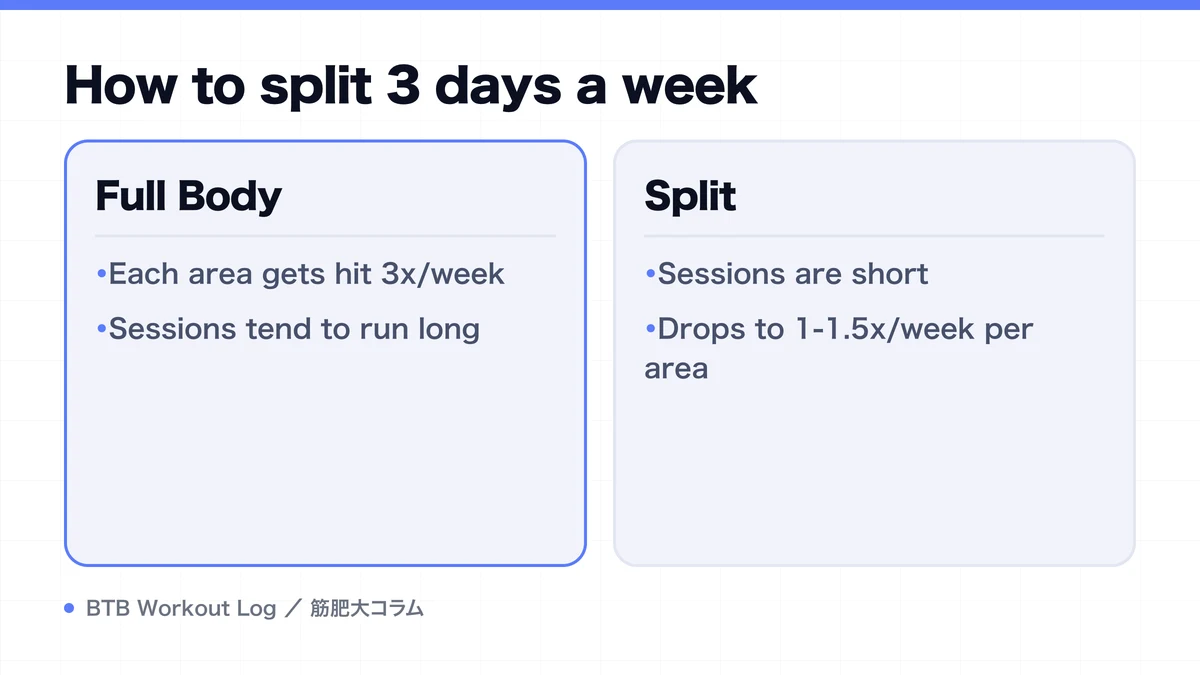
What changes isn't total volume — it's per-day concentration
Full body spreads local fatigue, but lining up squats, presses, rows and hinges on one day raises systemic fatigue and movement between stations. Running every session heavy on everything tends to leave you buried by Friday. The fix is to shift the emphasis by day — legs on Monday, pressing on Wednesday, pulling on Friday — while still training the whole body.
A split narrows the focus, so you need less equipment and the session flows more easily. But concentrate every chest set on chest day and reps fall late from local fatigue. And even though sessions get shorter, total weekly time doesn't necessarily shrink much when weekly set totals are the same.
At three days a week, resilience to missed sessions also separates them. Miss one full-body day and most muscle groups still get two exposures that week. On a Monday-Push, Wednesday-Pull, Friday-Legs split, missing Friday pushes legs into next week. That's why full body suits people whose schedules move, while a split suits those who can hold their days and want more concentration per session.
Don't judge fatigue on soreness alone. Include output changes: load or reps falling under the same conditions, form breaking before you reach target RIR, joint discomfort that persists.
Two three-day layouts where progress stays readable
Full body: rotate the emphasis across A, B and C
Cover the major groups on Monday, Wednesday and Friday while varying which exercise leads and how sets are allocated. A leans on squat patterns, B on pressing, C on pulling and hinging. Don't clone the same exercises at the same high load three times — cap sets on the non-emphasised work and you keep frequency without the late-session decline.
Training the same exercise more than once a week doesn't require one fixed load. Run a heavier day, a moderate day and a rep-building day, and chase last time's numbers within each condition. Setting RIR per how to use RIR stops you forcing the same load on a fatigued day.
Split: alternate two sessions rather than three
A three-day split doesn't have to be PPL. Alternate upper and lower — Upper, Lower, Upper one week; Lower, Upper, Lower the next — and each side gets three exposures per fortnight, averaging 1.5 a week. Because set counts swing week to week, check volume over fourteen days rather than seven. It's a middle path for people whose full-body sessions run too long but who don't want each area trained only once weekly.
Placing PPL on Monday, Wednesday and Friday means once a week per area. That still works if set quality holds to the end and load or reps climb the following week. Not swapping exercises often, and accumulating records under the same conditions, is the prerequisite for judging progressive overload at all.
In any layout, what counts isn't that the sets got done — it's that you loaded the target through your intended range at your intended effort, and progressed the next time under the same conditions. Replace all your exercises every time you change method and you'll never know what helped.
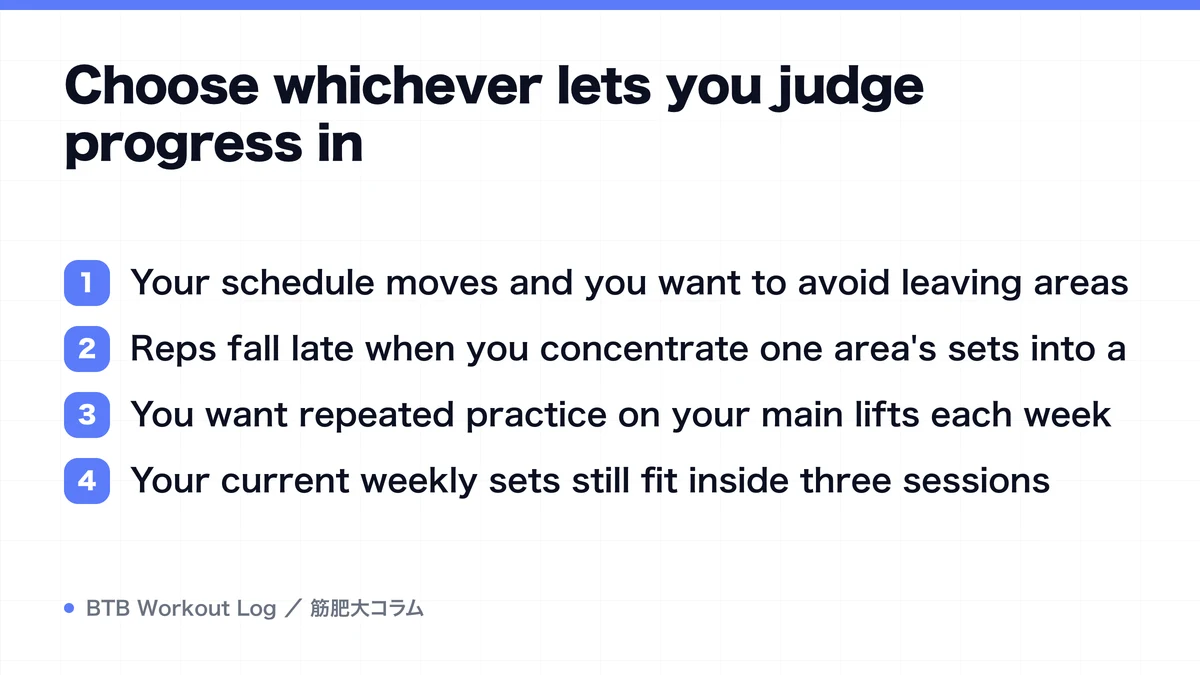
Choose whichever lets you judge progress in four weeks
Lean full body if most of these apply.
- Your schedule moves and you want to avoid leaving areas untrained
- Reps fall late when you concentrate one area's sets into a day
- You want repeated practice on your main lifts each week
- Your current weekly sets still fit inside three sessions
Lean split if most of these apply.
- Full body means so many exercises that your priority area is always last
- You want more sets on specific areas and maintenance elsewhere
- You have a hard cap on session length and must narrow the focus
- You can hold your days and reschedule a missed one
When you switch, keep weekly sets and main exercises as intact as possible and change only the distribution for four weeks. Compare load, reps and RIR on the first and last effective set, session length, and recovery into the next session. If only the last exercise consistently falls under full body, revisit order or split; if late sets break down on the split, move some of them to another day.
For that kind of comparison, a like-for-like history beats memory. Start from full body at three days, then move to an upper/lower or PPL layout if it stops fitting your constraints — that order keeps the choice from hardening into dogma.
FAQ
- Can I recover if full body trains the same muscles every session?
- You don't have to do the same volume to failure every time. Rotate the emphasis and set counts by day, and check whether load and reps return under the same conditions. If they don't, reduce per-session volume or effort before touching frequency.
- Can't you build muscle on three-day PPL?
- You can. Once a week per area works if you complete the weekly sets you need at high quality and progress into the following week. Just watch late-session output when sets are concentrated, and the risk of an entire area dropping out when you miss a day.
- When should I move from full body to a split?
- When load, reps or range of motion for a specific area repeatedly fall late in full-body sessions and reordering doesn't fix it. Keep weekly sets and main exercises, split the work, and compare set quality across four weeks of records.
Key takeaways
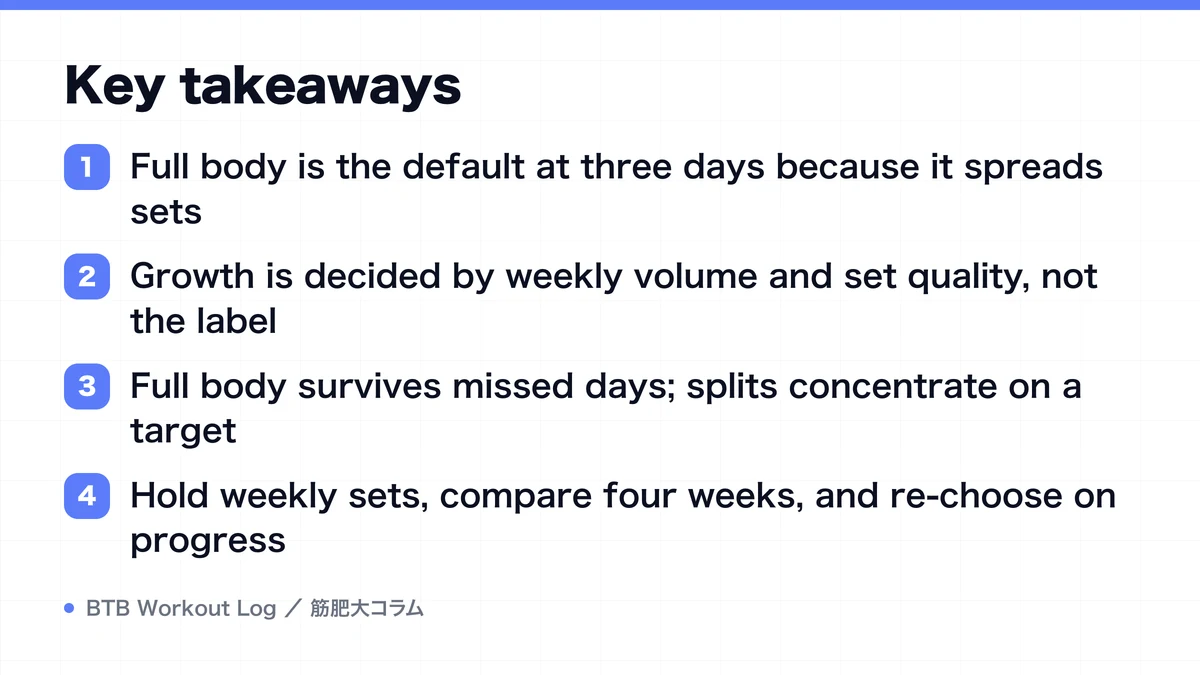
- Full body is the default at three days because it spreads sets
- Growth is decided by weekly volume and set quality, not the label
- Full body survives missed days; splits concentrate on a target
- Hold weekly sets, compare four weeks, and re-choose on progress
References
- Resistance Training Frequency and Muscle Hypertrophy: Systematic Review and Meta-analysis
- The Resistance Training Dose Response: Meta-Regressions Exploring the Effects of Weekly Volume and Frequency on Muscle Hypertrophy and Strength Gains
- Dose-response Relationship Between Weekly Resistance Training Volume and Muscle Mass
- Effects of Resistance Training Frequency on Muscle Hypertrophy: Systematic Review and Meta-analysis