Hypertrophy: Fixed Routine vs. Changing Exercises Every Workout
For hypertrophy, build on a fixed programme and rotate only the exercises where you have a problem to solve. Both fixed programmes and rotation have a role - it was never a choice between changing everything and changing nothing.
What to compare isn't novelty. It's whether you can accumulate sufficient stimulus, judge progress, and manage fatigue and pain at the same time.
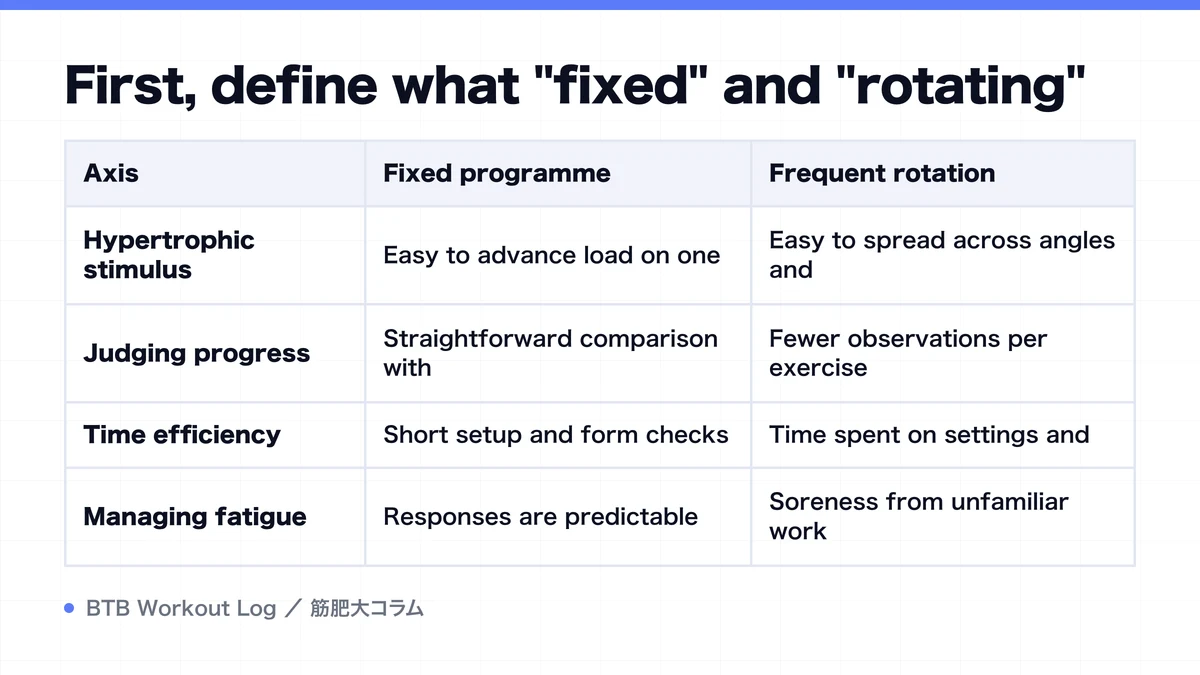
First, define what "fixed" and "rotating" mean here
A fixed programme here means holding your main exercises and their order for a block while load, reps and sets advance with adaptation. It doesn't mean repeating identical numbers forever. Frequent rotation means swapping main or accessory exercises weekly or session to session, so the window in which you observe any one movement is short.
To compare fairly, roughly match weekly hard sets per muscle group, RIR (reps left in reserve), frequency and range of motion. If the fixed side carries more sets, you're comparing volume rather than exercise selection.
| Axis | Fixed programme | Frequent rotation |
|---|---|---|
| Hypertrophic stimulus | Easy to advance load on one movement | Easy to spread across angles and muscle lengths |
| Judging progress | Straightforward comparison with last time | Fewer observations per exercise |
| Time efficiency | Short setup and form checks | Time spent on settings and practice |
| Managing fatigue | Responses are predictable | Soreness from unfamiliar work muddies the picture |
| Individual fit | Stable once an exercise suits you | Adapts to pain, equipment and preference |
So the question isn't which always grows more. It's which of stimulus, comparability, recovery and adherence you should be prioritising right now.
Novelty alone doesn't decide hypertrophy
There isn't enough research pitting fixed against frequent rotation to declare a winner for all trained lifters. What is clear is that resistance-training adaptation depends on frequency, intensity, volume and mode together. It's hard to argue the bare act of swapping an exercise carries a hypertrophy effect that outweighs those.
Fixed programming's strength is that repeating the same technique and range of motion makes rising load and reps interpretable. If your bench goes from 80 kg for 8 to 80 kg for 10 at similar RIR, you can at least say work capacity in that movement improved. That's a serious advantage when running progressive overload.
Rotation has room to use different joint angles and resistance profiles, covering stimulus a single exercise misses. But numbers rise on a brand-new exercise from learning the movement alone. And the heavy soreness that comes with unfamiliar work isn't proof of growth. As with growing without soreness, novelty and long-term hypertrophy need separate evaluation.
Planned periodisation means moving load and rep ranges deliberately toward a goal. "Adding variation" and "swapping exercises at random" are not the same thing. For hypertrophy, periodised and non-periodised training tend not to differ much when volume is comparable — so a change needs an aim.
Fatigue, time and load selection usually favour fixed
Keep an exercise and rack heights, seat settings, warm-up loads and your form cues all settle. If you're squeezing quality sets into limited time, that low setup cost matters. Past records also make the day's starting load easy to pick, and comparing at matched RIR becomes straightforward.
Frequent rotation adds light probing sets while you hunt for the right load. Miss high and you lose range of motion; miss low and you finish with too much in reserve. Either way, hitting your planned hard-set count doesn't mean the contents matched. Local fatigue and soreness from unfamiliar movements also make your usual recovery state harder to read.
Fixed has weaknesses too. Persistent discomfort in the same movement, one joint angle that always feels bad, or boredom eroding your effort — none of those are worth defending. Exercise changes work well when they solve a problem. Don't swap because of one session that didn't go to plan; check whether the issue persists after adjusting form, load and recovery.
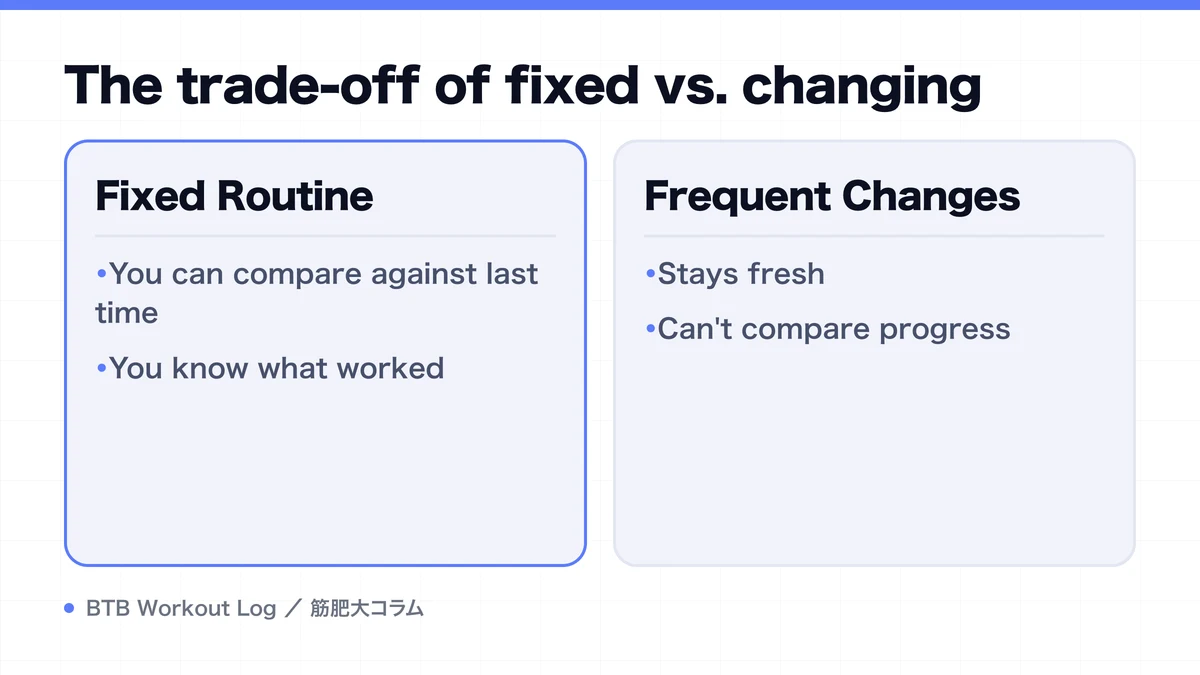
- Fixed saves time when: equipment is consistent, form is stable, and you can set load from last time.
- Rotation saves time when: you're waiting for equipment, travelling without your usual setup, or the setup cost exceeds the stimulus gained.
- Fixed clarifies fatigue when: you know the normal range for soreness and rep drop-off.
- Rotation relieves load when: a different implement or angle avoids discomfort on one path.
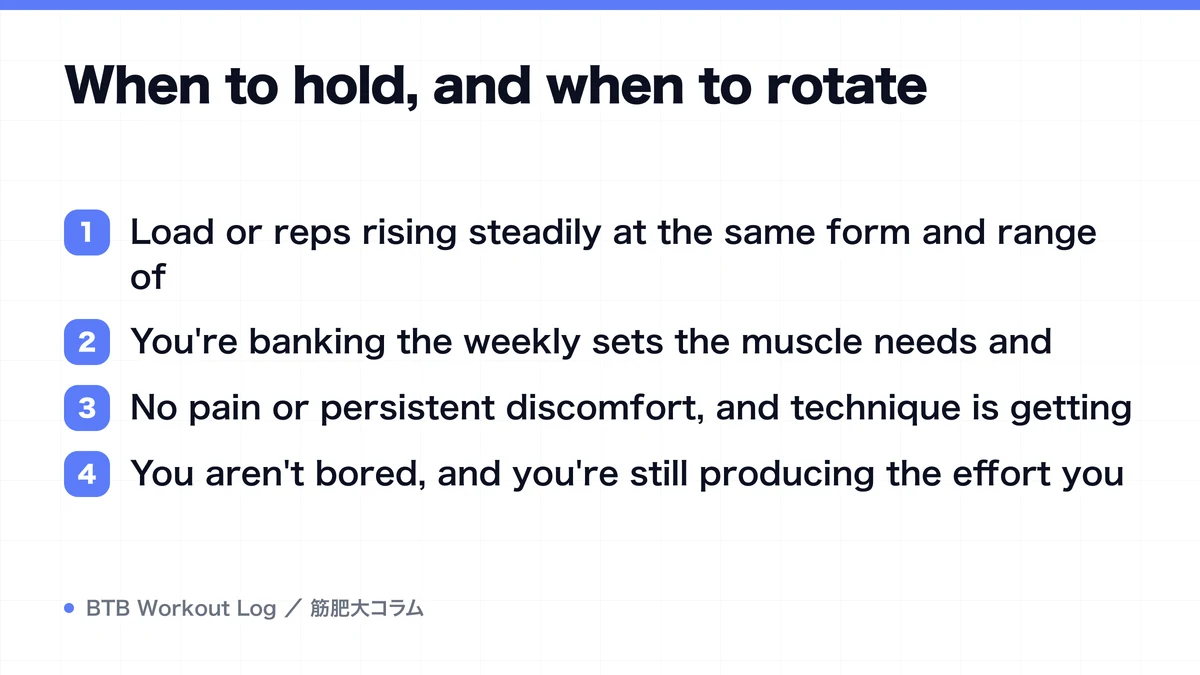
When to hold, and when to rotate
Reasons to keep it fixed
- Load or reps rising steadily at the same form and range of motion.
- You're banking the weekly sets the muscle needs and recovering before the next session.
- No pain or persistent discomfort, and technique is getting more repeatable.
- You aren't bored, and you're still producing the effort you need.
In that state, there's no reason to replace everything just because the calendar says so. The same programme isn't necessarily bad precisely because load and reps can keep updating within it.
Reasons to rotate
- Pain or discomfort persists in the same movement after adjusting form and load.
- After checking sleep, nutrition, volume and RIR, one exercise has been stalled for a long time.
- Roles overlap, leaving a real gap in muscle lengths or movement directions.
- Available equipment, training time or preference has changed and it's hard to sustain.
Even in a plateau, work through stimulus, recovery, nutrition and overload before replacing exercises. When you do change, keep it to one hypothesis — "switch the barbell to a machine to avoid shoulder discomfort". Wholesale rotation makes it impossible to tell improvement from simple skill acquisition.
In practice: anchor lifts plus a rotation slot
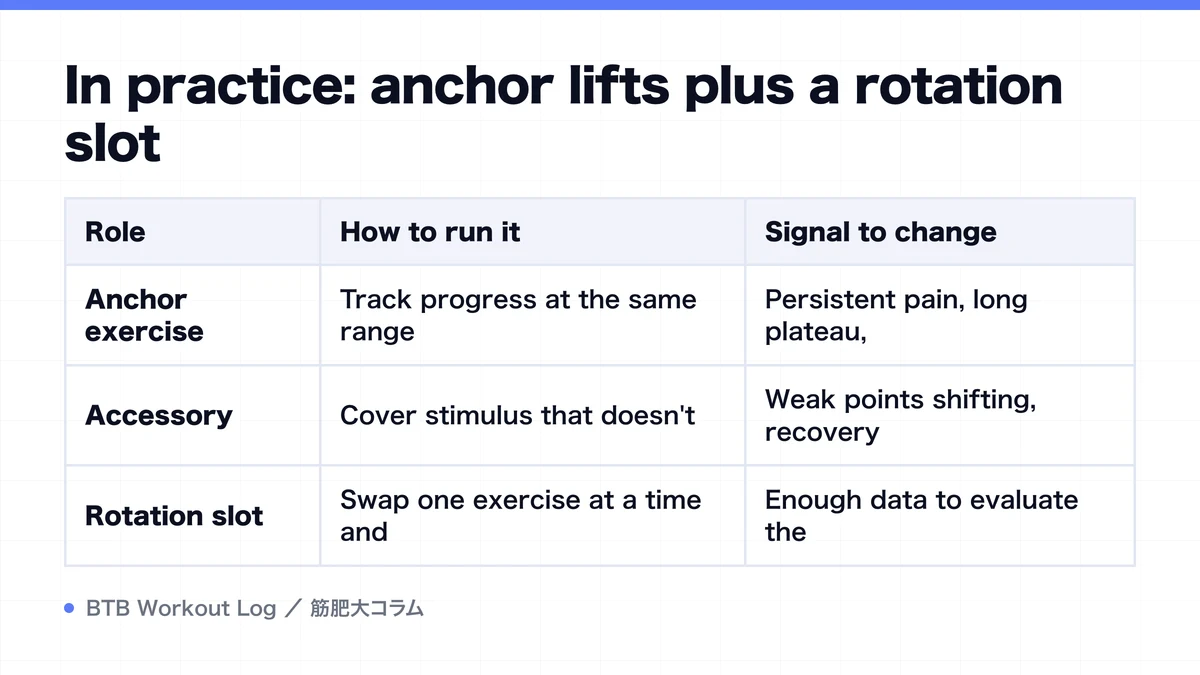
The simplest way to use both is to divide your programme into anchors and a rotation slot. An anchor is the main exercise you track per muscle group, held fixed for the block. The rotation slot gets reviewed each block based on weak points, joint tolerance, equipment and preference. Six to ten weeks is one workable block, but prioritise gathering enough stable data to decide over any specific number of days.
| Role | How to run it | Signal to change |
|---|---|---|
| Anchor exercise | Track progress at the same range of motion and rep range | Persistent pain, long plateau, equipment change |
| Accessory | Cover stimulus that doesn't overlap the anchor | Weak points shifting, recovery exceeded, overlapping roles |
| Rotation slot | Swap one exercise at a time and test | Enough data to evaluate the hypothesis |
- Write the reason: avoiding pain, breaking a plateau, covering a stimulus gap — state the problem.
- Keep conditions close: match weekly hard sets, RIR and frequency across the change.
- Establish a new baseline: a different exercise means no direct load comparison — track the new one from scratch.
- Judge over several sessions: not one pump or bout of soreness, but progress, pain, recovery and adherence once technique settles.
Why too many exercises thins out your observations is easiest to see through the conditions that make progress comparable. A log isn't there to forbid change — it's there to decide what to keep and what to swap. Fixed or rotating changes meaning depending on whether an anchor's baseline still exists, and BTB Workout Log keeps a separate baseline per exercise.
FAQ
- How often should I change a hypertrophy programme?
- There's no shared deadline. An exercise where load or reps rise, nothing hurts, and recovery and motivation hold can keep running. Six to ten weeks is just an example review point — use progress, pain, recovery and adherence rather than dates.
- Won't my muscles adapt to the same exercise and stop growing?
- The stimulus isn't identical if load, reps, sets, range of motion or RIR change. Getting familiar with a movement helps you apply load precisely. Consider changing when neither the numbers nor the effort have moved for a long time — after isolating why.
- Is rotating exercises between an A day and a B day a problem?
- Not if A and B are themselves fixed, so each exercise can be compared with last time it appeared. That's far more observable than picking something different on the spot each session. Just add up weekly sets and recovery per muscle group across both days.
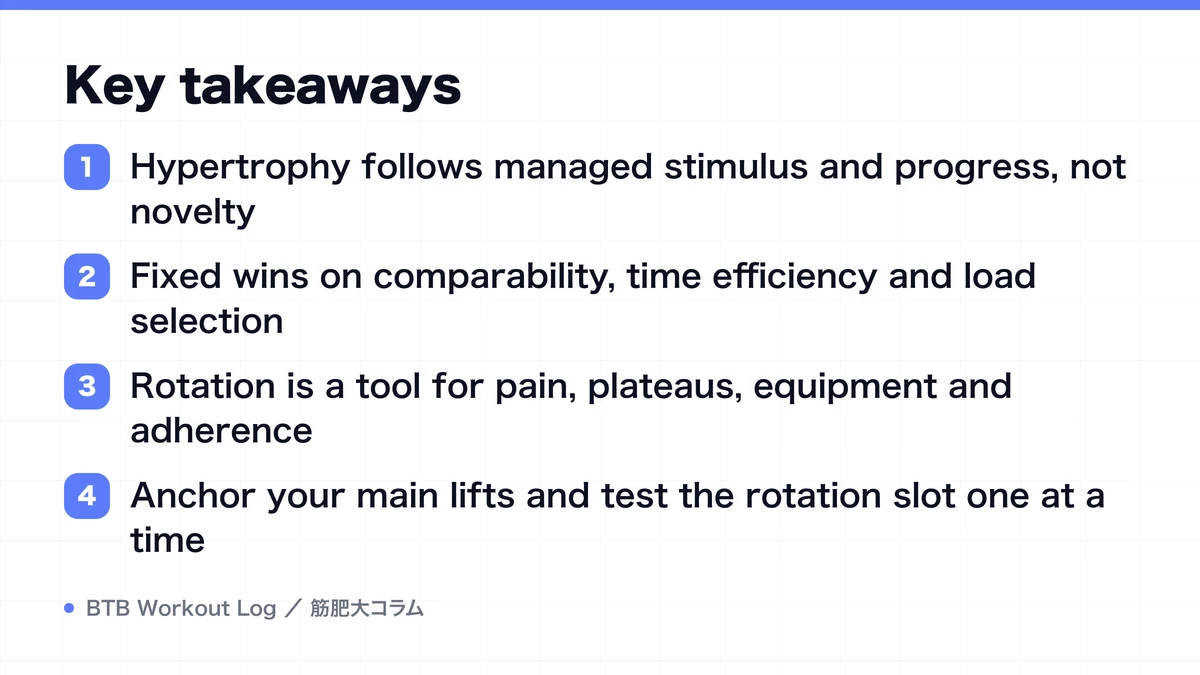
Key takeaways
- Hypertrophy follows managed stimulus and progress, not novelty
- Fixed wins on comparability, time efficiency and load selection
- Rotation is a tool for pain, plateaus, equipment and adherence
- Anchor your main lifts and test the rotation slot one at a time
References
- The Influence of Frequency, Intensity, Volume and Mode of Strength Training on Whole Muscle Cross-sectional Area in Humans
- ACSM Position Stand: Progression Models in Resistance Training for Healthy Adults
- Periodization, Strength and Muscle Hypertrophy: Systematic Review and Meta-analysis
- Linear vs Daily Undulating Periodized Training and Hypertrophy: Meta-analysis